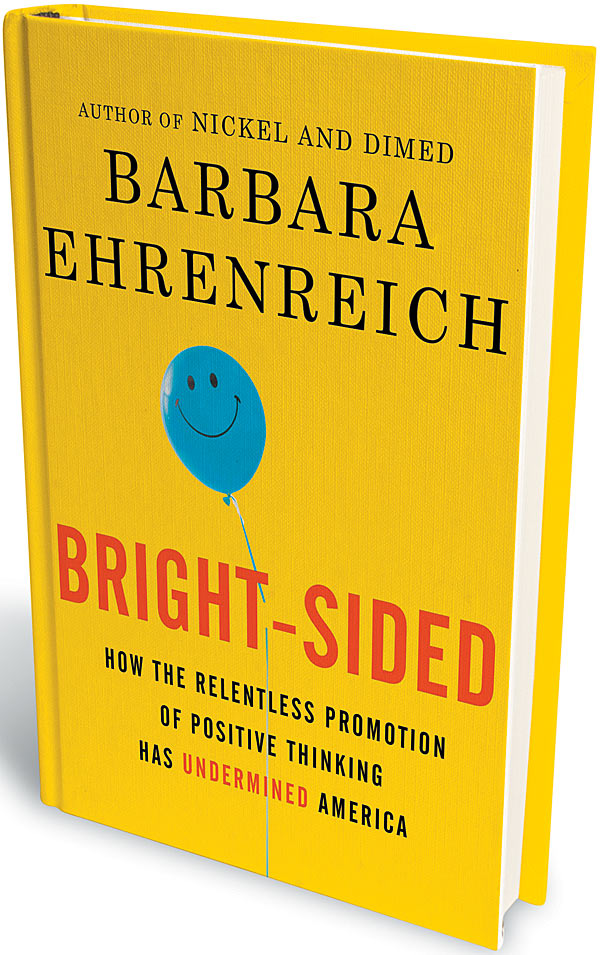
The Tyranny of Positivity

My friend’s childhood friend recently passed away after a painful bout with cancer. She was abandoned by her boyfriend because she was ‘too negative’ about her illness. A mutual friend of my friend’s also blamed the ailing woman for being too negative. If she couldn’t be positive about her disease, then she must in part have been responsible for her own decline. Or so the thinking goes.

If there is anything unique about this story, it is the nationality of the cast: they are Italian. In the United States, this is the norm. People who suffer from debilitating diseases are not only expected to endure the pain but also to put on a brave face. If they don’t, then friends can abandon them with a clear conscience. They just aren’t being positive, and hence are the architects of their own decline.

Positivity became the reigning attitudinal orthodoxy around the time of the ‘Reagan Revolution’, but it has its roots farther back in Calvinist theology. God rewards piety and hard work with success; failure, perforce, is evidence of sloth. Sidney Blumenthal once ironically summed up the mindset as ‘God takes most pleasure in people who are most pleased’. Reagan turned positivity into the central tenet of American civic religion. This also freed the New Right from the responsibility of caring for the destitute and vulnerable: if they aren’t doing well the fault must necessarily lie with them. It has come to a point, notes Barbara Ehrenreich in this excellent interview on Media Matters, that even people who lose their jobs are expected to be positive about it. Since a negative attitude will merely prove that their dismissal was justified.

As for illness, Tony Judt ends a recent essay about the torment of enduring nights while suffering from ALS thus: ‘Loss is loss, and nothing is gained by calling it by a nicer name. My nights are intriguing; but I could do without them.’
Continue reading “The Tyranny of Positivity”

Lest We Forget

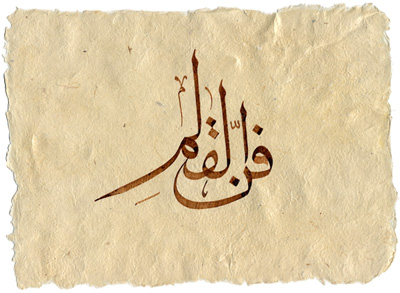
Fann alQalam - the Art of the Pen - by Soraya Syed

by Tam Hussain

On 4th of December, a rainy Friday evening, I visited Al-Khair school in Croydon. The school together with the Muslim Writers Awards were hosting a talk entitled ‘Creativity within Multi-Cultural Britain’. It had attracted me because of its absurdly ambitious vision: To jump start the creative processes which produced the likes of Iqbal, Ghalib and Al-Mutanabbi. The event was opened by Ms. Aisha Choudhry, head of Al-Khair, followed by Irfan Akram, Project Coordinator for Muslim Writers Award, Sufiya Ahmed, author of the Khadijah Academy series, Moazzam Begg, author and spokesperson for Cageprisoners, Zahid Hussain, author of The Curry Mile and Andrew Pelling, MP. The event was chaired by Abdul Fattah Hussain, organiser of the event.

Irfan Akram set the tone by pointing out that whilst Muslims in Britain are facing immense challenges, the positives outweighed the negatives. He brushed aside suggestions that publishers didn’t want to hear the voice of the Muslims; rather he suggested that Muslims should not expect automatic publication just because they have penned something. “If it is good enough it will get published and MWA is here to help.”

Continue reading “Lest We Forget”

Utopia as Alibi: Said, Barenboim and the Divan Orchestra

by Raymond Deane

As a classical musician involved in pro-Palestinian activism, I frequently encounter the assumption that I am an unconditional admirer of the West-Eastern Divan Orchestra (WEDO). My reservations on this score tend to produce shocked disapproval: How could I not enthuse about such an idealistic project, particularly since it was co-founded by the late Edward Said, a figure for whom I have frequently expressed respect and admiration?

In truth, I have always been a little wary of Said’s veneration for the eighteenth/nineteenth century canon of European classical music. I look in vain in his writings on the subject[1] for a historical and political contextualisation of music comparable of that to which he so perceptively subjected literature in his indispensable Culture and Imperialism.[2]

In his 2002 speech accepting the Principe de Asturias Prize, Said claimed that he and his friend the Israeli pianist and conductor Daniel Barenboim founded the WEDO “for humanistic rather than political reasons”. This surprising dualism implies that music belongs to a utopian sphere somehow removed from the dialectical hurly-burly of hegemony and resistance.

The paradoxes of Said’s position have been ably dissected by the British musicologist Rachel Beckles Willson.[3] She quotes her colleague Ben Etherington’s critique of Said’s tendency “to assert the intrinsic value of Western elite music without really exploring how that tradition escapes mediation.” Paraphrasing Said’s critique of literary scholars in his Humanism and Democratic Criticism[4] she convincingly claims that he “omitted to make ‘a radical examination of the ideology of the [musical performance] field itself.’” (Willson’s chain brackets).

Continue reading “Utopia as Alibi: Said, Barenboim and the Divan Orchestra”

Visiting the Great Satan

Notre Dame University

I’ve never before visited the USA. Like everybody else in the world, I’ve had it come to me. Its approach has been unstoppable, for good and for ill. For good first: the incredible achievement of American prose, which leaves British writing of the last century far behind. I am astounded by Faulkner, Bellow, Updike and Roth (when they’re good), Cheever, Scott Fitzgerald, and now Joshua Ferris. Formulaic Hollywood switches me off, but I can’t get enough Spike Lee or Martin Scorcese. I love Bob Dylan, Public Enemy and Miles Davis, just for starters. Jazz and particularly hip hop are American art forms which have travelled very well indeed. These two came originally from the black poor, and it’s the heterogeneity of America, and the possibility of marginalised genres and people being heard, which is so appealing. America is a continent-sized country of mixed-up Africans, Jews, Italians, Irish, Latinos, French, Wasps, and everyone else. It should be the most globally-minded and tolerant country in the world.

It isn’t of course. A narrow hyper-nationalism, the shaping of public discourse by corporations and lobbies, and a stupifying media and public education system have seen to that. Which brings us to the ill: America’s homogenising rage, which has ravaged first its own main streets (so Naomi Klein says in No Logo) and then the high streets of the world; its humourless TV gum; its advertising culture of false smiles and sugary platitudes; its racism, wars, military bases, aircraft carriers, support for dictators and apartheid regimes. These are the reasons why the US is known in some parts as the Great Satan, standing behind most of the little satans sitting on Asian and African thrones. In Muscat, Damascus, Shiraz and London I’ve met many people who have been made refugees by the USA.

America is the empire, admittedly in decline. In one sense, therefore, I haven’t needed to visit to know it. But last week I visited nevertheless, for a conference at Notre Dame University which I enjoyed very much.

Continue reading “Visiting the Great Satan”

Islam in the Writing Process

enjoin the good
photo by Rehan Jamil

If all goes well I will be at Notre Dame University in the US later this month for a conference on the role of Islam in contemporary European literature. I wrote the piece below for the conference.

Salman Rushdie once commented that ‘Islam’, in contrast to ‘the West’, is not a narrative civilisation. This, in my opinion, is obvious nonsense. Beyond the fact that human beings are narrative animals, whatever civilisation they live in, and that Islamic civilisation cannot be isolated from, for instance, Christian, Hindu or Arab civilisations, the Muslim world has a history of influential narratives which is second to none. These include Sufi tales, chivalric adventures, fantastical travelogues, romances and spiritual biographies written in several major languages.

Although the Arabic novel is generally considered to have developed in the early twentieth century from the experience of industrial urbanisation and the penetration of European genres and philosophies, Ibn Tufail’s 12th Century “Hayy ibn Yaqzan”, an inspiration for Defoe’s “Robinson Crusoe”, can reasonably stake a claim to being the world’s first novel. The Arabian Nights (via Don Quixote) is surely another source of the European novel tradition. And Islam the religion – as opposed to the even more nebulous ‘civilisation’ – is a text-based faith. The Qur’an is the religion’s only official miracle; the first word revealed to the Prophet was ‘iqra’ – ‘read’. Those who attempt to draw a distinction between literalist scripture and free and playful literature should pay attention to verse 26 of the Qur’an’s second chapter which, immediately after the first description of heaven and hell, proclaims: “Behold, God does not disdain to propound a parable of a gnat, or of something even less than that.” In other words, the Qur’an is a text unashamed to use metaphor, symbol and a whole range of literary devices in order to point to ineffable realities.
Continue reading “Islam in the Writing Process”

Maghut’s Shade and Noon Sun

maghutSyrian writer Muhammad al-Maghut was born the son of a peasant farmer in the dusty town of Salamiyah in 1934, during the French occupation. As a young man he joined the Syrian Social Nationalist Party, the second biggest mass party in Syria after the Ba’ath. Like the Ba’ath, the secular SSNP appealed to religious minorities – al-Maghut was of Ismaili origin. Unlike the pan-Arabists of the Ba’ath, it envisaged a fertile crescent state including Syria, Lebanon, Palestine, Jordan, Iraq, Kuwait and even Cyprus. Al-Maghut was locked up on several occasions for SSNP membership. During his first imprisonment – in Mezzeh prison in 1955 – he met the influential poet Adonis and started writing poetry himself.
As a poet he deserves to be much more widely known. Along with Adonis and Nizar Qabbani he was a modernist, using free verse instead of the traditional Arabic forms. Like Qabbani he aimed to be accessible to the ordinary people, but his ‘lover narrator’ is perhaps better suited to our twisted times than Qabbani’s. Certain verses sum up the decadent atmosphere very well indeed. The following remind me of those Gulf Arabs and others who profit from the prostitution of refugee women from occupied Iraq:

Lebanon is burning – it leaps, like a wounded horse, at the edge of the desert/ and I am looking for a fat girl/ to rub myself against on the tram/ for a Beduin-looking man to knock down somewhere. My country is on the verge of collapse/ shivering like a naked lioness/ and I am looking for two green eyes/ and a quaint café by the sea/ looking for a desperate village girl to deceive.”

Continue reading “Maghut’s Shade and Noon Sun”

The Search

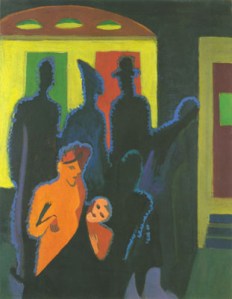
Ernst KirchnerOn a couple of occasions – that I know of – I’ve had my irises scanned. These in the airports where I get pulled over for the stupid questions. In theory, a computer link can now tie my iris to my bank account, credit rating, police record, driving license and passport details – all in the sharpest microsecond.
The town centre has been replaced by a shopping mall, owned and controlled. People take more interest in Angelina Jolie’s romantic life than in the course of political events. The politics on show are soap opera, and the soap opera is a British value to be transmitted to deserving immigrants. According to the new points system for migrants, access to Britishness can be speeded up by campaigning for a political party (I presume they don’t mean Hizb ut-Tahrir), while ‘active disregard for British values’ – which might or might not mean protesting against imperialist wars – will retard membership of the club.

The great Englishman Dr. Johnson said, “Patriotism is the last refuge of a scoundrel.” And on that sound note allow me to introduce a short story by the Syrian writer Ibrahim Alloush, translated by Domenyk Eades.

Continue reading “The Search”

A Map of Home

090831-jarrarThis review was also published in the Electronic Intifada.

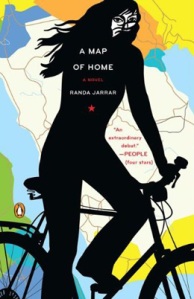
Randa Jarrar’s “A Map of Home” is a beautifully achieved coming of age novel which follows a clever girl through a war, a domestic battlefield, and repeated forced migrations. For our heroine, these events are aspects of the normal everyday stuff (because everything’s normal when it happens to you), like school, friends, family, and shopping. Despite the geographical and cultural particularities of the story, the themes – of awakening sexually, of learning how to love a parent yet firmly say no, and of struggling for independence and a place in the world – are universal, and the book will appeal to all but the most easily shocked readers.

At the novel’s centre is a family. The father, Waheed, is a Palestinian from Jenin exiled to a string of temporary residences. Resentful of his failure to develop a career as a poet, he projects his ambition onto his daughter, about whom Waheed is convincingly self-conflicted: he wants her to be a famous professor, but doesn’t want her to study away from home.

Continue reading “A Map of Home”

Our Dead Culture

Chris Hedges

Chris Hedges says America is gone. It’s lost to consumer culture and the cult of the self. We’re barreling towards collapse. Hedges points to Michael Jackson’s funeral, made into a maudlin form of entertainment where a celebrity attendee like Magic Johnson could plug his sponsor, A.K.A Kentucky Fried Chicken. In Hedges’ view of this world, lies and manipulation win over truth, as evidenced everywhere from Wall Street to reality television. Over time, says Hedges, corporations have morphed our consumption into a constant, nagging compulsion. One homogenous culture sold to us by large companies has stamped out our nation’s distinct regional differences, and there’s no turning back.

In this talk at Town Hall Seattle, Hedges makes his case against consumerism, celebrity culture, mainstream media and unfettered capitalism. His latest book is “Empire of Illusion: The End of Literacy and the Triumph of Spectacle.” Elliott Bay Book Company co–sponsored his talk on July 22, 2009.

The Triumph of Spectacle

Chris Hedges on GritTV: How did such a sizeable portion of modern society develop into a post-literate, fantasy-fueled, perma-reality show?  Noted reporter Chris Hedges speaks to the wonderful Laura Flanders about his new book: The Empire of Illusion: The End of Literacy and the Triumph of Spectacle.

Continue reading “The Triumph of Spectacle”