Zionism: Two Deficits

M. Shahid Alam

We do not fit the general pattern of humanity…”

David Ben-Gurion

…only God could have created a people so special as the Jewish people.

Gideon Levy

The fecundity of the Zionist project in producing claims of exceptionalism is not in doubt. Anyone who scans the voluminous Zionist literature will be suitably impressed by its repeated resort to claims of Jewish and Israeli exceptionalism. There is scarcely any aspect of Israeli or Jewish history that has not been embellished with some claim to uniqueness.

Israeli exceptionalism has many uses. It defends, obscures, explains away the ‘abnormal’ character of the Zionist nationalist project. When the Irish sought national liberation, their goal was straightforward. They wanted to regain national control over their lives and their country from a foreign power. No one had to convince the Irish that they are descended from the gods; that they possessed a unique essence which set them apart from all other peoples; or that their history, religion, race, language, morality or culture set them above their colonial masters. Occasionally, driven by exuberance or hubris, nationalists have advanced exceptionalist claims, but the success of their movement has not depended on their acceptance. The Irish claimed sovereignty because they knew that they are a nation with their own territory. In order to create their own state, they did not have to establish that they are exceptional.

The Zionists confronted two handicaps that Irish nationalists did not face. The diverse and scattered Jewish communities of Europe – and even more so, the world – did not constitute a single people. Instead, the Jews of the world were loosely united by their religious heritage, but they shared their languages, cultures and genes with their neighboring communities. Moreover, no Jewish community had its own country, a substantial and contiguous territory where it formed a majority of the population. Despite these twin Jewish deficits – the absence of a nation and a national territory – the Zionists were determined to ‘liberate’ the Jews of Europe and endow them with their own state.

The Zionists would remedy the first deficit by denying its existence. They knew that the Jews were not a nation, but it would be unwise to begin their ‘nationalist’ movement with the admission that a Jewish nation did not yet exist. They also did not think that this deficit was a serious hindrance to their movement. With help from anti-Semites, whose attacks had been growing in recent decades, the Zionists were convinced that they could quickly convince enough frightened Jews that they are a nation. Instead of constructing a nationalism based on a common religion, however, the Zionists chose to cultivate a racial basis for Jewish nationalism. They embraced the anti-Semitic accusation that Jews of Europe are an alien race, not Germans or Russians, descended from the ancient Hebrews.

Continue reading “Zionism: Two Deficits”

The Elephant in the Room

by Larbi Sadiki — An Al Jazeera Excerpt

Excluding Hamas from current and future Palestinian-Israeli peace negotiations is an exercise in futility.

Sidelining Hamas in any process to craft genuine peace between Israelis and Palestinians is a glaring omission tantamount to ignoring an elephant in the room. Whether it is Obama’s or the UN’s negotiating room, pretending something of that size absent is an exercise in futility. Hamas is definitely an elephant with many tales. Telling some of these tales recounts the Islamist movement’s rise to power against all odds.

A movement under ‘siege’

Like Hezbollah in Lebanon, Hamas exists in a world that does not want it and in which it is ‘wanted’, a world some might argue it does not also want. It is lumped with the bogeymen and ‘demons’ of world politics on whom are blamed ‘terror’ and the state of ‘structured chaos’ in the Middle East, Pakistan, and Afghanistan, amongst other hotspots. Hamas is no angel and there are no angels in politics. Indeed, part of the problem lies not only in the political strategies Hamas occasionally deploys, but also in the excessive secrecy surrounding most of the movement’s activities.

Continue reading “The Elephant in the Room”

Susan Abulhawa v. Alan Dershowitz: Novel Approaches

Palestinian author Susan Abulhawa, whose debut novel, Mornings in Jenin, is an international sensation, confronts Zionist bully Alan Dershowitz, known for fictions of a different variety, at the Boston Book Festival. The discussion is moderated by Director of the Harvard Negotiation project, James Sebenius and sponsored by the Jewish Community Centers of Greater Boston.

Breaking the Silence

Israel’s Channel 10 shows excerpts from Hagai Levi’s documentary about the wonderful folks behind Breaking the Silence.

Playing with Water

Screen Shot 102
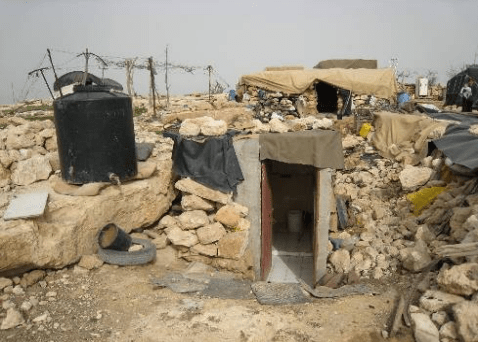
Susya toilet under demolition order by the Israeli army (Amnesty International, “TROUBLED WATERS – PALESTINIANS DENIED FAIR ACCESS TO WATER”, p.2 )

Water in Israel is probably one of the most blatant faces of apartheid. As reports like the Amnesty International report of 2009, “Troubled Waters” and the B’tselem website coverage of the issue, “The Water Crisis” show us,  Israel’s resources are invested in water theft/access denial from Palestinians. But water in Israel is not just a substance of life, for those who can’t have it, it’s a tradable commodity, for those who’ll never miss it.

Like a Fish in National Waters

Water resources in Israel are all state-owned. Naturally- as is usually the case within the militaristic, nationalistic Israel- the state will allocate these resources to serve its “national needs”. Water theft is a good example of “negative” policy, which is so obviously discriminatory, violent and inexcusable, that the only way to sell it to the public is not to mention it at all. True to form, when cave- dwelling Palestinians are kicked out of their caves and their harvesting canisters (on the cave roof?) are destroyed [“Troubled Waters”, p.2], there’s no Israeli media around to record it, spin it and dish it. “Positive” policy, however, is always easy to sell. After all, we “dried the swamps and made the wilderness bloom”, and the environmental devastation of swamp drying still isn’t being taught in schools.

Continue reading “Playing with Water”

But the Coffins Do Come In

by Mohammed Omer

IPS — GAZA CITY, Oct 13, 2010 – Samir Tahseen Al-Nadeem died after waiting 35 days for an exit permit for treatment for his heart condition. He was 26. The medicines he needed could not get in. But the coffins do.

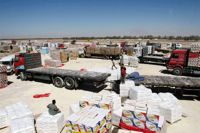
Goods waiting for months to be transferred to the Gaza Strip at the Israeli-controlled Karni crossing. (Photo: Mohammed Omer)

The health ministry now lists 375 deaths due to shortage of life-saving medicines. The medicines sit just outside the borders of the territory until most pass their expiry dates. But there are no expiry dates on about 10,000 coffins that have been donated for Gaza. The coffins do make it to those that eventually need them.

By the end of last month more than 70 percent of medicines donated for Gaza had been dumped because they were past their expiry date, the health ministry says. They were worth many millions of dollars. And they were worth many lives.

“Much of the donated medicines came from Arab states,” Dr Mounir Al- Boursh, director of the pharmaceutical department at the health ministry tells IPS. This added up to 10,300 tonnes of medicines worth 25 million dollars, he said.

Only about 30 percent of this could be used, he said; the rest either expired, or was inaccessible because of restricted distribution by the Israelis, who control what gets into Gaza.

It’s not easy to dump medicines safely either. Much of unused supply mixes with domestic waste, creating health hazards far from bringing relief. The World Health Organisation has had to “raise concern about the unsafe disposal of expired medication and other medical disposable material,” WHO spokesperson told IPS.

But the Gaza ministry has received 10,000 coffins, about 1,000 of them for children, Dr Boursh said. Such help, he said, “does not meet with the needs of the Gaza Strip.”

Continue reading “But the Coffins Do Come In”

Palestine liberation recalls anti-apartheid tactics, responsibilities and controversies

by Patrick Bondhttps://i0.wp.com/sabbah.biz/mt/wp-content/uploads/2007/04/4_9Mirror_on_Apartheid_Wall.jpg

On a full-day drive through the Jordan Valley late last month, we skirted the earth’s oldest city and the lowest inhabited point, 400 meters below sea level. For 10,000 years, people have lived along the river separating the present-day West Bank and Jordan.

Since 1967 the river has been augmented by Palestinian blood, sweat and tears, ending in the Dead Sea, from which no water flows out, it only evaporates. Conditions degenerated during Israel’s land-grab, when from a peak of more than 300,000 people living on the west side of the river, displacements shoved Palestinian refugees across to Jordan and other parts of the West Bank. The valley has fewer than 60,000 Palestinians today.

But they’re hanging in. “To exist is to resist,” insisted Fathi Ikdeirat, the Save the Jordan Valley network’s most visible advocate (and compiler of an exquisite new book of the same name). At top speed on the bumpy dirt roads, Ikdeirat maneuvered between Israeli checkpoints, through Bedouin outposts in the dusty semi-desert, where oppressed communities eke out a living from the dry soils.

Continue reading “Palestine liberation recalls anti-apartheid tactics, responsibilities and controversies”

Looting the Holy Land

Since 1967 countless artifacts have been unearthed and removed from the occupied West Bank and Gaza Strip. Many are displayed in Israeli museums and private collections, while others are sold to tourists. Al Jazeera searches through the evidence, unearthing the facts and exposing a power struggle in which every stone has meaning.

Jewish activists confront the JNF

The JNF according to historian Ilan Pappe is Israel’s main agency of ethnic cleansing. For nearly a decade the Scottish Palestine Solidarity Campaign has been waging a lonesome fight against this pernicious outfit which, outrageously, enjoys tax-exempt charitable status in many Western countries. Now it is being confronted by some great Jewish activists both in the UK and the US. This latest protest took place in Atlanta where some activists were physically abused after trying to disrupt the JNF event. They deserve our support and encouragement. (via Mondoweiss)

For more on the JNF see the SPSC’s invaluable e-book.

Two Schools in Nablus

“Most of the students from age fourteen have had a prison experience.” A great short film from 2008 on secondary schools in Nablus. Parts 2 to 4 over the fold. I challenge anybody to watch the girls’ terror in part three and remain unaffected. We must redouble our efforts to strengthen the Palestinians and to weaken their enemies.

Continue reading “Two Schools in Nablus”