The Mozlems Are Coming

by M. Shahid Alam

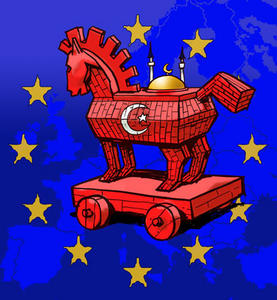
Fear grips the country from coast to coast.
Politicos, anchors and talk-show hosts

chatter all day, The Mozlems are coming;
they’ve dropped their drivel about fighting

them there. While our troops fought in Iraq
holding the ‘terrorists’ at the gates, back

home, greater troubles were brewing.
Radical Mozlems were actively scheming

to impose an Islamo-fascist theocracy
on the United States. Our great democracy

confronts an existential threat from within.
Let us act fast – good Republicans raise a din –

Moslems inside the US are working openly
to force sharia-law upon us. Act quickly,

harangue the pundits – or lose this great country
to heathens. Now’s not the time for an energy

plan, overhaul Medicare, fix the infrastructure,
or trim the deficit. We face greater dangers

from the enemy within: The Mozlems are coming.
It’s women in burqa, no gambling, no drinking,

nor driving for women. Americans get cracking
‘cause your country is calling. The Mozlems are coming.

– M. Shahid Alam is professor of economics at Northeastern University. He is author of Israeli Exceptionalism (Palgrave, 2009) and Poverty from the Wealth of Nations (Macmillan, 2000). Write to him at alqalam02760@neu.edu.
A Call from Home

By Majid Maqbool

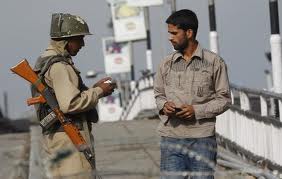
Checking a Kashmiri Youth’s ID Card

“Card chukha seath thavaan?”

(Do you carry the ID card with you?)

Mother worries over frequent phone calls

Away from home, home enters questions

‘Identity’ printed on a piece of paper

cuts through her voice; a discomforting lullaby:

“Card gase hamashe seath thavun”

(always carry the ID card with you)

Home leaves a permanent imprint…

On scattered notes, stamped on memories

At home, mother would tiptoe after me

At the door, before endless blessings, she always asked –

That question mothers have for their sons –

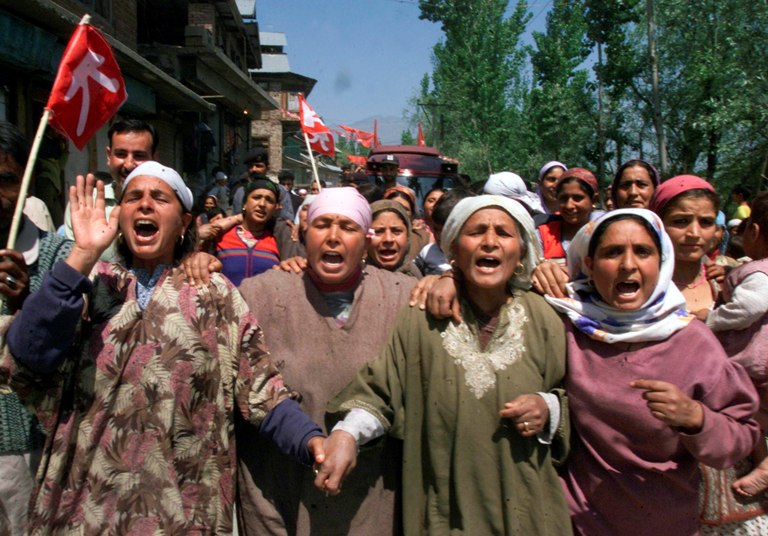
Protesting Kashmiri Women al (Yawar Nazir, IMOW)

“Card tultha seath?”

(are you carrying your ID card?)

From Delhi now, your question settles on my unrest

Identity – detached from the card – hangs heavy

This is not Kashmir, mother

“Toete gase card seath thavun…”

(Still you must carry the card with you…)

The line dropped on this insistence

I kept redialing, to rest her concerns,

her unfinished questions, unanswered

Hello..helloo… mother

Can you hear me?

I left the card at home, mother

In the back pocket of my worn-out jeans

Interrogating Identity in Kashmir

Find: a fading photograph, scrutinized edges

And no trace of those unrecognized questions

forever inked on my memory

For troops to question my absence

The proof I left behind is not enough

That frisked ID card remains

like a festering wound, pocketed pain

I carry everywhere


Majid Maqbool is a young journalist/writer from Kashmir.  Some of his writings can be found on his blog maqboolvoice.blogspot.com.

4. Ghazal from Ghalib

translated by M. Shahid Alam

Only a few come back to us in roses and tulips.
Many more lie buried, dust on their sleeping eyelids.

By day, the daughters of Pleiades play out of sight.
At night, they lift their veils in ravishing display.

My eyes pour blood on this night of savage partings:
two lamps I have lighted to sanctify love’s sorrow.

I will make them pay for the years of torment, if
by chance, these darlings play houris in paradise.

He shall have sleep, perfumed air, silken nights,
if you untie your jasmine-scented hair in his arms.

I have no use for your coy approaches to the divine.
Past your schools and creeds, we worship God alone.

If Ghalib were to keep this up (he cries inconsolably),
every man, woman, child will soon be leaving town.

first published in Prairie Schooner, Spring 2011

For more ghazals from Ghalib, click here.

M. Shahid Alam is professor of economics at Northeastern University. He is the author of Israeli Exceptionalism (Palgrave, 2009) and Challenging the New Orientalism (IPI, 2007). Visit his website at http://qreason.com. Write to him at alqalam02760@yahoo.com.

Voices

by Wislawa Szymborska

You scarcely move your foot when out of nowhere spring
the Aborigines, O Marcus Aemilius.

Your heel’s mired in the very midst of Rutulians.
In Sabines, and Latins you’re sinking up to your knees.
You’re up to your waist, your neck, your nostrils
in Aequians and Volscians, O Lucius Fabius.

These small peoples are thick as flies, to the point of irritation,
satiation and nausea, O Quintus Decius.

One town, another, the hundred seventieth.
The stubbornness of Fidenates. The ill-will of the Faliscans.
The blindness of Ecetrans. The vacillation of the
Antemnates.
The studied animosity of the Lavicanians, the Pelignians.
That’s what drives us benevolent men to harshness
beyond each new hill, o Gaius Cloelius.

If only they weren’t in our way, but they are,
the Auruncians, the Marsians, O Spurius Manlius.
The Tarquinians from here and there, the Etruscans from
everywhere.
The Volsinians besides. The Veientins to boot.
Beyond all reason the Aulercians. Ditto the Sapinians
beyond all human patience, O Sextus Oppius.

Small peoples have small understanding.
Stupidity surrounds us in an ever-widening circle.
Objectionable customs. Benighted laws.
Ineffectual gods, O Titus Vilius.

Mounds of Hernicians. Swarms of Marrucianians.
An insect-like multitude of Vestians, of Samnites.
The farther you go the more there are, O Servius Follius.

Deplorable are small peoples.
Their irresponsibility bears close watching
beyond each new river, O Aulus Junius.

I feel threatened by every new horizon.
That’s how I see the problem, O Hostius Melius.

To that I, Hostius Melius, reply to you,
O Appius Pappius: Forward. Somewhere out there the world
must have an end.

Wislawa Szymborska won the Nobel Prize for Literature for 1996. Poem courtesy of Andrew Bacevich.

Thus Alone, and Always, Have People Resisted Tyranny: Remembering Faiz on his Birth Centenary

Today is the first birth centenary of Faiz Ahmed Faiz: one of South Asia’s most beloved radical Urdu poets. Today is also, just two days after Mubarak’s resignation as a result of the inspiring revolution in Umm al-Duniya, Mother of the World, Egypt; and almost a month after Tunisia’s courageous revolution. How ecstatic would Faiz have been today?!

by Huma Dar

Today is the first birth centenary of Faiz Ahmed Faiz: one of South Asia’s most beloved radical Urdu poets.  Today is also, just two days after Mubarak’s resignation as a result of the inspiring revolution in Umm al-Duniya, Mother of the World, Egypt; and almost a month after Tunisia’s courageous revolution.  How ecstatic would Faiz have been today?!  Faiz, who had lived in Beirut, in exile from Pakistan — when ruled by the US-bolstered military dictator, General Zia-ul Haq.  Faiz, who wrote a beautiful lullaby for a Palestinian child, and a poem for those who were martyred outside their beloved Palestine.  Faiz, whose poem commonly mis-titled, “Ham Dekhenge,” is a battle-song for people fighting for social justice from Sindh, Pakistan to Kashmir to Chhattisgarh, India.

The title of this particular poem of Faiz is in Arabic: “Wa Yabqaa Wajhu Rabbika.”  It is most often brushed aside as it does not fit the simplistic profile of the “avowed atheist” assigned to Faiz.  Being a socialist does not preclude belief in Islam, but this nuance is lost on many who cannot easily imagine Faiz being a Muslim, leave alone leading a prayer in the mosque of his ancestral village, especially given the subtle Islamophobia that pervades élite political and literary discourses, both within and without South Asia.  For some, even more difficult “to reconcile [is] the glowing tribute [that Faiz wrote] to Muhammad Ali Jinnah,” but this has to do with the rigorous demonology of Jinnah, the founder of Pakistan, in Indian historiography, and the hegemonic status of India and Indian academics, even those who vigorously critique nationalisms of all kinds, within South Asian Studies.

Continue reading “Thus Alone, and Always, Have People Resisted Tyranny: Remembering Faiz on his Birth Centenary”

Departure Day

a poem by Naomi Foyle

for Egypt

Everywhere, the revolution

nods off in the wings, misses its cue
and the long-scripted farce bangs another door
in the face of the people

Here, the people resist
each other, the television flattens
and expands against the wall

until it is the wall
and its cold grey plasma
seeps like damp into our lungs.

There, it is blood that rises
in the back of the throat
spills on the pavement

with the little girl’s mango juice
and as she cries, the revolution
jerks awake, not too late

to bring the house down.

Continue reading “Departure Day”

Rainer Maria Rilke’s ‘Inner Sky’


Rilke's Damion Searls discusses the poetry of Rainer Maria Rilke with Christopher Lydon on Brown University’s Radio Open Source. Often bracketed with Yeats at the pinnacle of European poetry in the 20th Century, Rilke makes an even better pair with Walt Whitman as the irresistible great poet for everyone. In his essay ‘Looking for Rilke’ (in Stephen Mitchell’s Selected Poetry of Rainer Maria Rilke) Robert Hass relates:

When Rilke was dying in 1926 — of a rare and particularly agonizing blood disease — he received a letter from the young Russian poet Marina Tsvetayeva. “You are not the poet I love most,” she wrote to him. “‘Most’ already implies comparison. You are poetry itself.”

From The Inner Sky, “poems, notes, dreams” that Damion Searls has selected and translated, we are reading Rilke fragments that can make one gasp on a first hearing. I like specially, for example, these “Notes on the Melody of Things,” which snuck up on me six weeks ago and induced just the sort of trance Robert Hass recounts.

Howl

Allen Ginsberg on Pacifica Radio radio reading his banned poem “Howl” followed by a discussion with publisher Lawrence Ferlinghetti.

An interview with graphic artist Eric Drooker who has produced a graphic novel based on his friend Allen Ginsberg’s “Howl”. The full text of the poem is over the fold.

Download program audio (mp3, 47.85 Mbytes)

Few poems have been as celebrated or reviled as Allen Ginsberg’s ‘Howl,’ which was penned in Berkeley at the height of the Cold War, andwas the subject of a famous obscenity trial against publisher Lawrence Ferlinghetti. Renowned painter and graphic novelist Eric Drooker speaks about his friend Allen Ginsberg, whose poem he has animated, and discusses why ‘Howl’ still can’t be read in full on the radio today.

Allen Ginsberg and Eric Drooker, Howl: A Graphic Novel Harper Perennial, 2010
Continue reading “Howl”

3. A Ghazal from Ghalib

translated by M. Shahid Alam

If a thing’s delayed, there’s a thing delaying it.
Not you, your suitors slowed you down a bit.

It wasn’t right, pinning my troubles on you.
The furies, fate, kismet, each had a hand in it.

If you can’t remember, let me jog your memory.
I was your prized quarry: you grew fond of it.

Captive, I stay awake, thinking of you all night.
It’s true my shackled feet also hurt a bit.

I hadn’t asked for this blinding flash of light.
I wish He’d speak to me: my heart aches for it.

I bared my neck for her. She backed out of it.
She is a sharp shooter. An arrow too could do it.

Wrongly, we are tried on the report of angels.
Is there a man like us to say he saw us do it?

Ghalib, you do not have the crown of the ghazal.
It’s rumored there was Meer, with better claim to it.

First published in Beloit Poetry Journal, Fall 2001.

For more ghazals from Ghalib, click here.

M. Shahid Alam is professor of economics at Northeastern University. He is the author of Israeli Exceptionalism (Palgrave, 2009) and Challenging the New Orientalism (IPI, 2007). Visit his website at http://qreason.com. Write to him at alqalam02760@yahoo.com.

Moment of Silence

by Emmanuel Ortiz

Before I start this poem,
I’d like to ask you to join me
In a moment of silence
In honor of those who died in the World Trade Center and the
Pentagon last September 11th.

I would also like to ask you
To offer up a moment of silence
For all of those who have been harassed, imprisoned,
disappeared, tortured, raped, or killed in retaliation for those strikes
For the victims in both Afghanistan and the U.S.

And if I could just add one more thing…
A full day of silence
For the tens of thousands of Palestinians who have died at the
hands of U.S.-backed Israeli
forces over decades of occupation.
Six months of silence for the million and-a-half Iraqi people,
mostly children, who have died of
malnourishment or starvation as a result of an 11-year U.S.
embargo against the country.

Before I begin this poem,
Two months of silence for the Blacks under Apartheid in South Africa,
Where homeland security made them aliens in their own country.
Nine months of silence for the dead in Hiroshima and Nagasaki,
Where death rained down and peeled back every layer of
concrete, steel, earth and skin
And the survivors went on as if alive.
A year of silence for the millions of dead in Vietnam – a people,
not a war – for those who
know a thing or two about the scent of burning fuel, their
relatives’ bones buried in it, their babies born of it.
A year of silence for the dead in Cambodia and Laos, victims of
a secret war … ssssshhhhh….
Say nothing
we don’t want them to learn that they are dead.
Two months of silence for the decades of dead in Colombia,
Whose names, like the corpses they once represented,
have piled up and slipped off our tongues.

Continue reading “Moment of Silence”