As Sudan holds its first multi-party election since 1986, Al Jazeera’s Hassan Ibrahim hosts this one-hour roundtable discussion with Sudanese politicians from the government and leading opposition groups.
Category: Politics
On the abuse of language
Tony Judt on linguistic subterfuges practised in Europe and America.

In America the misuse of language is usually cultural rather than political. People will accuse Obama of being a socialist. Italians would say magari – if only. However, no one takes this very seriously. What we have instead in the US is cultural communities policing what can and can’t be said, and that shapes how we define difference. The idea is that you can’t have an elite, since elitism is undemocratic and unegalitarian. Therefore, you always make the point that people are in some important way the same. If they are badly disabled like me, they are ‘differently abled’, which I find very amusing. It is not a ‘different’ ability: it is no ability. But since it’s politically uncomfortable to distinguish between people who can do things and people who can’t, the latter are described as separate but equal. There are numerous things wrong with this: first, it is lousy language; second, it creates the illusion of sameness or achievement in its absence; third, it conceals the effects of real power and capacity, real wealth and influence. You describe everyone as having the same chances when actually some people have more chances than others. And with this cheating language of equality deep inequality is allowed to happen much more easily.
(Neo)Orientalism with an Attitude: In the Footsteps (and Beyond) of Richard Burton
Getting one’s picture taken with the Dalai Lama or the Pope will guarantee neither Buddhist enlightenment nor beatification: my apologies for shattering the hopes of some New Agers. Similarly, entering the Ka’aba in Burtonesque disguise — specially minus his arguably relevant though shifty linguistic skills and textual knowledge — will not and cannot necessarily guarantee much “learning” about Islam.
by Huma Dar
The March 10, 2010, page A27 of the New York edition of New York Times carries an Op-Ed piece by Maureen Dowd titled, “Pilgrim Non Grata in Mecca.” Dowd writes about her desire to “learn about the religion that smashed into the American consciousness on 9/11” via “sneaking” into Mecca in “a black masquerade cloak.” Her self-proclaimed inspiration is Richard Burton’s “illicit pilgrim[age] to the sacred black granite cube…in Arab garb” thereby “infiltrat[ing] the holiest place in Islam, the Kaaba [sic].”
Dowd, however, decides to “learn about Islam” in a way “less sneaky,” “disrespectful,” or “dangerous” and yet more entitled and privileged than Richard Burton could ever have dreamed of. She herself describes Burton as “the 19th-century British adventurer, translator of “The Arabian Nights” and the “Kama Sutra” and self-described ‘amateur barbarian.'” The words “illicit,” “Kama Sutra,” and “infiltration” and Dowd’s voyeuristic desires resonate with the Orientalism of yore. Moreover Dowd’s valuable US passport and USA’s special relationship with Saudi Arabia (read: enabling of the oppressive monarchy) entitle her to meet Prince Saud al-Faisal, the Saudi foreign minister — of the “sometimes sly demeanor” — on her “odyssey” to that country. “Infiltration” in disguise is no longer required, and yet this ease of access also disguises and makes more difficult the complexity of any real learning.
Dowd “presses” al-Faisal for the privilege to watch in Mecca, the “deeply private rituals” and “gawk at the parade of religious costumes fashioned from loose white sheets” although she knows in advance that “Saudis understandably have zero interest in outraging the rest of the Muslim world.” While talking to this high-ranking minister, Dowd bristles at al-Faisal’s reassuring suggestion that if she desired to see any mosque in a place other than in Mecca or Medina, and was prevented from doing so, all she had to do was to contact the “emir of the region” who would comply and enable the fulfillment of her desires. (Anyone else reminded of Aladdin’s djinn/genie?) Without conceding the irony of the situation that she, after all, is speaking to Prince al-Faisal, the Saudi foreign minister, Dowd quips, “Sure. Just call the emir. I bet he’s listed.” Imagine what Richard Burton would have done with the special privileges of this particular magic lamp provided by the New World Order!
Finally Dowd does indeed witness the Hajj — in an IMAX theatre watching Journey to Mecca: In the Footsteps of Ibn Battuta. Dowd, much to her surprise, makes the belated discovery that “the Kaaba [sic] was built by “Abraham, the father of the Jews” [why Jews only?]— a reminder that the faiths have a lot to learn from each other.” It is also a reminder that journalists like Ms. Maureen Dowd have a lot of homework to do before they set out on their surely expensive travels — and I am not even including the much recommended language lessons. Any commonly available text on Islam, for example by Karen Armstrong, Jamal Elias, Michael Sells, or Ziauddin Sardar, might have served the purpose. Dowd could thus have avoided relying solely on the “amateur barbarian” Richard Burton or Newsweek’s own Fareed Zakaria. The former’s scholarly credentials are hardly beyond doubt — see his problematic remarks on “Jewish human sacrifice” in The Jew, the Gipsy and el Islam (1898). The latter’s forte is not his knowledge of Islam — or at least no more than Zakaria’s mentor, Samuel Huntington’s forte is Christianity. Dowd might thus have disabused herself of the notion of “the sacred black granite cube.” The “sacred black” stone is not a “cube” and neither is the “sacred cube” — the Ka’aba — all granite!
Getting one’s picture taken with the Dalai Lama or the Pope will guarantee neither Buddhist enlightenment nor beatification: my apologies for shattering the hopes of some New Agers. Similarly, entering the Ka’aba in Burtonesque disguise — specially minus his arguably relevant though shifty linguistic skills and textual knowledge (See Parama Roy’s excellent essay for more on Burton) — will not and cannot necessarily guarantee much “learning” about Islam. On the other hand, a trip to any local library with a willingness to read and learn, and engagement with an open mind in meaningful conversations with the (gasp!) American Muslims, might be better starting points for undertaking this particular journey.
Did the Editor of The New York Times not know the price difference between the ticket to the IMAX theatre plus membership to a local library and the cost of Dowd’s lavish travels to the Kingdom of Saudi Arabia? The Neo-Orientalist fantasy to tread in the footsteps of Sir Richard Burton is accelerated with privilege and precisely because of this privilege skips and misses its target even more widely.
It is in the spirit of a gift that I offer Ms. Dowd this image: 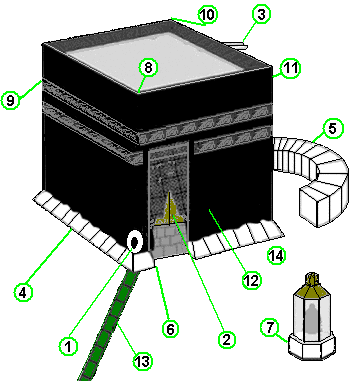
|
Labeled elements are as follows: 1 – The Black Stone; 2 – Door of the Kaaba; 3. Gutter to remove rainwater; 4 – Base of the Kaaba; 5 – Al-Hatim; 6 – Al-Multazam (the wall between the door of the Kaaba and black stone); 7 – The Station of Ibrahim; 8 – Angle of the Black Stone; 9 – Angle of Yemen; 10 – Angle of Syria; 11 – Angle of Iraq; 12 – Kiswa (veil covering the Kaaba); 13 – Band of marble marking the beginning and end of rounds; 14 – The Station of Gabriel.
|
|
Members of Congress sign letter urging Obama to stop the siege of Gaza
Some good news came out of Washington yesterday that went largely unnoticed. Ha’aretz reported 54 members of Congress sent a letter to president Barack Obama urging him to pressure Israel to end the siege on Gaza. Ha’aretz correspondent Natasha Mozgovaya writes:
The letter was the initiative of Representatives Jim McDermott from Washington and Keith Ellison from Minnesota, both of whom are Democrats. Ellison is the first American Muslim to ever win election to Congress. McDermott and Ellison wrote that they understand the threats facing Israel and the ongoing Hamas terror activities against Israeli citizens but that “this concern must be addressed without resulting in the de facto collective punishment of the Palestinian residents of the Gaza Strip.” “We ask you to press for immediate relief for the citizens of Gaza as an urgent component of your broader Middle East peace efforts,” they wrote, adding that the siege has hampered the ability of aid agencies to do their work in Gaza. The congressmen urged Obama to pressure Israel to ease the movement of people into and out of Gaza, especially students, the sick, aid workers, journalists and those with family concerns, and also to allow the import of building materials to rebuild houses. Israel has warned that such materials would be used to rebuild Hamas infrastructure and not civilian homes.
Fifty-four members of Congress urging the president to pressure Israel to treat Gazans like human beings is a positive development, albeit a VERY small one. Critics may content that the letter protects Israel’s image. I understand that. But I still think it’s encouraging.
Operation Cast Lead blew the lid off Israel’s rationale for the occupation and the congressional visits to Gaza have exposed to them what Gazans encounter on a day-to-day basis. More members of Congress need to do this.
Full text of the letter below.
Continue reading “Members of Congress sign letter urging Obama to stop the siege of Gaza”
Worst decision since Dred Scott
The US Supreme Court has ruled that as a legal ‘person’ a corporation can spend unlimited amounts in an election campaign to elect its preferred candidates. The lax campaign financing rules already allowed lobby groups such as AIPAC to funnel massive amounts to candidates through individuals. Instead of reforming the system, as people like Ralph Nader have been demanding for years, the court further hacks away at democratic checks and balances. The ruling has been rightly compared to the Dred Scott case justifying slavery. Here is a clip of Robert Weissman summing up what consequences this might have for US democracy (to the extent that it exists) followed by a statement by Ralph Nader. (For Americans who want to save their democracy, here is a campaign they can join: http://www.movetoamend.org/. Also check out Public Citizen’s proposed action).
PULSE: 20 Top Global Thinkers of 2009
On 30 November 2009 Foreign Policy magazine published its ‘Top 100 Global Thinkers’ list. We were naturally skeptical since the selection included Dick Cheney, General Petraeus, Larry Summers, Thomas Friedman, Bernard-Henri Lévy, David Kilcullen, Ayaan Hirsi Ali, Salam Fayyad, The Kagan Family (yes, all of them) and Ahmed Rashid among others. We don’t consider any of these people thinkers, let alone having global significance, and we couldn’t help but notice that the main thrust of all their work aligns with the global military and economic agenda of the US government. In response we asked twelve of our writers and editors to nominate their Top 20 global thinkers of 2009. Our criteria included choosing those who inspire critical thinking, as well as those who have been able to buck received wisdom and shape public debate. Always agreeing with their statements and positions was not a requisite, but in all cases our selections involved nominating those who have spurred people to challenge or enhance their own thinking in different ways. The following is our unranked list.
Update: See Foreign Policy’s response, our rejoinder, and our reflections on the debate. (Also see our 20 Top Global Media Figures of 2009)
Arundhati Roy
 The top nominee when it came to number of votes among PULSE contributors, Indian writer and activist Arundhati Roy is as much known for her non-fictional political work as she is for her award-winning fiction. She is a spokesperson of the alter-globalization movement and a critic of hegemonial US foreign policy, as well as vocal on behalf of the anti-nuclear and environmental movements both in India and abroad. She is also a staunch critic of the repressive Indian policies in Kashmir. Most recently a contributor to We Are One: A Celebration of Tribal Peoples (October 2009), Roy continues to be passionately engaged and eloquently outspoken in building a social movement towards developing alternatives. Her latest book is Listening to Grasshoppers: Field Notes on Democracy.
Mahmood Mamdani: State Formation and Conflict
Mahmood Mamdani on state formation and conflict in Sudan. This lecture is a couple of years old (from 2007), but highly informative.
Allama Iqbal, God’s Command To Angels
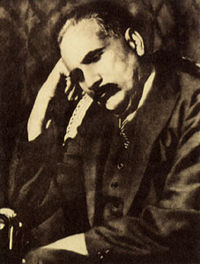 translated by – M. Shahid Alam
اٹھو میری دنیا کے غریبوں کو جگا دو
Marshall the meek of my world. Arise, set them free.
Seize the towers of the rich. Shake their tyranny.
Lift the slaves. Ignite them. Instill a faith that rocks.
Teach the feeble sparrow to fight the taloned hawk.
Power belongs to the people: their kingdom has come.
Burn the totems of tyranny: their history is done.
Why do toiling peasants reap death and misery?
Capture the gilded castles. Seize the granaries.
These minders, meddlers, ushers play for a fee.
I do not need priests to parse my words for me.
I have no use for painted walls and ornamented frieze.
Build me a tabernacle with mud, thatch and leaves.
This age of smoke and mirrors: is this modernity?
Move the poet. Make him rage. Hitch him to Eternity.
_________________________________________________
— M. Shahid Alam is professor of economics at Northeastern University. He is author of Israeli Exceptionalism: The Destabilizing Logic of Zionism (Palgrave Macmillan: 2009).
Imagining Radical Change with David Harvey & Alexander Cockburn
Vodpod videos no longer available.
Event description:
David Harvey, author of A Brief History of Neoliberalism, and Alexander Cockburn, author of End Times: The Death of the Fourth Estate, don’t think small when it comes to change. They aren’t afraid to think about significant, even radical changes to the social order we’ve grown so used to, whether it’s requiring full employment, reimagining urban living, or repudiating credit card debt and abolishing Wall Street speculation.
Continue reading “Imagining Radical Change with David Harvey & Alexander Cockburn”
The Absurdity of the Dalai Lama
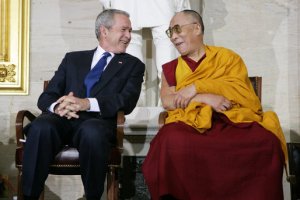
He has been quoted as saying “Sleep is the best meditation.” May I suggest his holiness wake up to the fact that the two wars started by his friend George W. Bush are the clearest violations of his own espoused principles of peace and non-violence. Really, does no one else find it absurd that the Dalai Lama has on multiple occasions since 2001 stood unopposed to the brutal, barbaric and illegal wars first in Afghanistan and later Iraq? This sought-after personality loved by celebrities, the CIA, political leaders and civilians alike restated today in Calgary that “It’s hard to tell which category the current military interventions in Afghanistan and Iraq will eventually fall into.”
 P U L S E
