By Charles Davis
One of the iron laws of the know-nothing “anti-imperialists” is that if a group is supported by the United States, however minimally, or even just perceived as being aligned with U.S. interests, it goes without saying that the group is very bad and to be opposed by every good practicing opponent of empire. This is why many see no need to learn a thing about Syria beyond what can be found in 140 characters or less from Julian Assange, left-wing class analysis forsaken for conspiracy and a tautology: The U.S. is bad, and it says Assad is bad – maybe because of a pipeline, or because he made John Kerry pick up their last bar tab – Assad is therefore good, or at the very least less bad than those backed by the empire.
Preferring the simplicity of a “regime change” narrative that went from stale to rotten in 2013, when the U.S. eagerly embraced an Israeli-brokered deal with Russia to keep Assad in power, those who believe their theory of everything relieves them of the duty to know a thing about Syria or Syrians in particular long ago settled on claiming that all who fight the regime in Damascus are but unthinking “Contras,” or mercenaries fighting not for their own reasons but for the reasons of the regime in Washington. This, despite the fact that when the U.S. tried to create an actual mercenary army to fight ISIS – and, explicitly, ISIS alone – it managed to recruit all of 54 people.
“Prominent writers in India are collectively protesting what they consider an increase in hostility and intolerance, which they argue has been allowed to fester under the government of Prime Minister Narendra Modi, by returning a prestigious literary award.”
Referring to attacks against Muslims, including the killing of a man who had been suspected of slaughtering a cow, he said, “This is not the country that our great leaders had envisioned.” (Ghulam Nabi Khayal, Sahitya Akademi Award, 1975)
The newsfeed on most South Asian social media has been deluged by articles like the one in The New York Times above. However, one has to wonder what kept these literary “stars” from this praiseworthy gesture of returning their State-given awards when the Gujarat pogroms were going on in 2002, or against the pogroms that followed the demolition of Babri masjid in 1992/3, or against the genocide of Sikhs around 1984, or heck, against the ongoing genocide in Indian Occupied Kashmir or that of Dalits…
My apologies for this query, which despite seeming cynical at first blush, is actually a probing of the very problematic and exceptionalizing notions of “India as a nation” and “Indian secularism” that these authors and poets valorize, explicitly or implicitly, through this joint gesture of returning their awards or through their separate oeuvre at large. It is precisely these twin concepts of unprobed “Indian secularism” and even more foundationally, the unproblematized, dehistoricized, and normalized idea of “India as a nation” (see The Indian Ideology (2012) by Perry Anderson for a resounding deconstruction of this) that are the fecund incubating grounds of much violence – violence which is Brahminical, colonial, and Islamophobic at the core. This is true not only with regard to the acts of spectacular violence, like the mob lynching of Muhammad Ikhlaq in the current context of Dadri, at the contemporary moment of Modi-fied India, but also for the billion and one banal acts of quotidian casteist, colonial, and communal violence that fertilize the roots of the phenomenon in modern India. This is especially true for the comparably spectacular violence of the allegedly “secular” contexts – the genocidal violence of the Indian state in Kashmir, Punjab, Hyderabad, Assam, Manipur, Jharkhand, Chhattisgarh, in every Dalit basti et al – that preceded the current Hindutva regime (and co-exist at any given time). In fact, it can be argued that the exceptionalization of India not only papers over much of this epistemic violence by making it invisible but actually enables it by helping it elide scrutiny. Thus no gesture of protest, however “well intentioned” it might be, will bear fruit until and unless the very problematic exceptionalism that undergirds the allegedly “secular India” is deconstructed.
The situation facing the Assad regime is dire. Having lost almost every major battle it has fought with the armed rebels for over a year now, it is facing crises on every front. Since March it has lost control of the entire province of Idlib to the Jaysh Al-Fatah coalition. In Aleppo, the Fatah Halab coalition are on the offensive and gradually liberating districts of the city from the regime, while last month the regime’s only ground supply route to the city was temporarily severed by rebels. In the south the Southern Front continues to pressure the regime around Daraa, and is advancing in Quneitra province, while rebels in Lattakia continue to mount incursions into the regime loyalist province.
Rebel advances in Idlib province May 2014 – May 2015 Credit: ArchiciviliansRebel advances in Daraa province May 2014 – May 2015 Credit: Archicivilians
Assad is facing a manpower shortage as tens of thousands of Syrians flee regime held areas to escape conscription and deteriorating living conditions. Refugees who left Syria recently describe being unable to live, as regular electricity and water cuts, and the rising price of food and rents makes the situation unbearable.
A recent 2-part series on Syria in The Independent by Patrick Cockburn, one of the most influential journalists on the subject, is a masterclass in sophistry that illustrates why the conflict is so misunderstood. A closer look is therefore instructive.
Reaction to Russia’s military intervention in Syria shows that the lack of knowledge of the Syrian political landscape on the part of Western political leaders and media is hindering the adoption of more constructive policies. During the past four years, over-simplifications and wishful thinking have prevented any realistic attempt to end the civil war, mitigate its effects or stop it from spreading to other countries.
Since 2011 the departure from power of President Bashar al-Assad has been prescribed as a quick way to bring an end to the conflict, although there is no reason to believe this. There are no quick or easy solutions: Syria is being torn apart by a genuine, multi-layered civil war with a multitude of self-interested players inside and outside the country. If Assad dropped dead tomorrow, Syrians in his corner would not stop fighting, knowing as they do that the success of an opposition movement dominated by Isis and al-Qaeda clones such as Jabhat al-Nusra would mean death or flight for them and their families.
Sophism 1: Those in the West who have been calling for Assad’s departure as a condition for bringing an end to the conflict meant it as part of a “national reconciliation” and “managed transition,” not as Assad “dropping dead tomorrow,” of course.
Today there are four million Syrian refugees, mostly from opposition areas being bombarded indiscriminately by government forces. But this figure could double if the more populous pro-government areas become too dangerous to live in.
In the past, this was not likely to happen because Assad always controlled at least 12 out of 14 Syrian provincial capitals.
A story published in the Guardian on 16 September entitled “West ‘ignored Russian offer for Assad to step down as President’” has evoked considerable excitement on both sides of the Atlantic. The story is based on a claim by former Finnish President and UN Diplomat Martti Ahtisaari that the West failed to respond to an overture made in February 2012 by Russia’s UN Ambassador Vitaly Churkin. According to Ahtisaari, Churkin, in a private conversation suggested a means for resolving the Syrian crisis:
He said: ‘Martti, sit down and I’ll tell you what we should do.’ “He said three things: One – we should not give arms to the opposition. Two – we should get a dialogue going between the opposition and Assad straight away. Three – we should find an elegant way for Assad to step aside.”
The Guardian seems to have felt the need to “sex up” these comments, turning them into a “3-point plan”. (Of course this plan already existed, in the form of the Arab League initiative of 22 January 2012, of which more below).
Partha Chatterjee, professor of anthropology at Columbia University
I wholly endorse Huma Dar’scritique of the Indian state’s relation to Kashmir, even though, not being Kashmiri myself, I cannot share the position from which she writes. My declared position on the Kashmir issue has always been at odds with Indian nationalist views, as indeed have my views on the hill states of north-eastern India. Politically, I have taken every opportunity open to me to condemn the operations of the Indian security apparatus in Kashmir and the north-east. I have always argued against turning the Kashmir question into an exclusive matter of bilateral negotiation between Pakistan and India and insisted on recognizing the right of the Kashmiri people to determine its own political future. My views on the north-eastern states too are shaped by similar considerations. Those who are familiar with my critique of the Indian nationalist ideology recognize my position. Needless to say, for the last three decades, I have been condemned by Indian nationalists of every hue, including sections of the Indian Left, for holding those views. I have also realized that regardless of one’s standing in the academy, the voices of people like us in India’s public domain are utterly marginal.
I felt it necessary to bring up the question of Kashmir and Tripura in connection with my statement on the boycott of Israeli institutions only to point out that I was not employing a different standard in judging colonialist claims within the territorial state of India. That statement was obviously not the place to elaborate on my critique of the Indian state ideology. I was merely explaining my way of negotiating, as a private individual, the terrain of national and colonial power relations in which one is necessarily implicated. I do not mean my refusal to visit Kashmir or Tripura to serve as a demonstrative act of resistance, nor indeed do I mean it to be exemplary in any way. It is merely a personal ethical choice that I have never before felt it necessary to talk about in public. I did not mention in my essay the north-eastern hill states not because I accept their relation to the Indian state as unproblematic but because I did once visit those states – in the early 1970s. That visit, and the experience of being an “Indian” in Indian-occupied territory, left a deep impression on me. Since then, I have never visited Kashmir, Tripura and other such places not because I wanted to avoid observing a colonial occupation at work but because I was sure I knew exactly what I would see and yet would remain powerless to do anything about. All I have managed to do in the last forty years, besides adding my feeble voice to feeble public statements, is apologize to my friends in those places for not being able to visit them.
I fervently hope that where my generation has signally failed, another generation of young Kashmiris like Huma will, with their intelligence and commitment, succeed in changing things in those unhappy regions of India.
Note: Received via email from Ayça Çubukçu, Thurs, Sep 10, 2015 at 11:57 PM GMT.
I heartily applaud your decision to boycott the colonial & apartheid state of Israel. And I do this especially as a conscientious citizen of the world and as a Kashmiri born outside of Kashmir due to the catastrophic ethnic cleansing of 1947-8, engineered by the Brahminical (though not Brahmin) Dogra ruler of the erstwhile princely state and the newly “independent” Indian State, when up to 1.1 million Muslims were massacred and forcibly exiled out of Indian Occupied Jammu & Kashmir. That means about one third of the total Muslim population of the larger princely state of J&K was eliminated from the area that came to be under Indian Occupation, by state complicity. This figure is disproportionately high given that the total population of J&K was less than one percent of the population of British India and presents a contrast to most, though not all, accounts of Partition 1947 violence in Punjab and Bengal, which was largely construed as spontaneous or unplanned. Moreover, up to 25,000 Muslim women from J&K, mostly from Jammu, were abducted and raped as a part of this genocide — a distant aunt of mine amongst them, who bore three children to an abductor. (And these women, comprising almost a quarter of the total number of women abducted during that time, though coming from less than a single percent of the overall population, never became a part of the “subcontinental” feminist accounting of the Partition, as done by Urvashi Butalia.) I reveal this in part to explain why your statement of solidarity with our fellow Palestinians, struggling to dismantle a brutal Occupation, feels even more intimate to me.
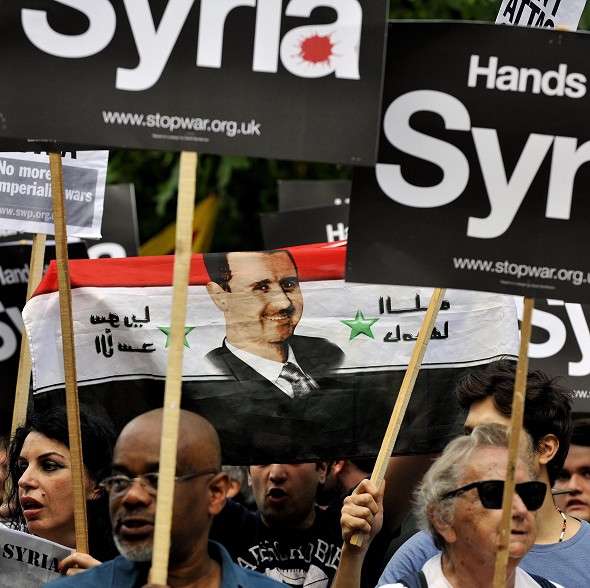
Leftist protesters carry pictures of Bashar al Assad at an “anti-war” march.
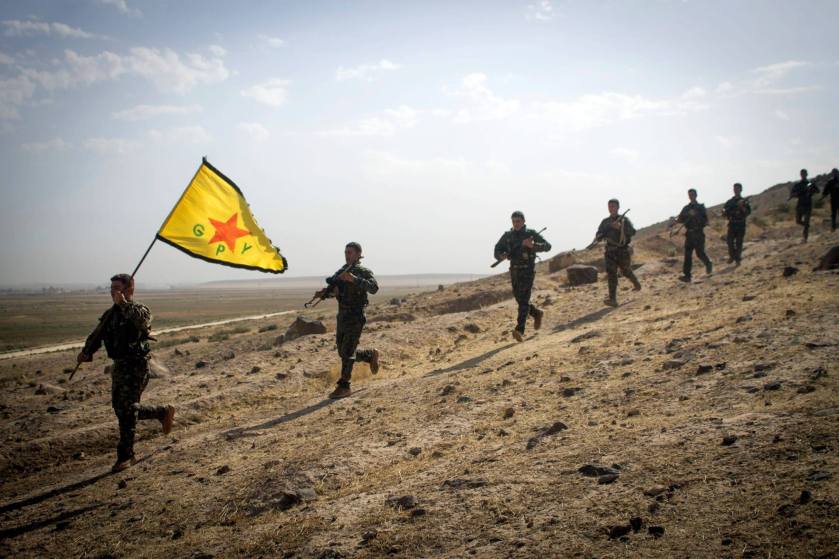
Perhaps the most humorous aspect of the latest drivel published by Jacobin in defense of the Syrian regime headed by Bashar al-Assad is the way the “anti-imperialist” author is forced by their own tautological premise to downplay the decisive role that U.S. imperialism has played in defending what appears to be a leftist revolution (with, as always, flaws) currently taking place in Syrian Kurdistan.
It’s understandable, to a degree: as one who also sympathizes with this seemingly left-libertarian project, which the author describes as a “spark of hope to many leftists in the West” – hope that is “not misplaced” – I too have been challenged by the fact that were it not for an extensive air campaign that the United States reluctantly carried out in Kobane, it might very well not exist. But while one can have doubts as to the ultimate wisdom of allying with a nation-state not known for its long-term friendships with left-wing radicals, one can’t deny that thus far that alliance has proved beneficial to the Democratic Union Party (PYD) and its militias, the all-men YPG and all-women YPJ. One can also acknowledge that while it might sully the beneficiaries’ anti-imperialist credentials to accept U.S. aid, those beneficiaries would say that in a world full of bad options they chose the least-bad one available, preferring it to genocide.


 P U L S E