Julian Assange’s Sydney Peace Medal speech

Julian Assange was recently awarded the Sydney Peace Foundation (SPF)’s peace medal, presented to him in London. The  event was organised at the Frontline Club. Assange’s acceptance address follows introductions by the SPF’s Stuart Rees and Mary Kostikidis.

A write up of a Q&A section with Assange, which followed the speeches, can be found here (part I) and here (part II).

Vodpod videos no longer available.

United we stand

by Brenda Heard

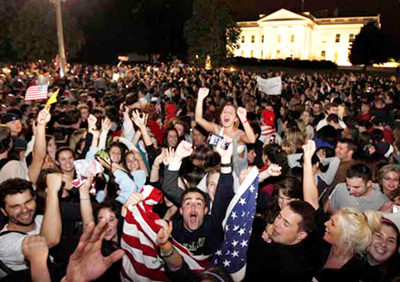
News during the last couple of weeks has rumbled in to shake an already rickety balance of world order.   Perhaps one of the most disturbing images accompanying those headlines, though, was not that of more bruised and bulleted bodies.  Rather, the image was of what the Associated Press termed a ‘jubilant crowd’.   As though they had just won the World Cup Final, Americans waved flags as they sang and chanted their patriotic celebration.

Osama Bin Laden, they had just been told, had been shot dead.  After nearly a decade-long manhunt, he had finally been pounced upon in Pakistan.  The crowd cheered.  And when President Obama made the official announcement, he coaxed the nation to cheer the same; he concluded by quoting the American pledge of allegiance:

Let us remember that we can do these things not just because of wealth or power, but because of who we are: one nation, under God, indivisible, with liberty and justice for all’.

‘Indivisible’.  In this one word lies the notion that has fed American policy for many, many years:  united we stand—divided they fall.

Continue reading “United we stand”

Conversations with History: Anatol Lieven on Pakistan

Anatol Lieven is the author of the excellent America Right or Wrong. In the following interview he discusses his new book Paksitan: A Hard Country, which I shall review here shortly.

Conversations host Harry Kreisler welcomes Anatol Lieven for a discussion of his new book Pakistan: A Hard Country. Lieven emphasizes the important role of kinship in understanding society and the state in Pakistan. Discussing the military’s unique position as the preeminent national institution, he explains the sources of its power and prestige. Focusing on Pakistani national security thinking, he traces the perceived strategic threat posed by India, the role of Afghanistan in Pakistani strategy, the distinction between the Afghan and Pakistani Taliban, and the importance of Kashmir. He then proceeds to an analysis of the complex relationship between the United States and Pakistan. Lieven concludes with a discussion of the threat posed by Pakistan’s geographical location in the Indus valley and the long term implications of climate change for its future.

The Predators: Where is Your Democracy?

by Kathy Kelly

On May 4, 2011, CNN World News asked whether killing Osama bin Laden was legal under international law.  Other news commentary has questioned whether it would have been both possible and advantageous to bring Osama bin Laden to trial rather than kill him.

World attention has been focused, however briefly, on questions of legality regarding the killing of Osama bin Laden.  But, with the increasing use of Predator drones to kill suspected “high value targets” in Pakistan and Afghanistan, extrajudicial killings by U.S. military forces have become the new norm.

Just three days after Osama bin Laden was killed, an attack employing remote-control aerial drones killed fifteen people in Pakistan and wounded four. CNN reports that their Islamabad bureau has counted four drone strikes over the last month and a half since the March 17 drone attack which killed 44 people in Pakistan’s tribal region. This most recent suspected strike was the 21st this year.  There were 111 strikes in 2010. The Human Rights Commission of Pakistan estimated that 957 innocent civilians were killed in 2010.

I’m reminded of an encounter I had, in May, 2010 ,when a journalist and a social worker from North Waziristan met with a small Voices for Creative Nonviolence delegation in Pakistan  and described, in gory and graphic detail, the scenes of drone attacks which they had personally witnessed:  the carbonized bodies, burned so fully they could be identified by legs and hands alone, the bystanders sent flying like dolls through the air to break, with shattered bones and sometimes-fatal brain injuries, upon walls and stone.

Continue reading “The Predators: Where is Your Democracy?”
Why Kill Bin Laden Now?

Gareth Porter: Domestic politics dictated decision to assassinate bin Laden, not national security. Also, in the National Journal, Tim Fernholz and Jim Tankersley estimate that the pursuit of Bin Laden cost the US $3 trillion over the past 15 years.

Beyond bin Laden

Tariq Ali, Fazwaz Gerges and Vali Nasr discuss Usama bin Laden’s assassination on Al Jazeera’s Empire with Marwan Bishara.

Osama bin Laden is dead. The world’s most wanted man has finally been killed after a hunt that lasted more than a decade, triggered global wars, and cost the lives of tens of thousands of people. What does it mean for US wars in the Muslim world? And will the US actions unleash a new wave of attacks around the world?

Khirbat Tuqu’ & the Silent World

It must have been late at night when this rare, short, late-night segment on Channel 10 sneaked by the editors:

Between Judea and Samaria & the West Bank

While I’m astonished that an Israeli mainstream news service would even address this story at all, let alone report in a considerably balanced manner; There are many very basic questions that this 2-and-a-half minute segment whizzes through, that I’d like to comment on.
Continue reading “Khirbat Tuqu’ & the Silent World”

Inside Wikileaks

Hero or villian, Julian Assange stunned the world when he leaked more than 90,000 war files. Accompanying Assange through every step of the unfolding drama, this report reveals a man on a mission.

Continue reading “Inside Wikileaks”

Helen Thomas and the Political Cleansing of America

by James Abourezk

You remember Helen Thomas?  She was the senior White House Correspondent who always opened Presidential press conferences and closed them by saying the magic words:  “Thank you Mr. President.”  Her Wikipedia entry cites her professional accomplishments:

“Helen Thomas (born August 4, 1920) is an American author and former news service reporter, member of the White House Press Corps and opinion columnist.[1] She worked for the United Press International (UPI) for 57 years, first as a correspondent, and later as White House bureau chief. She was a columnist for Hearst Newspapers from 2000 to 2010, writing on national affairs and the White House. She covered every President of the United States from the last years of the Eisenhower administration until the second year of the Obama administration. She was the first female officer of the National Press Club, the first female member and president of the White House Correspondents’ Association, and the first female member of the Gridiron Club. She has written six books; her latest, with co-author Craig Crawford, is Listen Up, Mr. President: Everything You Always Wanted Your President to Know and Do (2009).”

Helen was cashiered from her position as a Hearst columnist after she answered a question by a Rabbi with a video camera who asked her to talk about Israel.  She answered—honestly—that the Israelis should get the hell out of Palestine.  The Rabbi’s follow up question was, “Where should they go?”

“Back where they came from,” she answered, citing Germany, Poland, and elsewhere.

Now, we all know that those countries that were so murderous and cruel to European Jews are not what they were in the 1940s.  But, judging from the reaction of the media, and from Abe Foxman, head of the Anti-Defamation League, one would have thought that she was sending Israeli Jews back to the 1940s.  It was a media firestorm that engulfed her, sending a message to anyone else who might stray from the official party line on Israel.

Continue reading “Helen Thomas and the Political Cleansing of America”

Want to make your war a “Just War”? A quick how-to, with help from WikiLeaks.

War is hell, war is pain and sorrow–unless of course it’s a Just War which is noble, heroic, every true Christian’s blessed jihad, and if you can swing it, fully authorized by the UN Security Council.  Even if Just Wars both ancient (say, the Albigensian crusade) and modern (the starvation of thousands of Iraqis by UN Security Council-authorized sanctions) have been unspeakably nasty, Just Wars are still at least Just, so what’s not to like?

cluster-bombs.jpg
These cluster bombs are just.

There are two ways to make your war a Just War, with all the fringe benefits.  Please read carefully.

First, convince the world that the war is just by invoking the UN Charter and getting Security Council authorization.   The law involved is less straightforward than the Scholastic neo-Aristotelianism that used to justify Just Wars, so you’ll be wanting to hire some lawyers.  Less intelligent presidents will put angry anti-diplomats like John Bolton on the task, but cannier ones will hire smoother jurists like Harold Koh and Samantha Power to make the case in the dulcet tones of humanitarian NGOese.  This is the preferred way of making a war Just nowadays, most likely a matter of supply and demand, as there’s no shortage of secular casuists graduating from the top law schools, and the US Department of Defense has 15,000 lawyers on hand.

The second way to make your war a Just War is to get the Pope to declare it so, or at least not denounce it as an unjust war.  This may sound self-consciously retro, but new WikiLeaks disclosures reveal that it has never truly gone out of style.  The story Continue reading “Want to make your war a “Just War”? A quick how-to, with help from WikiLeaks.”