Capital murder

First and foremost, united Jerusalem, which will include both Ma’ale Adumim and Givat Ze’ev — as the capital of Israel, under Israeli sovereignty…
Prime Minister Yitzhak Rabin, on the vision for a “permanent solution”, 5 October 1995

Jerusalem is the eternal capital of the Jewish people, a city reunified so as never again to be divided
Prime Minister Benjamin Netanyahu, 21 May 2009

The current consensus in the international community is that East Jerusalem, occupied by Israel since 1967, is the capital of a future Palestinian state. Israel’s unilateral annexation of territory to create expanded municipal boundaries for a ‘reunited’ Jerusalem was never recognised.

Over the last forty-three years, Israel has created so-called ‘facts on the ground’ in the Occupied Palestinian Territories (OPT), in defiance of international law. Since the Madrid/Oslo peace process, successive Israeli governments have continued to colonise Palestinian land at the same time as conducting negotiations.

The extent and scale of Israel’s illegal settlement project across the West Bank, as well as the road network, the Separation Wall, and other ways in which Israel maintains its rule over the OPT, has led some to believe that the creation of an independent, sovereign Palestinian state is impossible.

Perhaps one of the clearest indicators that there is no Palestinian state-in-waiting under Israel’s regime of control is East Jerusalem.

Continue reading “Capital murder”

The Conquest of Cool I

When is dissent hip? This is the subject of the following discussion hosted by the excellent Your Call Radio. Participants include Douglas Haddow of Adbusters, whose article, ‘Hipster: The Dead End of Western Civilization‘, generated one of the longest running debates in the magazines history (the article presently records more than four thousand responses on the Adbusters website). Also participating are  Dan Sinker of Punk Planet, and journalist and hip-hop historian Davey D. They discuss: What is the relationship today between pop-culture, counterculture and dissent? What is the counterculture that sells media now? And can activists reclaim the counterculture that now permeates the mainstream?

The discussion is also joined later by Ishmael Reed and Thomas Frank, author of the splendid work The Conquest of Cool. In the book Frank (who also authored the classic What’s the Matter with Kansas? and edits The Baffler) shows that the advertising industry did not just co-opt the ’60s counterculture movement, in many respects it anticipated, indeed created, it. The instant-gratification individualism and the perpetual pursuit of uniqueness were the perfect compliments to capitalism’s manufacturing of needs to fuel the consumption on which it thrives. If capitalism had built planned obsolescence into its products,  the counterculture’s very idea of rebellion was premised on  ‘standing apart’. As soon as a new product was in the hands of more than one, it had lost its uniqueness, pushing the rebel to search for a new ticket to cool. Rebellion which seeks expression in merchandise manufactures its own needs, and the engines of capital obligingly hum along. Franks gives the example of the Volkswagen Beetle ads, which were all designed as a critique of mass culture. To own a Beetle, then, was to stand apart.  And the process continues as I’ll show in this series of three posts.

The Only Democracy in the Middle East: 22.1.2010

The biggest protest to date in Sheikh Jarrah neighborhood (350 people strong). The police riot again, 22 of our friends arrested:

Continue reading “The Only Democracy in the Middle East: 22.1.2010”

The Power and Necessity of Dissent

On Jan 21st, a group of student activists at Georgetown University provided guest speaker, General Patraeus, with an unexpected welcome, successfully interrupting his address by reading out the names and ages of those killed in the wars in Iraq and Afghanistan. In the process, they’ve reminded us of the power and necessity of dissent, which, in this case, was effectively achieved by less than a dozen remarkable students.

Continue reading “The Power and Necessity of Dissent”

Biden Announces U.S. Decision to Appeal Blackwater Dismissal

In a press conference from Baghdad earlier today, Vice President Joe Biden has announced that the U.S. will appeal a district court’s decision to dismiss manslaughter charges against five Blackwater guards involved in a 2007 Baghdad shooting that killed 17 people including children.

When the court’s opinion in the case involving Blackwater was issued on December 31, 2009, Judge Ricardo Urbina premised his dismissal upon the following ‘facts’: 1) that the prosecution’s case was built upon sworn statements that had been given under a promise of immunity, and 2) that this action violated the guards’ constitutional rights. Based on this argument, he concluded that the prosecution’s explanations were “contradictory, unbelievable and lacking in credibility.”

What Judge Urbina’s decision confirms for us, is that contracting companies like Blackwater (now Xe) have historically been granted a ‘get out of jail free’ card due to government assurances of immunity. The devastating result of this: companies like Blackwater have been ‘allowed’ to kill, indeed to the extent that they may even confess to killing, without fear of recourse. Consequently, we see the implications of the abuse of power that Jeremy Scahill’s longstanding critique  – of the administration’s failure to exercise greater government oversight over private contractors like Blackwater –  is based upon.

Continue reading “Biden Announces U.S. Decision to Appeal Blackwater Dismissal”

A Country of Words

“We travel like other people, but we return to nowhere…

We have a country of words.”

A traditional Arab media operation, according to Abdel Bari Atwan, is “characterised by editorial interference from the owners, slavishness to social hierarchies, backstabbing and nepotism.” It goes without saying that all the Arab local-national press, TV and radio stations are controlled by their respective regimes. Only in the pan-Arab sphere, beyond the control of any single regime, is there a possibility of anything better. Yet of the pan-Arab newspapers, ash-Sharq al-Awsat and al-Hayat are owned by different branches of the Saud family dictatorship, while the smaller-circulation al-Arab is part of the Libyan regime’s propaganda apparatus. Even after the satellite revolution, pan-Arab TV remains tame and partial, fattened and diluted by Gulf money, often providing its viewers a contradictory diet of Islamic and American-consumerist bubble gum. The second most famous channel in the Arab world, al-Arabiyya, is yet another mouthpiece for the Sauds (during last winter’s Gaza massacre it became known amongst Arabs as al-Ibriyya, or ‘the Hebrew’). The most famous channel, al-Jazeera, is of course the model that broke the mould. Its challenging reporting and inclusion of all sides in open debate has had a revolutionary effect on the Arabs.

Al-Jazeera’s print equivalent is the London-based al-Quds al-Arabi, founded in 1989, seven years before al-Jazeera. It may not have the immediate impact or mass audience of al-Jazeera (it’s banned in most Arab countries) but with its cast of excellent writers, its fearless exposure of Arab regime corruption, its scoops (al-Qa’ida chooses to communicate with the world through its pages), its renowned culture section, and its refusal to bury news from Palestine behind the football results, al-Quds al-Arabi is indispensable. Rather than backstabbing, its staff have sometimes worked for no pay to keep the operation afloat. Its founder, editorialist and editor-in-chief Abdel Bari Atwan is as passionate and articulate in speech as on the page, and is admired by the Arabs for his call-a-spade-a-spade style on those TV channels which dare to host him, usually al-Jazeera Arabic and Hizbullah’s al-Manar. Atwan’s “The Secret History of al-Qa’ida” is a book-length account of his meeting with Osama bin Laden and of the development of the al-Qa’ida network. Now Atwan has written an autobiographical memoir titled with a line from a Mahmoud Darwish poem, “A Country of Words.”

Continue reading “A Country of Words”

The Haitian Revolution

Even if you have been watching Democracy Now’s outstanding coverage of the Haitian tragedy, the despicable neglect with which the United States and other rich countries have treated the disaster-struck nation, you still can’t fathom the depth of outrage the Haitians feel unless you put it into the context of its tortured history. Here is an excellent overview from C. S. Soong’s Against the Grain.

It was a cataclysmic event, the first and only successful slave revolution in the Americas. In 1791 brutally exploited slaves on a small Caribbean island rose up and eventually won emancipation. Their story, a legacy that has inspired and instructed people and nations for centuries, is told in Laurent Dubois’s Avengers of the New World.

Worst decision since Dred Scott

The US Supreme Court has ruled that as a legal ‘person’ a corporation can spend unlimited amounts in an election campaign to elect its preferred candidates. The lax campaign financing rules already allowed lobby groups such as AIPAC to funnel massive amounts to candidates through individuals. Instead of reforming the system, as people like Ralph Nader have been demanding for years, the court further hacks away at democratic checks and balances. The ruling has been rightly compared to the Dred Scott case justifying slavery. Here is a clip of Robert Weissman summing up what consequences this might have for US democracy (to the extent that it exists) followed by a statement by Ralph Nader. (For Americans who want to save their democracy, here is a campaign they can join: http://www.movetoamend.org/. Also check out Public Citizen’s proposed action).

Continue reading “Worst decision since Dred Scott”

The Tyranny of Positivity

My friend’s childhood friend recently passed away after a painful bout with cancer. She was abandoned by her boyfriend because she was ‘too negative’ about her illness. A mutual friend of my friend’s also blamed the ailing woman for being too negative. If she couldn’t be positive about her disease, then she must in part have been responsible for her own decline. Or so the thinking goes.

If there is anything unique about this story, it is the nationality of the cast: they are Italian. In the United States, this is the norm. People who suffer from debilitating diseases are not only expected to endure the pain but also to put on a brave face. If they don’t, then friends can abandon them with a clear conscience. They just aren’t being positive, and hence are the architects of their own decline.

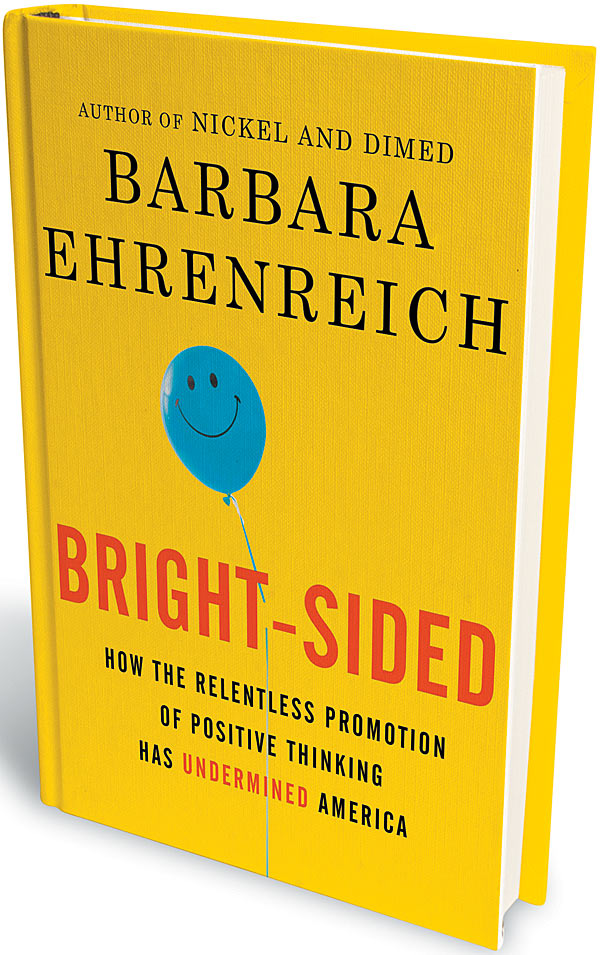
Positivity became the reigning attitudinal orthodoxy around the time of the ‘Reagan Revolution’, but it has its roots farther back in Calvinist theology. God rewards piety and hard work with success; failure, perforce, is evidence of sloth. Sidney Blumenthal once ironically summed up the mindset as ‘God takes most pleasure in people who are most pleased’. Reagan turned positivity into the central tenet of American civic religion. This also freed the New Right from the responsibility of caring for the destitute and vulnerable: if they aren’t doing well the fault must necessarily lie with them. It has come to a point, notes Barbara Ehrenreich in this excellent interview on Media Matters, that even people who lose their jobs are expected to be positive about it. Since a negative attitude will merely prove that their dismissal was justified.

As for illness, Tony Judt ends a recent essay about the torment of enduring nights while suffering from ALS thus: ‘Loss is loss, and nothing is gained by calling it by a nicer name. My nights are intriguing; but I could do without them.’


Continue reading “The Tyranny of Positivity”