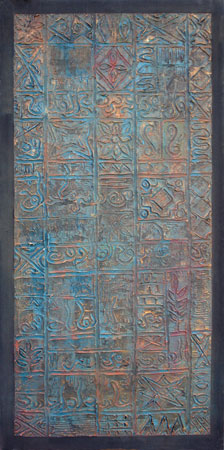
She

She
sits on the smaller square gravestone
throwing tiny pebbles of fine firestone
at me as she recites Quranic quatrains
after a pause that follows each throw.

She
looks at the azure horizon in the West
whispering of the agony in her hearts
one under her breast another in womb
after my plea for a midnight flight fails.

She
draws mud circles on the graveyard soil
calling each by a hundred names of God
each an invocation for my safe passage
after night falls and death comes for us.

She
leaves me standing on the grave of hope
moving towards a distant cliff in the dark
to end the two lives and a love despised
after she opts for shame rather than him.

JKS Makokha is a Kenyan writer living in Berlin, Germany. He is the author of Reading M.G. Vassanji: A Contextual Approach to Asian African Fiction (2009).  His poetry has been published in the Atonal Poetry Review, African Writing, The Journal of New Poetry and the Postcolonial Text and Stylus Poetry Journal.

The Veil, Again

Yes, some women who cover their heads smile, too.

Some strands of feminism have a long history of serving as adjuncts of Western imperialism. Today they also enable domestic prejudice. Gore Vidal once mocked George Bush’s idea of democracy promotion as being synonymous with: ‘Be free! Or I’ll kill you’. In a similar vein, some feminists today want to ‘liberate’ Arab-Muslim women by constraining their freedoms. These women can’t possibly know what they really want, you see. The European feminists, like Bush, know what’s best for them. What could my sister — who studied at a co-ed university (in Peshawar!) but turned to wearing the hijab after moving to Canada — know about her interests? She must be told by the enlightened Westerner. She must be liberated.

Ignorance and racism combine in this potent form of messianism to sanction prejudice which increasingly targets Europe’s immigrant communities. Like the Orientalists of yore, this brand of feminism insists on seeing the brown or black woman in the subordinate role, wistfully awaiting a Westerner liberator. They are childlike, they must be protected in the same manner that a responsible parent protects an unruly nestling. They must be saved from the hijab, or — God forbid! — the veil. To protect their freedom of choice, their freedom to choose must be revoked.

Continue reading “The Veil, Again”

Beyond the praise for Paul Kagame

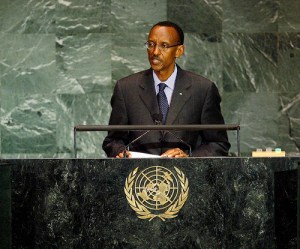
Rwandan Tutsi leader turned President Paul Kagame is a popular man in the West. And why not? In his ten years in office he has lead his war-ravaged nation through a period of unprecedented economic growth which has turned Rwanda into a playground for foreign investors. At the same time, he emphasizes self-reliance and efficient government while supporting populist spending programs that could make Rwanda the only African nation to meet the UN Millennium Development Goals (not that he is a fan of the UN, which he frequently criticizes for its response to the 1994 civil war). His administration in Kigali has admittedly wracked up a deficit that would ordinarily draw frowns from World Bank bureaucrats but in the case of Rwanda, the organization that usually demands drastic budget cuts is underwriting a litany of government programs. It helps that some of Kagame’s greatest admirers are Bill Clinton, Tony Blair, and Starbucks magnate Howard Schultz (1). American evangelist Rick Warren (2) considers him something of an inspiration and even Bill Gates has invested in what has been called Africa’s success story. Yes, Western liberals, reactionary evangelicals, and capitalist carpetbaggers alike tout Paul Kagame as the herald of a new, self-reliant African prosperity.

Continue reading “Beyond the praise for Paul Kagame”

And they call this man eloquent…

‘The middle east is obviously an issue that has plagued… the region… for … centuries.’

It appears the word ‘occupation’ is not a part of this blathering milquetoast’s vocabulary. (Kudos to the courageous questioner, who, I am told, was Laila Abdelaziz of the University of South Florida.)

The person he reminded me most of was this:

“One Thousand Tents for Haiti”

By Joe Shansky

As the extent of the destruction in Haiti becomes clearer, so do the priorities on the ground.  The majority of Haitians affected by the earthquake are now homeless, and the need for shelter is urgent.  There are many ways to help for those who cannot afford to donate money, and innovation has become a major theme in many of the smaller grassroots efforts.

One example is a US-based initiative whose mission lies in the name, “One Thousand Tents for Haiti”.  Created by Seattle activist Johnny Fernandes, the beauty of the project is that it is both simple and practical.  Anyone can participate.  The initial goal is to collect 1000 extra tents from around the US by the end of February to send to Haiti.

Continue reading ““One Thousand Tents for Haiti””

Oprah’s Neoliberal Empire

Following on from last week’s discussion about the tyranny of positive thinking here is Janice Peck, author of the excellent The Age of Oprah: The Making of a Cultural Icon for the Neoliberal Era speaks about the place of Oprah Winfrey’s media enterprise in the last quarter century of U.S. culture and politics. The first interview was conducted by Bruce Dixon of Black Agenda Report, the latter by Bob McChesney of Media Matters. (Update: The first mp3 appears to have vanished from the internet. I have reproduced a transcript of Dixon’s interview with Peck below).

(Also don’t miss the excellent piece, ‘The selling of “Precious”‘ by Ishmael Reed.)

Janice Peck  Associate Professor at the University of Colorado, her research interests include critical theory, the relationship of media and society, the social meanings and political implications of mediated popular culture, communication history and theories of media and culture. She has also authored a book on the history and politics of religious television in the U.S.,The Gods of Televangelism: The Crisis of Meaning and the Appeal of Religious Television (1993).  She has published articles and book chapters on the theoretical and intellectual history of cultural studies, issues in media theory, the family and television, TV talk shows, Oprah’s Book Club and issues of literacy, religion and advertising, and representations of race in media.

Continue reading “Oprah’s Neoliberal Empire”

Mohammed Khatib, Coordinator of West Bank Popular Committee Arrested

From the Popular Struggle website:

Mohammed Khatib during a speaking his speaking tour in Canada last year. Pictures Credit: Tadamon!

In the highest profile arrest of the recent wave of repression against West Bank popular struggle, Israeli soldiers arrested Mohammed Khatib today before dawn. Khatib is a member of Popular Committee against the Wall and Settlement in the West Bank village of Bil’in and the coordinator of the Popular Struggle Coordination Committee.

At a quarter to two AM tonight, Mohammed Khatib, his wife Lamia and their four young children were woken up by Israeli soldiers storming their home, which was surrounded by a large military force. Once inside the house, the soldiers arrested Khatib, conducted a quick search and left the house.

Roughly half an hour after leaving the house, five military jeeps surrounded the house again, and six soldiers forced their way into the house again, where Khatib’s children sat in terror, and conducted another, very thorough search of the premises, without showing a search warrant. During the search, Khatib’s phone and many documents were seized, including papers from Bil’in’s legal procedures in the Israel High Court.

Continue reading “Mohammed Khatib, Coordinator of West Bank Popular Committee Arrested”

The Conquest of Cool II

Douglas Rushkoff was once an enthusiast of the revolutionary potential of cyberculture. During the ’90s the increasing conglomeration of the internet business led him to temper his enthusiasm. But I think his prophecies had more substance than he was given credit for. The internet truly came into its own with Web 2.0 technologies and from blogging to Twitter, its true democratizing potential is only now being recognized. It has already succeeded to a certain degree in holding MSM accountable, though it hasn’t quite levelled the playing field as some optimists like to imagine.

Like Neil Postman, however, an important aspect of Ruskhkoff’s work has been the effect of media and advertising on culture. Every other year I teach an undergraduate course in Globalization and Resistance in which I show students this excellent documentary which Rushkoff made for PBS’s Frontline. It illustrates the ersatz nature of alternative culture, the process of its manufacture, in a manner than leaves many of them flabbergasted. It also illustrates the feedback loop through which businesses steal from youth the fruits of their creativity, stamp it with their label, mass produce it, and then sell it to everyone else until it has lost its ‘cool’ — much as Thomas Frank argued in The Conquest of Cool. As the culture degenerates, the ideal female and male types are reduced to the ‘midriff’ and the ‘mook’. (According to the BBC, two-thirds of all teenage females in the UK aspire to be models). Youths, as Rushkoff shows in The Merchants of Cool, have become one of corporate America’s largest sources of revenue.

Members of Congress sign letter urging Obama to stop the siege of Gaza

Some good news came out of Washington yesterday that went largely unnoticed. Ha’aretz reported 54 members of Congress sent a letter to president Barack Obama urging him to pressure Israel to end the siege on Gaza.  Ha’aretz correspondent Natasha Mozgovaya writes:

The letter was the initiative of Representatives Jim McDermott from Washington and Keith Ellison from Minnesota, both of whom are Democrats. Ellison is the first American Muslim to ever win election to Congress. McDermott and Ellison wrote that they understand the threats facing Israel and the ongoing Hamas terror activities against Israeli citizens but that “this concern must be addressed without resulting in the de facto collective punishment of the Palestinian residents of the Gaza Strip.” “We ask you to press for immediate relief for the citizens of Gaza as an urgent component of your broader Middle East peace efforts,” they wrote, adding that the siege has hampered the ability of aid agencies to do their work in Gaza. The congressmen urged Obama to pressure Israel to ease the movement of people into and out of Gaza, especially students, the sick, aid workers, journalists and those with family concerns, and also to allow the import of building materials to rebuild houses. Israel has warned that such materials would be used to rebuild Hamas infrastructure and not civilian homes.

Fifty-four members of Congress urging the president to pressure Israel to treat Gazans like human beings is a positive development, albeit a VERY small one.  Critics may content that the letter protects Israel’s image. I understand that. But I still think it’s encouraging.

Operation Cast Lead blew the lid off Israel’s rationale for the occupation and the congressional visits to Gaza have exposed to them what Gazans encounter on a day-to-day basis. More members of Congress need to do this.

Full text of the letter below.

Continue reading “Members of Congress sign letter urging Obama to stop the siege of Gaza”