Doing the Rounds

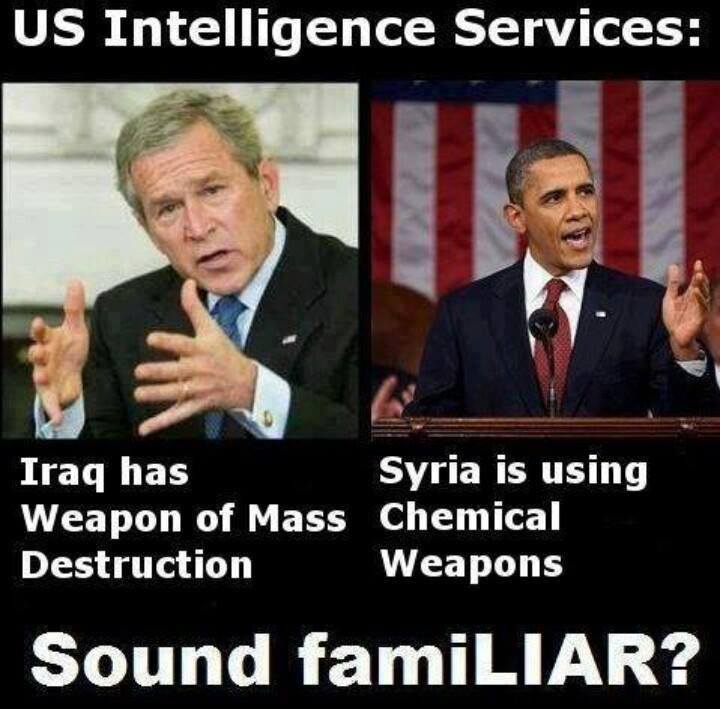
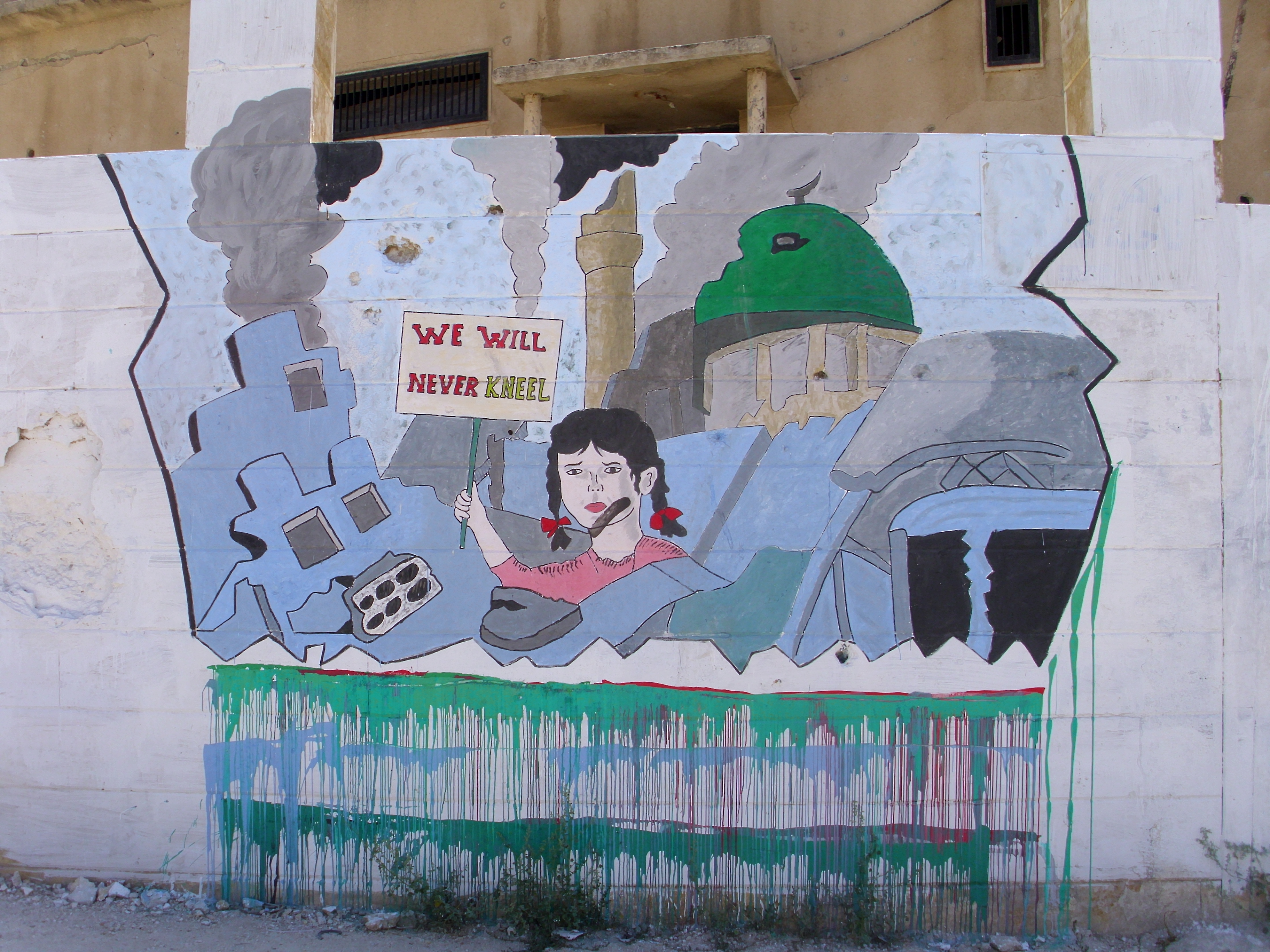
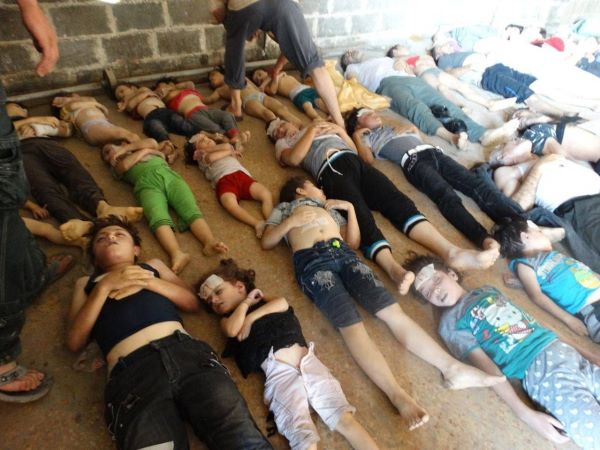
familiarSo much lazy thinking. Here’s an agit-prop picture doing the rounds, the sort to appeal to the George Galloway crowd. And here’s my comment: “Except it isn’t familiar. In one case they wanted to invade and used chemical weapons as an excuse. There were no chemical weapons. In the other case a genocide has been going on for over two years, they don’t want to invade, don’t even want to arm the people resisting, they don’t have the economic power or pliant international scene to do so even if they wanted; and chemical weapons not only exist, they have been used on a vast scale. Oppose potential US air attacks against Assad bases if you like, but don’t insult the victims of genocide while you’re doing it.”

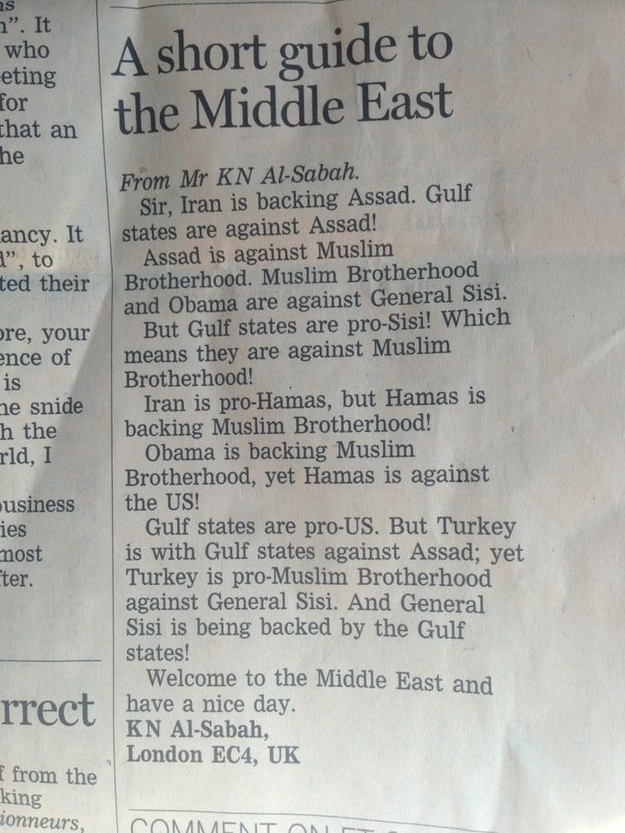
Another one doing the rounds is this supposedly very clever letter: short guideA Short Guide to the Middle East. And here’s Idrees’s response to that:

“To the hundreds of people who’ve been passing this fatuous bit of village-idiocy around, let me explain a few things:

1) States, like individuals, balance competing and contradictory interests. Like you, after two of your friends brawl, they don’t disown one to please the other.

2) States are not unitary, self-aware entities, whose interests are constant and indivisible. Like you, they carry in them multiple impulses and their attitudes towards others change based which impulses predominate under a given circumstance.

3) You might resent the tendency to treat the east as somehow exceptional and throw words like “orientalism” around, but like bad breath, you only notice it when others others have it. (Or perhaps the US is really a middle eastern country since it treated Communism as the ultimate evil but allied itself with Stalin to defeat Hitler; and then with right-wing Germans to defeat Communism. It was allied with France, yet supported Algerian independence. And so on ).

4) You have very little regard for facts. (Obama is anti-Sisi and is backing the Muslim Brotherhood? Really?)

5) Since you expect that states should be as one dimensional as Ayn Rand characters, you are unfit to comment on the Middle East or international affairs.”

Legitimizing A Military Occupation With Music: Zubin Mehta in Kashmir

It is most unfortunate that the German Embassy should seek to collaborate, perhaps unwittingly, with the Indian State in Kashmir, recognized as an international dispute by the United Nations and the international community, without any sensitivity to the aspirations of the people, or issues faced, or the machinations of the Indian State.

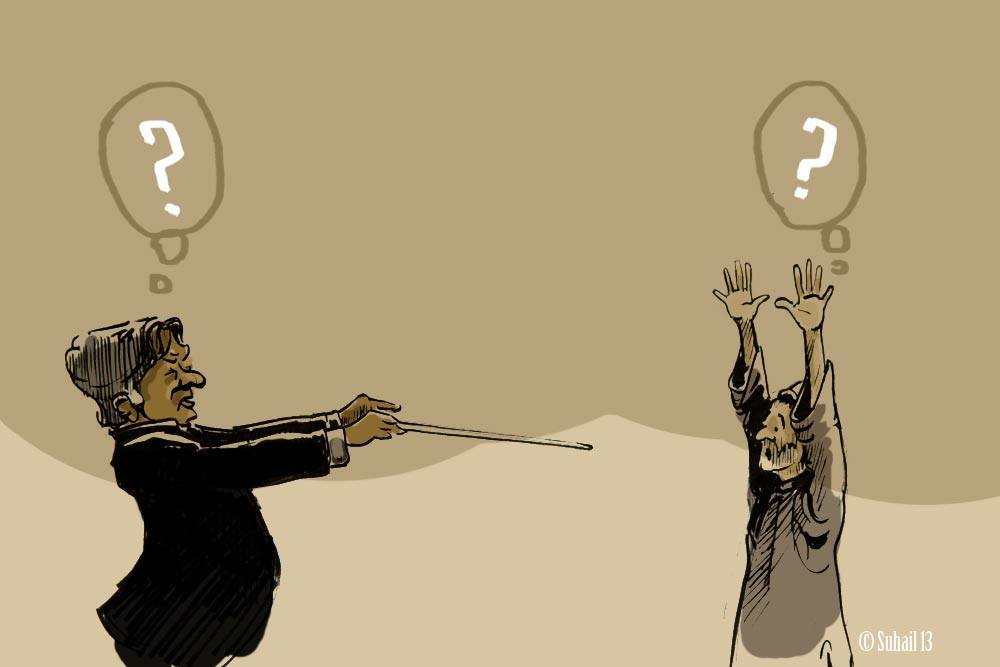
"Facing the Music!" by Suhail Hassan Naqshbandi
“Facing the Music!”

PLEASE SHARE WIDELY! Thanks!

26 August 2013

To
Ambassador Michael Steiner,
German Embassy,
New Delhi, India.

Subject: URGENT Protest Letter to German Embassy on scheduled Zubin Mehta concert in Srinagar, Jammu and Kashmir, on 7 September 2013

1. On 22 August 2013, a press release was issued by the German Embassy that Zubin Mehta would be conducting an orchestra on 7 September 2013 at Shalimar Bagh, Srinagar, Jammu and Kashmir.

2. The press release quoted you as stating that the concert was for the people of Jammu and Kashmir by way of a cultural tribute. The press release also reads that the concert was intended to give a message of hope and encouragement to the people of Jammu and Kashmir. The concert, said to be a part of a “broader engagement” is being organized by the German Embassy and supported by the “competent authorities both at Central as well as at Union State level.” The costs of the concert are covered by “benevolent sponsors mainly from the business world in India and Germany, as well as “Incredible India” and the German Foreign Office”.

3. The people of Jammu and Kashmir take immense pride in our rich history of resisting oppression. We also have historically cultivated a sublime tradition in, and love for, music. Music – which appeals to the higher truths of love, justice, dignity, and peace; which genuinely acknowledges the long suffering, and yet bravely resisting, Kashmiris; and which is performed for the actual public – is wholeheartedly welcomed. However, legitimizing an occupation via a musical concert is completely unacceptable. Art as propaganda, as abundantly documented, was put to horrific use in Nazi Germany. We are sure you will understand that we cannot welcome anything even remotely analogous in Jammu and Kashmir. Sadly, the occupation will be amply reflected in the demographics of the audience of the proposed concert – the list of “invitees only” is bound to be restricted to the members of the apparatuses of the Occupying State: from perpetrators of crimes, as heinous as murder, rape, and torture, to the local collaborators of the State and perhaps some powerless, vulnerable and compliant few. Continue reading “Legitimizing A Military Occupation With Music: Zubin Mehta in Kashmir”

Herzog: Cave Of Forgotten Dreams

Cave of Forgotten Dreams is a 2010 3D documentary film by Werner Herzog, about the Chauvet Cave, a cavern in southern France that contains the oldest human-painted images yet discovered, some as old as 32,000 years. The film premiered at the 2010 Toronto International Film Festival and consists of footage filmed inside the cave as well as interviews with various scientists and historians. The film also includes footage of the nearby Pont d’Arc natural bridge. Herzog is considered to be one of the most important film director alive. *

Herzog on the Cave of Forgotten Dreams

Cave of Forgotten Dreams [full]

Continue reading “Herzog: Cave Of Forgotten Dreams”

A Curse on Dostoevsky

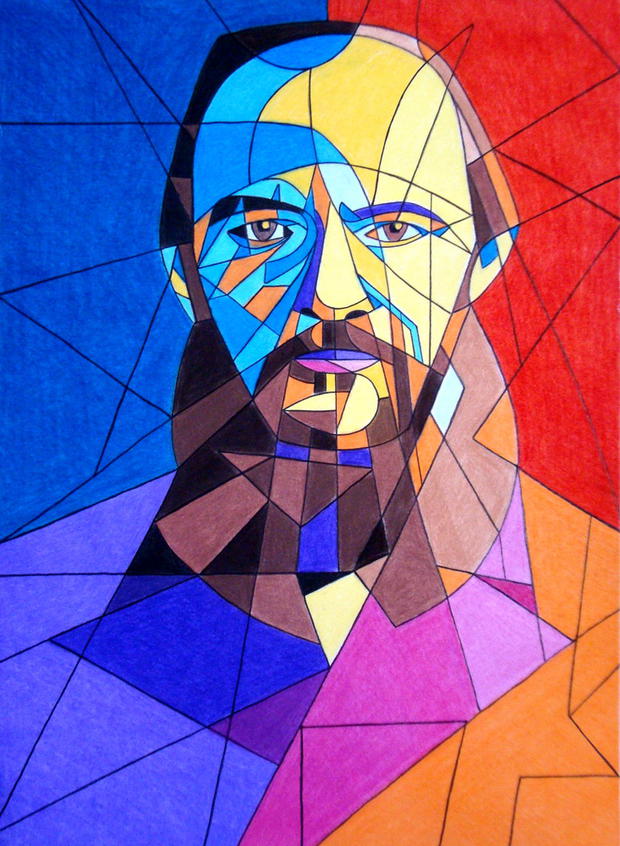
Andrey Volkok's Dostoevsky
Andrey Volkok’s Dostoevsky

This review was published at the Guardian. As so often, in places it’s been edited so it makes little sense and becomes clumsy. (Not a Guardian-specific problem, but a general problem with subeditors. I’ve never worked out why writers are paid to write, then non-writers are paid to mess up the writer’s writing.) Anyway, the unedited version is below.

As its title suggests, Atiq Rahimi’s “A Curse on Dostoevsky” puts itself in conversation with the great Russian writer, specifically with “Crime and Punishment”. Instead of Saint Petersburg, the action unfolds in Kabul. In place of Raskolnivok, Rassoul (though in his solipsism and misanthropy he may bear more resemblance to Dostoevsky’s underground man); in place of Sonia, Rassoul’s fiancee Sophia, a character who never quite comes into focus; and in place of the detective Porfiry, a series of commanders and militiamen. The murderee is, like Dostoevsky’s, a pawnbroker, also a landlady and a madam. Rassoul doesn’t know why he kills her, but potential motives include saving Sophia from her clutches, theft, and justice.

The text justifies its relationship with Dostoevsky’s novel thus: “This book is best read in Afghanistan, a land previously steeped in mysticism, where people have lost their sense of responsibility.” The murder of the pawnbroker sparks an investigation of crime and punishment (and law and lawlessness, sacrifice and vengeance) in Afghan society. Dostoevsky claimed that if God didn’t exist, everything would be permitted. Yet in Afghanistan God exists not to prevent sins but to justify them. Sophia’s father poisoned the director of the National Archives with counterfeit alcohol, a punishment for selling documents to the Russians. “These days,” he says, “any idiot thinks he can take the law into his own hands, with no investigation and trial. As I did then.” (The setting seems to be the period after the Russians and before the Taliban, when Islamist warlords struggled for power.)

According to the novel’s logic, Rassoul’s motto – “I’d rather be a murderer than a traitor” – could just as well be Afghanistan’s: “You can kill, rape, steal… the important thing is not to betray. Not to betray Allah, your clan, your country, your friend.” Yet the pages brim with real or perceived traitors, those who desert their friends for ideology or material gain.

Continue reading “A Curse on Dostoevsky”

Creative Community for Peace in Letter to Jose Feliciano: Healing with Music in Colonial Times, Building Bridges Over the Bodies of the Oppressed

Right: Jose Feliciano Left: Steve Schnur

Jose Feliciano is scheduled to perform in apartheid Israel on October 10, at Nokia Stadium. Already he’s being sent messages professing liberal language of equality and harmony for all, by that elite club for the endless cycle of war profiteering, whitewashing and violence, otherwise known as “Creative Community for Peace” (CCfP). Creative Community for Peace is a specialist in apartheid PR. They’re mere existence is about diverting attention from Israel’s systematic daily war crimes against the Palestinian population under its control, by abusing the word “Peace” and shooting the messenger- Boycott, Divestment and Sanctions activists (BDS), who connect the dots between Israel’s image of itself and the reality of its erasure of the Palestinian narrative and people.

Unfortunately, Jose Feliciano, for the time being, endorses the “Creative Community for Peace” statement that has been sent to him, and has posted it on the website. Continue reading “Creative Community for Peace in Letter to Jose Feliciano: Healing with Music in Colonial Times, Building Bridges Over the Bodies of the Oppressed”

Letter to John Baron MP

john baronBehind the scenes at Newsnight, John Baron MP said to me, “If you put your emotions aside, for the sake of containment, wouldn’t it be better if Assad won?” I wrote him the following response. As he hasn’t responded, I’m making it public. (To John Baron’s credit, he was one of the few Tories to oppose the invasion of Iraq and the occupation of Afghanistan).

We met at the BBC Newsnight debate on Syria. I think you gave me a card, which I promptly lost. I hope you find this message.

I’m taking the liberty of sending you my latest article concerning sectarian readings of the Syrian situation (my other stuff is on the same blog) as well as something by the secular intellectual Yassin al-Haj Saleh which presents a case better than I could.

As for your question, wouldn’t it be better for containment if Assad were to win? here’s a slightly fuller answer.

Assad can’t win completely, even with continuing solid support from Russia, Iran and Iran’s Iraqi and Lebanese clients, because the opposition has numbers on its side (and secondarily because Saudi weapons will continue to come in). If things go on as they are, a much more likely medium term result is the splintering of the country into zones of destabilisation:

1. a regime/Alawi zone between Damascus and the coast bridged by Homs, which will involve a massive ethnic cleansing of Sunnis from the Homs area (the regime has already burnt the land registry) and probably from the coastal cities too. The blowback from this probable future may well catalyse the sectarian mass slaughter of civilians which hasn’t yet happened from the opposition’s side. As I said in the green room, Assad’s rump state would be in effect Iran’s state (as opposed to Iran’s ally, which Syria was before 2011), beholden to Iran, because it’s Iran and its clients who are directing the regime fightback now. The risk is high that Iran will use Syria as a proxy front for its war with Israel in the same way that Syria once used Lebanon. And while Iran already ‘has’ Lebanon, Hizbullah is forced to deal with other groups in Lebanese politics. Control of a straightforward military/sectarian dictatorship, and a bigger country, is much more of a prize for Iran. I’m no friend of Israel, but America and Britain generally are, so it’s surprising to see all concerned ignoring the emergence of a greater strategic threat to the status quo than Iran’s nuclear programme (if they actually believe their rhetoric of Iran posing a threat to Israel).

Continue reading “Letter to John Baron MP”

Politics not Theology

DSCI0206This was published by the National. If you’d prefer to read my tense choices, before the subediting process, read this version here.

I live in Scotland, where I am witness to the continuing legacy of Protestant-Catholic communal hatred, despite the theological indifference and general irreligiosity of the populace.

The hatred is most commonly activated by the Rangers-Celtic football game. (In his great novel “Kieron Smith, Boy”, James Kelman brings it viscerally alive through the mouth of a Glaswegian child.) It is manifest too in Orange Order marches and schoolyard slurs. It intersects with the gang violence of the ‘schemes’. Most of the time, of course, it’s absent, or it emerges as friendly competitiveness rather than actual conflict, but you can bet your last communion wafer that it would blossom into something much fiercer if, in the event of political crisis, a divide-and-rule tyrant were to send Catholic militia in to pacify restive Protestant areas, or vice versa.

Like Scotland’s sectarians, Syria’s Alawis are usually largely secular and ignorant of their own theology (at least they were – a war-driven religious revival is touching them as well as the Sunnis). Over the last four decades Alawi religious scholars have been assassinated or otherwise silenced by the Assad regime as it sought to render the community entirely dependent on the Ba‘athist state. Most Alawis (by no means all) continue to support Assad because they have no other community leadership. Add to this that many have relatives working in the security forces, and so fear a loss of privileges and even violent revenge when the regime falls. Alawis also remember their historical marginalisation by the Sunni majority, and therefore fear majority rule.

As in Iraq, Palestine-Israel, or Northern Ireland, the conflict in Syria is not about theology but about group fears and resentments. Ultimately, it’s about power. Communal tensions are the result not of ancient enmities but of contemporary political machinations. And nothing is fixed in time. Syria’s supposedly ‘Sunni rebellion’ (which contains activists and fighters of all sects) becomes more or less Islamist in response to rapidly-changing political realities. A few months ago, for example, Islamist black flags dominated demonstrations in Raqqa, in the east of the country; now Raqqa’s demonstrations are as likely to protest Jabhat an-Nusra, the extremist militia which nominally controls the city, as the regime. This isn’t an Islamist rebellion but a popular revolution. As in Egypt, if the Islamists oppress the people or fail to deliver, they too will be revolted against.

Continue reading “Politics not Theology”

Journey to Kafranbel

This account of my trip into Syria’s partially liberated Idlib province was published by the Guardian.

DSCI0172To cross the border I had to climb a wall three times my height. It was the most frightening part of my trip into liberated Syria.

At Atmeh camp (where I’d been working, just inside Syria on the Turkish border) there’s no passport control but only a gap in the barbed wire. On the day of our journey, however, the Free Syrian Army and PKK-linked Kurds were facing off nearby and the Turkish authorities blocked access as a result. This meant we had to go through the official border at Bab al-Hawa. Two of our party possessed Syrian passports, and were waved through. Two of us didn’t, and so were smuggled across by Kurdish teenagers.

We skirted a deserted shack which our escorts pretended was a policeman’s house. One disappeared for a while, pretending to pay an expensive bribe. Our winding path led through a red-soiled olive grove, far away from the border post, but then wound back towards it, and to the wall. I could see the backs of soldiers through the trees, smoking not patrolling.

There were no security cameras. The boys told me they’d taken Chechens across like this.

At wallside a whispered negotiation ensued. We soon haggled a price for their service. The next part was more difficult – They wanted us to scale the wall into what was obviously still the Turkish border post.

I looked at my fellow smugglee. “Do you believe this?” I asked in English.

“I don’t know. Talk to them some more.”

So it went on, until at last Abdullah, one of our hosts inside Syria, phoned to advise me to do as the boys said.

So I climbed too fast for vertigo to strike, scissored my legs over the railings, dropped onto concrete, rolled, picked myself up, then endeavoured to walk across the neatly-trimmed lawn with a nonchalant but entitled and entirely legal air. I strolled through the airconditioned duty free zone and rejoined my companions to wait for the bus through no-man’s-land. (No private cars have been allowed here since a car bombing in February killed thirteen). Sitting in front of me on the bus: a fattish version of Che Guevara, in curls, beard and black beret, but with nogodbutgod printed on the beret.

Continue reading “Journey to Kafranbel”