The genius of an oeuvre is measured by the breadth of its message – Avatar as not “just another war movie”

by Kim Bizzarri

Following last night’s choice of the Oscars’ jury to award Katherine Bigelow’s The Hurt Locker with the Best Picture prize, the debate has since then moved to the pubs and the ether. It appears to be primarily concerned with whether Bigelow’s portrait of “the” war does justice to the genre and whether, with time, Avatar will come to be recognised as more deserving of the aspired title. The debate however is having the effect of reducing Cameron’s gargantuan critique of modernity to “just another war movie”, adding to the already popular dismissal of the film, by the intellectual left, as a western guilt-fantasy. 

Lets start by considering the assumption that Avatar is “just another war movie”.  

If indeed we accept that Cameron’s intention was to provide us with a science-fictional portrait of war, then we must also conclude that von Trier’s Dogville is nothing more than an aesthetically minimalist representation of the Great Depression. Just as von Trier exploits the Great Depression as a historical backdrop against which he develops a provocative portrayal of human nature, so does Cameron in the use he makes of military intervention in Avatar.  
Continue reading “The genius of an oeuvre is measured by the breadth of its message – Avatar as not “just another war movie””

The Only Democracy in the Middle East: 5.3.2010

In the village of Nebi Salah, 14 year old Ehab Fadel Beir Ghouthi from Beit Rima was shot with a rubber-coated steel bullet in the head. He was taken to a hospital where he underwent emergency surgery and is currently in a coma.

Israeli army shoots live ammunition at Ni’lin village:

Continue reading “The Only Democracy in the Middle East: 5.3.2010”

Will the Afghan Surge Succeed?

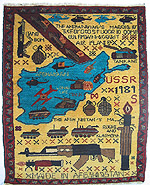
Soviet Exodus War Rug

M. Shahid Alam

More than eight years after dismantling the Taliban, the United States is still mired in Afghanistan. Indeed, last October it launched a much-hyped ‘surge’ to prevent a second Taliban takeover of Afghanistan, not imminent yet, but eminently possible.

The first dismantling of the Taliban was a cakewalk.

In 2001, the United States quickly and decisively defeated the Taliban, killed, captured or scattered their fighters, and handed over the running of Afghanistan to their rivals, mostly Uzbeks and Tajiks from the Northern Alliance.

Unaware of Pashtoon history, American commentators were pleased at the smashing victory of their military, convinced that they had consigned the Taliban to history’s graveyard.

Instead, the Taliban came back from the dead. Within months of their near-total destruction, they had regained morale, regrouped, organized, trained, and returned to fight what they saw as a foreign occupation of their country. Slowly, tenaciously they continued to build on their gains, and by 2008 they were dreaming of taking back the country they had lost in 2001.

Could this really happen? That only time will tell, but prospects for the Taliban today look better than at any time since November 2001.

Continue reading “Will the Afghan Surge Succeed?”

Finkelstein in Prague

Last week, Norman Finkelstein delivered a series of lectures in Prague as part of his European speaking tour. Finkelstein was initially invited to speak at the prestigious Czech Academy of Sciences but had his invitation revoked less than 24 hours prior to his scheduled talk, allegedly at the behest of the Prime Minister’s office. A similar fate befell Finkelstein’s appearance in Munich and Berlin, where the Heinrich Boll and Rosa Luxembourg Foundations cancelled the events, following “a concerted campaign by neoconservative and pro-Israeli pressure groups, such as Honestly Concerned and BAK Shalom, known for their unconditional support of Israeli policies and the defamation of critics as anti-Semites.”

Here is Finkelstein’s lecture at Casa Gelmi in Prague, organised by the Czech pro-Palestinian group ‘Friends of Palestine’.

Continue reading “Finkelstein in Prague”

Taher, a UCI protester originally from Gaza, writes that heckling Oren was right

Taher Herzalla is a third-year political science major at UC Riverside and was part of the “Irvine 11” that protested Michael Oren’s recent address. Taher is himself originally from Gaza and has been directly affected by the hafrada regime’s brutality. He had this piece published in the Orange County Register: be sure to write to the editor or leave a quick comment to thank them for publishing it. Check out their blog, Stand with the Eleven and spread their Stand With the Eleven action flyer.

Today, our American civil rights movement is praised worldwide for its humanism, righteousness, and courage. But, it was not always this way.

The same leaders we now hold in high esteem were once labeled as rabble-rousers for their principled and unpopular stands. It is no surprise then, that those who stand today against one of the greatest injustices of our time are similarly labeled. I am in a worldwide movement advocating for the indigenous Palestinian population and opposing the apartheid policies of Israel. The United Nations has condemned Israeli actions with more resolutions than any other nation.

I know the pain of Israel’s brutal military tactics firsthand. Three members of my immediate family were killed in Gaza last year during “Operation Cast Lead,” in which more than 1,400 Palestinians were killed and more than 5,300 wounded.

Continue reading “Taher, a UCI protester originally from Gaza, writes that heckling Oren was right”

How Western anti-Muslim bigotry became respectable

The Real News on the historic roots of the resilient ideology of Islamophobia.

What future for capitalism?

From New York to Dubai and Bangladesh, Empire looks at the impact of US-style capitalism and asks: What does the future hold for crony capitalism? And what are the alternatives to neo-liberal globalisation?

Joseph Stiglitz and our friend Tariq Ali on Al Jazeera’s Empire.

Continue reading “What future for capitalism?”

Europe’s Alliance with Israel

by David Cronin

Avigdor Lieberman meets Javier Soalan who has described Israel as a 'member of the European Union without being a member of its institutions.'

One of the pitfalls of specialising in European politics, as I have for the past 15 years, is that certain assumptions become hardwired in your brain.  For a long time, my critical faculties shut down when I heard senior EU representatives speak of the Middle East. I happily accepted the official narrative that they were striving for a just resolution to the conflict between Israel and the Palestinians and that it would be foolish to park the so-called peace process in a “blood-soaked lay-by”, in the words of former EU commissioner Chris Patten.

Israel’s attacks on Lebanon in 2006 and on Gaza just over a year ago illustrated how naive and gullible I had been. In the first instance, Tony Blair blocked the EU from formally calling for a ceasefire because he wanted Israel to be given whatever space it perceived necessary to fight Hezbollah (Israel’s slaughter of Lebanese civilians in that 33-day war elicited no more than statements of “regret” from London).

It is true that the Union did urge a halt to the violence that Israel inflicted on Gaza’s 1.5 million inhabitants in late 2008 and early 2009. Yet by describing that attack as “disproportionate”, key EU representatives implicitly approved the Israeli version of events – that everything had been provoked by the missiles Hamas was firing on the southern Israeli towns of Ashkelon and Sderot. “Gaza was a crisis waiting to happen,” Marc Otte, the Union’s Middle East envoy, told me. “Do you think the Palestinians could continue to launch rockets on Israel without Israel reacting?”

Continue reading “Europe’s Alliance with Israel”

A Struggler in Context

An edited version of this review appeared at the Electronic Intifada.

“From afar,” writes Ramzy Baroud (founder of the indispensable Palestine Chronicle), “Gaza’s reality, like that of all of Palestine, is often presented without cohesion, without proper context; accounts of real life in Gaza are marred with tired assumptions and misrepresentations that deprive the depicted humans of their names, identities and very dignity.”

Baroud’s “My Father was a Freedom Fighter” is an antidote to the media’s decontextualisation and dehumanisation of Palestinians. It’s also an instant classic, one of the very best books to have examined the Palestinian tragedy.

As the title suggests, Baroud relates the life of his father, Mohammed Baroud. Each step in the story is located in a larger familial, social, economic and political context, one distinguished by eyewitness accounts and made concrete by an almost encyclopedic wealth of detail. But neither the book’s detail nor its deep reflection conflict with its compulsive readability. It’s quite an achievement.

Continue reading “A Struggler in Context”

In the Shadow of Power

Washington, DC is the most powerful capital city in the world. But it’s also a city that is deeply divided between a wealthy and extremely influential minority and an impoverished and largely disenfranchised African American majority. The seat of global power is also home to a population that remains largely invisible to the politicians, journalists, lawyers, lobbyists and contractors around Capitol Hill. This other Washington, DC maintains the dubious distinction of having the highest rate of child poverty, the highest mortality rate from HIV/AIDS, and the lowest life expectancy in the country.

Kike Arnal on his superb new book of photography, In the Shadow of Power, with an inroduction by Ralph Nader.