Evidence of WMD found in Iraq: The tragic legacy of Depleted Uranium

by Steven Harkins

Conspiracy theories exist in ‘the realm of myth’, where ‘imaginations run wild, fears trump facts, and evidence is ignored’ [i]. This is according to a website created by the US State Department to debunk a range of outlandish conspiracy theories.

Among the theories criticized on the website are conspiracies regarding the assassination of JFK, the moon landings, and the September 11th attacks [ii]. Alongside these well-known sources of wild speculation is the subject of depleted uranium (DU). The website states:

Uranium evokes very powerful fears. It is associated with atomic weapons, mass annihilation, radiation sickness, cancer and birth defects. Depleted uranium evokes these same fears, despite the fact that it has been depleted of much of its radioactivity. Fear-based associations can be more powerful than logic and facts. Compare how you feel about tungsten to how you feel about depleted uranium. Both are heavy metals, but “depleted uranium” might sound scarier to you [iii].

So the US State Department argue that when it comes to conspiracy theories ‘evidence is ignored’ and that it is ‘fear-based associations’ and not ‘logic and facts’ that have caused people to make a connection between birth defects, cancer and depleted uranium.

Continue reading “Evidence of WMD found in Iraq: The tragic legacy of Depleted Uranium”

Thousands join Kashmir protests

Tens of thousands of people across Indian-administered Kashmir have joined protests against Indian rule in the Himalayan region. The Indian police has been battling to contain demonstrations for months, ignited by the killing of a 17-year-old student by police in June.

Al Jazeera’s Nilanjan Chowdhury reports.

Lauren Booth’s Open Letter To Israel

Free Gaza’s Lauren Booth has an open video letter to the people of Israel.

Continue reading “Lauren Booth’s Open Letter To Israel”

Anthony Lawson: BBC Bias on the Gaza Freedom Flotilla

Continue reading “Anthony Lawson: BBC Bias on the Gaza Freedom Flotilla”

Mozambique’s Food Riots – the True Face of Global Warming

Thirteen people were killed and hundreds wounded last week in Mozambique when police cracked down on a three-day protest over a 30 percent hike in the price of bread. The UN says the riots in Mozambique should be a wake-up call for governments that have ignored food security problems since the global food crisis of 2008, when countries around the world saw angry protests in the streets over the rising prices of basic food items. In this extremely informative interview on Democracy Now!, Raj Patel connects the dots between climate change, financial speculation, land grabs across Africa, food sovereignity and global hunger.

Also check out Johann Hari’s recent article on the “speculation-starvation-bubble” behind the 2008 global ‘food crisis’, below the fold.

Continue reading “Mozambique’s Food Riots – the True Face of Global Warming”

Ahmed Rashid’s Strange Plan

by Tariq Ali

Ahmed Rashid: Pentagon's man in Pakistan

A few days ago, the West’s favorite Pakistani journalist, Ahmed Rashid, wrote a ‘guest column’ on the BBC website in which he suggested that the Afghan governance model be transferred to Pakistan:

Pakistan’s Reconstruction Trust Fund could be run by a board that included the World Bank, other international lending agencies and independent and prominent Pakistani economists and social welfare figures with no ties to the government.

Pakistanis would still take all the major decisions, but those who did so would not be the cronies of the president, the PM or the opposition leaders.Pakistan’s finance bureaucracy and army would have seats at the table, but certainly no veto powers over how the money is spent.

Their job would be impartial implementation of recovery overseen by the Trust Fund. Such a fund would not just monitor the cash, but help the government put together a non-political, neutral reconstruction effort. It would also help plan long-term economic reforms….

The notion that that the World Bank, IMF and friends are ‘non-political’ and ‘neutral’ is risible and not worth wasting time on, especially given that their supervision of Afghanistan’s largest bank (largely owned and controlled by the Karzai family and just as corrupt as Zardari and his cronies) doesn’t seem to have been all that effective since it collapsed just as the BBC website published the path-breaking text.

Continue reading “Ahmed Rashid’s Strange Plan”

Moment of Silence

by Emmanuel Ortiz

Before I start this poem,
I’d like to ask you to join me
In a moment of silence
In honor of those who died in the World Trade Center and the
Pentagon last September 11th.

I would also like to ask you
To offer up a moment of silence
For all of those who have been harassed, imprisoned,
disappeared, tortured, raped, or killed in retaliation for those strikes
For the victims in both Afghanistan and the U.S.

And if I could just add one more thing…
A full day of silence
For the tens of thousands of Palestinians who have died at the
hands of U.S.-backed Israeli
forces over decades of occupation.
Six months of silence for the million and-a-half Iraqi people,
mostly children, who have died of
malnourishment or starvation as a result of an 11-year U.S.
embargo against the country.

Before I begin this poem,
Two months of silence for the Blacks under Apartheid in South Africa,
Where homeland security made them aliens in their own country.
Nine months of silence for the dead in Hiroshima and Nagasaki,
Where death rained down and peeled back every layer of
concrete, steel, earth and skin
And the survivors went on as if alive.
A year of silence for the millions of dead in Vietnam – a people,
not a war – for those who
know a thing or two about the scent of burning fuel, their
relatives’ bones buried in it, their babies born of it.
A year of silence for the dead in Cambodia and Laos, victims of
a secret war … ssssshhhhh….
Say nothing
we don’t want them to learn that they are dead.
Two months of silence for the decades of dead in Colombia,
Whose names, like the corpses they once represented,
have piled up and slipped off our tongues.

Continue reading “Moment of Silence”

The Indefensible Drones: A Ground Zero Reflection

by Kathy Kelly

The survivor of a drone attack in Pakistan

Libby and Jerica are in the front seat of the Prius, and Mary and I are in back.  We just left Oklahoma, we’re heading into Shamrock, Texas, and tomorrow we’ll be Indian Springs, Nevada, home of Creech Air Force Base.  We’ve been discussing our legal defense.

The state of Nevada has charged Libby and me, along with twelve others, with criminal trespass onto the base.  On April 9, 2009, after a ten-day vigil outside the air force base, we entered it with a letter we wanted to circulate among the base personnel, describing our opposition to a massive targeted assassination program. Our trial date is set for September 14.

Creech is one of several homes of the U.S. military’s aerial drone program.  U.S. Air Force personnel there pilot surveillance and combat drones, unmanned aerial vehicles with which they are instructed to carry out extrajudicial killings in Afghanistan and Iraq.  The different kinds of drone include the “Predator” and the “Reaper.” The Obama administration favors a combination of drone attacks and Joint Special Operations raids to pursue its stated goal of eliminating whatever Al Qaeda presence exists in these countries.  As the U.S. accelerates this campaign, we hear from UN special rapporteur for extrajudicial executions, Philip Alston, who suggests that U.S. citizens may be asleep at the wheel, oblivious to clear violations of international law which we have real obligations to prevent (or at the very least discuss).  Many citizens are now focused on the anniversary of September 11th and the controversy over whether an Islamic Center should be built near Ground Zero.  Corporate media does little to help ordinary U.S. people understand that the drones which hover over potential targets in Afghanistan, Pakistan and Yemen create small “ground zeroes” in multiple locales on an everyday basis.

Continue reading “The Indefensible Drones: A Ground Zero Reflection”

Islamophobia is Bad—Only Because Occupying Muslims is Good

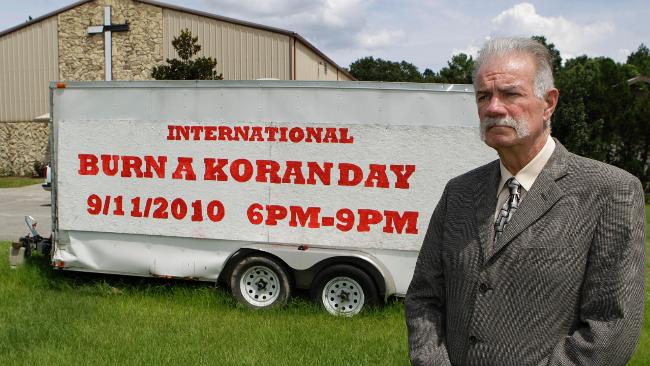
Pastor Terry Jones plans to hold a Koran burning to mark the September 11 terror attacks, despite warnings it would incite more violence (Photo: AP)

by M. Junaid Levesque-Alam

At this point, it’s not even clear whether Jones will go ahead with his pyrotechnics, but the lesson still stands.

Animosity toward Islam has reached such extremes in America that officialdom only rallies against anti-Muslim invective if it interferes with its warring on Muslim countries.

Perhaps it’s just the skeptic and former journalist in me, but that’s my impression as I review the recent blow-up about the planned September 11th Qur’an bonfire.

Terry Jones, the pastor of the tiny Florida church that may conduct the book-burning, has garnered endless—and doubtless desired—attention from media outlets as military commanders and administration officials fret over the fallout of his obscene reimagination of Farenheit 451.

General Petreaus, who is rightly concerned for the welfare of the women and men under his command, warned that Jones’s actions “would undoubtedly be used by extremists in Afghanistan—and around the world—to inflame public opinion and incite violence.”

Petreaus’s pronouncements were followed by an equally onerous message from White House spokesman Robert Gibbs, who averred that any behavior “that puts our troops in harm’s way would be a concern to this administration.”

Continue reading “Islamophobia is Bad—Only Because Occupying Muslims is Good”

Islam and America’s Most Powerful Cult

by M. Junaid Levesque-Alam

In their spirited assault on Islam, conservatives have seized upon one notion with particular delight: the Abrahamic faith embraced by a quarter of humanity is a “cult.”

Tennessee Lt. Gov. Ron Ramsey popularized the claim in July when a constituent asked about the “threat that’s invading our country from Muslims”; Ramsey wondered aloud whether Islam “is actually a religion or is it a nationality, way of life or cult” and later asserted that “far too much of Islam has come to resemble a violent political philosophy more than peace-loving religion.” Soon after, some of Ramsey’s constituents set ablaze a planned mosque site near Nashville and fired shots when parishioners tried to inspect the damage.

Farther south, in Florida, Pastor Terry Jones proclaimed that Islam is not just a cult but a Satanic creation — hence his planned bonfire of Qur’ans. He is not alone among Floridians. Congressional candidate and retired Army officer Allen West announced earlier this year that Islam is “not a religion” but a “vicious enemy” intent on “infiltrating” America. Another candidate in the sunshine state, Ron McNeil, described Islam as a malicious plot to “destroy our way of life.”

And in upstate New York this August, teenagers who viewed the local mosque as a “cult house” terrorized mosque-goers by blasting a shotgun and sideswiping a parishioner.

What accounts for this renewed alacrity in attacking Islam?

Continue reading “Islam and America’s Most Powerful Cult”