The genius of an oeuvre is measured by the breadth of its message – Avatar as not “just another war movie”

by Kim Bizzarri

Following last night’s choice of the Oscars’ jury to award Katherine Bigelow’s The Hurt Locker with the Best Picture prize, the debate has since then moved to the pubs and the ether. It appears to be primarily concerned with whether Bigelow’s portrait of “the” war does justice to the genre and whether, with time, Avatar will come to be recognised as more deserving of the aspired title. The debate however is having the effect of reducing Cameron’s gargantuan critique of modernity to “just another war movie”, adding to the already popular dismissal of the film, by the intellectual left, as a western guilt-fantasy. 

Lets start by considering the assumption that Avatar is “just another war movie”.  

If indeed we accept that Cameron’s intention was to provide us with a science-fictional portrait of war, then we must also conclude that von Trier’s Dogville is nothing more than an aesthetically minimalist representation of the Great Depression. Just as von Trier exploits the Great Depression as a historical backdrop against which he develops a provocative portrayal of human nature, so does Cameron in the use he makes of military intervention in Avatar.  

Continue reading “The genius of an oeuvre is measured by the breadth of its message – Avatar as not “just another war movie””

What future for capitalism?

From New York to Dubai and Bangladesh, Empire looks at the impact of US-style capitalism and asks: What does the future hold for crony capitalism? And what are the alternatives to neo-liberal globalisation?

Joseph Stiglitz and our friend Tariq Ali on Al Jazeera’s Empire.

Continue reading “What future for capitalism?”

Oprah’s Neoliberal Empire

Following on from last week’s discussion about the tyranny of positive thinking here is Janice Peck, author of the excellent The Age of Oprah: The Making of a Cultural Icon for the Neoliberal Era speaks about the place of Oprah Winfrey’s media enterprise in the last quarter century of U.S. culture and politics. The first interview was conducted by Bruce Dixon of Black Agenda Report, the latter by Bob McChesney of Media Matters. (Update: The first mp3 appears to have vanished from the internet. I have reproduced a transcript of Dixon’s interview with Peck below).

(Also don’t miss the excellent piece, ‘The selling of “Precious”‘ by Ishmael Reed.)

Janice Peck  Associate Professor at the University of Colorado, her research interests include critical theory, the relationship of media and society, the social meanings and political implications of mediated popular culture, communication history and theories of media and culture. She has also authored a book on the history and politics of religious television in the U.S.,The Gods of Televangelism: The Crisis of Meaning and the Appeal of Religious Television (1993).  She has published articles and book chapters on the theoretical and intellectual history of cultural studies, issues in media theory, the family and television, TV talk shows, Oprah’s Book Club and issues of literacy, religion and advertising, and representations of race in media.

Continue reading “Oprah’s Neoliberal Empire”

The Conquest of Cool II

Douglas Rushkoff was once an enthusiast of the revolutionary potential of cyberculture. During the ’90s the increasing conglomeration of the internet business led him to temper his enthusiasm. But I think his prophecies had more substance than he was given credit for. The internet truly came into its own with Web 2.0 technologies and from blogging to Twitter, its true democratizing potential is only now being recognized. It has already succeeded to a certain degree in holding MSM accountable, though it hasn’t quite levelled the playing field as some optimists like to imagine.

Like Neil Postman, however, an important aspect of Ruskhkoff’s work has been the effect of media and advertising on culture. Every other year I teach an undergraduate course in Globalization and Resistance in which I show students this excellent documentary which Rushkoff made for PBS’s Frontline. It illustrates the ersatz nature of alternative culture, the process of its manufacture, in a manner than leaves many of them flabbergasted. It also illustrates the feedback loop through which businesses steal from youth the fruits of their creativity, stamp it with their label, mass produce it, and then sell it to everyone else until it has lost its ‘cool’ — much as Thomas Frank argued in The Conquest of Cool. As the culture degenerates, the ideal female and male types are reduced to the ‘midriff’ and the ‘mook’. (According to the BBC, two-thirds of all teenage females in the UK aspire to be models). Youths, as Rushkoff shows in The Merchants of Cool, have become one of corporate America’s largest sources of revenue.

The Conquest of Cool I

When is dissent hip? This is the subject of the following discussion hosted by the excellent Your Call Radio. Participants include Douglas Haddow of Adbusters, whose article, ‘Hipster: The Dead End of Western Civilization‘, generated one of the longest running debates in the magazines history (the article presently records more than four thousand responses on the Adbusters website). Also participating are  Dan Sinker of Punk Planet, and journalist and hip-hop historian Davey D. They discuss: What is the relationship today between pop-culture, counterculture and dissent? What is the counterculture that sells media now? And can activists reclaim the counterculture that now permeates the mainstream?
The discussion is also joined later by Ishmael Reed and Thomas Frank, author of the splendid work The Conquest of Cool. In the book Frank (who also authored the classic What’s the Matter with Kansas? and edits The Baffler) shows that the advertising industry did not just co-opt the ’60s counterculture movement, in many respects it anticipated, indeed created, it. The instant-gratification individualism and the perpetual pursuit of uniqueness were the perfect compliments to capitalism’s manufacturing of needs to fuel the consumption on which it thrives. If capitalism had built planned obsolescence into its products,  the counterculture’s very idea of rebellion was premised on  ‘standing apart’. As soon as a new product was in the hands of more than one, it had lost its uniqueness, pushing the rebel to search for a new ticket to cool. Rebellion which seeks expression in merchandise manufactures its own needs, and the engines of capital obligingly hum along. Franks gives the example of the Volkswagen Beetle ads, which were all designed as a critique of mass culture. To own a Beetle, then, was to stand apart.  And the process continues as I’ll show in this series of three posts.

Worst decision since Dred Scott

The US Supreme Court has ruled that as a legal ‘person’ a corporation can spend unlimited amounts in an election campaign to elect its preferred candidates. The lax campaign financing rules already allowed lobby groups such as AIPAC to funnel massive amounts to candidates through individuals. Instead of reforming the system, as people like Ralph Nader have been demanding for years, the court further hacks away at democratic checks and balances. The ruling has been rightly compared to the Dred Scott case justifying slavery. Here is a clip of Robert Weissman summing up what consequences this might have for US democracy (to the extent that it exists) followed by a statement by Ralph Nader. (For Americans who want to save their democracy, here is a campaign they can join: http://www.movetoamend.org/. Also check out Public Citizen’s proposed action).

Continue reading “Worst decision since Dred Scott”

The Tyranny of Positivity

My friend’s childhood friend recently passed away after a painful bout with cancer. She was abandoned by her boyfriend because she was ‘too negative’ about her illness. A mutual friend of my friend’s also blamed the ailing woman for being too negative. If she couldn’t be positive about her disease, then she must in part have been responsible for her own decline. Or so the thinking goes.

If there is anything unique about this story, it is the nationality of the cast: they are Italian. In the United States, this is the norm. People who suffer from debilitating diseases are not only expected to endure the pain but also to put on a brave face. If they don’t, then friends can abandon them with a clear conscience. They just aren’t being positive, and hence are the architects of their own decline.

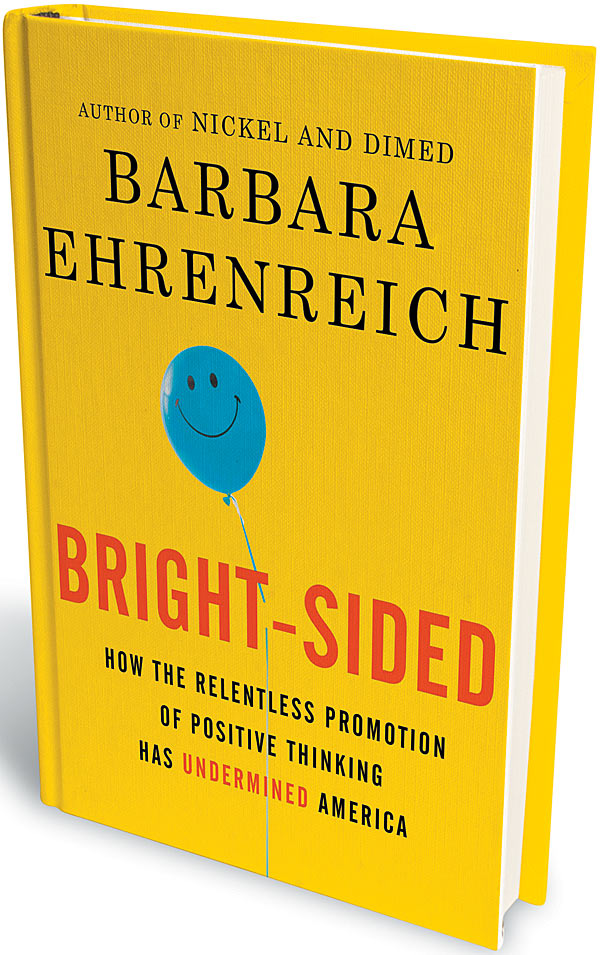
Positivity became the reigning attitudinal orthodoxy around the time of the ‘Reagan Revolution’, but it has its roots farther back in Calvinist theology. God rewards piety and hard work with success; failure, perforce, is evidence of sloth. Sidney Blumenthal once ironically summed up the mindset as ‘God takes most pleasure in people who are most pleased’. Reagan turned positivity into the central tenet of American civic religion. This also freed the New Right from the responsibility of caring for the destitute and vulnerable: if they aren’t doing well the fault must necessarily lie with them. It has come to a point, notes Barbara Ehrenreich in this excellent interview on Media Matters, that even people who lose their jobs are expected to be positive about it. Since a negative attitude will merely prove that their dismissal was justified.

As for illness, Tony Judt ends a recent essay about the torment of enduring nights while suffering from ALS thus: ‘Loss is loss, and nothing is gained by calling it by a nicer name. My nights are intriguing; but I could do without them.’


Continue reading “The Tyranny of Positivity”

Haiti and the Instruments of Death

This is how the ‘International Community’ (read the West) is responding to the tragedy in Haiti: still no aid, yet plenty of guns. US has taken control of the Port-au-Prince airport and according to Al Jazeera it is turning back aircraft with much needed aid from other nations.

Don’t miss Patrick Cockburn’s brilliant piece. Here are some highlights:

The rhetoric from Washington has been very different during these two disasters, but the outcome may be much the same. In both cases very little aid arrived at the time it was most needed and, in the case of Port-au-Prince, when people trapped under collapsed buildings were still alive…In New Orleans and Port-au-Prince there is the same official terror of looting by local people, so the first outside help to arrive is in the shape of armed troops. The US currently has 3,500 soldiers, 2,200 marines and 300 medical personnel on their way to Haiti…

A sour Haitian joke says that when a Haitian minister skims 15 per cent of aid money it is called “corruption” and when an NGO or aid agency takes 50 per cent it is called “overheads”…

Continue reading “Haiti and the Instruments of Death”

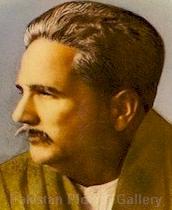
Iqbal, Is the Sky Yours or Mine?

Allama Iqbal
Muhammad Iqbal, 1877-1938, was a poet of Urdu and Farsi, philosopher, sufi, and revolutionary, who combined in his works the traditions of Al-Ghazzali, Rumi, Ibn-e-Khaldun, Ahmad Sirhindi and Shah Walilullah. While he understood the power of the West, had read the Western philosophers, and was familiar with the advances in physics, unlike Syed Ahmad Khan, he remained firmly rooted in Islamic tradition, and refused to re-examine the Islamicate through Orientalist texts. He was criticial of the West’s excessive emphasis on reason, its materialism, and the depredations of capitalism. Many decades before Frantz Fanon and Aime Cezaire, he was the deep thinker and stirring poet of self-discovery, urging peoples of color to regain their dignity, to dig deep into their own traditions in order to overcome, and transcend, the materialism, racism, excessive rationalism, and the West’s abuse of power and its own principles.

This ghazal is a translation from Wings of Gabriel, the best collection of Iqbal’s Urdu poetry. From time to time, I will be presenting translations from this collection.

اگر کج رو ہیں انجم آسمان تیرا ہے یا میرا

translation by M. Shahid Alam

If the stars are topsy-turvy: is the sky yours or mine?
Should this fret me? Is the world yours or mine?

If Heaven lacks the tug, the heat of love’s adventure,
Dear Lord, this cosmic enigma is yours: not mine.

On that first dawn of creation, how dared he to defy
Your decree. Was he your emissary: or was he mine?

Muhammad is yours, Gabriel and the Qur’an too.
But these melodic words: are they yours or mine?

It’s this star, scintillating, that lights your creation.
Whose loss is it – the fall of Man? Is it yours or mine?

— M. Shahid Alam is professor of economics at Northeastern University, Boston. He is author of Poverty from the Wealth of Nations (Macmillan: 2000), Challenging the New Orientalism (IPI: 2007), and Israeli Exceptionalism (Palgrave: 2009). You may reach him at alqalam02760@yahoo.com.

Imagining Radical Change with David Harvey & Alexander Cockburn

Vodpod videos no longer available.

Event description:

David Harvey, author of A Brief History of Neoliberalism, and Alexander Cockburn, author of End Times: The Death of the Fourth Estate, don’t think small when it comes to change. They aren’t afraid to think about significant, even radical changes to the social order we’ve grown so used to, whether it’s requiring full employment, reimagining urban living, or repudiating credit card debt and abolishing Wall Street speculation.

Continue reading “Imagining Radical Change with David Harvey & Alexander Cockburn”