Pakistan’s flood crisis is making the spread of disease a fast increasing problem and hospitals are struggling to cope with the sheer volume of affected people. Women and children, especially newborns, are suffering the most from malnourishment. Al Jazeera’s Jonah Hull reports from northwest Pakistan.
Jemima Khan has a must-read piece in the Sunday Times. Here’s an excerpt:
The death toll, amounting to 1,600 people, has, Alhamdulillah (praise to God), so far been low relative to the magnitude of the disaster facing Pakistan. Mostly, though, the stories are grim. My ex-husband Imran Khan, whom I spoke to after he visited flood-hit areas in the northwest, sounded uncharacteristically defeated; more so, I thought, than even after his cancer hospital was bombed in 1996. “Pakistan could implode, Jem,” he said. “We are already on the brink of bankruptcy. The poverty and the suffering will be unimaginable. Best not to send the children this weekend. There’s too much to do.”
In annexing Kashmir, Indian leaders put aside their progressive anti-colonialism, and pursued a policy that stood in direct confrontation with the goals of struggling Kashmiris. Nehru’s professed derision for princes and despots proved facile in Kashmir in this first real test of his commitment to anti-colonialism and democratic values. His decision to urge the discredited and runaway Dogra ruler to sign the imperial Instrument of Accession, and then accept it, was a defeat for the oppressed Kashmiris who had, with great sacrifices, forced the Dogra ruler out. By recognizing the authority of the Dogra ruler, Indian sovereignty over Kashmir simply replaced the sovereignty enshrined in the Dogra maharaja. But along with that sovereignty, India inherited Dogra rule’s illegitimacy as well.
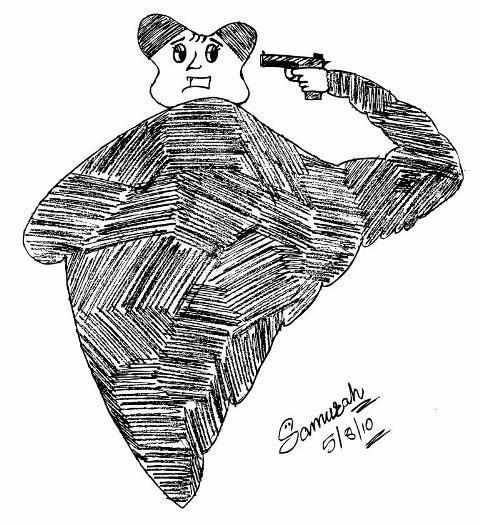
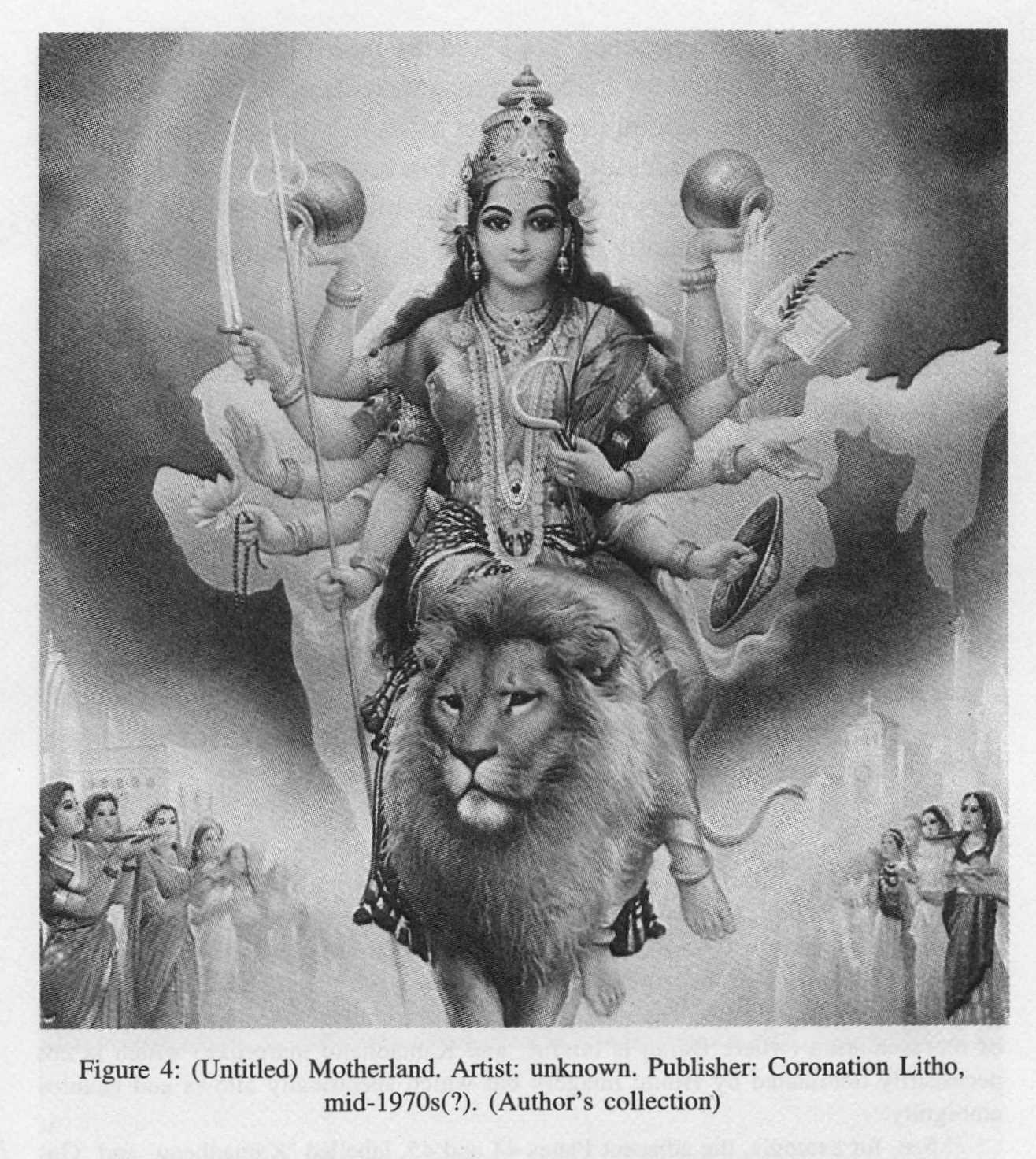
Untitled by Samurah Kashmiri, August 5, 2010Bharat Mata or Mother India
On 26 January 1992, Murli Manohar Joshi, the leader of the Hindu nationalist Bharatiya Janata Party, after travelling by road all the way from the southern tip of India, was airlifted from Jammu to the heart of Srinagar where he half-raised the Indian flag near historic Lal Chowk. All of Kashmir was put under severe curfew, and the army was given shoot-at-sight orders. Throughout the day soldiers shot dead more than a dozen Kashmiris in the streets of Srinagar. Over the previous two years, the Indian government had unleashed a reign of terror on the people, with massacre upon massacre of unarmed protestors dotting Kashmir’s timeline. Joshi’s Ekta Yatra (Unity March), protected and provided of full support by the Indian government, was an important reminder of the nature of the Indian state and the relationship it sought with the people of Kashmir. The event was designed to put on display the majoritarian character of Indian nationhood, and line up power of the state behind it to send barely coded messages to audiences in India and in Kashmir.
The death toll from Pakistan’s worst flood in living memory has exceeded 1,100. It is estimated that over 27,000 people are still trapped, and approximately 1.5 million people have been affected by the flow of waters that continue to wash away villages and trigger devastating landslides in Khyber-Pakhtoonkhwa and parts of Punjab.
“Azadi” is also the chant whose echoes swirl in the Kashmir Valley with greater resonance each day, from the minarets and playgrounds, boulevards and alleys, schools and courts, despite the crushing screeches of teargas and bullets of the Indian (in)security forces. It is “scriptured” into utterance by each breath of Kashmiri women, children, and men; calligraphed by their blood on their emerald valley; embroidered by their bones in Kashmiri Arabesque on worn cobblestones of the downtown; and papier-mâchéd in paisley tears on the blue of their beloved lakes.
by Huma Dar
“A Defiant Kashmiri woman being frisked by Indian Security Forces.” 2007. Uncredited photograph from a Kashmiri blogger
And the night’s sun there in Srinagar? Guns shoot stars into the sky, the storm of constellations night after night, the infinite that rages on. It was Id-uz-Zuha: a record of God’s inability, for even He must melt sometimes, to let Ishmael be executed by the hand of his father. Srinagar was under curfew. The identity pass may or may not have helped in the crackdown. Son after son–never to return from the night of torture–was taken away.
… But the reports are true, and without song: mass rapes in the villages, towns left in cinders, neighborhoods torched. “Power is hideous / like a barber’s hands.” The rubble of downtown Srinagar stares at me from the Times.
… And that blesséd word with no meaning–who will utter it? What is it? Will the women pronounce it, as if scripturing the air, for the first time? Or the last?
… What is the blesséd word? Mandelstam gives no clue. One day the Kashmiris will pronounce that word truly for the first time. (Excerpt from Agha Shahid Ali’s “The Blesséd Word: A Prologue,” in The Country Without A Post Office, 1997: 16-17)
Lies are created around the truth of our struggle. But truth has a habit of confronting falsehood. Occupation is based on a pile of lies. There’s truth in the resistance of unarmed people on the streets. And truth triumphs in the end. It always does, even if it takes time.
by Majid Maqbool
The street is the home of our stones. Streets can be occupied, but stones are free for us to pick up, and angrily fling in the air — in protest. From the hands of the oppressed, once pelted, the stones deliver a message to the oppressor: while you kill with no remorse on my soil, and stage false encounters with all your advanced weapons, I’m not going to keep quiet. I will not let you kill us without offering resistance. I have these stones on my streets. I exist in these stones. If your occupation is in bullets, our resistance is in these rough-edged, homegrown stones.
We, who come out protesting on the streets, are not an ignorant, frustrated and unemployed lot — as the occupier likes to frame us, and the whole world seems to simplistically believe. Far from it! We are the ones who refuse to keep quiet in tyrannical times. We are the ones who shape the songs of resistance, as we practice them in our streets. It takes much courage and conviction to come out on the streets, and protest against the heavily militarized state forces. The sentiment of freedom confronts the idea of occupation. In every stone that’s pelted, there’s a promise to bring down the structures of occupation, bit by bit, crack by crack. We know in our hearts and minds that this ugly structure of occupation — built on deceit over the years — is bound to crumble one day under the force of our stones. It is this hope that keeps the resistance alive.
Can I tell how much I love peaches?
Not ordinary ones
But those plucked from
The orchards along Jhelum
The ones in the basket before me
Are nebrim for sure
But they blush like a home-grown innocence
And hold as many juicy promises
I wonder what tree bore them
I wonder if it’s wise to ignore them
The tree of life
Has many buried roots
It is said that my only son
Was killed under the canopy
Of the branches of one such tree
By the army
Also known as the security forces
An old joke
What do they secure
These so-called security forces?
Not the people, not our lives, not our liberty
Not our sentiments, nor our emotions, not our sanity
Not our sons who are shot
Nor our daughters who are raped
Not the truth, not the facts, not humanity
As a Libyan backed aid ship sails for the Gaza Strip, another group of international activists has been defying the blockade, but this time on the land. Foreigners acting as human shields have been helping farmers in Gaza harvest their crops. About 30 per cent of Gaza’s arable land is on the border with Israel and the area has been declared a buffer zone by the Israeli army. Palestinian farmers risk being shot with live fire for working their fields.
Al Jazeera – Witness – Three writers journey across Syria to an infamous jail by the ruins at Palmyra, recalling the spirit that helped them survive torture and abuse.
Editor’s note: The campaign against Moazzam Beg and Amnesty International is led by the McCarthyite Harry’s Place, an Israel lobby operation that specializes in defaming critics of Israel and what it broadly labels as ‘Islamists’ (which according to its definition is any Muslim who is not Ayaan Hirsi Ali). It is also assisted by The Spittoon which is jointly run by members of the neoconservative Centre for Social Cohesion and the Quilliam Foundation. Like Harry’s Place, the Spittoon also uses the cover of anonymity to smear opponents. Both frequently crosspost each others material and coordinate their attacks.
by Victoria Brittain
Guantanamo jumpsuit detainees.
Two weeks ago in Leeds, I gave a peace lecture honouring Olof Palme, which ranged over wars old and new, the bombing of Dresden, Daniel Ellsberg, Wikileaks, Bloody Sunday, and the Turkish flotilla to Gaza. Afterwards I was approached by two young Muslim women. They wanted to discuss the issues raised in the lecture, but also to talk about how isolated they felt and how hard it is for them these days to talk about politics without fearing hostility and feeling that they are being seen as “terrorists”. In the following two days I talked with another young Muslim woman whose husband is on a Control Order, and who in desperation had broken its conditions and faced possible dire consequences. I also went to see a Muslim woman whose husband is in prison accused of terror-related activities, and one of whose sons is in trouble. Three days… four Muslim women… The Leeds women came to my lecture because Moazzam Begg told them about it; the two London women I know because Moazzam Begg asked me to visit them some years back, to break their isolation; and he and I have visited the Control Order family together, with Home Office clearance.
Since he was released from Guantanamo, this has been his work – campaigning on behalf of those still held without trial or hope of justice, and doing what he can to help distraught wives and families.
At the centre of the bitter, feminist-led recent controversy over him and Amnesty International, is a completely false perception of his attitudes to women, based on the fact that he once worked in Afghanistan under the Taliban. Long-standing, complex and important debates on gender politics and religion have been shoe-horned into a simple demonisation of him.
According to the UN, in 2009 more than 600 Palestinians – over half of them children – lost their homes after they were demolished on order from the Israeli authorities.
“Palestinians living under Israeli occupation face such tight restrictions on what they can build and where that their right to adequate housing is being violated,” said Philip Luther, Amnesty International’s Deputy Director for the Middle East and North Africa.
“The Israeli authorities are putting Palestinians in an impossible situation. Whatever choice they make, they face homelessness.
“The majority of people are denied building permits by Israel, even after lengthy and expensive bureaucratic and legal processes, so they have little choice but to go ahead without official permission. But as they do so, they know that these buildings may soon be flattened by Israeli bulldozers.”
Demolitions are generally carried out with no warning of the date, giving no opportunity for Palestinians to salvage their possessions or find elsewhere to shelter. The UN has estimated that some 4,800 demolition orders are pending.
Under Israeli law, evicted families are not entitled to alternative housing or compensation, meaning many would face homelessness and destitution were it not for relatives, friends and charities.
While homes are often targeted, Israeli authorities have also issued demolition orders against Palestinian schools, clinics, roads, water cisterns, electricity pylons, sheds and animal shelters.


 P U L S E