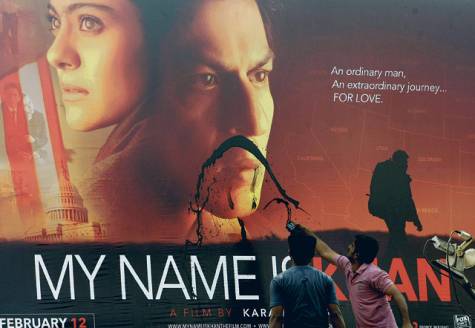
The King is Out, His Name is Khan: Long Live the King (Part I)

My Name is Khan, although narratively based mostly in the USA, has to be theorized within and around the framework of Bollywood; the Urdu-Hindi film history, and its transnational circuits of production, distribution, and consumption; Shahrukh Khan’s star narrative, and the determining context of the Indian political scene along with that in the US and its “war on/of terror.”

by Huma Dar


The Defacing of Khan: It's Not Easy Being Muslim in Mumbai or in Newark
My Name is Khan, although narratively based mostly in the USA, has to be understood and theorized within and around the framework of Bollywood; the Urdu-Hindi film history and its transnational circuits of production, distribution, and consumption; Shahrukh Khan’s star narrative, and the determining context of the Indian political scene along with that in the US and its “War on/of Terror.”  Even prior to the Indian Partition in 1947, most Muslim artists had what Sa’adat Hasan Manto (1912-1955) mockingly called “shuddified” or Hinduized names – Dilip Kumar for Yusuf Khan, Madhubala for Mumtaz Begum Jahan Dehlavi (1933-1969), Meena Kumari for Mahjabeen Bano (1932-1972), or the more ambivalent (non-halal) Johnny Walker for Badruddin Jamaluddin Qazi (1923-2003) and Nargis for Fatima Rashid (1929-1981).  At the contemporary moment, the biggest stars of the Urdu-Hindi film industry in India are Khans: Shahrukh, Salman, Aamir, Saif Ali et al.  It might therefore be tempting to conclude that the Bombay film industry is indeed a level playing field.  The Khans are all Muslims, at least nominally.  Cinematically, they enact, with a few notable exceptions, Hindu characters.  Culturally, the vigorous fanzines of Bollywood idolize them as comfortably suave denizens of metropolitan Bombay[Mumbai] with understated or unexpressed Muslimness — their Hindu wives, girlfriends, or mothers facilitating this imagined assimilation or passing.  Of course, for regular, non-filmi (“film-related” in Urdu-Hindi) Muslim men, this assimilation through marriage to Hindu women is generally frowned upon and can have potentially fatal consequences.

My ruminations on My Name is Khan, like a typical Urdu-Hindi film, lengthy and replete with intermissions, are an entryway into not just the film as cinematic text, but also its complex and rich transnational contexts that must be read in tandem.  In a series of six thematic posts, with this as the first, I will expand on:

(i) The (B)Onus of Muslimness in Bollywood

(ii) Shahrukh Khan and the Pound of Flesh: the Cost of Stardom

(iii) Placating the gods of Citizenship: the Ritual Sacrifice

(iv) A Suitable Boy, “Decent” People, and Names that Pass

(v) The Price of Translating a Narrative and its Context

(vi) Outing the Muslimness, Finally: Some Viewing (and Hearing) Pleasures

Continue reading “The King is Out, His Name is Khan: Long Live the King (Part I)”

Iraqi family demands justice for US attack death

The US military says it has no reason to doubt the authenticity of a video leaked through the whistleblower website WikiLeaks showing a US military attack on a group of civilians in Iraq.

In the 2007 attack, a US military helicopter fired on a group of Iraqis, killing 12 civilians, according to the website, including two employees of the Reuters news agency.

The footage from a helicopter cockpit also shows a man stopping to help the injured, but he too is shot dead.

In an Al Jazeera exclusive, Omar al-Saleh reports on the man’s children, who were injured but survived the attack. (Apr 07, 2010)

Continue reading “Iraqi family demands justice for US attack death”

Pakistan: A new wave of attacks?

This is a video of my appearance on Al Jazeera’s Inside Story. For context, I’d encourage viewers to read my articles in Political Insight and Le Monde Diplomatique.

The Pakistani Taliban have claimed responsibility for an attack on the US consulate in Peshawar on Monday. Is Pakistan paying the price for battles waged by the United States in the region?

Baghdad massacre investigations raise more questions

The Pentagon has not said if it will launch a new investigation into the US military shooting of civilians in Baghdad, following the release of video showing the attack.

The video, released by WikiLeaks, a website that publishes anonymously sourced documents, showed a US military helicopter firing at unarmed civilians in the 2007incident.

Al Jazeera has obtained a copy of the US military’s first two investigations, which cleared the soldiers of wrongdoing.

Patty Culhane reports that they contain inconsistencies that the military has not addressed (07 April 2010).

Murdered photographer’s brother denounces US military crimes

WikiLeaks, a website that publishes anonymously-sourced confidential documents, has published a previously unseen footage showing a US helicopter firing at civilians in Iraq, killing a dozen of them.

Among the dead were two journalists, Namir Nour El Deen, a photographer, and Saeed Chmagh, a driver, both employees of the Reuters news agency.

Namir’s brother, Nabil Nour El Deen, tells Al Jazeera after watching the footage that it is clearly a crime committed by the US military. (Apr 6, 2010)

Background: Wikileaks releases evidence of a barbaric US crime in Iraq

Wikileaks releases evidence of US warcrime in Iraq

Namir Noor-Eldeen, the photographer killed in the Baghdad air strike (Khalid Mohammed/AP)

The wonderful folks at WikiLeaks.org have released a video that captures a US Apache gunship murdering two Reuters journalists — 22-year-old Reuters photographer, Namir Noor-Eldeen, and his driver, Saeed Chmagh, 40 — and 18 Iraqis while wounding two children. Let me warn readers that the footage is disturbing, but not nearly as disturbing as the Nazi-like gloating of the killers. But the worse comes later when a clearly unarmed man, mortally wounded, is being assisted by some brave individuals in a minivan, with children inside, and very deliberately shot at by the murderers in the Apache gunship.

The Guardian reports that  WikiLeaks.org, will be shortly releasing a video of another atrocity, this time in Afghanistan. Wikileaks obtained the video after the Pentagon blocked a freedom of information request by Reuters. According to Wikileaks director Julian Assange, they had to break through encryption by the military to view the video.

Here is Julian Assange, the editor of WikiLeaks, speaking to Al Jazeera about why the story is only coming out now and how it was concealed earlier.

Continue reading “Wikileaks releases evidence of US warcrime in Iraq”

From the Front Line: Insurgent Pakistan

This article appeared in the Political Studies Association‘s excellent new publication Political Insight.

by Muhammad Idrees Ahmad

No nation has ever made a frank avowal of its real imperial motives. It always claims to be primarily concerned with the peace and prosperity of the people whom it subjugates. — Reinhold Niebuhr

The ironies of US President Barack Obama’s Nobel acceptance speech in Oslo were widely noted. Not since Theodore Roosevelt had a Nobel laureate used the acceptance ceremony to make a case for war. Both men appealed to St Augustine’s authority to support the justness of their cause. However, when Roosevelt spoke he had already concluded the peace for which he was honoured; Obama’s lies distant in the purgatory of  ‘hope’. In the present he remains at war — as Henry Kissinger was, when he picked up his prize — having recently ordered the second major escalation of his brief presidency. Kissinger’s war simmered on for two more years; Obama’s will likely last longer.

Afghanistan may well become Obama’s Vietnam, but his diversion is not Cambodia, or Laos, it is nuclear-armed Pakistan. History sometimes repeats itself both as tragedy and farce.

Weeks before Obama described al-Qaeda as a threat on a par with Nazi Germany, national security adviser, General James Jones, told CNN that the organisation had fewer than a hundred men in Afghanistan. Driven by institutional inertia and vulnerable to the charge of weakness, Obama appears unable to disengage. Instead he has borrowed Bush’s rhetoric of good and evil and joined the fear factory. He has subsumed al-Qaeda and the Taliban into a singular threat of global proportions whose defeat he pronounced ‘fundamental to the defense of our people’. Afghanistan, he argued,will not be pacified until the Taliban’s allies in Pakistan are vanquished. Precipitate withdrawal will restore the Taliban to power, and create a safe haven for al-Qaeda to plan more terrorist attacks on the west.

Continue reading “From the Front Line: Insurgent Pakistan”

On the abuse of language

Tony Judt on linguistic subterfuges practised in Europe and America.

Tony Judt

In America the misuse of language is usually cultural rather than political. People will accuse Obama of being a socialist. Italians would say magari – if only. However, no one takes this very seriously. What we have instead in the US is cultural communities policing what can and can’t be said, and that shapes how we define difference. The idea is that you can’t have an elite, since elitism is undemocratic and unegalitarian. Therefore, you always make the point that people are in some important way the same. If they are badly disabled like me, they are ‘differently abled’, which I find very amusing. It is not a ‘different’ ability: it is no ability. But since it’s politically uncomfortable to distinguish between people who can do things and people who can’t, the latter are described as separate but equal. There are numerous things wrong with this: first, it is lousy language; second, it creates the illusion of sameness or achievement in its absence; third, it conceals the effects of real power and capacity, real wealth and influence. You describe everyone as having the same chances when actually some people have more chances than others. And with this cheating language of equality deep inequality is allowed to happen much more easily.

Continue reading “On the abuse of language”

AIPAC confronts its worst fear: Daylight

by Philip Weiss

Col (ret.) Ann Wright and Code Pinkers bring long overdue attention to the AIPAC annual conference, that great annual firesale of American politics.

In that radical handbook on the workings of American society, the Wizard of Oz never recovered once Dorothy pulled back the curtain of her own innocence. One would like to believe that AIPAC will never recover from a brutal spring that has exposed its real interests to the American public. Even supporters of the Jewish state have criticized the American Israel Public Affairs Committee for fully taking Israeli Prime Minister Benjamin Netanyahu’s side in his battle with Barack Obama over settlements, and during its recent annual conference, the lobby looked wobbly and defensive.

Yes, there was the usual procession of weak-kneed politicians professing love for Israel, not to mention AIPAC board members explaining how they cultivate “relationships” with the powerful. Yes, Sen. Chuck Schumer gave a bloodcurdling yowl, Am Yisroel Chai—the Jewish people live!—as he pledged to be Israel’s guardian. But a large shift in American policy and opinion has left the lead institution of the lobby exposed, and worse, mocked.

AIPAC was taking on water before its VIP-studded conference began in late March. Important supporters of Israel in the media, including Jeffrey Goldberg of The Atlantic and David Remnick of The New Yorker, questioned whether reflexive support for Israel’s right-wing policies served the American interest, echoing the view of Gen. David Petraeus that the Palestinian problem is our problem in the battle for hearts and minds in the Middle East.

Continue reading “AIPAC confronts its worst fear: Daylight”

Zeitoun

This review appeared in the Independent.

Abdulrahman Zeitoun was born in Jebleh, on Syria’s Mediterranean coast. Decades later and thousand of miles away he awakes from dreaming of a fishing expedition out of his childhood home: “Beside him he could hear his wife Kathy breathing, her exhalations not unlike the shushing of water against the hull of a wooden boat.” As so often in Dave Eggers’s latest novel, the docudrama “Zeitoun”, a caught image opens a window on an ocean of memory and a state of mind.

Zeitoun now lives in New Orleans, where he runs a painting and building company and owns several buildings. He’s a dedicated businessman, father, husband, and Muslim. His painter’s van is emblazoned with a rainbow, which Zeitoun soon discovers has gay associations for Americans. But he doesn’t change it. “Anyone who had a problem with rainbows, he said, would surely have trouble with Islam.”

Kathy, practical and strong-willed, was brought up a Baptist in Baton Rouge. Attracted by “the doubt sown into the faith” and “the sense of dignity embodied by the Muslim women she knew,” she converted to Islam after her failed first marriage. Some years later she married the much older Zeitoun. Eggers describes their domestic bustle and warmth, and their personal irritations. For Zeitoun, these include his children’s wastefulness and obsession with pop music, and his alienation in a family of women. Kathy is bothered by Zeitoun’s stubbornness and her own family’s Islamophobic nagging.

Continue reading “Zeitoun”