The courage of these protesters is admirable even if some of their politics (their positions on the Palestinians and on Lebanon) is less than savoury. (Remember that Iran executed many who protested back in 2009)
Month: February 2011
The Macy Gray Effect
 A few weeks ago, while I was in al-Araqib after the 11th ethnic cleansing attempt (yesterday was the 15th), I was interviewed by the Israeli Channel 10 culture editor, about Vanessa Paradis’ cancellation of her performance in Israel. Only one of the sentences I uttered in the 15-minute interview was included in the segment, and the rest is somewhere on the Channel 10 editing floor. So in an act of preservation, I’d like to paraphrase a part of the interview:
Channel 10 culture editor: “OK, so Vanessa Paradis canceled, do you really think anybody cares?”
Myself: “You came all the way to al-Araqib to ask me that, I think it’s pretty effective.”
Continue reading “The Macy Gray Effect”
Wealthy Egyptians fear change
While millions of Egyptians are welcoming in the post-Mubarak era. Others, particularly the wealthy members of the society, have a lot to lose. Al Jazeera’s Andrew Simmons reports from Cairo.
US, the Arab Revolt and al-Qaida
M. Shahid Alam
On December 24 2004, I wrote an essay, “America and Islam,” for which I received much heat from Zionist and right-wing bloggers in the United States.
The article made the point that the leaders of al-Qaida believe that they have to carry their war to the home ground of the ‘far enemy’ – the United States, Israel and Western powers – in order to free the Muslim world from foreign domination. This anyone can verify from the numerous communiqués of al-Qaida.
To say this is not to endorse the terrorist methods that al-Qaida employs. This was my moral position then: and it is my moral position now. At the same time, we should not shrink from recognizing that the total wars waged by many states, including the United States, since WWII differ from the methods of al-Qaida only in the infinitely greater scale of the destruction they wreak upon civilians.
The article made another critical point. It argued that al-Qaida, in some measure, reflects the political and moral failings of Muslim societies. If Muslims had shown more spine in resisting local tyrannies through non-violent means, their courage would have scotched the violent extremism of groups like al-Qaida.
Thus Alone, and Always, Have People Resisted Tyranny: Remembering Faiz on his Birth Centenary
Today is the first birth centenary of Faiz Ahmed Faiz: one of South Asia’s most beloved radical Urdu poets. Today is also, just two days after Mubarak’s resignation as a result of the inspiring revolution in Umm al-Duniya, Mother of the World, Egypt; and almost a month after Tunisia’s courageous revolution. How ecstatic would Faiz have been today?!
by Huma Dar
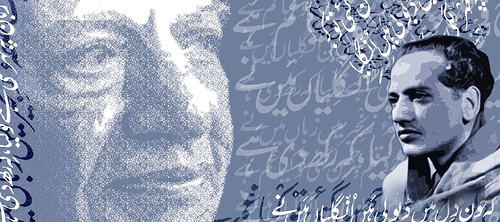 Today is the first birth centenary of Faiz Ahmed Faiz: one of South Asia’s most beloved radical Urdu poets. Today is also, just two days after Mubarak’s resignation as a result of the inspiring revolution in Umm al-Duniya, Mother of the World, Egypt; and almost a month after Tunisia’s courageous revolution. How ecstatic would Faiz have been today?! Faiz, who had lived in Beirut, in exile from Pakistan — when ruled by the US-bolstered military dictator, General Zia-ul Haq. Faiz, who wrote a beautiful lullaby for a Palestinian child, and a poem for those who were martyred outside their beloved Palestine. Faiz, whose poem commonly mis-titled, “Ham Dekhenge,” is a battle-song for people fighting for social justice from Sindh, Pakistan to Kashmir to Chhattisgarh, India.
The title of this particular poem of Faiz is in Arabic: “Wa Yabqaa Wajhu Rabbika.” It is most often brushed aside as it does not fit the simplistic profile of the “avowed atheist” assigned to Faiz. Being a socialist does not preclude belief in Islam, but this nuance is lost on many who cannot easily imagine Faiz being a Muslim, leave alone leading a prayer in the mosque of his ancestral village, especially given the subtle Islamophobia that pervades élite political and literary discourses, both within and without South Asia. For some, even more difficult “to reconcile [is] the glowing tribute [that Faiz wrote] to Muhammad Ali Jinnah,” but this has to do with the rigorous demonology of Jinnah, the founder of Pakistan, in Indian historiography, and the hegemonic status of India and Indian academics, even those who vigorously critique nationalisms of all kinds, within South Asian Studies.
Standoff on the Nile
After seven days of mass protests in Egypt, a people’s movement has taken hold throughout the country, demanding the end of Hosni Mubarak’s 30 years in power. A day-by-day account of how Egypt has been set alight by a mass revolt against President Hosni Mubarak.
Saeb Erekat Resigns
Al Jazeera English — Saeb Erekat, the Palestine Liberation Organisation’s chief negotiator, has resigned from his post after an investigation showed his office was the source of a leak.
Celebrations across the Arab world
Mosaic’s round-up of the celebrations across the Middle East on Egypt’s people power toppling of Mubarak.
Vodpod videos no longer available.Egyptian People Power Versus the Oligarchy
By Michael Barker
 The ongoing insurrection in Egypt is fantastic, but the barriers standing between the people and any substantive form of democracy are formidable and will need to be overcome in the near future. As one might expect there are plenty of ‘reformers’ waiting amongst the counter-revolutionaries to undermine any forthcoming revolution, ready and willing to proudly take on the mantle of power in the name of the democracy. Leading neoconservative ideologue, Paul Wolfowitz, suggests that Hossam Badrawi, the “recently appointed head of Egypt’s government party may be emerging as an interesting and reasonable transition figure.” Acknowledging that there are many such leaders who stand between the Egyptian people and a successful revolution, this article will focus on the elites in Badrawi’s higher circles in an attempt to draw attention to just a few of the many of the powerful groups and individuals ready and willing to smash/co-opt the peoples movement under the iron heel/velvet slipper of the Oligarchy.[1]
Until recently Hossam Badrawi served on the board of governors of Mubarak’s National Democratic Party (NDP), but with the en masse resignations of many of the members of the NDP’s top executive committee, Badrawi a founding member of Arab Parliamentarians Against Corruption, became their new Secretary General. To gain an idea of Badrawi’s reformist ambitions for Egypt one might turn to look at some of his colleagues at Egypt’s International Economic Forum, a group whose “ultimate objective” is “fully integrating the Egyptian economy into the world economy on favourable terms.”
Continue reading “Egyptian People Power Versus the Oligarchy”
Egypt: Seeds of Change
Revolutions do not come about from determination and desire for change alone, they need organization and planning. If you are one of those who believes that the Egyptian revolution was the consequence of a spontaneous outpouring of discontent, the following episode from AJE’s People and Power, which is a unique study in the art of revolution, should help disabuse you. Western activists in particular — whose failures were noted by Antonio Gramsci in the early decades of the century, and who have maintained an unbroken record of defeat since — will find a lot to learn from this.
 P U L S E