Copenhagen, Danish Hospitality and The Elements

It took some time, almost a whole week, but Danish riot police have finally been given the chance to greet the thousands of climate justice activists visiting Copenhagen with some traditional elements of Scandinavian hospitality – a mass pre-emptive arrest of almost 1,000 people and the ‘kettling’ of hundreds of others, forcing some to “urinate themselves while detained on the ground.” The churnalists who have converged upon Copenhagen seem satisfied too, eagerly engaging in the media ritual of filling the headlines with the standard litany of cliches about “anarchists running street battles with the police. Sadly, it seems beyond their intellectual capacity to use the occasion to even mention the existence of a parallel People’s Climate Summit – the Klimaforum 09 – taking place in Copanhagen at the moment. But if the arguments and policy alternatives presented by the likes of Naomi Klein (see video below the fold) are too rational for the mainstream press to digest, perhaps they’ll find this wonderful bit of creative subversivness produced by artists at the Klimaforum more palatable.  Here’s episode 5 of The Elements, where our hereos take on the The Paramount Public Opinion Distortion and Confusion Data Processor:

Continue reading “Copenhagen, Danish Hospitality and The Elements”

The ‘First Wives Club’ or the Politics of Visibility and Invisibility

by Huma Dar

In her article in The Observer, ‘The First Ladies Of The Arab World Blaze A Trail For Women’s Rights’, Helena Smith waxes eloquent about a very exclusive, seven-year-old club, called “Arab Women Organisation” with only fifteen members so far: the first ladies of Jordan, the Emirates, Bahrain, Tunisia, Algeria, Sudan, Syria, Oman, Palestine, Lebanon, Libya, Egypt, Mauritania, Morocco and Yemen.1

The first wives of the other seven Arab countries with “some of the more traditional societies” have also been invited and there are “tremendous hopes” that they, too, will join up, Smith gently reassures the reader.  This article carries the tag line: “A large and powerful alliance of leaders’ wives is making huge strides in breaking taboos and getting feminist issues on the political agenda.” The list of issues being “sexual slavery,” “trafficking,” “child exploitation,” “prostitution” and “rape” in the Middle East,” and, of course, this is duly prefaced by an obligatory, pious declamation that these “societies [are] not known for their commitment to feminist agendas.”

One wonders if this particular set of issues has indeed been adequately dealt with in any part of the world, and immediately thinks of the epidemic proportion of violence against women in the United States of America, which happens to be one of the more violent places for women as far as the proportionate rates of rapes, assaults, and murders are concerned, with every two minutes a woman being sexually assaulted, and every eight minutes a woman being raped.2

Continue reading “The ‘First Wives Club’ or the Politics of Visibility and Invisibility”

Utopia as Alibi: Said, Barenboim and the Divan Orchestra

by Raymond Deane

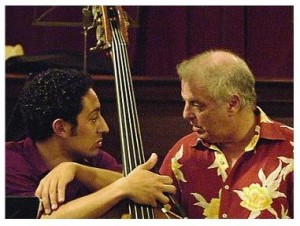
As a classical musician involved in pro-Palestinian activism, I frequently encounter the assumption that I am an unconditional admirer of the West-Eastern Divan Orchestra (WEDO). My reservations on this score tend to produce shocked disapproval: How could I not enthuse about such an idealistic project, particularly since it was co-founded by the late Edward Said, a figure for whom I have frequently expressed respect and admiration?

In truth, I have always been a little wary of Said’s veneration for the eighteenth/nineteenth century canon of European classical music. I look in vain in his writings on the subject[1] for a historical and political contextualisation of music comparable of that to which he so perceptively subjected literature in his indispensable Culture and Imperialism.[2]

In his 2002 speech accepting the Principe de Asturias Prize, Said claimed that he and his friend the Israeli pianist and conductor Daniel Barenboim founded the WEDO “for humanistic rather than political reasons”. This surprising dualism implies that music belongs to a utopian sphere somehow removed from the dialectical hurly-burly of hegemony and resistance.

The paradoxes of Said’s position have been ably dissected by the British musicologist Rachel Beckles Willson.[3] She quotes her colleague Ben Etherington’s critique of Said’s tendency “to assert the intrinsic value of Western elite music without really exploring how that tradition escapes mediation.” Paraphrasing Said’s critique of literary scholars in his Humanism and Democratic Criticism[4] she convincingly claims that he “omitted to make ‘a radical examination of the ideology of the [musical performance] field itself.’” (Willson’s chain brackets).

Continue reading “Utopia as Alibi: Said, Barenboim and the Divan Orchestra”

ON PRESIDENTS AND PRECEDENTS: IMPLICATIONS OF THE HONDURAN COUP

By Joseph Shansky

First published in Upside Down World, 10 December 2009

President Obama was elected partly because of his promise to a large Hispanic constituency to give both new attention and new respect to Latin America. Judging from the US role in the military coup in Honduras, he must think that one of the two is enough.

For those who closely followed the coup and its aftermath, a tiny fear sat in the back of our minds. Eventually it was confirmed. As the State Department position shifted from condemning to condoning the illegal government, the outline of a bigger picture became clear. If this violent takeover were really to be approved by the US, it would mark a frightening new focus on the region.

In late June, Honduran President Manuel Zelaya was kidnapped by the military and forced out of the country. For the next five months, an illegitimate government, headed by Congressional leader Roberto Micheletti, suppressed the outrage of many Honduran citizens against this regime through a number of violent means including murder, torture, and detention of citizens.

Throughout this time, the US response to these allegations was silence.

Continue reading “ON PRESIDENTS AND PRECEDENTS: IMPLICATIONS OF THE HONDURAN COUP”

What does courage look like?

Student protester Majid Tavakoli was arrested on December 7, 2009.

While the majority of mainstream news media’s focus on Iran has returned to the debate over who has the right to control the country’s nuclear energy ambitions, Iranian students continue to risk their lives while protesting for their human and civil rights.  Hundreds of Iranian men and women have been arrested and interrogated since the recent Iranian presidential election, and claims of torture and abuse of detainees continue to surface.

On December 7 Majid Tavakoli, a student at Amir Kabir University in Tehran, was reportedly violently arrested after giving a speech at one among several protests that were held around the country on Iran’s Student’s Day, or 16 Azar.  16 Azar commemorates the murder of 3 Iranian student protesters who were shot and killed by Mohammad Reza Pahlavi’s military during a large protest that occurred in 1953 against US Vice President Richard Nixon’s visit to the country in support of the Shah’s government.  Earlier that year the popular and democratically elected government of Mohammad Mosaddeq was overthrown by a CIA/MI6 sponsored coup which restored the Shah to power.  The brutal and corrupt Iranian monarchy maintained control of the country until the revolution of 1979.

It has been reported that Tavakoli had already been imprisoned before for his activism, and that he was tortured during his detention.  Tavakoli was well aware of the risks involved in giving his impassioned speech, but contended that it was the “duty” of all students to make their voices heard despite the heavy air of fear and paranoia weighing upon them in solidarity with the protesters that have been imprisoned and tortured, as well as those who have been killed during the ongoing wave of protests which hit Iran following the 2009 election.  Early on in his speech Tavakoli states:

Today is 16 Azar.  It is our day.  It is the day of students…

Continue reading “What does courage look like?”

Five Books on Israel-Palestine

The interview below was published in the Five Books section of The Browser. I chose five books on the Israel-Palestine conflict.

Tell me about the Ilan Pappe book, The Ethnic Cleansing of Palestine.

Pappe has written a great historical work on the ethnic cleansing of Palestine in 1947/8 and he shows that it was organised and planned, called Plan D, or plan Dalit, and he has exploded the myths that were current until his work.

What myths?

Well, for example, that the Arab leaders told the Palestinians to leave, or that the Palestinians were Bedouin people who didn’t really live there anyway, and he showed that they were ordinary people in brick and mortar homes who were intentionally forced out. This is very important because the ethnic cleansing of Palestine is the original sin of Zionism and the root of the current problem.

Continue reading “Five Books on Israel-Palestine”

Oh, the Irony!

According to the UK Telegraph, lawyers in the United States are not too pleased about the verdict in the Amanda Knox trial. Amongst the unhappy is Harvard Professor of Law, Alan Dershowitz, a well-known advocate of unlawful-preventive-indefinite- administrative  (it’s all the same anyhow) detention in the U.S and in Israel. Here’s an excerpt, with a few of the responses from bummed out lawyers in the United States:

Within minutes of the verdict on Friday, the cable news network CNN had given over its coverage to two American correspondents, both roundly condemning the trial and what they saw as a lack of evidence.

As they regularly did during the trial, the American media has been quick to wheel out domestic legal experts to rail against the iniquities of the Italian justice system.

Under the headline “An American in the Italian Wheels of Justice”, the New York Times quizzed senior academics but found none who approved of the verdict.

Continue reading “Oh, the Irony!”

The Price of ‘Existing’ as a Muslim Today

In the classic French novel, Adolphe, Benjamin Constant writes: 


There are things that for a long time remain unsaid, but once they are spoken, one never ceases to repeat them.

How true this is of so many of the things we keep inside for a time. Think, for example, of how an argument with a loved one often reveals the things that we have felt, but carefully hidden from them. Once spoken, those words repeat themselves with a frequency that suggests that we are seeking vengeance for the time they spent in silence.

The same is true of our secret prejudices, which often remain unsaid until the moment ‘feels right’ or circumstances seemingly produce the ‘necessity’ for their articulation.

It appears that circumstances today have produced a space in which articulating anti-Islamic sentiment both ‘feels right’ and ‘necessary’. It is an environment marked by series of events invoked as evidence in the ever-growing case against Islam.

Continue reading “The Price of ‘Existing’ as a Muslim Today”

What the US Elite Really Thinks About Israel

Senator William Fulbright had first called the US Congress an Israeli Occupied Territory

Our friend Jeffrey Blankfort on the surprising results of CFR survey — surprising, to the extent that it goes against the lefitst conventional wisdom which has accorded Israel the status of a ‘strategic asset’; much less so, however, when it comes to revealing the level ignorance about the situation in Pakistan. For background, also see Blankfort’s rejoinder to Joseph Massad’s fatuous attack on John Mearsheimer and Stephen Walt.

The Council on Foreign Relations is always near the top of the Left’s list of bogeymen that stand accused of pulling the strings of US foreign policy. It is right up there with the Bilderberg Group and the Trilateral Commission, right? Wrong. If that was the case,  those arguing that US support for Israel is based on it being a “strategic asset”  will have a hard time explaining a Pew Research Center survey on America’s Place in the World, taken of 642 CFR members between October 2 and November 16. The Pew poll  not only reveals that the overwhelming majority, two-thirds of the members of this elite foreign policy institution, believes that the United States has gone overboard in favoring Israel, it doesn’t consider Israel to have have much importance to the US in the first place.

Continue reading “What the US Elite Really Thinks About Israel”

The Interview Ha’aretz Doesn’t Want You To See

Ali Abunimah

Rehaviya Berman conducted an interview with Ali Abunimah, for Ha’aretz, a few weeks ago. The Interview was never published. Berman decided to publish it on his blog [Hebrew] and I decided to translate it, for your reading pleasure:

Exclusive: One On One with the Leader of the Electronic Intifada

Rehaviya Berman

Meet Ali Abunimah, the son of a Jordanian diplomat, a Palestinian activist, and the man who brings the hottest news of the struggle to thousands of people. His message: Forget two states, one will be tough enough to get it right.

The Interview before you was commissioned by one of the the big newspapers. For a reason that has yet to be clarified, this paper decided not to publish the interview. It’s published here, because it’s the opinion of the editor that it’s important that this be read by the Israeli public.

“First of all, it’s important for me to clarify that I’m not a leader, and I’m not interested in being a leader.” Continue reading “The Interview Ha’aretz Doesn’t Want You To See”