What prompted the popular writer to go back to his Cambridge roots and rehash this very Humanities 101 debate? Why the Boycott Divestment and Sanctions movement of course!
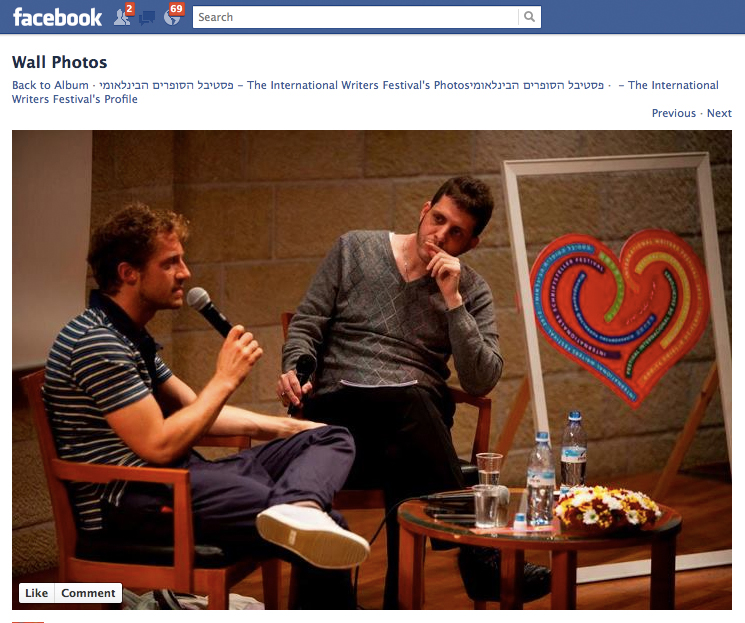
Tom Rob Smith at the Jerusalem Writers Festival not discussing the ways in which it whitewashes apartheid, and is sponsored by an organization which is responsible for ongoing ethnic cleansing, only minutes away from the premises. (source: The Jerusalem Writers Festival Facebook page)
PUMPKIN: Everybody be cool, this is an occupation!
YOLANDA: Any of you fucking pricks move, and I’ll execute every motherfucking last one of you!
JULES: So, tell me again about those killing-for-promotions there…
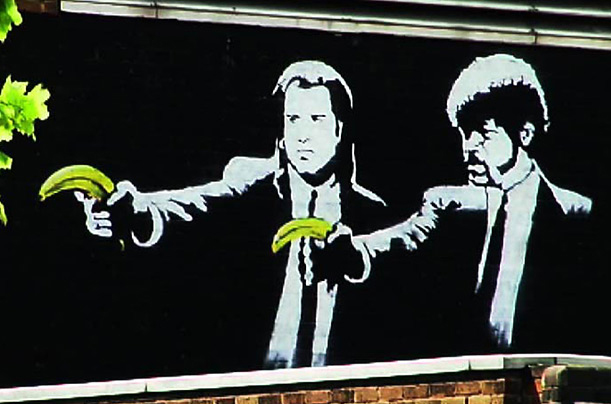
"Pulp Fiction Bananas" by Banksy, once near Old Street Tube Station, London, now whitewashed.
PUMPKIN: Everybody be cool, this is an occupation!
YOLANDA: Any of you fucking pricks move, and I’ll execute every motherfucking last one of you!
JULES: So, tell me again about those killing-for-promotions there…
VINCENT: What do you want to know?
JULES: Killing is legal there, right?
VINCENT: Yeah, it is legal but it ain’t 100% legal. I mean you can’t walk into a house and start shooting right away. You’re only supposed to take those fucking pricks to certain designated places and blast off their fucking brains? You have to give them some name…
JUKES: Those are encounter sites?
VINCENT: Yeah, it breaks down like this: it’s legal to kill them, it’s legal to own it and, if you’re the occupier of the encounter site, it’s legal to bury them there. It’s legal to carry their bodies, but that doesn’t really matter ’cause — even if you got a truckload of them — if the cops stop you, it’s illegal for them to search you. Searching you is a right that the cops in Kashmir don’t have. Continue reading “A Scene from Pulp Fiction in Kashmir”
On +972 magazine, IPCRI’s Dan Goldenblatt has invited “anyone who has criticism of how we at IPCRI try to advance this goal to tell us so, engage and challenge us, and help us and others improve.” As a long-time critic of the “liberal left” “peace industry” (I thank Goldenblatt himself for the latter term), I’m taking him up on his invitation, picking up from where PACBI left off. To start off, I’ll wonder whether IPCRI “brought [themselves] together” with PACBI to “meet, discuss, argue, build, take apart, share and cooperate”? Or did Goldenblatt just write up his public response to PACBI’s engaging and challenging critique of the organization?
This piece first appeared in the Honour newsmagazine.
Khanyar, Srinagar. photo credit: Huma Dar, 2006
Every night, when she drops the slightly bluish liquid into a glass of water, Nisaare feels pride more than embarrassment, or even disgrace. The liquid is a sedative drug. The glass of water is meant for her husband. She feels reassured that she has dealt with the loss of their son much better than he has.
Nine years have passed since the death of their only child in an ‘encounter’ with the Rashtriya Rifles. He had been a bashful young man; not the kind you would easily associate with militant revolution. He had gone ‘across’ for ‘training’ simply because everybody in his peer group had, and he did not want to be the only one left behind. Any other motives he had are buried with him and will surely be summoned back to life one day. On his return, he was of little help to the group because he would not shoot to kill. He had been barely audible when he had expressed his ideological opposition to ambush. He had stated that he would much rather fight the soldiers openly. The commanders assigned him the role of a donation collector during the day and a patrol at night.
The story of King Leopold II of Belgium’s brutal colonisation of central Africa, turning it into a vast rubber-harvesting labour camp in which millions died.
Almost a month in, Tahrir-envy in Israel is now at what seems to be its peak. 150,000 people took the streets last Sunday, at what must have been the biggest protests here since the protests against the “disengagement” from Gaza. For months now, a public whisper was spread through the mainstream media; why don’t the Israelis take the streets?
“Where are the masses? With its lack of ideology and values, the phenomenon of postmodernism is one reason why downtrodden Israelis choose not to rise up and free themselves of latter-day bondage. Revolution Square is empty.”
Renowned anthropologist Laura Nader (sister of Ralph Nader) discusses how Arab/Muslim women perceived the west during their encounters in the past centuries.
Edward Said spent much of his distinguished career combatting Western stereotypes of the Arab world. Laura Nader explains what Said meant by “Orientalism,” and describes what Arabs who visited the West in past centuries came to think of Western practices. Also, Adel Iskandar talks about the volume in which Laura Nader’s article about Said appears.
While I’m astonished that an Israeli mainstream news service would even address this story at all, let alone report in a considerably balanced manner; There are many very basic questions that this 2-and-a-half minute segment whizzes through, that I’d like to comment on. Continue reading “Khirbat Tuqu’ & the Silent World”
A new report by Who Profits maps the involvement of the Israeli wine industry in the occupation of the West Bank and the Syrian Golan Heights and traces some of the ways in which it masks this involvement. For this purpose, this report surveys the Israeli wine industry, maps the vineyards and wineries in the occupied territory and traces the connections between the main Israeli wine producers and this settlement industry.
 On +972 magazine, IPCRI’s Dan Goldenblatt


 P U L S E