Boycott Israel? Amitav Ghosh & the Dan David Prize

The call for academic and cultural boycott is clearly a way to encourage civil society to play a broader political role—that is why it has the support of wide sections of Palestinian civil society. One of the most significant questions that call poses to us is simply this: How could those of us who oppose apartheid, occupation, and colonialism not support such a call?

Dear Amitav Ghosh,

We wish to express our deep disappointment in your decision to accept the Dan David prize, administered by Tel Aviv University and to be awarded by the President of Israel. As a writer whose work has dwelled consistently on histories of colonialism and displacement, your refusal to take stance on the colonial question in the case of Israel and the occupation of Palestine has provoked deep dismay, frustration, and puzzlement among readers and fans of your work around the world. Many admired your principled stand, and respected your decision not to accept the Commonwealth Writers Prize in rejection of the colonialist framework it represented.

Continue reading “Boycott Israel? Amitav Ghosh & the Dan David Prize”

Inside the Lawfare Project

Netanyahu’s Attack on Human Rights NGO’s Hits the States

by Max Blumenthal

As the anti-Goldstone, human rights-bashing Lawfare Project’s opening event on March 11 wrapped up, I asked its chairman, Columbia University Law School Dean David Schizer, for an interview. Schizer, who had just attacked the Goldstone Report from the podium, pointedly refused to speak to me and looked for the exit. As Schizer was leaving, he was politely confronted by Columbia Law School Professor Katherine Franke, who heads the school’s Program in Gender and Sexuality Law.

“Why didn’t you invite any speakers with an alternative perspective?” Franke asked Schizer.

His reply was curt. “We invited one or two but they couldn’t make it,” Schizer claimed before hurrying away.

Schizer was understandably nervous about his exposure. After all, he had just presided over a day-long conference during which Israeli human rights workers were labeled as traitors while Judge Richard Goldstone and human rights groups were compared to “anti-Semitic street gangs.” After several speakers had harshly condemned legal efforts against the construction of Israeli settlements in East Jerusalem and the West Bank, Schizer appeared beside them to lend his credibility to their views.

Continue reading “Inside the Lawfare Project”

Finkelstein in Prague

Last week, Norman Finkelstein delivered a series of lectures in Prague as part of his European speaking tour. Finkelstein was initially invited to speak at the prestigious Czech Academy of Sciences but had his invitation revoked less than 24 hours prior to his scheduled talk, allegedly at the behest of the Prime Minister’s office. A similar fate befell Finkelstein’s appearance in Munich and Berlin, where the Heinrich Boll and Rosa Luxembourg Foundations cancelled the events, following “a concerted campaign by neoconservative and pro-Israeli pressure groups, such as Honestly Concerned and BAK Shalom, known for their unconditional support of Israeli policies and the defamation of critics as anti-Semites.”

Here is Finkelstein’s lecture at Casa Gelmi in Prague, organised by the Czech pro-Palestinian group ‘Friends of Palestine’.

Continue reading “Finkelstein in Prague”

The Second Battle of Gaza: Israel’s Undermining Of International Law

by Jeff Halper

The Israeli attack on Gaza in December 2008/January 2009 was not merely a military assault on a primarily civilian population, impoverished and the victim of occupation and besiegement these past 42 years. It was also part of an ongoing assault on international humanitarian law by a highly coordinated team of Israeli lawyers, military officers, PR people and politicians, led by (no less) a philosopher of ethics. It is an effort coordinated as well with other governments whose political and military leaders are looking for ways to pursue “asymmetrical warfare” against peoples resisting domination and the plundering of their resources and labor without the encumbrances of human rights and current international law. It is a campaign that is making progress and had better be taken seriously by us all.

Since Ariel Sharon was indicted by a Belgian court in 2001 over his involvement in the Sabra and Chatila massacres and Israel faced accusations of war crimes in the wake of its 2002 invasion of the cities of the West Bank, with its high toll in civilian casualties (some 500 people killed, 1,500 wounded, more than 4,000 arrested), hundreds of homes demolished and the urban infrastructure utterly destroyed, Israel has adopted a bold and aggressive strategy: alter international law so that non-state actors caught in a conflict with states and deemed by the states as “non-legitimate actors” (“terrorists,” “insurgents” and “non-state actors,” as well as the civilian population that supports them) can no longer claim protection from invading armies. The urgency of this campaign has been underscored by a series of notable setbacks Israel subsequently incurred at the hands of the UN. In 2004, at the request of the General Assembly, the International Court of Justice in The Hague ruled that Israel’s construction of wall inside Palestinian territory is “contrary to international law” and must be dismantled—a ruling adopted almost unanimously by the General Assembly, with only Israel, the US, Australia and a few Pacific atolls dissenting. In 2006 the UN Commission of Inquiry concluded that “a significant pattern of excessive, indiscriminate and disproportionate use of force by the IDF against Lebanese civilians and civilian objects, failing to distinguish civilians from combatants and civilian objects from military targets.” together with the harsh criticism of the UN’s Goldstone report on Gaza accusing the Israeli government and military again of targeting Palestinian civilians and causing disproportionate destruction, has made this campaign even more urgent.

Continue reading “The Second Battle of Gaza: Israel’s Undermining Of International Law”

Smoke and Mirrors – On the Hardships of Self-Inquiry

Looking in the mirror is no easy task. Especially when your eyes are smoked by Zionism. Now that impunity is slowly diminishing, Israel finds itself stuck between the Goldstone and a hard place. How does the spoiled brat of the Middle East deal with the fact that years of stealing cookies from the cookie jar have left its face covered in damning chocolate?

Common Sense Solutions to Self-Inquiry

For weeks now, the Goldstone report has gained its rightful place in the Israeli mainstream media- the front page. At first, articles were all about the “one-sidedness” and the “antesemitism” of the report. Now, what we’re seeing is a consistent media push for self-inquiry. Not because we have some ethical ‘splaining to do, mind you, but because Israel’s public image is in jeopardy. Ha’aretz’s diplomatic correspondent (and a fellow at the Israeli Institute For National Security Studies), Aluf Benn- a shining example of this “practical strategic thinking”- finally remembers to ask some tough questions:

Continue reading “Smoke and Mirrors – On the Hardships of Self-Inquiry”

Goldstone and the Kids

Illustration by Carlos Latuff

Anything that happens in my world, now, seems just that little bit more ironic, since Obama was awarded the Nobel Peace Prize. Not that I credit the institution with too much merit, considering its list of peace-fakers, but the propaganda of this ill-executed award bothers me, nevertheless. While it’s easy to discredit Obama as an initiator of peace just for the sheer amassing of dead Afghans, this year I’d like to take it to my own little corner of the world.

Politics of Human Rights

Another action against peace, which the Obama administration has taken, is the pressure it applied in the UN to bury the Goldstone report:

Unsurprisingly, an early ally in the Israeli campaign for impunity was the Obama Administration, whose UN ambassador, Susan Rice, expressed “very serious concerns” about the report and trashed Goldstone’s mandate as “unbalanced, one-sided and basically unacceptable.” (Rice was acting true to her word; in April she told the newspaper Politico that one of the main reasons the Obama Administration decided to join the UN Human Rights Council was to fight what she called “the anti-Israel crap.”) [Electronic Intifada]

Continue reading “Goldstone and the Kids”

Callous and impenitent

Bolton at the Hay Festival last year before his attempted arrest for war crimes

John Bolton, with his characterisic contempt for international law, writes in today’s Washington Post that ‘with no other timely option, the already compelling logic for an Israeli strike [on Iran] is nearly inexorable’. The article is reproduced in full below. It should, I suggest, be read whilst mindful of Article 2 of the UN Charter by which it was agreed that: ‘All Members shall refrain in their international relations from the threat or use of force against the territorial integrity or political independence of any state, or in any other manner inconsistent with the Purposes of the United Nations.’

Last year, you may recall, the Guardian columnist George Monbiot attempted a citizens arrest on Bolton. It was a futile but symbolic act; and a rare acknowledgment that this man is a war criminal by any decent standard – and an unrepentant one at that.

Time for an Israeli Strike?

By John R. Bolton
Thursday, July 2, 2009

With Iran’s hard-line mullahs and the Islamic Revolutionary Guard Corps unmistakably back in control, Israel’s decision of whether to use military force against Tehran’s nuclear weapons program is more urgent than ever.

Iran’s nuclear threat was never in doubt during its presidential campaign, but the post-election resistance raised the possibility of some sort of regime change. That prospect seems lost for the near future or for at least as long as it will take Iran to finalize a deliverable nuclear weapons capability.

Continue reading “Callous and impenitent”

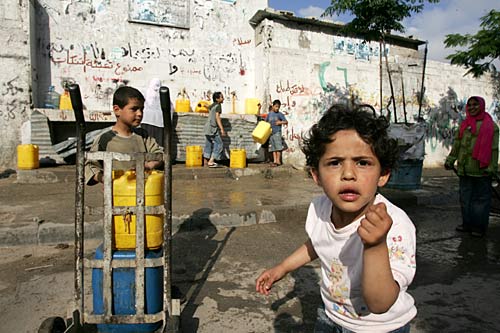
Gaza: 1.5 million people trapped in despair

Khan Younis. Public taps for drinking water,
Khan Younis. Public taps for drinking water, May 2009.

Today the International Red Cross released a report detailing the catastrophic results of Israel’s brutal war on Gaza. As the siege which has crippled Gazans for the past two years continues, the Red Cross found seriously ill patients facing difficulty obtaining the treatment they needed; children suffering from deep psychological problems and people whose homes and belongings were destroyed during the conflict unable to recover.

The report in full reads:

During the 22 days of the Israeli military operation, nowhere in Gaza was safe for civilians. Hospitals were overwhelmed with casualties, including small children, women and elderly people. Medical personnel showed incredible courage and determination, working around the clock to save lives in extremely difficult circumstances. Meanwhile, daily rocket attacks launched from Gaza put thousands of residents at risk in southern Israel. Medical workers in Israel provided care for the traumatized population and treated and evacuated casualties.

Many people in Gaza lost a child, a parent, another relative or a friend. Israel’s military operation left thousands of homes partly or totally destroyed. Whole neighbourhoods were turned into rubble. Schools, kindergartens, hospitals and fire and ambulance stations were damaged by shelling and have to broker deals with financiers for support.

This small coastal strip is cut off from the outside world. Even before the latest hostilities, drastic restrictions on the movement of people and goods imposed by the Israeli authorities, particularly since October 2007, had led to worsening poverty, rising unemployment and deteriorating public services such as health care, water and sanitation. Insufficient cooperation between the Palestinian Authority in Ramallah and the Hamas administration in Gaza had also hit the provision of essential services. As a result, the people of Gaza were already experiencing a major crisis affecting all aspects of daily life when hostilities intensified in late December. Continue reading “Gaza: 1.5 million people trapped in despair”

Occupation, Colonialism, Apartheid

For those who refuse to accept the brutal reality on the ground, the Human Sciences Research Council of South https://i0.wp.com/sabbah.biz/mt/wp-content/uploads/2007/04/4_9Mirror_on_Apartheid_Wall.jpgAfrica has produced a new detailed legal report which confirms “that Israel is practicing both colonialism and apartheid in the Occupied Palestinian Territories (OPT).” The study was commissioned to “test the hypothesis posed by Professor John Dugard in the report he presented to the UN Human Rights Council in January 2007, in his capacity as UN Special Rapporteur on the human rights situation in the OPT:

Israel is clearly in military occupation of the OPT. At the same time, elements of the occupation constitute forms of colonialism and of apartheid, which are contrary to international law. What are the legal consequences of a regime of prolonged occupation with features of colonialism and apartheid for the occupied people, the Occupying Power and third States?

On the specific question of colonialism the report unambiguously states that:

“Five issues, which are unlawful in themselves, taken together make it evident that Israel’s rule in the OPT has assumed such a colonial character: namely, violations of the territorial integrity of occupied territory; depriving the population of occupied territory of the capacity for selfgovernance; integrating the economy of occupied territory into that of the occupant; breaching the principle of permanent sovereignty over natural resources in relation to the occupied territory; and denying the population of occupied territory the right freely to express, develop and practice its culture” (pp. 15-16). Furthermore, “Israel’s annexation of East Jerusalem is manifestly an act based on colonial intent” (ibid.).

Concerning the charge of apartheid, the report states:

By examining Israel’s practices in the light of Article 2 of the Apartheid Convention, this study concludes that Israel has introduced a system of apartheid in the OPT (p. 17)

Continue reading “Occupation, Colonialism, Apartheid”

After Iraq, it’s not just North Korea that wants a bomb

Steve Bell on the new nuclear arms race

The ‘international condemnation’ of North Korea’s nuclear test on Monday was severely lacking in credibility for its fantastical double-standards, writes Seumas Milne, who argues only radical disarmament can halt their spread.

Here in Scotland the SNP made an attempt to seek support from this same ‘international community’ to rid the country of its nuclear weapons, which are stored in a naval base on the River Clyde. In October 2007 First Minister Alex Salmond wrote to representatives of 189 countries signed up to the Nuclear Non-Proliferation Treaty, seeking ‘observer status’ as defence is not an area devolved to Holyrood. The renewal of the Trident missiles is set to run into the tens of billions over the next 20 years, with the parent Westminster government insisting this is a necessary “deterrent” to protect “national security interests”. Sadly the list of replies were published last summer showing there to be little international support for this brave move from a minority administration.

This example reflects Milne’s Guardian article nicely I think.

The big power denunciation of North Korea’s nuclear weapons test on Monday could not have been more sweeping. Barack Obama called the Hiroshima-scale ­underground explosion a “blatant violation of international law”, and pledged to “stand up” to North ­Korea – as if it were a military giant of the Pacific – while Korea’s former imperial master Japan branded the bomb a “clear crime”, and even its long-suffering ally China declared itself “resolutely opposed” to what had taken place. Continue reading “After Iraq, it’s not just North Korea that wants a bomb”