The King is Out, His Name is Khan: Long Live the King (Part I)

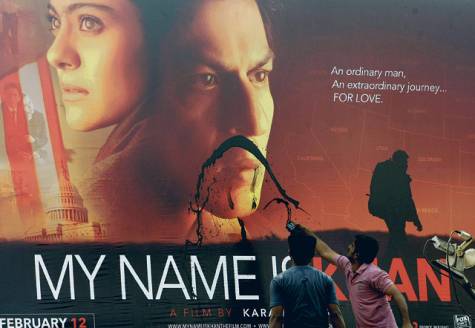
My Name is Khan, although narratively based mostly in the USA, has to be theorized within and around the framework of Bollywood; the Urdu-Hindi film history, and its transnational circuits of production, distribution, and consumption; Shahrukh Khan’s star narrative, and the determining context of the Indian political scene along with that in the US and its “war on/of terror.”

by Huma Dar


The Defacing of Khan: It's Not Easy Being Muslim in Mumbai or in Newark

My Name is Khan, although narratively based mostly in the USA, has to be understood and theorized within and around the framework of Bollywood; the Urdu-Hindi film history and its transnational circuits of production, distribution, and consumption; Shahrukh Khan’s star narrative, and the determining context of the Indian political scene along with that in the US and its “War on/of Terror.”  Even prior to the Indian Partition in 1947, most Muslim artists had what Sa’adat Hasan Manto (1912-1955) mockingly called “shuddified” or Hinduized names – Dilip Kumar for Yusuf Khan, Madhubala for Mumtaz Begum Jahan Dehlavi (1933-1969), Meena Kumari for Mahjabeen Bano (1932-1972), or the more ambivalent (non-halal) Johnny Walker for Badruddin Jamaluddin Qazi (1923-2003) and Nargis for Fatima Rashid (1929-1981).  At the contemporary moment, the biggest stars of the Urdu-Hindi film industry in India are Khans: Shahrukh, Salman, Aamir, Saif Ali et al.  It might therefore be tempting to conclude that the Bombay film industry is indeed a level playing field.  The Khans are all Muslims, at least nominally.  Cinematically, they enact, with a few notable exceptions, Hindu characters.  Culturally, the vigorous fanzines of Bollywood idolize them as comfortably suave denizens of metropolitan Bombay[Mumbai] with understated or unexpressed Muslimness — their Hindu wives, girlfriends, or mothers facilitating this imagined assimilation or passing.  Of course, for regular, non-filmi (“film-related” in Urdu-Hindi) Muslim men, this assimilation through marriage to Hindu women is generally frowned upon and can have potentially fatal consequences.

My ruminations on My Name is Khan, like a typical Urdu-Hindi film, lengthy and replete with intermissions, are an entryway into not just the film as cinematic text, but also its complex and rich transnational contexts that must be read in tandem.  In a series of six thematic posts, with this as the first, I will expand on:

(i) The (B)Onus of Muslimness in Bollywood

(ii) Shahrukh Khan and the Pound of Flesh: the Cost of Stardom

(iii) Placating the gods of Citizenship: the Ritual Sacrifice

(iv) A Suitable Boy, “Decent” People, and Names that Pass

(v) The Price of Translating a Narrative and its Context

(vi) Outing the Muslimness, Finally: Some Viewing (and Hearing) Pleasures

Continue reading “The King is Out, His Name is Khan: Long Live the King (Part I)”

(Neo)Orientalism with an Attitude: In the Footsteps (and Beyond) of Richard Burton

Getting one’s picture taken with the Dalai Lama or the Pope will guarantee neither Buddhist enlightenment nor beatification: my apologies for shattering the hopes of some New Agers. Similarly, entering the Ka’aba in Burtonesque disguise — specially minus his arguably relevant though shifty linguistic skills and textual knowledge — will not and cannot necessarily guarantee much “learning” about Islam.

by Huma Dar

The March 10, 2010, page A27 of the New York edition of New York Times carries an Op-Ed piece by Maureen Dowd titled, “Pilgrim Non Grata in Mecca.” Dowd writes about her desire to “learn about the religion that smashed into the American consciousness on 9/11” via “sneaking” into Mecca in “a black masquerade cloak.”  Her self-proclaimed inspiration is Richard Burton’s “illicit pilgrim[age] to the sacred black granite cube…in Arab garb” thereby “infiltrat[ing] the holiest place in Islam, the Kaaba [sic].”

Dowd, however, decides to “learn about Islam” in a way “less sneaky,” “disrespectful,” or “dangerous” and yet more entitled and privileged than Richard Burton could ever have dreamed of.   She herself describes Burton as “the 19th-century British adventurer, translator of “The Arabian Nights” and the “Kama Sutra” and self-described ‘amateur barbarian.'”  The words “illicit,” “Kama Sutra,” and “infiltration” and Dowd’s voyeuristic desires resonate with the Orientalism of yore.  Moreover Dowd’s valuable US passport and USA’s special relationship with Saudi Arabia (read: enabling of the oppressive monarchy) entitle her to meet Prince Saud al-Faisal, the Saudi foreign minister — of the “sometimes sly demeanor” — on her “odyssey” to that country.  “Infiltration” in disguise is no longer required, and yet this ease of access also disguises and makes more difficult the complexity of any real learning.

Dowd “presses” al-Faisal for the privilege to watch in Mecca, the “deeply private rituals” and “gawk at the parade of religious costumes fashioned from loose white sheets” although she knows in advance that “Saudis understandably have zero interest in outraging the rest of the Muslim world.”  While talking to this high-ranking minister, Dowd bristles at al-Faisal’s reassuring suggestion that if she desired to see any mosque in a place other than in Mecca or Medina, and was prevented from doing so, all she had to do was to contact the “emir of the region” who would comply and enable the fulfillment of her desires.  (Anyone else reminded of Aladdin’s djinn/genie?)  Without conceding the irony of the situation that she, after all, is speaking to Prince al-Faisal, the Saudi foreign minister, Dowd quips, “Sure. Just call the emir. I bet he’s listed.”   Imagine what Richard Burton would have done with the special privileges of this particular magic lamp provided by the New World Order!

Finally Dowd does indeed witness the Hajj — in an IMAX theatre watching Journey to Mecca: In the Footsteps of Ibn Battuta. Dowd, much to her surprise, makes the belated discovery that “the Kaaba [sic] was built by “Abraham, the father of the Jews” [why Jews only?]— a reminder that the faiths have a lot to learn from each other.”  It is also a reminder that journalists like Ms. Maureen Dowd have a lot of homework to do before they set out on their surely expensive travels — and I am not even including the much recommended language lessons.  Any commonly available text on Islam, for example by Karen Armstrong, Jamal Elias, Michael Sells, or Ziauddin Sardar, might have served the purpose.  Dowd could thus have avoided relying solely on the “amateur barbarian” Richard Burton or Newsweek’s own Fareed Zakaria.  The former’s scholarly credentials are hardly beyond doubt — see his problematic remarks on “Jewish human sacrifice” in The Jew, the Gipsy and el Islam (1898).  The latter’s forte is not his knowledge of Islam — or at least no more than Zakaria’s mentor, Samuel Huntington’s forte is Christianity.  Dowd might thus have disabused herself of the notion of “the sacred black granite cube.”  The “sacred black” stone is not a “cube” and neither is the “sacred cube” — the Ka’aba — all granite!

Getting one’s picture taken with the Dalai Lama or the Pope will guarantee neither Buddhist enlightenment nor beatification: my apologies for shattering the hopes of some New Agers.  Similarly, entering the Ka’aba in Burtonesque disguise — specially minus his arguably relevant though shifty linguistic skills and textual knowledge (See Parama Roy’s excellent essay for more on Burton) — will not and cannot necessarily guarantee much “learning” about Islam.  On the other hand, a trip to any local library with a willingness to read and learn, and engagement with an open mind in meaningful conversations with the (gasp!) American Muslims, might be better starting points for undertaking this particular journey.

Did the Editor of The New York Times not know the price difference between the ticket to the IMAX theatre plus membership to a local library and the cost of Dowd’s lavish travels to the Kingdom of Saudi Arabia?  The Neo-Orientalist fantasy to tread in the footsteps of Sir Richard Burton is accelerated with privilege and precisely because of this privilege skips and misses its target even more widely.

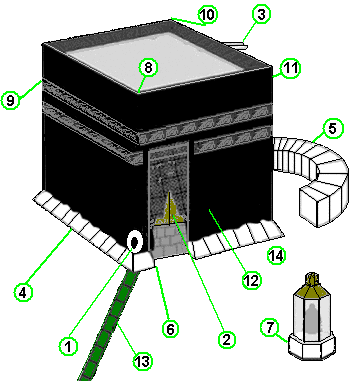
It is in the spirit of a gift that I offer Ms. Dowd this image:
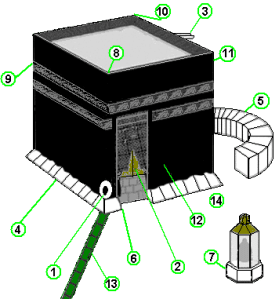
Labeled elements are as follows: 1 – The Black Stone; 2 – Door of the Kaaba; 3. Gutter to remove rainwater; 4 – Base of the Kaaba; 5 – Al-Hatim; 6 – Al-Multazam (the wall between the door of the Kaaba and black stone); 7 – The Station of Ibrahim; 8 – Angle of the Black Stone; 9 – Angle of Yemen; 10 – Angle of Syria; 11 – Angle of Iraq; 12 – Kiswa (veil covering the Kaaba); 13 – Band of marble marking the beginning and end of rounds; 14 – The Station of Gabriel.

Myth-Making

We often project our current political concerns backwards in time in order to justify ourselves. I say ‘we’ because everyone does it. Nazi Germany invented a mythical blonde Aryan people who had always been kept down by lesser breeds. The Hindu nationalists in India imagine that Hinduism has always been a centralised doctrine rather than a conglomerate of texts and local traditions, and describe Muslim, Buddhist, Christian, Sikh, Jain and animist influences on Indian history as foreign intrusions. Black nationalists in the Americas depict ancient Africa as a continent not of hunter-gatherers and subsistence farmers but as a wonderland of kings and queens, gold and silk, science and monumental architecture. To our current cost, Zionists and the neo-cons have been able to reactivate old Orientalist myths in the West, myths in which the entirety of Arab and Islamic history has involved the slaughter and oppression of Christians, Jews, Hindus, women, gays, intellectuals .. and so on.

Such retrospective mythmaking frequently goes to the most absurd extremes in young nations conscious of their weakness or of a need for redefinition (America may be one of these). Probably for that reason it is particularly evident in the Middle East.

Many Muslims go beyond adherence to those concepts and taboos that are necessary for religious belief and idolise or demonise historical figures who have nothing to do with the divine revelation. For many Sunnis, the first caliphs were ‘rightly guided’ saints who could do no wrong. During their reign there was no crime, poverty or injustice in the realm of Islam. For many Shia, the same men (apart from Ali) were decadent criminals. These secular figures were not deities or prophets but human beings working in specific contexts, with all the good and bad and moral ambiguity that implies, but Muslims frequently hold religious positions on their worth. The same applies even to later worldly figures like Haroon ar-Rasheed (saint or criminal) and Salahuddeen al-Ayubbi (likewise; as well as Kurdish traitor and hero of Arabism).

Continue reading “Myth-Making”

Is One Iraqi’s Self-Hatred Newsworthy?

Crusaders in Iraq?

M. Shahid Alam

An Arab-American of Lebanese descent, fluent in Arabic, Anthony Shadid was one of a handful of unembedded Western journalists reporting from Iraq during the US invasion in 2003. At the time, he was The Washington Post’s correspondent for Islamic Affairs in the Middle East.

His dispatches from Iraq were about Iraqis, about the destruction visited upon them by a war whose architects claimed that they were bringing democracy to that country. He reported the destruction and mayhem caused by this war by letting the Iraqis speak for themselves: and they spoke of their pain, their anguish, their perplexity and their anger.

For his honest reporting, for a job well done, Anthony Shadid received some of the highest accolades of his profession. In 2004 he received the Michael Kelly Award and the Pulitzer Prize for international reporting. Other honors followed, all well-deserved. He had won his spurs for reporting, not cheerleading, neither praising nor denouncing the United States. He was reporting for The Washington Post, a neoconservative newspaper.

On Jan 29, I noticed for the first time a report in The New York Times that carried Anthony Shadid’s byline. Was this a promotion? It was written from Halaichiya, a remote village in the southern tip of Iraq, untouched by the war. The village has never seen Americans before, neither troops nor diplomats.

Continue reading “Is One Iraqi’s Self-Hatred Newsworthy?”

Al-Biruni on India

M. Shahid Alam

Painting - Ajanta Caves

Speak the truth,
even if it were against yourselves.

Quran (4:134)

It was my master, Abu Sahl, who led me on to it.
“Write what you know about the Hindus,” he said,
“There are people who want to converse with them,
To understand their religion, science and literature.
We only have hear-say, a farrago of materials never
Sifted for accuracy. Give us facts with analysis.”

And so I put my heart to it, starting with Sanskrit.
This wasn’t an easy undertaking, without grammar
And dictionaries. I traveled through their country
Quite a bit, talking to learned Brahmans, and spared
Neither trouble nor money collecting manuscripts.
Often I invited their scholars from far-away places–
Kashmir and Kashi–to come and work with me
In Ghazni. I have endeavored in writing this book
Not to be polemical. I intend this account of India
To be nothing but a simple historic record of facts,
At once comprehensive and objective. I present
To you the theories of the Hindus, exactly as they
See them, supporting my explanations of them
With ample quotations. If any of this strikes you
As heathenish, then try to understand that such
Are the beliefs of the Hindus, and they themselves
Are best able to defend it. This book should suffice
Anyone who wants to understand the Hindus,
And discuss with them their myths, metaphysics,
And mathematics; their astronomy, arithmetic,
And astrology; their codes, customs, and conceits
On the very basis of their own civilization.

First published in Swan, 2004

–M. Shahid Alam is professor of economics at Northeastern University. He is author of Israeli Exceptionalism: The Destabilizing Logic of Zionism (Palgrave Macmillan, 2009). Write to him at alqalam02760@yahoo.com.

Iqbal, Is the Sky Yours or Mine?

Allama Iqbal
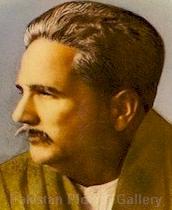
Muhammad Iqbal, 1877-1938, was a poet of Urdu and Farsi, philosopher, sufi, and revolutionary, who combined in his works the traditions of Al-Ghazzali, Rumi, Ibn-e-Khaldun, Ahmad Sirhindi and Shah Walilullah. While he understood the power of the West, had read the Western philosophers, and was familiar with the advances in physics, unlike Syed Ahmad Khan, he remained firmly rooted in Islamic tradition, and refused to re-examine the Islamicate through Orientalist texts. He was criticial of the West’s excessive emphasis on reason, its materialism, and the depredations of capitalism. Many decades before Frantz Fanon and Aime Cezaire, he was the deep thinker and stirring poet of self-discovery, urging peoples of color to regain their dignity, to dig deep into their own traditions in order to overcome, and transcend, the materialism, racism, excessive rationalism, and the West’s abuse of power and its own principles.

This ghazal is a translation from Wings of Gabriel, the best collection of Iqbal’s Urdu poetry. From time to time, I will be presenting translations from this collection.

اگر کج رو ہیں انجم آسمان تیرا ہے یا میرا

translation by M. Shahid Alam

If the stars are topsy-turvy: is the sky yours or mine?
Should this fret me? Is the world yours or mine?

If Heaven lacks the tug, the heat of love’s adventure,
Dear Lord, this cosmic enigma is yours: not mine.

On that first dawn of creation, how dared he to defy
Your decree. Was he your emissary: or was he mine?

Muhammad is yours, Gabriel and the Qur’an too.
But these melodic words: are they yours or mine?

It’s this star, scintillating, that lights your creation.
Whose loss is it – the fall of Man? Is it yours or mine?

— M. Shahid Alam is professor of economics at Northeastern University, Boston. He is author of Poverty from the Wealth of Nations (Macmillan: 2000), Challenging the New Orientalism (IPI: 2007), and Israeli Exceptionalism (Palgrave: 2009). You may reach him at alqalam02760@yahoo.com.

Lest We Forget

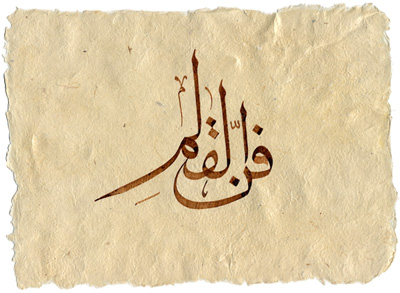
Fann alQalam - the Art of the Pen - by Soraya Syed

by Tam Hussain

On 4th of December, a rainy Friday evening, I visited Al-Khair school in Croydon. The school together with the Muslim Writers Awards were hosting a talk entitled ‘Creativity within Multi-Cultural Britain’. It had attracted me because of its absurdly ambitious vision: To jump start the creative processes which produced the likes of Iqbal, Ghalib and Al-Mutanabbi. The event was opened by Ms. Aisha Choudhry, head of Al-Khair, followed by Irfan Akram, Project Coordinator for Muslim Writers Award, Sufiya Ahmed, author of the Khadijah Academy series, Moazzam Begg, author and spokesperson for Cageprisoners, Zahid Hussain, author of The Curry Mile and Andrew Pelling, MP. The event was chaired by Abdul Fattah Hussain, organiser of the event.

Irfan Akram set the tone by pointing out that whilst Muslims in Britain are facing immense challenges, the positives outweighed the negatives. He brushed aside suggestions that publishers didn’t want to hear the voice of the Muslims; rather he suggested that Muslims should not expect automatic publication just because they have penned something. “If it is good enough it will get published and MWA is here to help.”

Continue reading “Lest We Forget”

Pakistan’s ‘Oral’ Society

Public library of Hulwan, Baghdad

M. Shahid Alam

(Note: This essay was written nearly twenty years back, in April 1991. A great many changes have come to Pakistan since then, but I am afraid that the observations I had made then about ‘orality’ of Pakistani discourse still hold true. Pakistan’s best young minds do not go where their hearts and their talents lead them. Instead, overwhelmingly, they still pursue job security. Sadly, education – even for the brightest – is still mostly vocational education. With the introduction of multiple private cable channels, however, orality has entered a new age. The oral discourse, previously confined to drawing rooms and campuses, is now led by ‘talking heads’ in television studios. Is this discourse now more solidly rooted than before in the written word, in history and the social and natural sciences? I doubt it: and why should it? Pakistan’s brown Sahibs continue to drag the country deeper into dependency; they work overtime to trap Pakistanis in the most superficial consumerism, without the capital, technology and skills that support this malaise in developed Western societies. In other words, Pakistan is still caught in the disease that Jalal Al-i Ahmad had described in his book, Gharbzadagi Occidentotis: A Plague from the West.)

I first became aware of differences between ‘oral’ and ‘literate’ societies when I returned to Pakistan in 1979 – after an absence of some five years in the United States and Canada – to take up a fellowship at the Applied Economics Research Center, affiliated to the University of Karachi.

Continue reading “Pakistan’s ‘Oral’ Society”

The Price of ‘Existing’ as a Muslim Today

In the classic French novel, Adolphe, Benjamin Constant writes: 


There are things that for a long time remain unsaid, but once they are spoken, one never ceases to repeat them.

How true this is of so many of the things we keep inside for a time. Think, for example, of how an argument with a loved one often reveals the things that we have felt, but carefully hidden from them. Once spoken, those words repeat themselves with a frequency that suggests that we are seeking vengeance for the time they spent in silence.

The same is true of our secret prejudices, which often remain unsaid until the moment ‘feels right’ or circumstances seemingly produce the ‘necessity’ for their articulation.

It appears that circumstances today have produced a space in which articulating anti-Islamic sentiment both ‘feels right’ and ‘necessary’. It is an environment marked by series of events invoked as evidence in the ever-growing case against Islam.

Continue reading “The Price of ‘Existing’ as a Muslim Today”

‘Going Deeper’ Not ‘Muslim’: Islamophobia and its Discontents

Photo by Ridwan Adhami

by Huma Dar

I deeply missed June Jordan today. Back in Fall 1995 (or was it 96?) the acclaimed poet read not her own poems, but those of her Arab students, at the first ever Berkeley “Poetry at Lunch” event. I adored her, and adored her even more when she courageously asserted that Arabs/Muslims were one of last groups it was explicitly kosher (read: not un-PC) to be racist or prejudiced towards in any given circle. Way before 9/11…

Tunku Varadarajan, a professor at NYU’s Stern Business School and a research fellow at Stanford’s Hoover Institution, recently wrote a piece “Going Muslim: America after Fort Hood.”(1) He coins the phrase “Going Muslim” to “describe the turn of events where a seemingly integrated Muslim-American—a friendly donut vendor in New York, say, or an officer in the U.S. Army at Fort Hood—discards his apparent integration into American society and elects to vindicate his religion in an act of messianic violence against his fellow Americans.”(2)

Continue reading “‘Going Deeper’ Not ‘Muslim’: Islamophobia and its Discontents”