What Price Assad’s Rehabilitation?

Bente Scheller, Middle East Director of Heinrich Böll Stiftung and author of the excellent The Wisdom of Syria’s Waiting Game: Foreign Policy Under the Assads, asks if the West is prepared to pay the high political and financial costs of rehabilitating Assad.

A rehabilitation of Syria would come at an exorbitantly high price, politically as well as financially. How much is the West prepared to pay?
Photo: Beshr Abdulhadi. This image is licensed under Creative Commons License.

If you cannot overthrow the tyrant, co-operate with him – after four disastrous years in Syria this seems to be the conclusion the international community has arrived at. While back in 2011 Bashar al-Assad’s days appeared to be drawing to a close, a growing number of people are now suggesting to see him as part of the solution, as illustrated recently by UN Special Envoy Staffan de Mistura in Vienna.

The more methodical and brutish Syria’s dictator disregards human rights, the more he seems to assume the role of a potentially reliable partner in the eyes of some. That is primarily due to the Islamist terror army ISIS. Albeit there are few atrocities with civilian victims the regime is not responsible of committing and although it commits these crimes to a much greater, deadlier extent – Assad is readily seen as the “lesser evil”.

The implication that the situation in Syria could be pacified through a co-operation with Assad in the battle against terrorism is as plain as it is ill-conceived when it comes to the actual implementation. The fight against ISIS requires three things: the means, the will and a strategy.

Continue reading “What Price Assad’s Rehabilitation?”

A Critical Exchange with Reese Erlich on Syria, ISIS & the Left

Reese Erlich is a foreign correspondent with GlobalPost and reports regularly for National Public Radio (NPR), the Canadian Broadcast Corporation (CBC), and Radio Deutsche Welle. His reporting has earned him multiple awards over the years. The San Francisco Board of Supervisors declared September 14, 2010, “Reese Erlich Day” in honor of his investigative work. “Mr. Erlich,” the resolution read, “exhibits the finest qualities of…reporters willing to comfort the afflicted and afflict the comfortable.”

He is also a friend of mine. We met in the home of our mutual friend Stephen Kinzer. Kinzer wrote the Foreword to Erlich’s book Dateline Havana: The Real Story of US Policy and the Future of Cuba and when Erich was in Chicago in early 2009 to discuss the book, Kinzer hosted a gathering for him in his home in Oak Park. It was a fabulous evening, and Erlich and I stayed in touch. A few months later he was in Iran, reporting on the historic protests that convulsed the Islamic Republic following its June presidential election. He wrote some of the very smartest stuff about those dramatic events. Erlich is a dyed–in–the–wool New Leftist who cut his teeth at Ramparts, the iconic magazine of 1960s radicalism, but he took many of his fellow leftists to task for the utter myopia they displayed amidst the events in Iran that summer. His essay “Iran and Leftist Confusion” was bang-on and desperately-needed. He also provided a healthy corrective to the pervasive narcissistic blather about Iran’s Green movement being a Twitter revolution.

A couple years on, when his book Conversations with Terrorists: Middle East Leaders on Politics, Violence and Empire came out, I set up an event for Erlich at Chicago’s No Exit Cafe. And in 2013, when Erlich and Norman Solomon (his co-author on the 2003 book Target Iraq: What the News Media Didn’t Tell You) did a speaking tour to mark the 10th anniversary of the US invasion of Iraq, I set up an them for them in Denver.

In Erlich’s latest book, Inside Syria: The Backstory of Their Civil War and What the World Can Expect​, he criticizes me and my colleague Nader Hashemi for advocating humanitarian intervention to end the criminal starvation sieges in Syria. He reached out to me before the book went to print, asking me to read this section and send him feedback. We had sharp disagreements about Syria, but I appreciated his spirit of generosity and friendship. In this same spirit, I was happy to host him once again in Denver for a talk on his new book. But I was also keen to sit him down for a critical exchange about his book for the video series that our Center for Middle East Studies produces.

Our conversation reflects both my deep respect for Reese’s work and also my serious disagreements with him. It is a spirited and critical (in the best sense) exchange between two leftists with different perspectives on one of key issues of our time.

Israelpolitik, the Neocons and the Long Shadow of the Iraq War—A Review of Muhammad Idrees Ahmad’s book ‘The Road to Iraq: The Making of a Neoconservative War’

This essay first appeared in The Drouth (‘The Thirst’), a quarterly magazine published in Glasgow (Issue 50, Winter 2014/2015). I wrote it in December 2014.

The Road to Iraq book coverThe Road to Iraq: The Making of a Neoconservative War
By Muhammad Idrees Ahmad
Edinburgh University Press
£19.99

Reviewed by Danny Postel

I was reluctant to review this book. With all the dramatic developments in the Middle East today—the ISIS crisis, the siege of Kobanê, the deepening nightmare in Syria, the escalating repression in Egypt, the fate of Tunisia’s democratic transition, the sectarianization of regional conflicts driven by the Saudi-Iranian rivalry—delving back into the 2003 invasion of Iraq seemed rather less than urgent. It’s hard enough just to keep up with the events unfolding day-to-day in the region. Reading—let alone reviewing—a detailed study of the internal processes that led to the United States toppling Saddam Hussein over a decade ago seemed remote, if not indeed a distraction.

But I’m glad I set these reservations aside and took the assignment. This forcefully argued and meticulously researched (with no fewer than 1,152 footnotes, many of which are full-blown paragraphs) book turns out to be enormously relevant to the present moment, on at least three fronts:

  • ISIS emerged from the ashes of al Qaeda in Iraq, which formed in the immediate aftermath of the 2003 invasion and occupation of Iraq. Without the 2003 invasion, there would be no ISIS as we know it—and the region’s political landscape would look very different.
  • The US Senate report on CIA torture has brought back into focus the rogues gallery of the Bush-Cheney administration—the same cast of characters who engineered the 2003 Iraq invasion. This book shines a heat lamp on that dark chapter and many of its protagonists.
  • There is talk of a neoconservative comeback in Washington. This thoroughly discredited but zombie-like group are now angling for the ear of Hillary Clinton, who might be the next US president. Ahmad’s book provides a marvelously illuminating anatomy of the neocons, which has lessons that apply directly to this movement’s potentially ominous next chapter.

The central question Ahmad attempts to answer is: Why did the 2003 Iraq War happen? In one of the book’s most valuable sections, felicitously titled ‘Black Gold and Red Herrings’, he goes through several prevalent explanations/theories and takes them apart one by one: Continue reading “Israelpolitik, the Neocons and the Long Shadow of the Iraq War—A Review of Muhammad Idrees Ahmad’s book ‘The Road to Iraq: The Making of a Neoconservative War’”

Should We Oppose the Intervention Against ISIS? An Exchange of Views

Reposted from In These Times


Should We Oppose the Intervention Against ISIS?

Most U.S. leftists say yes. But voices we rarely hear—Kurds and members of the Syrian opposition—have more ambiguous views.

ISIS (or ISIL, or the Islamic State) sent shock waves through the Middle East and beyond in June when it seized Mosul, Iraq’s second-largest city. The organization has now laid claim to a swath of territory “stretching from Baghdad to Aleppo and from Syria’s northern border to the deserts of Iraq in the south,” in the words of Patrick Cockburn, author of The Jihadis Return: ISIS and the New Sunni Uprising.

In August, the United States assembled an international coalition (eventually including more than a dozen countries) to conduct a campaign of air strikes on ISIS positions in Iraq, coordinating with Iraqi and Kurdish Peshmerga forces. Then, in October, the coalition expanded the intervention into Syria, coordinating with Kurdish fighters on the Syrian-Turkish border and Free Syrian army forces.

American progressives have been relatively uniform in opposing the intervention against ISIS. But to most Kurds and many Syrian activists, the intervention is more welcome. Turkish and Syrian Kurds along the border watch the battles against ISIS from hilltops, breaking out in cheers and chanting, “Obama, Obama.” Within the Syrian opposition, one finds a range of perspectives—some support intervention, others oppose it, and many, like the Syrian leftist intellectual Yassin al-Haj Saleh, are torn. In late September Saleh told me, Continue reading “Should We Oppose the Intervention Against ISIS? An Exchange of Views”

How does the “Islamic State” change the perception of the conflict in Syria?

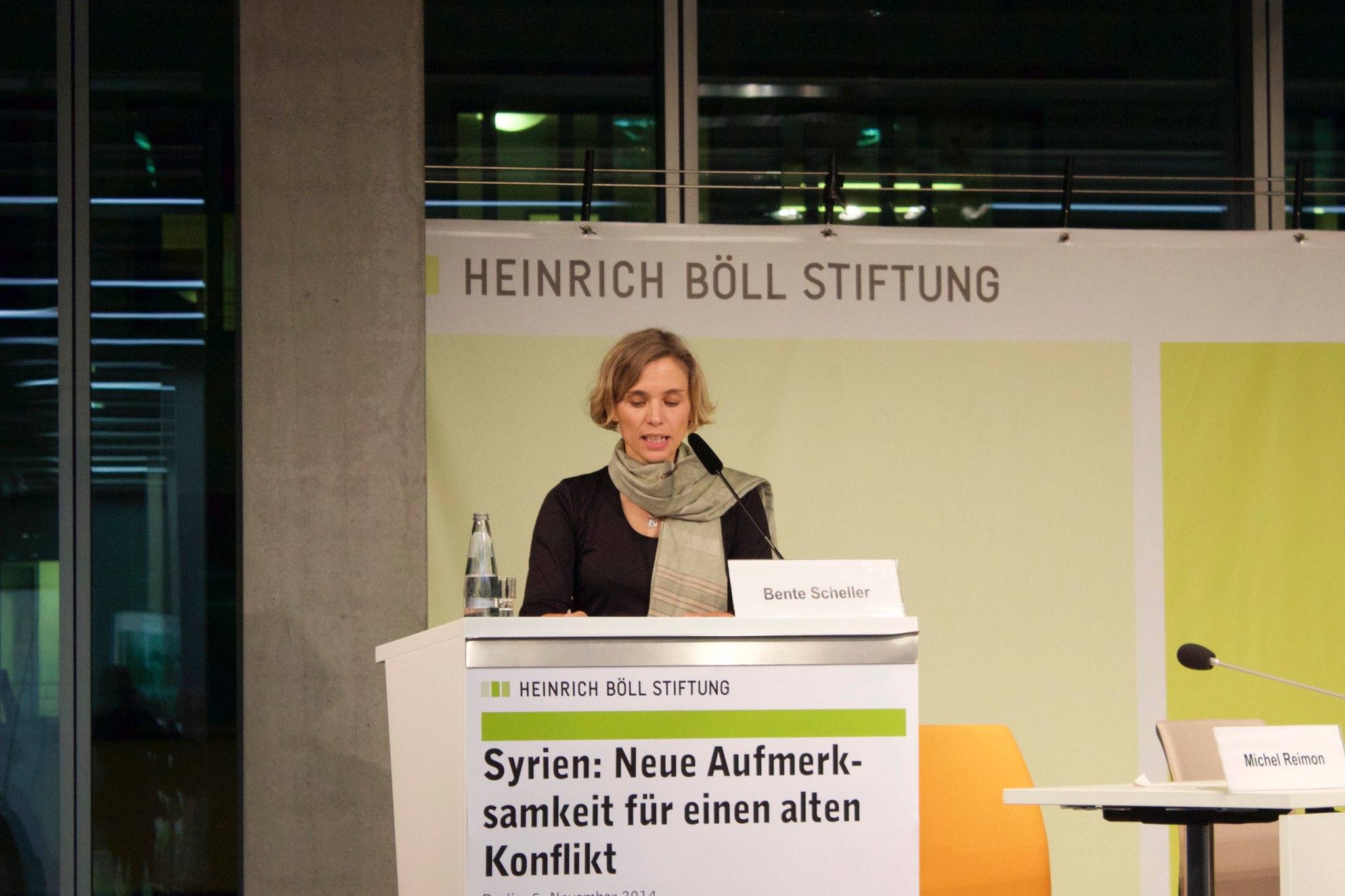
Bente Scheller delivered the following keynote lecture at a recent conference on Syria at the Heinrich Böll Foundation in Berlin.

10700636_10154775355540591_192187468175987021_o

War, it is commonly said, is a last resort. That is a wise notion and one that should be in the best interest of every party. However, it is problematic to use it as legitimation for the choice to perpetually remain in an observant position. ‘Last’ should mean: last possible – when diplomatic efforts are of no avail, and not for when it is already too late.

The Syrian regime has turned the concept of ‘war as a last resort’ inside out. It commenced the war against its own population without seriously considering the reforms initially demanded by protesters. Children were the first victims of the regime, the first victims of torture in the recent conflict, which led to the outbreak of the revolution in March 2011. Rarely did the regime negotiate in the course of this conflict – and when it did, it regularly broke its promises.

Continue reading “How does the “Islamic State” change the perception of the conflict in Syria?”

Sectarianization: Steven Heydemann & Joshua Landis on the Trajectory of the Syrian Nightmare

Earlier this month I had the opportunity to interview two of the leading Syria experts in the world, Steven Heydemann and Joshua Landis, about the “big picture” of the Syrian conflict and the wider crisis engulfing the Middle East today, as part of the CMES Conversations series produced by the Center for Middle East Studies at the University of Denver. Landis, while best known as a blogger and commentator on Syria, is an historian. Heydemann is a political scientist who has written an influential study of Syrian politics covering the years 1946-1970.

The two interviews offer contrasting perspectives, but both take us several steps back from the news cycle and place the events unfolding in the region today in a wider historical, comparative and global lens. This was the focus of the forum that brought them to Denver, “Sectarianization: ISIS, the Syrian Conflict & the Future of the Middle East”. Sectarianization will be a central focus of our  in the coming months, and is the theme of the book my colleague Nader Hashemi and I are currently co-editing (our last book being The Syria Dilemma).

Steven Heydemann is Vice President of Applied Research on Conflict at the United States Institute of Peace (USIP). He’s the author of Authoritarianism in Syria: Institutions and Social Conflict, 1946-1970, the editor of War, Institutions and Social Change in the Middle East and co-editor of Middle East Authoritarianisms: Governance, Contestation, and Regime Resilience in Syria and Iran.

Our interview revolves largely around Heydemann’s far-reaching report “Syria’s Uprising: sectarianism, regionalisation, and state order in the Levant”, published by the European think tank FRIDE. Have a look:

Joshua Landis is Associate Professor in the College of International Studies at the University of Oklahoma, where he is also Director of the Center for Middle East Studies. Widely regarded as one of the leading Syria experts in the world, he is the former President of the Syrian Studies Association. He writes and edits the widely-read blog Syria Comment.

Our interview revolves principally around two of his recent articles: “The Great Sorting Out: Ethnicity & the Future of the Levant” and “Why Syria is the Gordian knot of Obama’s anti-ISIL campaign”. Have a look:

The West’s Syria policy has been shaped by media missionaries

A version of this appeared in The National:

nationalThree beheadings have compelled the US into an action that nearly 200,000 gruesome deaths had failed to precipitate.

Last Monday, the US launched a bombing campaign in Syria putatively aimed at the extremist jihadi group ISIL. Also targeted were some “Al Qaeda-linked” organisations. The strikes killed many members of Jabhat Al Nusra (JAN) and Ahrar Al Sham (AS). Both groups are hardline, but their focus is regional. Neither threatens the US; both fight ISIL. But for the US, according to one administration official, it is all “a toxic soup of terrorists”.

Syrian dictator Bashar Al Assad concurs. State media quoted him as supporting any international effort to combat “terrorism” in Syria. For weeks, his regime had been volunteering itself as an ally to the US in its “war on terror”, a status that it had enjoyed under George W Bush. Damascus was once a favoured destination for CIA rendition flights.

It is possible it got its wish. The Syrian opposition, which western polemicists habitually describe as “US-backed”, received no warning of the attacks. Assad and Iran did. Syria’s UN representative Bashar Ja’afari was personally briefed by Samantha Power. The Free Syria Army (FSA) learnt of the attacks from the news.

If JAN and AS have ended up in the same “toxic soup” with their rival ISIS, then it has much to do with poor intelligence and an impoverished media discourse.

Continue reading “The West’s Syria policy has been shaped by media missionaries”

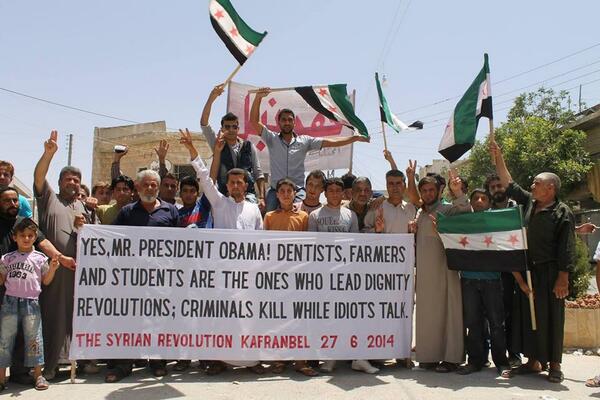
Shock and Awe versus Dentists, Farmers and Students

binladensWhatever the hearts-and-minds rhetoric at the United Nations, in Syria the Obama administration is feeding the flames of Sunni extremism, and proving once again the truism that the American state is an enemy of the Syrian people (as it’s an enemy, like all states, of all peoples, including the American).

We expected strikes on ISIS. Some of the strongest strikes (and the strikes are far stronger than in Iraq), however, have been aimed at Jabhat al-Nusra (the Victory Front), the organisation from which ISIS split. Nusra is certainly an extremist Salafist group, and is openly linked to al-Qa’ida. Because its ideology terrifies not only minorities but also huge swathes of the Sunni population, it’s also a strategic obstruction in the way of the Syrian revolution. In August 2013 it participated (with ISIS) in the only documented large-scale massacre of Alawi civilians in the conflict. On the other hand, Nusra (unlike ISIS) was until yesterday actually fighting the regime, not other rebel groups. From January, along with every rebel formation, it’s been fighting ISIS too. And its leadership is entirely Syrian. Many Syrians, not necessarily extremist Salafists themselves, admire Nusra’s victories against their most immediate enemy – the Assadist forces dropping barrel bombs and raping and torturing at checkpoints. A sensible answer to Nusra would be to provide weapons and funds to Free Army forces who would then be in a position to gradually draw men from the organisation, slowly making it irrelevant (most men don’t care about the ideology of their militia’s leadership; they care about food and ammunition). But the Americans are allergic to working with the people on the ground most immediately concerned by the outcome, and bomb from the air instead. Nusra is now abandoning front line positions (in some areas the regime may be able to take immediate advantage). One Nusra leader has already spoken of an alliance with ISIS against the Americans.

Syria’s new daily routine: the Americans and Gulf Arabs bomb the Salafist extremists while Assad bombs the Free Army and Islamic Front (and of course civilians – as usual it isn’t being reported, especially not now the televisual US war is on, but about a hundred are being killed every day). The headline in regime newspaper al-Watan reads “America and its Allies in One Trench with the Syrian Army against Terrorism”. The opposition reads it this way too. Several demonstrations yesterday condemned the American strikes, called for America’s fall, and for solidarity with ISIS and Nusra. A sign at one protest read: “Yes, It’s an International Coalition Against Sunnis.”

Continue reading “Shock and Awe versus Dentists, Farmers and Students”

Three Monsters

threemonstersPart of me, of course, is happy to see bombs fall on the heads of the international jihad-fascists tormenting the Syrian people (I refer to ISIS, not the Shia jihad-fascists fighting for Assad, who I’d love to see bombed too). Mostly, I’m just disgusted. In the name of disengagement the West not only refused to arm and supply the democratic Syrian opposition – even as Assad launched a genocide against the people – the United States actually prevented other states from providing the heavy weapons and anti-aircraft weaponry the Free Army so desperately needed. It was obvious what would happen next. The Free Army – and the Syrian people – were increasingly squeezed between Assad and the ISIS monster. And now the Americans are bombing both Iraq and Syria. This is where ‘disengagement’  and ‘realism’ has brought us.

ISIS, like Assad, can be hurt from the air but defeated only on the ground. Obama and the Congress have just agreed to spend $500 million on training 5000 vetted members of the Free Syrian Army – the same people that Obama mocked as irrelevant “pharmacists, farmers and students” a few months ago. The training won’t be finished for eight months, and anyway will be of little use. The Free Army now houses some of the best, most battle-hardened fighters in the world. They don’t need training; they need weapons. In the present balance of forces, in any case, the wounds inflicted by America’s photogenic bombing run may not translate into any improvement on the ground. Only Syrians can improve things on the ground.

The West was not moved to act by 200,000 (at least) slaughtered, or nine million homeless, or by barrel bombs, rape campaigns, starvation sieges or sarin gas. It was only moved when an American was beheaded. The inconsistency is noted well by Syrians. In some quarters, an assault on ISIS which is not accompanied by strikes on Assad and aid to the Free Army will be perceived as a Western-Shia-Assadist alliance against persecuted Sunnis. This could increase the appeal of ISIS and successor Sunni extremist groups.

ISIS has many parents, but the first of these, in Syria at least, is Assad. He released extremists from prison while he was assassinating unarmed democrats. He sectarianised the conflict by setting up sectarian death squads and by bringing in Iran-backed Shia militias from Iraq and Lebanon. His scorched earth policy made normal life impossible in the liberated areas, creating the vacuum in which organisations like ISIS thrived. And until this June, he had an effective non-aggression pact with ISIS, not fighting it, buying oil from it. From January, on the other hand, all opposition militias – the Free Army groups and the Islamic Front groups – have been fighting ISIS (and losing thousands of men in the struggle). These fighters are not about to become an on-the-ground anti-ISIS militia, as the Americans seem to want. They know the truth – that both states, the Assadist and the psychotic-Islamist, are absolute enemies. There’s no destroying one without the other. And both must be destroyed by Syrian hands, not by foreign planes.

Continue reading “Three Monsters”

What Realism wrought in Syria

Some weeks back, I debated the renowned political scientist Steve Walt of Harvard’s Kennedy School of Government on Chris Lydon’s excellent Radio Open Source. The debate happened at 3am my time, so I wasn’t as coherent and articulate as I’d have liked to be, and I didn’t get enough time to challenge some of Steve’s statements. I recently wrote the following piece for The National in which I critique what I think is wrong with political Realism, an approach that in most cases I tend to agree with.

Four months after the Syrian regime gassed the neighborhoods of Eastern Ghouta, Ryan Crocker, the blue-eyed scion of the US foreign policy establishment, offered sobering advice. “It is time to consider a future for Syria without Assad’s ouster,” wrote he in an op-ed for the New York Times, “because it is overwhelmingly likely that is what the future will be.”

It is overwhelmingly likely that this is what the future will be, but it is only because there is a readiness in the US foreign policy establishment to consider a future for Syria without Assad’s ouster. The readiness is based on false choices and flawed assumptions. It is undergirded by the intellectual dogmas of realism.

Realism is making a triumphant return after a decade of disasters wrought by neoconservatism. Realists had warned about the folly of invading Iraq and predicted dire consequences. They were proved right. Realism had also served as a useful check on imperial over-reach during the Cold War. As an analytical aid, it is sober, conscious of the limits of power, and leery of what the American sociologist C. Wright Mills called “military metaphysics” – the preference for resolving political problems through military means.

Continue reading “What Realism wrought in Syria”