The Reut Report: Taking Over the World – One Antisemite at a Time

The Reut Blog banner - The image of "beautiful, tolerant, modern, iconic Israel"

The Reut Institute sent their “National Security Team” for a whole year in London; conducted interviews with over 150 people (“experts and activists from a range of fields”); Studied biology, economics, terrorism, the internet and Frank Sinatra. All this in order to investigate the BDS movement. They wrote a report, mouthfully titled “Building a Political Firewall against the Assault on Israel’s Legitimacy: London as a Case Study” and this is their conclusion:

Hamas Did It Because They Want to Destroy Israel!

Continue reading “The Reut Report: Taking Over the World – One Antisemite at a Time”

Why Academic Boycott?

Last week I thoroughly dealt with the not-so-scholarly and o-so-fallacious Nobel Laureates’ statement on BDS.  In almost pure cosmic irony I just got a link from a friend to a Prime Minister’s Office “non-tender”: Request for information about improving Israel’s image on U.S.A campuses.

Now that those talkback-esque arguments are out of the way, let’s get into the direct cynical use the Israeli government makes of the academia, in order to further its propaganda.

[Limited by my translation]:

Continue reading “Why Academic Boycott?”

Shylock, Fagin, and Finkler: Howard Jacobson’s The Finkler Question

by Jeremiah Haber

Fink – “an unpleasant, contemptible person”; “a strikebreaker”; “an informer”. The slang word is an Americanism, which may have Germanic roots, and is not common in England.

Move over Shylock and Fagin -there is a new star in the firmament of negative Jewish characters in English Literature, the anti-Zionist Jew of Howard Jacobson’s new novel, The Finkler Question. While he is in his anti-Zionist phase, Samuel Finkler has only two positive character traits: Like Shylock, he is concerned with the pursuit of justice (though not for his own people); like Fagin he is faithful to his friends (but not to his people, or his wife.) Until Finkler becomes disenchanted with anti-Zionism he is an odious fellow; selfish, arrogant, hypocritical. A professional philosopher specializing in ethics (since he is an amoralist he can rationalize cheating on his wife), Finkler relishes his role as public intellectual, talking head, and household name. He gladly accepts an invitation to appear on the BBC program Desert Island Discs, despite the fact that he knows little and cares less about music; for him the appearance is a “career move.” And when Finkler announces on the show that he is ashamed of being a Jew because of Israel’s treatment of the Palestinians (after duly noting about how important Judaism is to him), he joins a club of “ASHamed Jews” — not because he has serious ideological affinities with the members but because some of them are quasi-celebs who admire his “courage” for speaking out. In the company of Jews who are ashamed about Israel’s treatment of the Palestinians, Finkler finds his Jewish métier; indeed, only as a self-hating anti-Zionist Jew can Finkler be truly Jewish. As his wife, a convert to Judaism, puts it,

Have you forgotten that you don’t like Jews? You shun the company of Jews. You have publically proclaimed yourself disgusted by Jews because they throw their weight around and then tell you they believe in a compassionate God. And now because a few mediocre half household-name Jews have decided to come out and agree with you, you’re mad for them. Was that all it ever needed? Would you have been the goodest of all good Jewish boys if only the other Jewish boys had loved you earlier? I don’t get it. It makes no sense. Becoming an enthusiastic Jew again in order to turn on them…Remember what it is you really want, Samuel…Sam! And what you really want isn’t the attention of Jews. There aren’t enough of them.

Continue reading “Shylock, Fagin, and Finkler: Howard Jacobson’s The Finkler Question”

Some Unvarnished Truths About the US and Israel

by M. Shahid Alam

Was there ever a time when a leading organ of the US media could speak the unvarnished truth about the links between the United States and Israel?

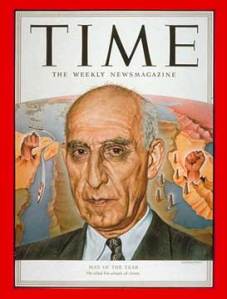
Consider this quote from Time magazine of January 1952, embedded in an article that explained its choice of Mohammed Mossadegh as its Person of the Year for 1951. It had no compliments for Mossadegh, the man who was spearheading his country’s bid to take back its oil resources from the British-owned Anglo-Iranian Oil Company. No surprise there.

Surprising, however, is Time’s candor on Israel. It minces no words. US support for the creation of Israel had alienated the Middle East: it had been a costly error, motivated not by national interest but petty considerations of presidential politics. Truman had supported the creation of Israel in order to court American Jewish votes. This was the plain truth: a US President had placed his electoral chances ahead of a vital national interest. Apparently, in those days, Time could write the plain truth without worrying about the tide of flak from the American Jewish community.

Continue reading “Some Unvarnished Truths About the US and Israel”

Ilan Pappe on Zionist Ideology


Ilan Pappe at the Palestine Solidarity conference in Stuttgart am 27 November 2010.

Continue reading “Ilan Pappe on Zionist Ideology”

Shahid Alam’s Destabilising Logic of Zionism

This review of Shahid Alam’s indispensable book was written for Holy Land Studies.

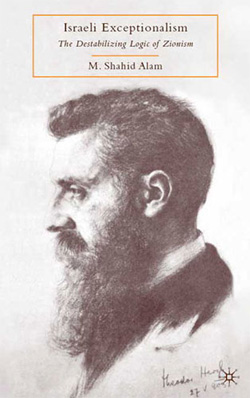
M. Shahid Alam’s latest book “Israeli Exceptionalism: The Destabilising Logic of Zionism” is a fascinating historical analysis, densely detailed and referenced, of the nature and trajectory of Jewish nationalism. It is bracingly honest, dispensing with the usual Western pieties to describe three elements of what Edward Said called Israel’s “ideology of difference.” These are, firstly, the notion of Jewish chosenness and divine right to Palestine; secondly, the ‘miraculous’ creation and survival of the state; and thirdly, the uniquely tragic history of the Jewish people.

Many studies have deconstructed the first two myths. Less attention has been lavished on countering the third, the “lachrymose historiography” of the Jews (in Salo Baron’s words) and its employment to neutralise criticism of the Zionist project. Alam argues persuasively that Zionism was not simply a response to virulent anti-Semitism but also, crucially, the result of Jewish power.

Until the rise of fascism, the trend of Jewish involvement in modern Europe was one of phenomenal success. This is despite recurring episodes of anti-Semitism, particularly in the east. The European Jewish population increased more than tenfold in the eighteenth and nineteenth centuries (the general population increase was by a factor of 3.3). In the same period, Jews moved into the West’s urban power centres. Ironically, anti-Semitic discrimination had “endowed the Jews disproportionately with those assets that would give them vital advantages in Europe’s emerging capitalist societies.” By the early 19th Century, Jews owned 30 of 52 private banks in Berlin. In Vienna in 1900, 62% of lawyers, half the doctors and over half the journalists were Jews. An important strata of Jews now had both money and access to political and cultural elites.

Continue reading “Shahid Alam’s Destabilising Logic of Zionism”

Zionism: Two Deficits

M. Shahid Alam

We do not fit the general pattern of humanity…”

David Ben-Gurion

…only God could have created a people so special as the Jewish people.

Gideon Levy

The fecundity of the Zionist project in producing claims of exceptionalism is not in doubt. Anyone who scans the voluminous Zionist literature will be suitably impressed by its repeated resort to claims of Jewish and Israeli exceptionalism. There is scarcely any aspect of Israeli or Jewish history that has not been embellished with some claim to uniqueness.

Israeli exceptionalism has many uses. It defends, obscures, explains away the ‘abnormal’ character of the Zionist nationalist project. When the Irish sought national liberation, their goal was straightforward. They wanted to regain national control over their lives and their country from a foreign power. No one had to convince the Irish that they are descended from the gods; that they possessed a unique essence which set them apart from all other peoples; or that their history, religion, race, language, morality or culture set them above their colonial masters. Occasionally, driven by exuberance or hubris, nationalists have advanced exceptionalist claims, but the success of their movement has not depended on their acceptance. The Irish claimed sovereignty because they knew that they are a nation with their own territory. In order to create their own state, they did not have to establish that they are exceptional.

The Zionists confronted two handicaps that Irish nationalists did not face. The diverse and scattered Jewish communities of Europe – and even more so, the world – did not constitute a single people. Instead, the Jews of the world were loosely united by their religious heritage, but they shared their languages, cultures and genes with their neighboring communities. Moreover, no Jewish community had its own country, a substantial and contiguous territory where it formed a majority of the population. Despite these twin Jewish deficits – the absence of a nation and a national territory – the Zionists were determined to ‘liberate’ the Jews of Europe and endow them with their own state.

The Zionists would remedy the first deficit by denying its existence. They knew that the Jews were not a nation, but it would be unwise to begin their ‘nationalist’ movement with the admission that a Jewish nation did not yet exist. They also did not think that this deficit was a serious hindrance to their movement. With help from anti-Semites, whose attacks had been growing in recent decades, the Zionists were convinced that they could quickly convince enough frightened Jews that they are a nation. Instead of constructing a nationalism based on a common religion, however, the Zionists chose to cultivate a racial basis for Jewish nationalism. They embraced the anti-Semitic accusation that Jews of Europe are an alien race, not Germans or Russians, descended from the ancient Hebrews.

Continue reading “Zionism: Two Deficits”

Palestine liberation recalls anti-apartheid tactics, responsibilities and controversies

by Patrick Bondhttps://i0.wp.com/sabbah.biz/mt/wp-content/uploads/2007/04/4_9Mirror_on_Apartheid_Wall.jpg

On a full-day drive through the Jordan Valley late last month, we skirted the earth’s oldest city and the lowest inhabited point, 400 meters below sea level. For 10,000 years, people have lived along the river separating the present-day West Bank and Jordan.

Since 1967 the river has been augmented by Palestinian blood, sweat and tears, ending in the Dead Sea, from which no water flows out, it only evaporates. Conditions degenerated during Israel’s land-grab, when from a peak of more than 300,000 people living on the west side of the river, displacements shoved Palestinian refugees across to Jordan and other parts of the West Bank. The valley has fewer than 60,000 Palestinians today.

But they’re hanging in. “To exist is to resist,” insisted Fathi Ikdeirat, the Save the Jordan Valley network’s most visible advocate (and compiler of an exquisite new book of the same name). At top speed on the bumpy dirt roads, Ikdeirat maneuvered between Israeli checkpoints, through Bedouin outposts in the dusty semi-desert, where oppressed communities eke out a living from the dry soils.

Continue reading “Palestine liberation recalls anti-apartheid tactics, responsibilities and controversies”

Zionists: terrorist pioneers

Via Stuart Littlewood:

Here’s the roll-call [from delphiforums] on who introduced terrorism (along with biological, chemical and nuclear weapons) to the Middle East:

  • Bombs in cafés: first used by Zionists in Palestine on 17 March 1937 in Jaffa (they were grenades)
  • Bombs on buses: first used by Zionists in Palestine on 20 August- 26 September 1937
  • Drive-by shootings with automatic weapons: IZL and LHI in 1937-38 and 1947-48 (Morris, Righteous Victims, p681.)
  • Bombs in market places: first used by Zionists on 6 July 1938 in Haifa. (delayed-action, electrically detonated)
  • Bombing of a passenger ship: first used by the Zionists in Haifa on 25 November 1940, killing over 200 of their own fellows.
  • Bombing of hotels: first used by Zionists on 22 July 1946 in Jerusalem (Menachem Begin went on to become prime minister of Israel).
  • Suitcase bombing: first used by Zionists on 1 October 1946 against British embassy in Rome.
  • Mining of ambulances: first used by Zionists on 31 October 1946 in Petah Tikvah
  • Car-bomb: first used by Zionists against the British near Jaffa on 5 December 1946.
  • Letter bombs: first used by Zionists in June 1947 against members of the British government, 20 of them.
  • Parcel bomb: first used by Zionists against the British in London on 3 September 1947.
  • Reprisal murder of hostages: first used by Zionists against the British in Netanya area on 29 July 1947.
  • Truck-bombs: first used by Zionists on January 1948 in the centre of Jaffa, killing 26.
  • Aircraft hijacking: world-first by Israeli jets December 1954 on a Syrian civilian airliner (random seizure of hostages to recover five spies) – 14 years before any Palestinian hijacking.

Continue reading “Zionists: terrorist pioneers”

Zionist Dialectics: Past and Future

Excerpted from Israeli Exceptionalism (Palgrave: 2009).

by M. Shahid Alam

My God! Is this the end? Is this the goal for which our fathers
have striven and for whose sake all generations have suffered?
Is this the dream of a return to Zion which our people have
dreamt for centuries: that we now come to Zion to stain its soil
with innocent blood?”

Ahad Ha’am, 1921

This study has employed a dialectical framework for analyzing the destabilizing logic of Zionism. We have examined this logic as it has unfolded through time, driven by the vision of an exclusionary colonialism, drawing into its circuit – aligned with it and against it – nations, peoples, forces, and civilizations whose actions and interactions impinge on the trajectory of Zionism, and, in turn, who are changed by this trajectory.

It would be a bit simplistic to examine the field of interactions among the different actors in this historic drama on the essentialist assumption that these actors and their interests are unchanging. Instead, we need to explore the complex ways in which the Zionists have worked – and, often have succeeded – to alter the behavior of the other political actors in this drama: and, how, in turn, the Zionists respond to these changes. Most importantly, we need to explore all the ways in which the Zionists have succeeded in mobilizing the resources of the United States and other Western powers to serve their specific objectives.

Continue reading “Zionist Dialectics: Past and Future”