PRESS RELEASE from Free Kashmiri Political Prisoners Campaign

Free Kashmiri Political Prisoners, an online campaign to release Kashmiri political prisoners from various Indian jails, has attracted endorsement and support from academics, intellectuals and filmmakers from around the world. The campaign has been successful in raising awareness about the condition of Kashmiri political prisoners, young and old, who have been languishing in Indian prisons for years or live under continuous threat from draconian ordinances like Public Safety Act. This might also be the beginning of the end of Indian colonial obfuscation around its occupation of Kashmir in academia worldwide.

Indian Occupied Kashmir

Free Kashmiri Political Prisoners, an online campaign for the release of Kashmiri political prisoners from various Indian jails, has attracted endorsement and support from academics, intellectuals and filmmakers from around the world. Eminent intellectuals and scholars like Judith Butler (Hannah Arendt Chair at the European Graduate School and Maxine Elliot Professor in the Departments of Rhetoric and Comparative Literature, University of California at Berkeley), Hamid Dabashi (Hagop Kevorkian Professor of Iranian Studies and Comparative Literature, Columbia University), Ayesha Jalal (Mary Richardson Professor of History, Professor at Fletcher School of Law and Diplomacy, Director of Center for South Asian and Indian Ocean Studies, Tufts University), Lisa Duggan (Professor, American Studies and Gender and Sexuality Studies, Department of Social and Cultural Analysis, New York University (NYU), President-Elect American Studies Association (ASA), USA), Tariq Modood (Professor of Sociology, Politics and Public Policy, Director of the University Research Centre for the Study of Ethnicity and Citizenship, University of Bristol), Lisa Hajjar (Professor of Sociology, University of California at Santa Barbara), Chandra Talpade Mohanty (Distinguished Professor, Department of Women’s and Gender Studies, Dean’s Professor of the Humanities, Syracuse University), Abdul R. JanMohamed (Professor, English Department, Emory University, University of California at Berkeley), Rabab Ibrahim Abdulhadi (Associate Professor of Ethnic Studies/Race and Resistance Studies, Senior Scholar, Arab and Muslim Ethnicities and Diasporas Initiative (AMED), San Francisco State University), Suvir Kaul (A. M. Rosenthal Professor of English, University of Pennsylvania), Ania Loomba (Catherine Bryson Professor of English, University of Pennsylvania), Joel Beinin (Donald J. McLachlan Professor of History, Professor of Middle East History, Department of History, Stanford University), Sherene Razack (Professor, Department of Humanities, Social Sciences and Social Justice Education and Department of Comparative, International and Development Education,  OISE, University of Toronto), Ruth Wilson Gilmore (Professor of Earth & Environmental Sciences, and American Studies, Director of Center for Place, Culture, and Politics, Graduate Center, City University of New York), Ibrahim Abdurrahmani Farajajé (Provost and Professor of Cultural Studies and Islamic Studies, Starr King School, Graduate Theological Union (GTU), Berkeley), Neferti Tadiar (Professor and Chair of Women’s Studies, Barnard College, Columbia University), Kamala Visweswaran (Associate Professor of Anthropology, University of Texas at Austin), Piya Chatterjee (Dorothy Cruickshank Backstrand Chair of Gender and Women’s Studies, Scripps College), and Joseph Massad (Associate Professor, Middle Eastern, South Asian, and African Studies, Columbia University) are amongst the prominent signatories. Continue reading “PRESS RELEASE from Free Kashmiri Political Prisoners Campaign”
Free Kashmiri Political Prisoners, End the Occupation of Kashmir

We send you this request in hopes of garnering your crucial and valuable support for the letter attached below. This letter is a response to the dire conditions of thousands of Kashmiri political prisoners, both adults and minors, under the Indian Occupation. Your support will help bring global attention to this critical and urgent issue.

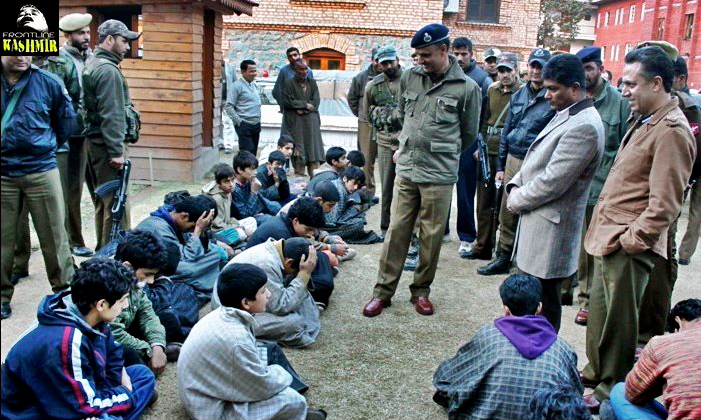
Indian Occupation Forces and their 'Fearsome' Targets: Young Kashmiri Boys
Indian Occupation Forces and their ‘Fearsome’ Targets: Young Kashmiri Boys

Greetings,

We send you this request in hopes of garnering your crucial and valuable support for the letter attached below. This letter is a response to the dire conditions of thousands of Kashmiri political prisoners, both adults and minors, under the Indian Occupation.  Your support will help bring global attention to this critical and urgent issue.

On the ground, in Kashmir and elsewhere, we have a concurrent month-long campaign, the “Fast for Freedom,” first initiated via Facebook, which involves optional fasting, sit-ins, protests, lectures, and film-screenings.  This will culminate in civil protests, fasts and sit-ins by various organizations – including the Association of Parents of Disappeared Persons(APDP) – and campus events in Srinagar, Delhi, and Berkeley et al, from 9th to 11th February 2014.  It is an opportunity not just for Kashmiris but for all people of conscience to show solidarity with an oppressed people, to protest an illegal military occupation, the illegal detention and torture of thousands of Kashmiri political prisoners, and incessant human rights abuse, including mass graves, fake encounters, forced disappearances, mass and gang-rapes, and daily humiliation under the ongoing military occupation.  (Please see the linked report Alleged Perpetrators for more details.)

Your endorsement of the attached letter will help bring urgently needed political attention to this long-festering issue, as well as help to generate intellectual energy to begin necessary conversations on military occupations with regard to power and privilege, coloniality and postcolonialism, sexual assault as a weapon of war, imperial and decolonial feminisms, the colonial politics of prisons and capital punishment, post/colonial tourism, the construction of the “terrorist,” Islamophobia and other forms of racialization in the context of Kashmir.   Continue reading “Free Kashmiri Political Prisoners, End the Occupation of Kashmir”

The Cultural Cold War, Frances Saunders

cultural-cold-war-saundersFrances Saunders talked about how the Central Intelligence Agency created the Congress for Cultural Freedom in 1947 as a secret program of cultural propaganda in Western Europe. The program focused on creating and sponsoring pro-American arts and literature. Following her remarks she answered questions from the audience.

Frances Saunders is the author of The Cultural Cold War: The CIA and the World of Arts and Letters, published by the New Press.

The article that first sparked Saunders’ interest in this subject can be read here: Abstract Expressionism, Weapon of the Cold War.

Click here to watch the lecture.

Dusklands

maghrebLast summer I travelled in Morocco (where I used to live) in order to write an essay for the Maghreb issue of the Critical Muslim, which I also edited. This essay is available in full online (for free). To read the other essays, stories and poems (and there are some truly brilliant ones) you’ll have to buy the issue (available on Amazon) or subscribe. Please support the journal/ magazine by encouraging your local library/ college to subscribe.

Morocco’s Arabic name, ‘al-Maghreb’, emerges from the root gh-r-b, which denotes concepts including the west, distance, and alienation. ‘Ghareeb’ means strange. ‘Ightirab’ means living outside the Arab world, whether in the west or the east. ‘Maghreb’ also means sunset, dusk, the evening prayer, the time at which the daily fast is broken. Al-Maghreb al-Arabi refers to the entire Arab west – Libya, Algeria, Tunisia, Mauritania, the Western Sahara – but Morocco has no other name. It is al-Maghreb al-Aqsa, the furthest west, the strangest.

The ancient Egyptians believed they spent the afterlife wandering ‘the Western Lands’. William Burroughs, who lived in Tangier, wrote a novel inspired by the notion. When I lived in Morocco, teaching English at the turn of the century, a Syrian woman of my acquaintance used to play on the word like this: la tustughreb, anta fil-maghreb or, Don’t be shocked, you’re in Morocco! On this return visit I heard the same phrase from the mouth of a Moroccan man in a train.

But shocked I was, a little bit, twelve years ago.

I’d been living in the mashreq, the Arab east, before I arrived, and (foolishly) I expected the maghreb to be similar. I found a much more liberal place, one much less subject to taboo. For instance, depending on class and region, a Moroccan girl with a boyfriend is not quite the social catastrophe it would be further east. Moroccan sleaze is not hidden away (which is perhaps, overall, a good thing). I once almost pushed my son in his pushchair past men engaged in a sexual act, not in a dark basement but among the trees at the side of a main road. Several times I walked past the same exhibitionist in central Rabat. There were police nearby but they ignored him. And I frequently saw ragged street children sniffing glue-soaked rags, more of a South American scene than an Arab one. (I didn’t see that on this recent trip). In addition to public taboos, Moroccans lack the softness and eloquence, the courtliness, of the eastern Arabs. But they also lack the airs and graces, the intense class resentments, the hypocrisies. You don’t feel everyone is judging everyone else as you can do in the east, at least not in the same way, not to the same extent.

Then there were the contradictions, or perhaps the diversity, better put, of language, ethnicity, culture and, most of all, class. Parts of the big cities were comparable to Europe in their lifestyles and aspirations. Some of my students went to French-language schools, spent their holidays in Europe, and spoke French at home. Meanwhile much of the countryside was consigned to illiteracy and grinding poverty. There was almost no modern infrastructure out there. The people didn’t speak French. Some didn’t speak Arabic either.

Continue reading “Dusklands”

All Things Considered (Again)

Again I was on All Things Considered, a BBC Radio Wales programme, talking with Nadim Nassar, Bishop Angelos, and Harry Hagopian about Muslims, Islamists, Christians, Syria and Egypt. Follow the link to listen (it may only be available for a few days).

Download Mp3

Samuel Bowles on Economics, Socialism, and Cooperation

Samuel Bowles on Economics and Cooperation

Samuel Bowles, Gary Becker, and Milton Friedman on the Failure of Socialism

The Wall Street Takeover and the Next Financial Meltdown

Continue reading “The Wall Street Takeover and the Next Financial Meltdown”

Pedagogy of the Oppressed, a discussion with Chomsky

Pedagogy of the Oppressed: Noam Chomsky, Howard Gardner, and Bruno della Chiesa (Askwith Forum – Harvard Graduate School of Education).

Continue reading “Pedagogy of the Oppressed, a discussion with Chomsky”

Reconsidering a Classic: How Europe Underdeveloped Africa

Reconsidering a Classic: Walter Rodney’s “How Europe Underdeveloped Africa”

The seminar on March 19, with commentators Pius Adesanmi and Paul Tiyambe Zeleza, focused on Walter Rodney’s influential and much debated book, How Europe Underdeveloped Africa, originally published in 1972. Rodney was a Guyanese scholar educated first at the University of the West Indies and then at the School of Oriental and African Studies, University of London. His pioneering work focused both on the slave trade and on the European colonization of Africa. Rodney was also active politically in Guyana, where he was assassinated in 1980 at the age of thirty-eight.