By Johnny Barber
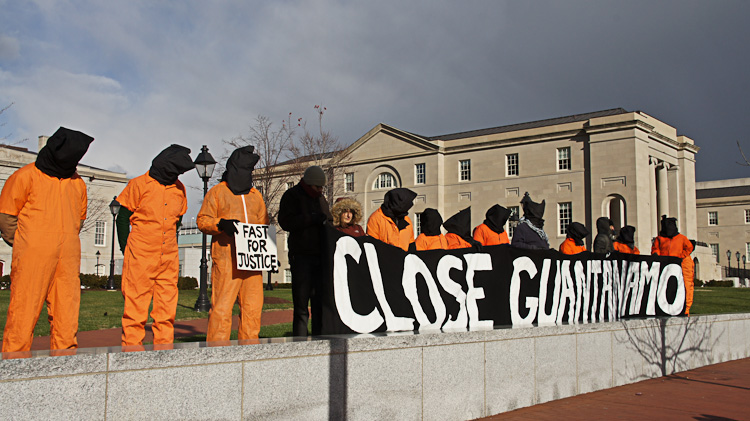
Four members of Witness Against Torture were found guilty in a jury trial at D.C. Superior Court on January 5, 2012. The jury brought back guilty verdicts in the cases of defendants Brian Hynes of the Bronx, NY, Mike Levinson of White Plains, NY, Judith Kelly of Arlington, Virginia, and Carmen Trotta of New York City, NY. Josie Setzler of Fremont, Ohio was acquitted mid-trial after the prosecution’s witnesses failed to identify her.
The demonstrators were charged with one count of disorderly and disruptive conduct on Capitol grounds. The charges stemmed from protests against a Defense Appropriations Bill—a precursor to the recently passed National Defense Authorization Act of 2012 (NDAA)—that took place in the citizen’s gallery at the House of Representatives on June 23, 2011. The protests were in response to provisions in the bill that make it essentially impossible to close the prison in Guantánamo Bay, Cuba and that legalize indefinite detention.
Prior to the start of the trial, the Prosecutor Brandon Long asked District of Columbia Superior Court Judge Gerald Fisher to disallow any statements regarding Guantánamo into the courtroom fearing that mentioning the detention center and the torture that occurred there “could possibly inflame the jury”. Judge Fisher readily agreed, saying, “Speaking about Guantánamo is inappropriate for the purposes of this trial.” Carmen Trotta responded that it was vital for him to mention Guantánamo Bay because “due process everywhere is being threatened and we have the privilege of due process here, right now.” The judge rejected Trotta’s argument, saying, he “does not want an improper politicization of the defendants’ charge.”
Continue reading “Guantánamo and Inflaming Passions in the Courthouse and the World”
 Denying the authenticity of the Syrian uprising is a central plank of the Assad regime’s propaganda message – that the whole thing, as the official news agency put it recently, is a

 When oppression is successful, the oppressor gains control over his victim’s borders, erases them, and redraws them according to his whims. The victim’s narrative no longer exists, and as such, just telling their own story is an act of liberation. When Palestinians chose Boycott, Divestment and Sanctions (BDS) as a form of telling their story (not just a form of action), they changed a continual paradigm of abuse which made their story insignificant, and were finally able to cut the cycle of abuse and silence. No longer do Palestinians need to react to Israel’s Hasbara line. They have reclaimed their narrative, and now the state of Israel is forced to react in accordance to it.