The Indefensible Drones: A Ground Zero Reflection

by Kathy Kelly

The survivor of a drone attack in Pakistan

Libby and Jerica are in the front seat of the Prius, and Mary and I are in back.  We just left Oklahoma, we’re heading into Shamrock, Texas, and tomorrow we’ll be Indian Springs, Nevada, home of Creech Air Force Base.  We’ve been discussing our legal defense.

The state of Nevada has charged Libby and me, along with twelve others, with criminal trespass onto the base.  On April 9, 2009, after a ten-day vigil outside the air force base, we entered it with a letter we wanted to circulate among the base personnel, describing our opposition to a massive targeted assassination program. Our trial date is set for September 14.

Creech is one of several homes of the U.S. military’s aerial drone program.  U.S. Air Force personnel there pilot surveillance and combat drones, unmanned aerial vehicles with which they are instructed to carry out extrajudicial killings in Afghanistan and Iraq.  The different kinds of drone include the “Predator” and the “Reaper.” The Obama administration favors a combination of drone attacks and Joint Special Operations raids to pursue its stated goal of eliminating whatever Al Qaeda presence exists in these countries.  As the U.S. accelerates this campaign, we hear from UN special rapporteur for extrajudicial executions, Philip Alston, who suggests that U.S. citizens may be asleep at the wheel, oblivious to clear violations of international law which we have real obligations to prevent (or at the very least discuss).  Many citizens are now focused on the anniversary of September 11th and the controversy over whether an Islamic Center should be built near Ground Zero.  Corporate media does little to help ordinary U.S. people understand that the drones which hover over potential targets in Afghanistan, Pakistan and Yemen create small “ground zeroes” in multiple locales on an everyday basis.

Continue reading “The Indefensible Drones: A Ground Zero Reflection”
Islamophobia is Bad—Only Because Occupying Muslims is Good

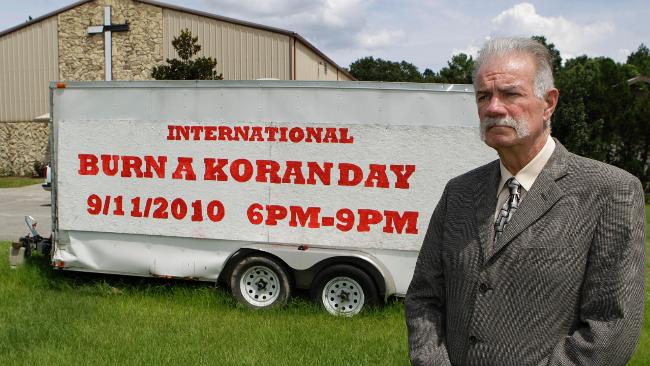
Pastor Terry Jones plans to hold a Koran burning to mark the September 11 terror attacks, despite warnings it would incite more violence (Photo: AP)

by M. Junaid Levesque-Alam

At this point, it’s not even clear whether Jones will go ahead with his pyrotechnics, but the lesson still stands.

Animosity toward Islam has reached such extremes in America that officialdom only rallies against anti-Muslim invective if it interferes with its warring on Muslim countries.

Perhaps it’s just the skeptic and former journalist in me, but that’s my impression as I review the recent blow-up about the planned September 11th Qur’an bonfire.

Terry Jones, the pastor of the tiny Florida church that may conduct the book-burning, has garnered endless—and doubtless desired—attention from media outlets as military commanders and administration officials fret over the fallout of his obscene reimagination of Farenheit 451.

General Petreaus, who is rightly concerned for the welfare of the women and men under his command, warned that Jones’s actions “would undoubtedly be used by extremists in Afghanistan—and around the world—to inflame public opinion and incite violence.”

Petreaus’s pronouncements were followed by an equally onerous message from White House spokesman Robert Gibbs, who averred that any behavior “that puts our troops in harm’s way would be a concern to this administration.”

Continue reading “Islamophobia is Bad—Only Because Occupying Muslims is Good”

Islam and America’s Most Powerful Cult

by M. Junaid Levesque-Alam

In their spirited assault on Islam, conservatives have seized upon one notion with particular delight: the Abrahamic faith embraced by a quarter of humanity is a “cult.”

Tennessee Lt. Gov. Ron Ramsey popularized the claim in July when a constituent asked about the “threat that’s invading our country from Muslims”; Ramsey wondered aloud whether Islam “is actually a religion or is it a nationality, way of life or cult” and later asserted that “far too much of Islam has come to resemble a violent political philosophy more than peace-loving religion.” Soon after, some of Ramsey’s constituents set ablaze a planned mosque site near Nashville and fired shots when parishioners tried to inspect the damage.

Farther south, in Florida, Pastor Terry Jones proclaimed that Islam is not just a cult but a Satanic creation — hence his planned bonfire of Qur’ans. He is not alone among Floridians. Congressional candidate and retired Army officer Allen West announced earlier this year that Islam is “not a religion” but a “vicious enemy” intent on “infiltrating” America. Another candidate in the sunshine state, Ron McNeil, described Islam as a malicious plot to “destroy our way of life.”

And in upstate New York this August, teenagers who viewed the local mosque as a “cult house” terrorized mosque-goers by blasting a shotgun and sideswiping a parishioner.

What accounts for this renewed alacrity in attacking Islam?

Continue reading “Islam and America’s Most Powerful Cult”

A Specious Compromise on Cordoba

by M. Junaid Levesque-Alam

You are not terrorists. Your religion is not evil. Your project is not a monument to murder. But since some believe otherwise, I propose a compromise:

Get out.

That is the message adopted by some liberals and their allies in the wake of smoldering conservative rage over the Cordoba proposal.

Nevada Senator Harry Reid, New York Governor David Patterson, former DNC chair Howard Dean, and New York Archbishop Timothy Dolan all echo the same theme: Muslims have the right to build a Muslim facility two blocks from Ground Zero—but they would be wrong to do so.

If the argument sounds familiar, that’s because it is. “No one is disputing that America stands for—and should stand for—religious tolerance,” Sarah Palin averred before assailing the proposal through her Facebook megaphone a month ago.

Of course, the official conservative position—“we are tolerant, just not here”—was always a transparent lie.

Continue reading “A Specious Compromise on Cordoba”

Christopher Hitchens and the Quest for Grade-A Muslims

by M. Junaid Levesque-Alam

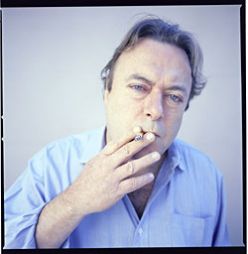
Christopher Hitchens

Almost 50 years ago, Frantz Fanon raced against death to finish his famous indictment of colonialism, The Wretched of the Earth. In that book, he wrote:

“Western bourgeois racial prejudice as regards the nigger and the Arab is a racism of contempt; it is a racism which minimizes what it hates.”

But there was a twist.

The ideology of Western prejudice, Fanon observed, “manages to appear logical in its own eyes by inviting the sub-men to become human, and to take as their prototype Western humanity…”

Today this ideology is once again attracting robust defenders, as conservatives and some liberals arrogate the right to judge which Muslims are worthy of their good graces.

Christopher Hitchens, for one, has recently declaimed that Imam Feisal Rauf of the embattled Cordoba House fails to make the grade. Hitchens mutters that as far as Muslims go, Rauf is “no great bargain.” The more Hitchens learns about him, the more “alarmed” he becomes.

Continue reading “Christopher Hitchens and the Quest for Grade-A Muslims”

Cordoba House and Religious Freedom

by David Bromwich

When Nancy Pelosi said the power and money backing the anti-Muslim protests in New York and elsewhere should be investigated, she had in mind the simplest of political questions. Who benefits? In this case, who benefits from a spectacle of words and images that suggest that right-wing populism in America has now taken a definitively anti-Muslim tone? The message of these protests against more than one mosque is that the fight to defeat al Qaeda has become a war against Islam.
No American is helped by that change of view. It exposes us to an enlarged hostility from the Arab world, heated by suspicion and legitimate fear. The only people who stand to gain are those who have an interest in setting the United States against the Arab countries of the Middle East. Who would that be? Pelosi has sharper instincts than the other leaders of her party. Her distrust of the sudden prosperity of a “grassroots” movement has been borne out by Jane Mayer’s recent investigation of the funding of the Tea Party by the billionaire Koch brothers.

The worst damage of the crowd actions of the summer has come from the faintheartedness of those who knew better, but declined to denounce them. The crowd has been permitted to go on believing it is wrong for Muslims to do something the Constitution gives all Americans a right to do. How did this deformation of public feeling begin? The protests against Cordoba House shifted from a parochial to a national issue on the impetus of two statements. The first came from Abraham Foxman, the national director of the Anti-Defamation League, on July 30. Foxman put the ADL on the record in sympathy with the protest against the planned community center and mosque. His statement conceded the right of the planners, but defended the prejudice, that is, the rooted feelings of the non-Muslims in this case, regardless of reason, right, or law.

Continue reading “Cordoba House and Religious Freedom”

Dangerous game

Editor’s note: The campaign against Moazzam Beg and Amnesty International is led by the McCarthyite Harry’s Place, an Israel lobby operation that specializes in defaming critics of Israel and what it broadly labels as ‘Islamists’ (which according to its definition is any Muslim who is not Ayaan Hirsi Ali). It is also assisted by The Spittoon which is jointly run by members of the neoconservative Centre for Social Cohesion and the Quilliam Foundation. Like Harry’s Place, the Spittoon also uses the cover of anonymity to smear opponents. Both frequently crosspost each others material and coordinate their attacks.

by Victoria Brittain

Guantanamo jumpsuit detainees.

Two weeks ago in Leeds, I gave a peace lecture honouring Olof Palme, which ranged over wars old and new, the bombing of Dresden, Daniel Ellsberg, Wikileaks, Bloody Sunday, and the Turkish flotilla to Gaza. Afterwards I was approached by two young Muslim women. They wanted to discuss the issues raised in the lecture, but also to talk about how isolated they felt and how hard it is for them these days to talk about politics without fearing hostility and feeling that they are being seen as “terrorists”. In the following two days I talked with another young Muslim woman whose husband is on a Control Order, and who in desperation had broken its conditions and faced possible dire consequences.  I also went to see a Muslim woman whose husband is in prison accused of terror-related activities, and one of whose sons is in trouble. Three days…  four Muslim women…  The Leeds women came to my lecture because Moazzam Begg told them about it; the two London women I know because Moazzam Begg asked me to visit them some years back, to break their isolation; and he and I have visited the Control Order family together, with Home Office clearance.

Since he was released from Guantanamo, this has been his work – campaigning on behalf of those still held without trial or hope of justice, and doing what he can to help distraught wives and families.

At the centre of the bitter, feminist-led recent controversy over him and Amnesty International, is a completely false perception of his attitudes to women, based on the fact that he once worked in Afghanistan under the Taliban. Long-standing, complex and important debates on gender politics and religion have been shoe-horned into a simple demonisation of him.

Continue reading “Dangerous game”

From “Islamist Watch” to Islamic Mimbar: the Politics of Hypocrisy

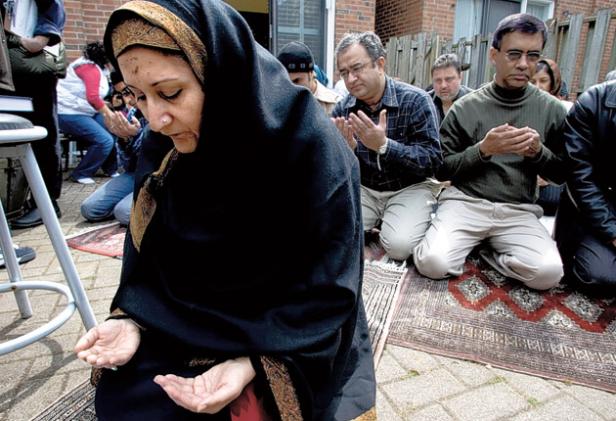
Raheel Raza leads a group of Muslims in prayer in Canada

By Huma Dar

On Thursday, June 10, 2010, Jerome Taylor, the Religious Affairs Correspondent of The Independent posted an article headlined, “First Woman to Lead Friday Prayers in UK.” Two-thirds of the way down this article, we find that:

“Ms Raza’s appearance in Oxford is a repeat of a similar prayer session in 2008 which was led by Amina Wadud, an American-born convert and Muslim feminist. But this is the first time a Muslim-born woman will lead a mixed prayer service in Britain.”

Continue reading “From “Islamist Watch” to Islamic Mimbar: the Politics of Hypocrisy”

The Carnival at Novara and Unmasking of a Racist Regime

by Huma Dar

The police, in the northern Italian town of Novara, fined a 26-year-old Tunisian woman for wearing a black niqab; she was going to a mosque for the Friday prayers.  According to the New York Times she was fined about $650 under a regulation introduced in January 2010.  Apparently, Novara — a bastion of the xenophobic Northern League — “bans clothing in public that prevents identification by the police.”

Continue reading “The Carnival at Novara and Unmasking of a Racist Regime”

Outing the Muslimness, Finally: Some Viewing (and Hearing) Pleasures (The King is Out: Part VI)

The King is out: he is irreversibly a Muslim. His name is Khan: pronounce it correctly please. Long Live the King!

by Huma Dar

[Read Part I Part II Part III Part IV Part V]

Rizwan Khan Offering His Namaz

[I]n one scene I wanted to have just a half open door and I wanted to be shown saying namaz once. We couldn’t take that shot. Then we put that bit where I say the prayer: Nasrun minal lahe wah fatahun kareeb (God give me strength to win) [sic] [Victory is Allah’s, and the opening/victory is close] which is my own prayer too. I don’t think we should intellectualise entertainment.  See the fun of it.

This is how Shahrukh Khan describes his experience working in the film Chak De! India (Dir: Shimit Amin, 2007).  With apologies to King Khan for discarding his proposal to not “intellectualize” films, yet taking due “fun” in it, I argue that it is only in My Name is Khan (Dir: Karan Johar, 2010) that the King finally comes “out” as a Muslim.  No “half open door” is needed.  This coming out affords particular visceral pleasures to an audience (or at least a large section of it spread across the globe) long resigned to seeing SRK endlessly and persistently marked by the specifically filmic variety of Hinduness practiced in Bollywood: doing various pujas and aartis at different Hindu temples, or adorning his spouses’ hair-parting with sindhoor and smearing his own forehead with tilaks.  This performative Hinduization of Shahrukh Khan in Urdu-Hindi cinema is unrelenting precisely due to the dogged presumption of SRK’s Muslimness that is not easily obscured.  “In my films I have been going to temples and singing bhajans; no one has questioned that,” (my emphasis) SRK exclaims in the same interview.  No one “questions” the diegetic (filmic) Hinduness of SRK; it is expected and mandatory.  With the increasing and explicit polarization in India since 1990s, the anxiety around Muslimness is such that it requires perpetual masking: an iterative performance of Hinduness, secular or otherwise.  When the mask slips off, the performance is momentarily paused – as when SRK plays a Muslim character in a film and critiqued the anti-Pakistani politics of Indian Premier League (IPL) – Hindutva activists target SRK’s suburban Bombay home, Mannat, with massive demonstrations (See the earlier Part II for more).[1]

Continue reading “Outing the Muslimness, Finally: Some Viewing (and Hearing) Pleasures (The King is Out: Part VI)”