Thus Alone, and Always, Have People Resisted Tyranny: Remembering Faiz on his Birth Centenary

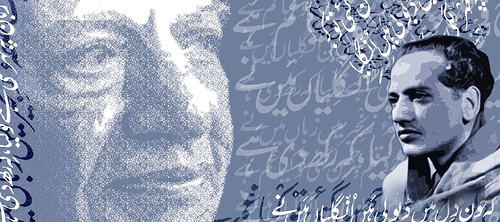
Today is the first birth centenary of Faiz Ahmed Faiz: one of South Asia’s most beloved radical Urdu poets. Today is also, just two days after Mubarak’s resignation as a result of the inspiring revolution in Umm al-Duniya, Mother of the World, Egypt; and almost a month after Tunisia’s courageous revolution. How ecstatic would Faiz have been today?!

by Huma Dar

Today is the first birth centenary of Faiz Ahmed Faiz: one of South Asia’s most beloved radical Urdu poets.  Today is also, just two days after Mubarak’s resignation as a result of the inspiring revolution in Umm al-Duniya, Mother of the World, Egypt; and almost a month after Tunisia’s courageous revolution.  How ecstatic would Faiz have been today?!  Faiz, who had lived in Beirut, in exile from Pakistan — when ruled by the US-bolstered military dictator, General Zia-ul Haq.  Faiz, who wrote a beautiful lullaby for a Palestinian child, and a poem for those who were martyred outside their beloved Palestine.  Faiz, whose poem commonly mis-titled, “Ham Dekhenge,” is a battle-song for people fighting for social justice from Sindh, Pakistan to Kashmir to Chhattisgarh, India.

The title of this particular poem of Faiz is in Arabic: “Wa Yabqaa Wajhu Rabbika.”  It is most often brushed aside as it does not fit the simplistic profile of the “avowed atheist” assigned to Faiz.  Being a socialist does not preclude belief in Islam, but this nuance is lost on many who cannot easily imagine Faiz being a Muslim, leave alone leading a prayer in the mosque of his ancestral village, especially given the subtle Islamophobia that pervades élite political and literary discourses, both within and without South Asia.  For some, even more difficult “to reconcile [is] the glowing tribute [that Faiz wrote] to Muhammad Ali Jinnah,” but this has to do with the rigorous demonology of Jinnah, the founder of Pakistan, in Indian historiography, and the hegemonic status of India and Indian academics, even those who vigorously critique nationalisms of all kinds, within South Asian Studies.

Continue reading “Thus Alone, and Always, Have People Resisted Tyranny: Remembering Faiz on his Birth Centenary”

Revolution In The Head And The Art Of Protest

A documentary about Rage Against The Machine by See of Sound.

Arguably the most provocative band of the last 20 years, Rage Against The Machine have since their explosive debut, been the group most associated with the American protest movement. This film dissects the work and career of RATM and looks at their place in this always fascinating lineage of artists and performers who have spoken out on behalf of, and drawn attention to, the world’s marginalised, downtrodden and oppressed. Picking up the flame from a linear musical tradition going back to the War Of Independence, with the best known protagonists coming up during the 1950s and 60s civil rights movement via artists such as Pete Segar and the young Bob Dylan, the anger remained as brutal as ever during the final decade of the 20th Century in Rage and contemporaries like Public Enemy. FEATURING: Brand new interviews with; renowned Rage producer and engineer, Garth Richardson; RATM Biographer, Colin Devenish; the band’s live sound engineer, Dave ‘Rat’ Levine and the man who signed them Michael Goldstone. With further contributions from folk-protest singer and author Jerry Silverman, ex-‘Rolling Stone’ editor Joe Levy, and Professor of American Studies and English at Washington State University, T.V. Reed.

A musical blast from the past

H/t to The Nation’s Greg Mitchell for finding this rare gem and posting it on Twitter.

This is from John Lennon’s documentary “Gimme Some Truth.”  It features a young Tariq Ali, Robin Blackburn, Regis Debray, and the legendary Miles Davis … shooting hoops with Lennon. Classic.

Onward!

DAM: between bombs and beats

by Ben Schiller

We are living in Palestine. Our history, our culture, our everything is Palestinian. — Mahmoud Jreri of DAM

Photo: Marilyn Donahue

“I see myself as a fisherman,” says Suhell Nafar, a member of DAM, the leading Palestinian hip-hop group. “Today, I fished a few fish who didn’t know anything and now know a little thing. Maybe now when they see the TV news, they will think differently about it. Maybe they will go on the Internet and learn about it.”

Suhell was speaking at last weekend’s WOMAD music festival, minutes after DAM had given a passionate performance in front of a big crowd. “There were thousands of people at the concert screaming ‘Free Palestine’. Most of them have never heard about Palestine, and now they know something.”

Hip-hop has been one of the Palestinians’ most effective communication vehicles in recent years. While conventional messages are often drowned out, groups like DAM have been able to reach several new audiences at home and abroad, including the young. The group is not only popular among Palestinians on the West Bank and Gaza, but also in their native Israel, where they have a following among some Jewish-Israelis. Since forming in 1999, they’ve toured several times in Europe and the US, appeared in the Sundance-nominated film Slingshot Hip-Hop, and received exposure in US and European media, including on CNN and in Time.

Continue reading “DAM: between bombs and beats”

Pink Floyd reunites for Palestine

David Gilmour and Roger Waters on stage.

Roger Waters and David Gilmour reunite to help young Palestinian refugees at an event organized by Jemima Khan. Rolling Stone reports:

For the first time in five years, the two driving forces behind Pink Floyd, Roger Waters and David Gilmour, reunited onstage at a benefit in England over the weekend. The unannounced team-up went down before the 200 attendees of the Hoping Foundation benefit in Oxfordshire, which raised money for young Palestinian refugees. The duo’s four-song set included Phil Spector’s “To Know Him Is To Love Him” (a Floyd sound-check staple according to the blog on Gilmour’s website) and the band’s classics “Wish You Were Here,” “Comfortably Numb” and “Another Brick in the Wall, Part 2.”

The Saturday night set marks the first time Waters and Gilmour have shared the stage since Pink Floyd’s reunion performance at 2005’s Live 8 in London. The duo’s Hoping Foundation performance helped raise £350,000. At the benefit, Gilmour and Waters — who swapped his bass for an acoustic guitar — were joined by keyboardists Harry Waters and Jonjo Grisdale, drummer Andy Newmark, guitarist Chester Kamen and bassist Guy Pratt, who ironically replaced Waters in the Gilmour-led, Division Bell-era Pink Floyd.

Continue reading “Pink Floyd reunites for Palestine”

Irish folk legend Tommy Sands joins the Sheikh Jarrah Protest

mariosavio — 19 June 2010 — Irish folk legend Tommy Sands performed in front of a crowd of hundreds of Israelis and Palestinians who came to the Sheikh Jarrah neighbourhood in East Jerusalem for the weekly Friday demonstration to protest against house evictions of Palestinians by Israeli courts and settlers.

After the performance, the demonstrators marched in the streets of the neighbourhood. Israeli police tried to prevent them from marching, but was unable to stop them due to the large numbers of demonstrators.

Shahrukh Khan and the Pound of Flesh: the Cost of Stardom (The King is Out: Part II)

by Huma Dar

[read Part I]

Shahrukh Khan (SRK) has a long history of playing the fraught field (of the Indian context) with flawless diplomacy, perhaps even overplaying the field.  In early 2002, precisely during the days of the state-sponsored anti-Muslim pogroms in Indian Gujarat, the then Indian Prime Minister Atal Bihari Vajpayee, from BJP (a Hindu Nationalist party), released an MTV-esque album,Samvedna [Sensitivity]. Widely broadcast on Doordarshan, the State-owned television channel, as well as on Indian-American programs (at least in the San Francisco Bay Area), the video features Vajpayee reciting his Hindi poetry while Jagjit Singh, the ghazal singer, sings in tune.  The album is prefaced by the rhapsodizing words of Javed Akhtar — another famous Muslim from Bollywood, narrated by Amitabh Bachhan.

Continue reading “Shahrukh Khan and the Pound of Flesh: the Cost of Stardom (The King is Out: Part II)”

The King is Out, His Name is Khan: Long Live the King (Part I)

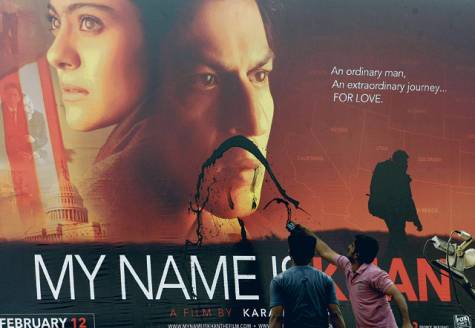
My Name is Khan, although narratively based mostly in the USA, has to be theorized within and around the framework of Bollywood; the Urdu-Hindi film history, and its transnational circuits of production, distribution, and consumption; Shahrukh Khan’s star narrative, and the determining context of the Indian political scene along with that in the US and its “war on/of terror.”

by Huma Dar


The Defacing of Khan: It's Not Easy Being Muslim in Mumbai or in Newark

My Name is Khan, although narratively based mostly in the USA, has to be understood and theorized within and around the framework of Bollywood; the Urdu-Hindi film history and its transnational circuits of production, distribution, and consumption; Shahrukh Khan’s star narrative, and the determining context of the Indian political scene along with that in the US and its “War on/of Terror.”  Even prior to the Indian Partition in 1947, most Muslim artists had what Sa’adat Hasan Manto (1912-1955) mockingly called “shuddified” or Hinduized names – Dilip Kumar for Yusuf Khan, Madhubala for Mumtaz Begum Jahan Dehlavi (1933-1969), Meena Kumari for Mahjabeen Bano (1932-1972), or the more ambivalent (non-halal) Johnny Walker for Badruddin Jamaluddin Qazi (1923-2003) and Nargis for Fatima Rashid (1929-1981).  At the contemporary moment, the biggest stars of the Urdu-Hindi film industry in India are Khans: Shahrukh, Salman, Aamir, Saif Ali et al.  It might therefore be tempting to conclude that the Bombay film industry is indeed a level playing field.  The Khans are all Muslims, at least nominally.  Cinematically, they enact, with a few notable exceptions, Hindu characters.  Culturally, the vigorous fanzines of Bollywood idolize them as comfortably suave denizens of metropolitan Bombay[Mumbai] with understated or unexpressed Muslimness — their Hindu wives, girlfriends, or mothers facilitating this imagined assimilation or passing.  Of course, for regular, non-filmi (“film-related” in Urdu-Hindi) Muslim men, this assimilation through marriage to Hindu women is generally frowned upon and can have potentially fatal consequences.

My ruminations on My Name is Khan, like a typical Urdu-Hindi film, lengthy and replete with intermissions, are an entryway into not just the film as cinematic text, but also its complex and rich transnational contexts that must be read in tandem.  In a series of six thematic posts, with this as the first, I will expand on:

(i) The (B)Onus of Muslimness in Bollywood

(ii) Shahrukh Khan and the Pound of Flesh: the Cost of Stardom

(iii) Placating the gods of Citizenship: the Ritual Sacrifice

(iv) A Suitable Boy, “Decent” People, and Names that Pass

(v) The Price of Translating a Narrative and its Context

(vi) Outing the Muslimness, Finally: Some Viewing (and Hearing) Pleasures

Continue reading “The King is Out, His Name is Khan: Long Live the King (Part I)”

Obama Nation

Just before the weekend dies, a little music. PULSE readers may already know British-Iraqi rapper LOWKEY from his regular appearances at rallies for justice. He’s a great speaker, and a great rapper. Intelligent rhymes intelligently delivered.