Telling the story backwards: Patrick Cockburn’s take on Syria

This article first appeared in the Daily Beast. Cockburn has since claimed that his eyewitness description of an alleged massacre in Adra was a “printing error”. Since the publication of this article, Cockburn has also called on Britain to forge an anti-ISIS military alliance with the regime, which is responsible for over 90% of all civilian deaths in Syria. 

by Muhammad Idrees Ahmad

Patrick Cockburn, the Irish foreign correspondent for The Independent, has an eclectic following. He is admired by Noam Chomsky and Rand Paul; and last December, when he won the British equivalent of a Pulitzer for his coverage of Syria and Iraq, the judges declared his journalism in a “league of its own” and wondered “whether the Government should [consider] pensioning off the whole of MI6 and [hire] Patrick Cockburn instead.”Cockburn is conscious of his exalted position. He frequently admonishes his colleagues against the distortions born of “political bias and simple error.” In his recent book, The Rise of Islamic State: ISIS and the New Sunni Revolution, he declares, “there is no alternative to first-hand reporting”. He adds: “Journalists rarely fully admit to themselves or others the degree to which they rely on secondary and self-interested sources.”

Journalists rarely admit such things—even those as self-aware as Cockburn is. Consider this gripping, first-hand account of the slaughter of religious minorities by the al Qaeda-affiliated Jabhat al-Nusra that appears on page 89 of his book. “In Adra on the northern outskirts of Damascus in early 2014, I witnessed [Nusra] forces storm a housing complex by advancing through a drainage pipe which came out behind government lines, where they proceeded to kill Alawites and Christians.” Cockburn was witnessing a war crime.

But there is a problem. The atrocity may or may not have occurred but Cockburn certainly did not witness it.

Before Cockburn published the first edition of his book in August 2014 and promoted himself to the status of witness, he had devoted only two articles to Adra; neither mentions him witnessing a massacre. Indeed, according to the first—published in his January 28, 2014 column for The Independent —Cockburn arrived in Adra after the alleged incident and was told the story about rebels advancing through a drainage pipe and massacring civilians by “a Syrian [regime] soldier, who gave his name as Abu Ali.”

The story about a massacre in Adra, allegedly carried out by Islamist rebels, was briefly reported on before disappearing in a swirl of contradictory claims. Human Rights Watch and Amnesty International have no record of it. The Russian broadcaster RT covered it, but used fake pictures, which it subsequently had to withdraw.

I first reported on Cockburn’s discrepancy in an article for The National and in a review of his book for In These Times. Cockburn corresponded with the latter’s editor last March. In an email sent on March 20, the editor offered him a chance to clarify if he had witnessed a different incident in early 2014 that also met the description given by Abu Ali? Cockburn never replied. (He also did not reply to requests for comment for this article.)

Cockburn’s apparent need to embellish might make sense if one looks at the main argument of his book. For him, Bashar al-Assad is at war with jihadi terrorism; the West has erred in supporting his opponents; and to support the opposition is to support ISIS.

To support this contention, Cockburn in his book quotes “an intelligence officer from a Middle Eastern country neighboring Syria” who tells him: “ISIS members ‘say they are always pleased when sophisticated weapons are sent to anti-Assad groups of any kind because they can always get the arms off them by threats of force or cash payments.’”

It is understandable why Cockburn would grant an intelligence officer anonymity, but what reason might there be for extending anonymity to the officer’s country? Could it be that the “country neighboring Syria” is Iraq, or Iran—both key Assad allies?

For over a year, Syria’s nationalist rebels have been at war with ISIS, which expanded mainly by seizing territory that they had earlier liberated from the regime. ISIS has led a war of attrition against the anti-Assad rebellion, assassinating its leaders, harassing its fighters, and disappearing civil society activists. Starting on New Year’s Day 2014, a rebel coalition led by the Free Syria Army (FSA), the Islamic Front (IF), Ahrar al-Sham (AS)—and even Jabhat al-Nusra—united to drive IS out of Idlib, Deir Ezzor, and parts of Aleppo and Damascus.

But far from applauding the rebels for confronting ISIS, Cockburn lumps ISIS with the moderates, noting at the time that “the bitterly divided rebels are fighting their own civil war in which 700 people have died in recent days.” That the fighters are divided along ISIS/anti-ISIS lines, and that ISIS captured and executed 100 of the Jabhat al-Nusra and Ahrar al-Sham rebels during its retreat, gets barely a mention. “The internecine warfare in the highly fragmented rebel movement”, he writes, “will further discredit them at home and abroad.”

By contrast, Cockburn takes a generous view of the regime’s belated and brief confrontation with ISIS. He has pronounced Assad’s army its “main military opponent”, deserving of western support. But facts tell a different story. According to a Carter Center study, the regime has spared ISIS in 90 percent of its attacks; and an IHS Jane’s Terrorism and Insurgency Center (JTIC) study finds that in 2014, the regime targeted ISIS in only 6 percent of its attacks (ISIS in turn directed its fire on the regime in only 13 percent its operations).

For Cockburn, the situation in Syria is stark: you are with the regime or you are with the terrorists.

This isn’t Cockburn’s only apparent omission. During the battle for Kobani, Cockburn briefly elevated the Kurds to the status of “the main military opponents” of ISIS, a position he usually reserves for the Assad regime. When the siege of the town was finally broken on January 26, the main Kurdish resistance force, the YPG, issued a statement thanking “brigades of the Free Syrian Army who fought shoulder to shoulder with our forces.” But Cockburn, who has dismissed the existence of nationalist rebels such as the FSA as “pure fantasy,” he ignored the Kurds’ own nod to their allies.

In his January 28 column, Cockburn credited U.S. airstrikes with helping the Kurds defend Kobani but made no mention of the FSA. Instead, he reported that, according to General James Mattis, “the time for supporting ‘moderate’ Syrian rebels had passed”. He added: “The Syrian armed opposition is increasingly under the control of ISIS and its rival, the al-Qaeda affiliate, Jabhat al-Nusra” and that overthrowing Assad would only “benefit ISIS and Jabhat al-Nusra.”

On February 8, Cockburn again dismissed Syria’s nationalist opposition (“these barely exist outside a few pockets”). This time he used a statement by Joe Biden as evidence that jihadists, backed by Turkey and Saudi Arabia, were dominating the anti-Assad opposition. (Biden did not exclude the presence of a non-jihadist opposition, but Cockburn did.) Cockburn then criticized the U.S. for “trying to overthrow President Bashar al-Assad whose army is the main military opponent of ISIS.”  The Kurds were already out of the picture.

Meanwhile the Kurds and the FSA continued their advance on Kobani and by February 19, according to the BBC, they had taken 240 of the surrounding villagesand were advancing on the strategic town of Tal Abyad.

On February 24, Cockburn made a glancing reference to the YPG advance without any mention of the FSA. The next day, he gave fuller coverage but framed the story as the first evidence of “military cooperation between the Syrian Kurds and the U.S. … continuing in offensive operations.” He used the Syrian Observatory for Human Rights (SOHR), the same source as the BBC, but, unlike the BBC, made no mention of the FSA fighting alongside the Kurds.

The omission is telling.

On March 19, when Cockburn concluded a five-part series for The Independent on life under ISIS, he complained that “the U.S. and its allies are not giving air support to the Shia militias and the Syrian army, which are the two largest ground forces opposing ISIS.” (As a matter of fact, against the wishes of its regional Sunni allies, the U.S. has been providing air support to Iran-backed Iraqi Shia militias,whose sectarian oppression was one cause of Sunni disillusionment and the rise of ISIS.)

Yet even as he presents the Syrian Army as a nemesis of ISIS, Cockburn hasn’t reported on a single instance where, since at least the start of the year, the regime has successfully confronted ISIS. More bizarrely, to emphasize “the importance of ground-air co-operation” in the fight against ISIS, he cites the example of Kobani, where Assad’s forces had no presence and where American air support helped the YPG—and the FSA—repel an ISIS offensive.

Perhaps Cockburn is loath to support the opposition because it now has a large Islamist component (a troubling development, no doubt). But Cockburn appears remarkably unconcerned about extreme Islamism when he is calling for airstrikes in support of the Iranian-backed Shia militias in Iraq.

Continue reading “Telling the story backwards: Patrick Cockburn’s take on Syria”
Brothers Blood

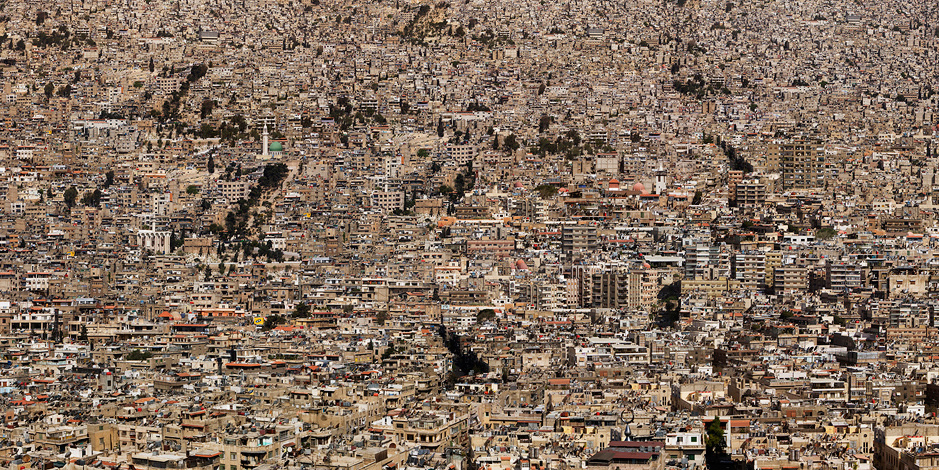
Damascus-Syria-2009I’m honoured that the wonderful poet Golan Haji has translated the prologue to my novel-in-progress for al-Arabi al-Jadeed. Here it is:

دم الشقيق
روبن ياسين قصاب

3 فبراير 2015

كلُّ اسم هنا يعني شيئاً، لكنّ بعض الأسماء قديمة جداً فنُسيت معانيها. قد تعني دمشق في الآرامية “التراب الأحمر”، وربما كانت تعني “قِربة النبيذ” لدى الإغريق والرومان. تسمية أخرى متداولة محلياً اشتُقت من “دم الشقيق”، لأن قابيل قتل هابيل في مكانٍ ما من الأرجاء المجاورة. يقع مزار هابيل في قمة قاسيون، والقبر في داخله عملاق الحجم لأن رجال تلك الأيام كانوا عمالقة حقاً. والعشق هو فرط الحب، وهكذا ثمة احتمال آخر لأصل الاسم هو “دم العشق
المدينة في تجويف إناء أسفل الجبال، وتترامى عبر السهل، وتزحف إلى أعالي المنحدرات، كتلةً كبيرة من المساكن، أبراجاً بيضاء ورمادية وبنية تعلو وتنخفض. واجهاتُ رخام وقبابٌ وأسطحة قرميد أحمر. حمام يحتشد في أسراب مرفرفاً ويحطّ على أعشاش السطوح.
أزقةٌ مغلقةُ المصاريع، متاهات، جدران عالية من ضوضاء السيارات. عالياً فوق هذه الجدران حلّقْ وانظرْ تحت.
سهامٌ من مصابيح ملونة تشير إلى محلات الشواء؛ شاشاتُ تلفزيون تومض عبر النوافذ المفتوحة، في المكتب، في الدكان، أو على الأرصفة حين يكون الطقس دافئاً؛ شاشات مليون هاتف جوّال (يملكها جميعاً الشخصُ نفسه)، تتحرك بمستوى الرؤوس، أو في الأحضان، أو على السرير؛ والصحون اللاقطة؛ ومقاهي الإنترنت.
محلات المثلجات، الحدائق العامة، العوائل الكريمة البدينة التي تفصص البذور. البنوك، الصرّافون، مكاتب الاستيراد والتصدير. سيارات الأجرة والسرافيس. رجال في زي موحد. رجال يدخنون السجائر.
عشاق، متزوجون، جمهرةٌ من راهبات متجهمات في محل أزهار يبيع باقاتٍ سريالية الحجم، محلٌ ضيق لتاجر بسطرمة، تاجر بُنّ في بنايةٍ لائقة، أضِفْ مطحنته وأضِفْ غبارَ القهوة، وصفٌّ من محلات الألبسة، كلها للفتيات، واجهاتها نيون كلّها أزرق ووردي وذهبي، أغنية آر أند بي أميركية Do Me You Do Me You Can Do Me ترجُّ الرصيف، نساء يضايقهن الأطفال محجباتٌ ويلبسن الأردية الطويلة يعبرن تحت مكبرات الصوت، أمام صاحب محل سيديهات ملمَّع الشعر مصفَّفه وراء زجاج مدخّن، ثم باعة محلات الأحذية بأباريق الشاي والابتسامات، تتوالى باباً لصق باب، جدران من صناديق الأحذية تعلو، وبين الجدران: متاهات.
ساحة مركز المدينة. الفنادقُ المواخير، الراقصات النَوَريّات. البدو يعطفون على كؤوس الشاي، لا يزال بعضهم يضفرون جدائلهم، أخاديد ثلّمتْ بها الريح وجناتِهم. جدران من الأقفاص في سوق الطيور، وبين الجدران: متاهات.
كذلك ألقِ بالاً إلى ما لم يكن أو ما لن يكون. حفرٌ لم تُردَمْ، هياكل ما بُنيت، مواسير شبه منسية، ثغرات. هدم غير محسوب، إنشاءات من دون مخطط، منازل عشوائية لم تصِرْ بيوتاً، ومنازل أخرى غائبة موجودة على الورق. ثقوب طلقات لم يجمعها الفرنسيون. نهرٌ أصبح ممشى من الإسمنت المسلح، نفقاً ومستنقعاً آسناً. بساتين مبتورة الجذوع، مخنوقة، مسوَّرة.
ألف مليون كيس نايلون.
صِبيةٌ موشومون، رجال بسواعد مشعرة، أقدام برتقالية تهتزّ بعضها إلى جوار بعض في صفوف المصلّين في مسجد عند الزاوية.
الفنادق الجديدة الفخمة في المدينة القديمة، الخانات والقصور، المطاعم: بعض من ألذّ العشاءات في الشرق الأوسط، في العالم.
الحشد. يلتئم ويتفرّق، يتجمهر ويتبعثر. على عجل.
شبان يبدؤون حيواتهم، يعانون، يحملون الكتب، يقعون في الحب، يشعرون بأنهم محبوسون، يزرّرون عيونهم ليروا طريقاً يجنون عبره بعض المال. شبان في منتصفات أعمارهم يتآكلهم الطموح والفشل، وأولئك المسحوقون بالعار يزرّرون عيونهم أيضاً ليروا طريقاً يجنون عبره بعض المال. العجائز يشتكون أو ييأسون أو يرضون أو يأملون، لا يزالون يزرّرون عيونهم ليروا طريقاً من أجل أبنائهم وأحفادهم يجنون عبره بعض المال. العجائز القانعون بشيخوختهم. العجائز المصلُّون.
في الزحام امرأة تعضُّ شفتها إلى أن تدمى لتمنع نفسها من الصراخ.
عبق الجنس. عبق الياسمين والمازوت والغبار.
فوحُ خَبزِ الخُبز. دوائر ساخنة من الخبز مكوَّمة خارج الأفران، أو ملمومة في أكياس نايلون شفافة لتبني جدراناً، وبين الجدران: متاهات.
فندق الشام والفصول الأربعة. دور السينما والمراكز الثقافية. الملاعب والمسابح. الأبراجُ السجون. المآذن وذروات الأبنية.
الحيّ الشيعي والحيّ المسيحي. المخيمات الفلسطينية. الناحية الدرزية. الأكراد المكدَّسون على السفح الذي يحمل اسمهم منذ عهد صلاح الدين الأيوبي.
الجيوب العلوية التي تتقدم صوب المدينة.
سائح، متغافل عن توترات الحاضر، يقصدُ التمشّي عبر حارة اليهود.
جبال نصلت في الشمس، أذْوَتها الرياحُ القارسة، قوّضتها رشقاتُ المطر، غصّتْ بتكرار الثلوج، وكلّستها مؤخراً أربعة عقود من الجمود.
الألوان على الجبل مرهونة بالغيم، بمواقيتِ النهار، بموضعِ الشمس. وردية، برتقالية، حمراء، بيضاء، سوداء. لون التلوث البني معلّقٌ ولا يُرى إلا من بعيد. ثم هواء يتخلخل في كل اتجاه، فوق الجبال والهضبة والسهل المقفر، هواء رقيق وجاف، مادّةُ الملائكة.
شيء ما مضطرب في الجو يشي بوصول اللحظة. لحظة ستبقى.
تحت السماء، فوق دمشق: الفرقة الرابعة متوارية نسبياً. المدفعية وراء المتاريس. مدافع ضخمة مثبتة في الجبل. القوات الإسرائيلية على قمة جبل الشيخ، بذروته المكتسيةِ ثلجاً في المدى المنظور. وأربعة ملايين سوري، تحت، في المدينة

The Road to Iraq

The Road to Iraq book coverA slightly shorter version of my review of Pulse editor Idrees Ahmad’s devastating dissection of the neoconservatives and their deeds appeared at the National.

Meticulously researched and fluently written, Muhammad Idrees Ahmad’s “The Road to Iraq: The Making of a Neoconservative War” is the comprehensive guide to the neoconservatives and their works. The book’s larger story is of the enormous influence wielded by unelected lobbyists and officials over the foreign policies of supposed democracies, their task facilitated by the privatisation and outsourcing of more and more governmental functions in the neoliberal era. (Similar questions are provoked by the state-controlled or corporate media in general, as it frames, highlights or ignores information.) The more specific story is of how a small network of like-minded colleagues (Ahmad provides a list of 24 key figures), working against other unelected officials in the State Department, military and intelligence services, first conceived and then enabled America’s 2003 invasion and occupation of Iraq, a disaster which continues to overshadow regional and global relations today.

The first crop of neoconservatives emerged from a Trotskyist-tinged 1930s New York Jewish intellectual scene; they and their descendants operated across the political-cultural spectrum, in media and academia, think tanks and pressure groups. Hovering first around the Democratic Party, then around the Republicans, they moved steadily rightwards, and sought to form a shadow defence establishment. During the Cold War they were fiercely anti-Soviet. Under George Bush Jr. they shifted from the lobbies into office.

The neoconservative worldview is characterised by militarism, unilateralism, and a firm commitment to Zionism. Even the Israel-friendly British Foreign Secretary Jack Straw said of neocon Irving Libby: “It’s a toss-up whether Libby is working for the Israelis or the Americans on any given day.” The neoconservatives aimed for an Israelisation of American policy, conflating Israeli and American enemies, and adopting their doctrine of ‘pre-emptive war’ from Israel’s 1967 war on the Arabs. Continue reading “The Road to Iraq”

Peshawar Blues

I wrote this feature in summer 2012 for the “Pakistan?” special issue of Critical Muslim.

On the Kuwait Airways flight from London to Islamabad, the unusually boorish flight crew handed us disembarkation cards that the government of Pakistan requires all international arrivals to fill. Besides our passport numbers, addresses and reason for visiting, the form asked if we had been to Africa or Latin America in the past week. The purpose of this question was unclear except perhaps as a means to boost national self-esteem: it implied that Pakistan was healthier than those two continents. With the only pen in my row, I helped five other passengers fill their forms.

At Islamabad’s decrepit Benazir Bhutto International Airport, I was pleasantly surprised to find the immigration staff making no undue effort to harass new arrivals. Former president Pervez Musharraf’s successful effort at gender-balancing has markedly improved the behaviour of male airport staff. After sailing through immigration and customs, I became conscious of the disembarkation card still in my hand. Not inclined to take chances, I asked an officer where to deposit it. He hadn’t a clue, nor did anyone else. Finally, a customs official took the card from my hand and helpfully threw it into a bin.

What is still known internationally as the Islamabad Airport is actually based in the city of Rawalpindi. As the historic Grand Trunk Road passes through its crowded precincts, its name changes twice—to Peshawar Road and The Mall. We drove North-West on the Peshawar Road, past the General Head Quarters (GHQ) of the Pakistan Army which in 1895 had served as the launching pad for the Malakand Field Force, the British colonial army’s counter-insurgency campaign against the recalcitrant frontier. The sanguine details of this campaign were preserved in vivid detail by a young Winston Churchill who was also serving as a correspondent for The Times. More recently, on 10 October 2009, the GHQ was the site of a bloody raid by a group of 10 militants who breached its defences and triggered a hostage crisis which ended with 9 soldiers, 2 civilians, and 9 assailants dead.

Continue reading “Peshawar Blues”

The struggle of man against power is the struggle of memory against forgetting

So said Milan Kundera. And because Assad’s western apologists are determined to overpower, let us preserve the endangered memories and remind people once again what the conflict in Syria is all about.

VETO is a short film sheds light on the current Syrian Revolution and the circumstances behind the transformation from peaceful movement to an armed revolution. VETO takes you through the last two years of this unbearable suffering with over 100,000 Syrian victims and more than 5 million displaced people, and a clueless world about how to stop this horrendous crime! VETO was made in 2012 and was nominated for the Documentary of The Year Award in Germany 2013 and was highlighted by several international media outlets.

Betrayal & Ambivalence: Syrian Activists Wrestle with ISIS, Intervention & the Fate of Their Country

When Dissent magazine recently invited me to write an article on ISIS and intervention, I thought to pick the brains of various Syrian activists, writers and intellectuals. The correspondence that ensued became the article, which appeared on the Dissent blog yesterday. Here’s my introduction:

Conspicuously absent from the debate about ISIS and U.S. intervention—both in the mainstream and in the leftosphere—are Syrian voices. ISIS and U.S. officialdom occupy center stage, leaving the perspectives of Syrian civil society activists and writers out of the equation. While hardly surprising, this omission is troubling.

In an attempt to remedy this imbalance, I asked several Syrians—longtime activists and intellectuals from a range of backgrounds, including Kurdish, Palestinian, and Assyrian Christian—what they think about the ISIS crisis and Western intervention.

Read the full article here.

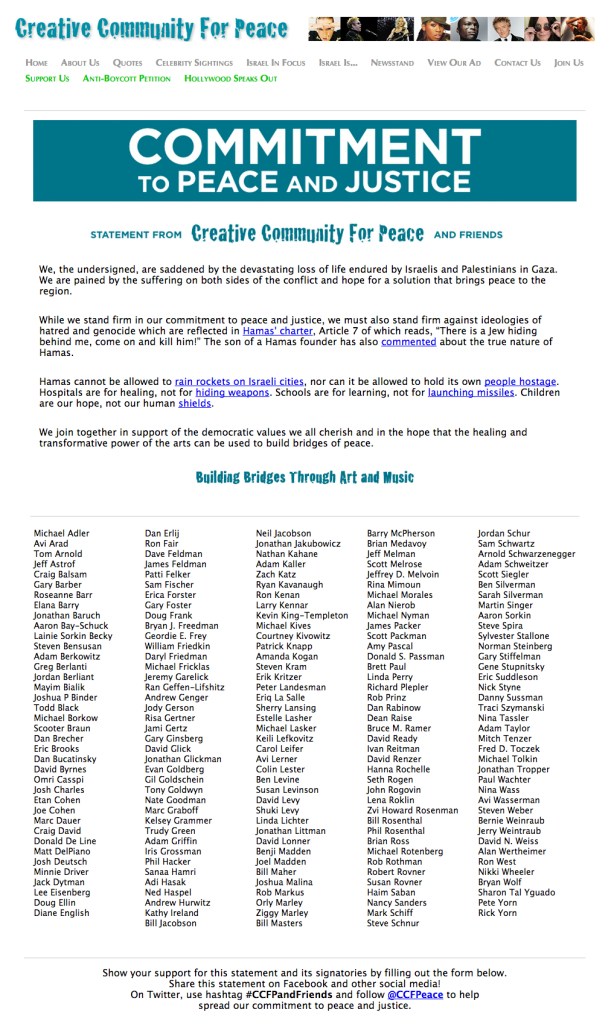
Almost 200 Hollywood Celebrities Sign on to Israel’s Genocide of the Palestinian People

Screen Shot 2014-08-25 at 16.36.04

Today, [Creative Community for Peace] say, there is not a single musical act, from Justin Timberlake to the Rolling Stones to Alicia Keys, that they have not approached and coached in advance of their performance in Israel. ~Times of Israel

It’s no surprise that the genocidal Times of Israel is so eager to push anti-BDS initiatives. It’s also no surprise that one of Israel’s most well connected, elite whitewashing team, Creative Community for Peace [CCfP], is doing exactly what it vowed to do- whitewash genocide. However one might wonder about some of the names on the below statement that CCfP has published:Crceative Community For Peace Genocide

Continue reading “Almost 200 Hollywood Celebrities Sign on to Israel’s Genocide of the Palestinian People”

Rula Jebreal gives her employer NBC a scolding for its pro-Israel coverage

More on it here. UPDATE: RJ continues to kick ass in this followup with Chris Hayes.

“Because of AIPAC, and because of the money behind it, and because of Sheldon Adelson, and because of all of us in the media. We are ridiculous. We are disgustingly biased when it comes to this issue,” Jebreal said.

“Look at how many airtime Netanyahu and his folks have on air on a daily basis. Andrea Mitchell and others,” she continued, referring to the MSNBC stalwart whose show airs right before Farrow’s afternoon program. “I never see one Palestinian being interviewed on theses same issues.”