Israeli Exceptionalism: A Grim Prognosis

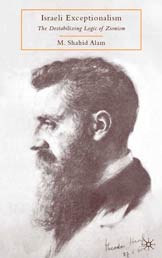
Cover Image GIFIn the coming weeks we’ll be publishing reviews and responses to M. Shahid Alam’s new book Israeli Exceptionalism: The Destabilizing Logic of Zionism (New York: Palgrave Macmillan, 2009). Following is the first from political scientist Ahrar Ahmad.

Dr. Shahid Alam is primarily an economist and an educator.  But, he is also a public intellectual, and often a lively polemicist, who writes with insight and conviction on issues dealing with culture, identity, religion, globalization, imperialism, and terrorism.  But nothing stirs his passions as intensely as the issue of the Palestinians – their dispossession, marginalization, despair.  His feelings are ardent, his language combative, his intellectual engagement prickly and zealous.  It is largely this pre-occupation that has earned him a place in David Horowitz’s book on the Hundred Most Dangerous Academics in the US (an ignominy that he probably wears as a badge of honor).  His latest book distills, clarifies and deepens much of his previous thinking on Zionism, the creation of the state of Israel, and the injustices inflicted on the Palestinians.

The trope along which this book is organized is the concept of “Exceptionalism” that is often claimed by the state of Israel, and sometimes by Jews themselves.  To Alam this is nothing other than a rhetorical device, and a moral posture, to ensure the West’s indulgence and support, to protect Israelis from any criticism, and exempt them from standards and behavioral norms that apply to other peoples.  This “exceptionalism” is derived from their Biblical covenants and the belief in their inherent “chosen-ness”, their wrenching history of suffering and persecution, their considerable achievements in science, philosophy and philanthropy, and their current status as a people allegedly besieged by Islamic fundamentalists, anti-Semitic bigots, and the barbaric and self-destructive Arabs.  To question anything about Israel is tantamount to denigrating every aspect of its special status.

Continue reading “Israeli Exceptionalism: A Grim Prognosis”

Peace Camp Man – Profile of a Zionist Pacifist

It's a bird! It's a plane! No! It's Peace Camp Man! (a.k.a Yaron London)

Today I was sent an op-ed, written by celebrated Israeli journalist, Yaron London, titled “The Victory of Cruelty”. In this op-ed, the man, who was apparently once known as the “peace camp man”, calls for another “disproportionate” blow to Gaza and disregard for ‘international public opinion“. The words ethics and morals aren’t mentioned once, the word law appears in regards to that wayward Islamic law (waywardness only implied, this is strictly my own syllogism). So how does it happen that Peace Camp Man stirs bloody violence and unethical criminality? I blame Zionism.

Peace Camp Man and Compassion

London seems to understand the problem and at the time of the 2006 Israel-Hezbollah war he had written:

Had we not driven out the Arabs who had settled in the Land of Israel, we would not have been able to build a stable country for the Jewish people, however, that’s how we created the Palestinian exile, which is the root cause of our problems.

Continue reading “Peace Camp Man – Profile of a Zionist Pacifist”

Photo Essay of a Settler

A friend of mine started a cyber-satirical Facebook profile for ex Israeli Air Force commander and Israeli army Chief of Staff, Dan Halutz (you’re all very welcome to join). Fortunately for the anthropology dabblers among us, some people don’t recognize satire when they see it, and among Lt. General Halutz’s friends, I stumbled upon “supporters of the settlers of the Simon the Righteous [aka Sheikh Jarrah] neighborhood”. Who are these supporters of criminals and ethnic cleansers? From their Facebook group (limited by my translation):

Lately, a number of houses have been saved in the “ Simon the Righteous” neighborhood in Jerusalem, which is very upsetting to the Anarchists and anti-semites around the world that are harassing the Jewish residents and the worshippers at the Simon the Righteous tomb, thinking that this will prevent Jews from visiting the area and living around it. Here at the group we’ll update about the going ons at the site and about the struggle to return the stolen Jewish houses.

News:
In honor of the new Christian year the Muslims are brown-nosing the Christians. A big christmas tree has been stationed in front of the settlers houses which proves to us that where there is sanctity the devil grows. We’d like to remind the Christians what happened when Bethlehem was given to Palestinian terrorists: Their daughters were raped, their houses robbed, and most of them left the country.

This delightful group is very active, but rather than waste my time on translating more racist, colonialist blather, I’d like to share with you the choice photos and their labels, from the group, which give lingual and graphic insight into their warped perspective. I call it “Photo Essay of a Settler”.

Continue reading “Photo Essay of a Settler”

Gaza Never Forget

One year ago, this pro-Israel rally took place in New York City. American independent journalist Max Blumenthal was there to get people’s responses to the attacks on Gaza. Watch for yourself.

As boxing promoter Don King always says: “Only in America!”

Utopia as Alibi: Said, Barenboim and the Divan Orchestra

by Raymond Deane

As a classical musician involved in pro-Palestinian activism, I frequently encounter the assumption that I am an unconditional admirer of the West-Eastern Divan Orchestra (WEDO). My reservations on this score tend to produce shocked disapproval: How could I not enthuse about such an idealistic project, particularly since it was co-founded by the late Edward Said, a figure for whom I have frequently expressed respect and admiration?

In truth, I have always been a little wary of Said’s veneration for the eighteenth/nineteenth century canon of European classical music. I look in vain in his writings on the subject[1] for a historical and political contextualisation of music comparable of that to which he so perceptively subjected literature in his indispensable Culture and Imperialism.[2]

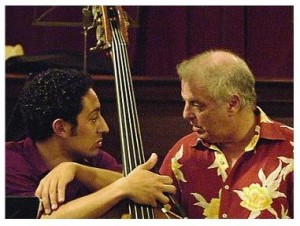
In his 2002 speech accepting the Principe de Asturias Prize, Said claimed that he and his friend the Israeli pianist and conductor Daniel Barenboim founded the WEDO “for humanistic rather than political reasons”. This surprising dualism implies that music belongs to a utopian sphere somehow removed from the dialectical hurly-burly of hegemony and resistance.

The paradoxes of Said’s position have been ably dissected by the British musicologist Rachel Beckles Willson.[3] She quotes her colleague Ben Etherington’s critique of Said’s tendency “to assert the intrinsic value of Western elite music without really exploring how that tradition escapes mediation.” Paraphrasing Said’s critique of literary scholars in his Humanism and Democratic Criticism[4] she convincingly claims that he “omitted to make ‘a radical examination of the ideology of the [musical performance] field itself.’” (Willson’s chain brackets).

Continue reading “Utopia as Alibi: Said, Barenboim and the Divan Orchestra”

Five Books on Israel-Palestine

The interview below was published in the Five Books section of The Browser. I chose five books on the Israel-Palestine conflict.

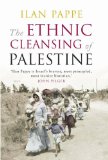
Tell me about the Ilan Pappe book, The Ethnic Cleansing of Palestine.

Pappe has written a great historical work on the ethnic cleansing of Palestine in 1947/8 and he shows that it was organised and planned, called Plan D, or plan Dalit, and he has exploded the myths that were current until his work.

What myths?

Well, for example, that the Arab leaders told the Palestinians to leave, or that the Palestinians were Bedouin people who didn’t really live there anyway, and he showed that they were ordinary people in brick and mortar homes who were intentionally forced out. This is very important because the ethnic cleansing of Palestine is the original sin of Zionism and the root of the current problem.

Continue reading “Five Books on Israel-Palestine”

To A Christian Zionist

Update: I wrote this in 2006. If I wrote it today I would do it a little differently. Specifically, I would discuss the pernicious role of the Scofield Bible in perverting protestantism in America. I would discuss the meeting point of Christian Zionism, orientalism and racism in Western cultures. And I would point out that contemporary science has shown us that the direct descendants of the ancient Israelites are the Palestinians, not the Ashkenazi or Berber Jews who have colonised Palestine in recent years. Shlomo Sand’s excellent book The Invention of the Jewish People, reviewed here, summarises the science and undercuts the blood-and-soil aspects of Zionism which are so important to Christian Zionists and their ultimately anti-Semitic agenda.

I have recently been discussing Middle East issues with an American colleague who I would describe as a Christian Zionist. Although I like him personally I find some of his ideas (on Palestinian history, and Lebanon, and the wider Middle East) pretty offensive, and I have told him so. So as not to start an argument, I told him so in writing. He replied, saying that although he disapproves of collective punishment of the Palestinians he believes that the Bible clearly states that the Holy Land belongs to the Jews, and that the rebuilding of Israel prophesied in the Old Testament has happened since 1948. Hmm. My first response is anger. I understand Jews with memories of European anti-Semitism being attracted to Zionism, however wrong I think they are, but Americans? People who are not oppressed, who think Palestine is a Cecil B Demille set, who think real human beings (Arabs) are less important than their own narrow interpretations of scripture. Who think that ethnic cleansing, massacres, and apartheid are supported by God. It makes my blood boil. But I think responding intelligently to this kind of thing is important, because there are millions of Americans (with power) who see the Middle East through a Biblical prism. Anyway, here is my latest letter:

Continue reading “To A Christian Zionist”

Avi Shlaim and Shlomo Sand in conversation with Jacqueline Rose

Avi Shlaim and Shlomo Sand in conversation with Jacqueline Rose at the Frontline Club (via PIWP).
Vodpod videos no longer available.

Event description:

Few modern conflicts are as attached to history as that of Israel and Palestine. Avi Shlaim, professor of international relations at Oxford will be in conversation with Shlomo Sand, professor of contemporary history at Tel Aviv University, at the Frontline Club for a seminal evening of discussion. Continue reading “Avi Shlaim and Shlomo Sand in conversation with Jacqueline Rose”

“Israeli Apartheid – A Beginner’s Guide”

gas arabs
settler graffitti in Hebron/al-Khalil

That there are striking parallels between white rule in apartheid South Africa and Zionist rule in Palestine – an analogy made by such mainstream figures as President Jimmy Carter and Archbishop Desmond Tutu – should no longer be controversial. But calling Israeli apartheid by its name will occasion the usual screams of anti-Semitism and ignorance from Zionist quarters, and for comprehensible reasons: the most politically inept American student knows that apartheid is a bad thing, a crime to be battled, not supported with weapons, vetoes in the Security Council and billions of dollars in ‘aid.’ Therefore the apartheid label must be vigorously resisted by Zionists and their fellow travellers.

Ben White’s “Israeli Apartheid – A Beginner’s Guide” begins by quoting Article II of the International Convention on the Suppression and Punishment of the Crime of Apartheid, UN General Assembly Resolution 3068, which defines the crime as “inhuman acts committed for the purpose of establishing and maintaining domination by one racial group of persons over any other racial group of persons and systematically oppressing them.” The rest of White’s book leaves the reader in no doubt that the Zionist instance of apartheid fits the bill even better than the erstwhile South African version.

Continue reading ““Israeli Apartheid – A Beginner’s Guide””

Gilad Schalit in Captivity – Israel’s Most Valuable Asset of Occupation

shalitThe youth in Israel are raised to willingly and even proudly enlist in the army. I personally remember being promised by my high school teachers that if something happened to me, Israel wouldn’t forsake its “sons and daughters”. It’s been a while since I was in school, but nothing has changed:

[IDF Chief of Staff Gabi Ashkenazi] also told the troops that Israeli soldiers “must always remember that if anything happens to them, we will make sure they are returned to their families.”

I often ask myself how this can be said, when raising crops of gun-wielding robots is the main focus of the Israeli educational system. When you encourage me to enlist, do you not encourage me to die? When you encourage my parents to turn me over to the state’s care,  for the sole purpose of enlisting, do you not encourage them to make the ultimate Abraham’s sacrifice? How do people get so crazy as to willingly sacrifice themselves for a “greater good” that they are constantly told is unattainable, because the other side is no partner?

Continue reading “Gilad Schalit in Captivity – Israel’s Most Valuable Asset of Occupation”