Volcano of Rage

Max Rodenbeck writes for the New York Review of Books

In a totalitarian regime, you never know the mistakes that are made. But in a democracy, if anybody does something wrong, against the will of the people, it will float to the surface. The whole people are looking.
—Hosni Mubarak in an interview from Sandcastles: The Arabs in Search of the Modern World by Milton Viorst (Knopf, 1994)

Late last March Muammar Qaddafi, whose official title is Brother Leader of the Great Libyan Arab People’s Jamahiriya, hosted a summit meeting of Arab heads of state. Leaders of the twenty-two Arab League member countries had gathered dozens of times since the first such meeting in 1964, but never before in Libya. Given Qaddafi’s penchant for rambling incoherence and his regime’s reputation for shambolic management, delegates rather dreaded the event, particularly since it was to be held not in the Libyan capital, Tripoli, but in Qaddafi’s bleak little hometown of Sirte, three hundred kilometers away.
Continue reading “Volcano of Rage”

An Élite Not Unlike Ours! Who’d Have Guessed?!

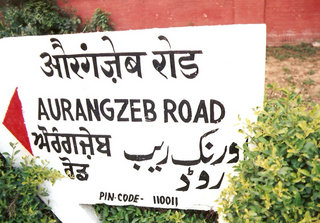
By Huma Dar

Rakhshanda Jalil writes in The Hindu, 27 February 2011, about “that elusive connect with India when she was least expecting it” on a visit to Karachi, Pakistan.  The title of her piece is “A city not unlike home.”

I am always amused when Indians are surprised and taken aback by Pakistanis (whether in Karachi or Lahore or elsewhere) who “speak Urdu and English with almost equal aplomb” or by their “silk sarees and natty blazers” or by their possible cosmopolitanism!!! (Class is class, unfortunately, and the élite exhibit their privileges in similar ways all over the region!)  Does it not, if just remotely, smack of the loaded “praise”: “Gee! Obama is so articulate!” — also known as “the racism of lowered expectation”?  Why would Indians expect otherwise from their class-affiliates on the other side of the border?  Or is it that Bollywood’s Pakistan-bashing fantasies are actually swallowed uncritically — hook, line, and sinker —  even (or perhaps especially) by the educated Indians, eliciting “fears about Kalashnikov-toting Taliban and marauding Muhajirs.”

And by the way, Pakistanis are not all “tall, well-built, good-looking people,” especially under the normative definition of “good-looking” in South Asia (fair-skinned or with a “wheatish complexion”) — thank god for the latter!  Sadly, the former two ascriptions, of course, too easily go awry given malnutrition due to poverty. Continue reading “An Élite Not Unlike Ours! Who’d Have Guessed?!”

A new report by Who Profits exposes: SodaStream misleads consumers by labeling settlement products as ‘Made in Israel’

A view of SodaStream’s main factory in the industrial park of Mishor Edomim in the occupied West Bank. Photo: Esti Tsal, Who ProfitsThe company, based in Mishor Edomim Industrial Park, an Israeli settlement in the West Bank, markets its devices and bottles under a ‘Made in Israel’ label.  By doing so, SodaStream (also known as Soda Club), world leader of home beverage carbonating devices, misleads consumers in Europe and the United States.

SodaStream misleadingly markets its devices and bottles under the Made in Israel label while in fact these products were manufactured in the Mishor Edomim Industrial Park, an illegal settlement in the occupied West Bank.

The company has recently faced a ruling by the European Court of Justice, stating that goods produced in settlements should not be considered as made in Israel and enjoys the tax exempt of the EU-Israel Association Agreement.

The report was published by Who Profits from the Occupation, a research project of the Coalition of Women for Peace. The project investigates Israeli and international corporate involvement in the Israeli occupation.

Continue reading “A new report by Who Profits exposes: SodaStream misleads consumers by labeling settlement products as ‘Made in Israel’”

Muammar Gaddafi’s planned resignation speech

‘Muammar Gaddafi’s planned resignation speech,’ as seen by Tariq Ali.

“It’s raining outside which is why I cannot address you. Sorry. It seems to be raining inside my tent as well. Can this be rain? No. It’s dogs polluting the uniforms of my bodyguards. No respect for women. Benghazi. I hate that city. Once I accidentally addressed my friend Berlusconi as Benghazi. Drunkards, pimps and religious extremists. I will bomb them again before I leave. I wish we had bought some drones so I could press button myself. My relations with the people are informal, based on friendship and fear. Why have they become so noisy and combative? I have many children. The British Foreign Office adopted one of them, my dear Saif, and wanted to put him on the throne, but that would have no effect on the intellectual landscape of the Jamahiriya.
I just received a tweet from Venezuela: ‘Have you read The Autumn of the Patriarch by G.G. Marquez?’ Why should I read this shit? Has G.G. Marquez read my science-fiction short stories ‘Escape from Hell’ that are even better than my little Green Book which is very nutty? They are set in an imaginary country with an imaginary ruler who kills his people and they rise and get rid of him. It’s very funny story. It is popular in Arab lands. I met them, these jokers and stray dogs of Europe. Blair, Berlusconi, they are my friends, but now they ask me to go. Why? Did they not go? It’s always raining in London. And that Roman pimp is always raining on his people. I will go when my time comes. When Allah summons me to discuss the political conjuncture. I like pizzas. Once there was a good pizza place in Tripoli. Much better pizzas than in Benghazi, but now all these shops are burning. Is it still raining? No? OK. Then I will go. Bury me in a colored shroud, not white. Bill Clinton. His penis should have been chopped off and fed to swine for letting Monica play with him when he was talking to heads of state. Men will be men, but that still upsets me. I never did that. Nor did Blair or Berlusconi.

Continue reading “Muammar Gaddafi’s planned resignation speech”

Stay in Your Home You Will Be Safe

From our anonymous eyes and ears in Tripoli.

Right after Friday prayers, people started to leave the mosque which is a two-minute walk from my building. I could hear that gunfire had already started in another area before the people finished their prayers. As the peaceful protestors left the mosque, they started to chant: La Ellaha Ela ALLAH, Qaddafi Adouaa Allah – “There is no god but God, Qaddafi is the enemy of God”. The moment I saw that scene I was so happy, proud, and speechless!

The gunfire in my area, and in Souk Jomaa, Mayzaran, Siyahiya, Dahra and elsewhere, was random and didn’t stop until around 5 pm.

A short time after the protestors passed by my street, an open car with 5 armed thugs parked in front of my building. They opened fire in the air, and then one of them said loudly, “Whoever doesn’t like Qaddafi, get out of your house now!” Then he said, “As long as you stay inside your homes you will be safe, and whoever comes out will be immediately killed.”

Continue reading “Stay in Your Home You Will Be Safe”

Battle for Tripoli continues

Game is up for Gaddafi. And it seems the balance of power is also shifting in Yemen. Riyadh I presume is preparing for the arrival of two more guests.

A Perfect Storm in the Arab World?

Middle East scholar Prof. Fawaz Gerges on the Arab revolt.

Regardless of the outcome of events in Egypt, for Arabs, psychologically and symbolically, this is their Berlin Wall moment. They are on the brink of a democratic wave similar to the one that swept through Eastern Europe more than 20 years ago, hastening the Soviet Union’s collapse. The Arab intifada has put to rest the claim that Islam and Muslims are incompatible with democracy. The democratic virus is mutating and will probably give birth to a new language – and a new era – of politics in the Arab world. Fawaz A. Gerges is a Professor of Middle Eastern Politics and International Relations at the London School of Economics and Political Science.

This event was recorded on 24 February 2011 in Sheikh Zayed Theatre, New Academic Building. It was chaired by Dr Maha Azzam.

Available as: mp3 (41 MB; approx 87 minutes)
Event Posting: A Perfect Storm in the Arab World?

Philip Weiss on the Arab Revolt

This is as good as talk radio gets. Our friend, the great Phil Weiss on Radio Open Source with Chris Lydon to discuss the implications of the Arab revolt and the changing discourse in the American Jewish community.

Information Wars

Information is power and in the age of the information revolution, cyber and satellite communication is transforming our lives, reinventing the relationship between people and power. New media, from WikiLeaks to Facebook, Twitter to YouTube, is persistently challenging the traditional flow of information, and cyber disobedience is exposing powerful governments. Websites are now being treated like hostile territories; whistleblowers and leakers as terrorists, and hackers as insurgents. Governments are scrambling to salvage their influence and take advantage of the new cyber and satellite media. From China to the Sudan, Egypt to Iran, despots and armies are tracking web activity and setting up Facebook accounts to spy on their citizens. So is this the century of free information and expression as the cyber utopians predicted, or new methods of electronic oppression as the cyber sceptics warned?