Friends of Israel Initiative: The neoconservatives’ eastern front

by Tom Mills

Today in the House of Commons Britain’s leading neoconservative organisation the Henry Jackson Society hosts the UK launch of the Friends of Israel Initiative.  This new organisation is the latest of a number of well connected advocacy groups in the UK seeking to deflect criticism of Israel’s illegal occupation and repeated human rights abuses.

The Friends of Israel Initiative says it ‘aims to create a network linking private and public figures who agree with the idea of an Israel fully anchored in the West’.  This network will not have to be built from scratch; rather Friends of Israel will be able to integrate itself into extremist networks already well established in UK politics.

The Friends of Israel Initiative is an international operation and was first launched in Paris on 31 May – the same day that Israeli soldiers boarded the Mavi Marmara in international waters and killed nine activists.  The organisation was reportedly established by Dore Gold, an American born Israeli who heads the Jerusalem Center for Public Affairs and was formerly an adviser to Ariel Sharon and the current Israeli Prime Minister Benjamin Netanyahu.[1]

Gold also has links with UK politicians.  In January 2007 he led an Israeli delegation at a conference at the House of Commons debating possible measures against Iran.[2]  The conference resulted in an Early Day Motion signed by 68 MPs urging ‘the British Government to put forward a resolution at the United Nations Security Council demanding President Ahmadinejad be brought to trial on the charge of incitement to commit genocide’.[3]  The Motion was introduced by the neoconservative MP Michael Gove, a signatory to the Henry Jackson Society’s Statement of Principles and now a Cabinet Minister.

Continue reading “Friends of Israel Initiative: The neoconservatives’ eastern front”
Not Crushed, Merely Ignored

by Tariq Ali (first published in the London Review of Books)

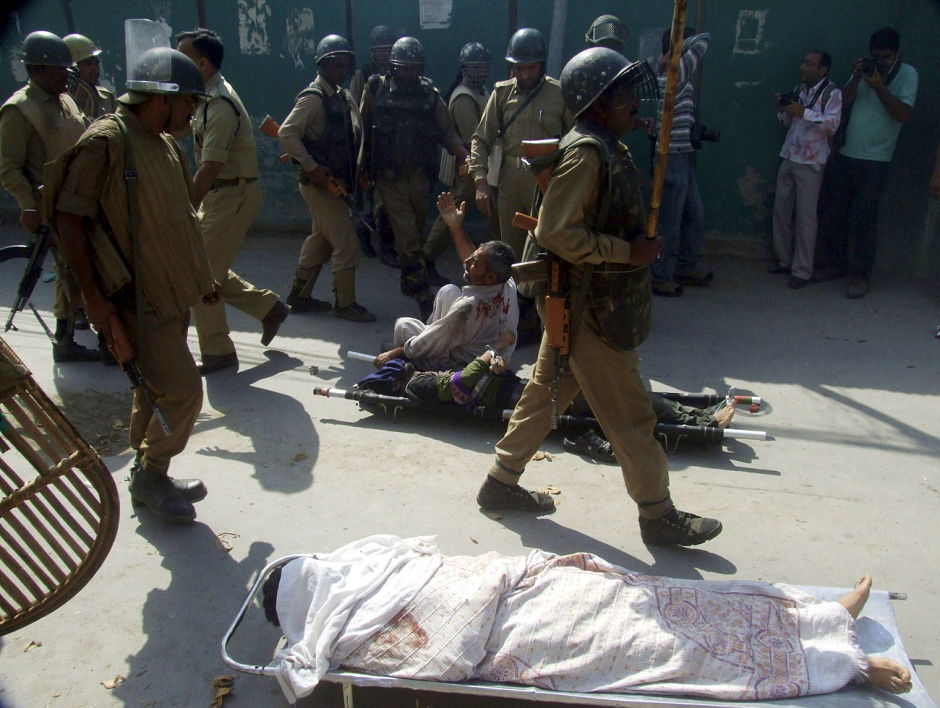
Indian policemen walk past the bodies of Muzaffar Ahmad Bhat and Fayaz Ahmad Wani (front) as they lie on the road after police stopped the funeral procession of the two in Srinagar July 6, 2010. India placed restrictions in parts of its controlled Kashmir on Tuesday and deployed thousands of troops to stop anti-India demonstrations after the death of two youths. Protesters said Fayaz Ahmad Wani and Muzaffar Ahmad Bhat were killed when police took action to stop anti-India demonstrations. (Photo: Umar Ganie/Reuters)

A Kashmiri lawyer rang me last week in an agitated state. Had I heard about the latest tragedies in Kashmir? I had not. He was stunned. So was I when he told me in detail what had been taking place there over the last three weeks. As far as I could see, none of the British daily papers or TV news bulletins had covered the story; after I met him I rescued two emails from Kashmir informing me of the horrors from my spam box. I was truly shamed. The next day I scoured the press again. Nothing. The only story in the Guardian from the paper’s Delhi correspondent – a full half-page – was headlined: ‘Model’s death brings new claims of dark side to India’s fashion industry’. Accompanying the story was a fetching photograph of the ill-fated woman. The deaths of (at that point) 11 young men between the ages of 15 and 27, shot by Indian security forces in Kashmir, weren’t mentioned. Later I discovered that a short report had appeared in the New York Times on 28 June and one the day after in the Guardian; there has been no substantial follow-up. When it comes to reporting crimes committed by states considered friendly to the West, atrocity fatigue rapidly kicks in. A few facts have begun to percolate through, but they are likely to be read in Europe and the US as just another example of Muslims causing trouble, with the Indian security forces merely doing their duty, if in a high-handed fashion. The failure to report on the deaths in Kashmir contrasts strangely with the overheated coverage of even the most minor unrest in Tibet, leave alone Tehran.

On 11 June this year, the Indian paramilitaries known as the Central Reserve Police Force fired tear-gas canisters at demonstrators, who were themselves protesting about earlier killings. One of the canisters hit 17-year-old Tufail Ahmad Mattoo on the head. It blew out his brains. After a photograph was published in the Kashmiri press, thousands defied the police and joined his funeral procession the next day, chanting angry slogans and pledging revenge. The photograph was ignored by the mainstream Indian press and the country’s celebrity-trivia-obsessed TV channels. As I write, the Kashmiri capital, Srinagar, and several other towns are under strict military curfew. Whenever it is lifted, however briefly, young men pour out onto the streets to protest and are greeted with tear gas. In most of the province there has been an effective general strike for more than three weeks. All shops are closed.

Continue reading “Not Crushed, Merely Ignored”

A Class War by Any Other Name

IDF Economics: Keynote Speaker Chief of the IDF General Staff, Lt. Gen. Gabi Ashkenazi addressing the audience at the Friends of the IDF 2010 National NY Gala Dinner, where 20 million dollars was raised

About a month ago I wrote an article about a bill proposition to heavily fine initiators and encouragers of a boycott directed at the state of Israel. On Wednesday, I joined a “Non Violence Short Course”. Today a friend posted an article on my Facebook wall [translation of important parts below] about the inflated “security budget”. I’m an activist in Israel, so naturally the boycott, nonviolence and the IDF budget all fall within my interest span. But this morning, as I read this very not-new news article about wining and dining generals, the assumptions tickling at last month’s article were driven home like a punch in the gut: Class war.

Continue reading “A Class War by Any Other Name”

The Real Bibi: Netanyahu Brags About Manipulating US, Sabotaging Oslo Accords

Recorded in 2001 during the second intifada, Netanyahu is captured on film bragging about destroying Oslo whilst visiting Israelis on a ‘condolence call’ in the occupied Palestinian West Bank. Israel’s Channel 10 recently broadcast the video, which records Netanyahu’s unguarded comments about his first term as prime minister from 1996-99, including a boast that America can “easily be moved”.

Gideon Levy notes in ‘Tricky Bibi‘: “No more claims that the Palestinians are to blame for the failure of the Oslo Accords. Netanyahu exposed the naked truth to his hosts at Ofra: he destroyed the Oslo accords with his own hands and deeds, and he’s even proud of it. After years in which we were told that the Palestinians are to blame, the truth has emerged from the horse’s mouth.”

Also check out John Cole’s ‘Flying the flag‘ cartoon in The Times-Tribune.

Translation by Dena Shunra (via Richard Silverstein):

Bibi:…The Arabs are currently focusing on a war of terror and they think it will break us. The main thing, first of all, is to hit them. Not just one blow, but blows that are so painful that the price will be too heavy to be borne. The price is not too heavy to be borne, now. A broad attack on the Palestinian Authority. To bring them to the point of being afraid that everything is collapsing…

Woman: Wait a moment, but then the world will say “how come you’re conquering again?”

Netanyahu: the world won’t say a thing. The world will say we’re defending.

Woman: Aren’t you afraid of the world, Bibi?

Netanyahu: Especially today, with America. I know what America is. America is something that can easily be moved. Moved to the right direction.

Continue reading “The Real Bibi: Netanyahu Brags About Manipulating US, Sabotaging Oslo Accords”

Peaches

by Arif Ayaz Parrey

Can I tell how much I love peaches?
Not ordinary ones
But those plucked from
The orchards along Jhelum

The ones in the basket before me
Are nebrim for sure
But they blush like a home-grown innocence
And hold as many juicy promises

I wonder what tree bore them
I wonder if it’s wise to ignore them

The tree of life
Has many buried roots

It is said that my only son
Was killed under the canopy
Of the branches of one such tree
By the army
Also known as the security forces
An old joke
What do they secure
These so-called security forces?
Not the people, not our lives, not our liberty
Not our sentiments, nor our emotions, not our sanity
Not our sons who are shot
Nor our daughters who are raped
Not the truth, not the facts, not humanity

Continue reading “Peaches”

Fear, Suspicion as US Military En Route to Costa Rica

by Joseph Shansky

Tensions are high in Costa Rica following the announcement of the impending arrival of United States military vessels. In the past year alone, a sudden expansion of US military presence around Latin America has alarmed many in the region. Now it is spreading to the one nation which had previously been known for the absence of any standing permanent army, foreign or national.

After receiving a diplomatic request from the US Embassy, on July 1 the Costa Rican legislative assembly approved a measure to grant unprecedented access to a US military fleet in Costa Rica’s waters. The vessels will arrive for at least six months to assist counter-narcotics operations by Costa Rican authorities. Costa Rica has long been used a stopping point of entry for drugs coming from Colombia and Panama on their way further north.

This type of partnership between the US and Costa Rica is not new. Since 1999, a maritime agreement titled the “Joint Patrol” has allowed the US Coast Guard to operate in the waters of Costa Rica for similar purposes. However, this particular agreement goes far beyond previously established boundaries. The Joint Patrol agreement limited US personnel to Coast Guard only, allowing for Costa Rican law enforcement to ride on US ships if they have reason to suspect suspicious activity, and vice versa.
Continue reading “Fear, Suspicion as US Military En Route to Costa Rica”

Dying Sea Turtles Warn of Toxic Gulf

by Dennis Bernstein

Endangered Olive Ridley sea turtle (Photo: Greenpeace USA)

Scientists and environmentalists across the United States and around the globe have their fingers crossed that BP’s claim to have finally capped its runaway well, after three months, is true, and that the damage of history’s worst environmental disaster can now be assessed in finite terms.

Yet, it will take years, if not decades, to truly comprehend the extent of the devastation: the dead and damaged wildlife, the soiled beaches and marshes, and the huge swaths of the sea that may become dead zones, so polluted that fish and other animals can’t survive there.

Even as BP was announcing its alleged capping success, many more wounded animals were being spotted and oil was still splashing on shorelines across the Gulf. Just recently, oil surged into one of the largest sea-bird nesting areas along Louisiana’s coast near Raccoon Island.

Three hundred to four hundred more pelicans were spotted with oil, as well as hundreds of terns. Scientists say these visible blotches of oil mean death for the sea birds.

To date, it’s estimated that over 3,000 birds have been killed, 59 dolphins, at least one sperm whale, and more than 460 turtles. Indeed, perhaps the species most threatened by the tens of millions of gallons of oil and toxic dispersants is the giant prehistoric sea turtle.

Dr Christopher A. Pincetich, a marine biologist and toxicologist for the Turtle Island Restoration Network, is convinced that the BP oil spill has destroyed a “generation” of turtles.

“We’re working as fast as we can on several fronts,” Dr. Pincetich said in an interview from New Orleans. “Most urgent right now is the immediate rescue of more of the endangered sea turtles that are in the Gulf oil spill right now.”

Continue reading “Dying Sea Turtles Warn of Toxic Gulf”

David Hirst interviewed

My interview with David Hirst, author of Beware of Small States, reviewed here, was done on behalf of the indispensable Electronic Intifada.
Veteran Middle East correspondent David Hirst, author of the seminal work on the Palestinian plight The Gun and the Olive Branch, has a new release: Beware of Small States, an equally important book on Lebanon’s complex tragedy. The Electronic Intifada contributor Robin Yassin-Kassab interviewed Hirst on his work and views.

Robin Yassin-Kassab: You did your national service in Cyprus and Egypt just before the 1956 Suez War. What effect did your first experience of the Middle East have on you? Why did you end up spending your life in the Middle East, particularly in its more violent corners? Have kidnappings and bannings discouraged you?

David Hirst: Yes, I was one of the last generation of British 18-year-olds obliged to do two years of military service. Politically speaking, it had virtually no effect on me; I was an immature youth from a thoroughly apolitical middle class background, and knew next to nothing about international affairs, and hardly knew, for example, the difference between Arabs and Israelis. But — unusually for a mere private soldier — I sought and secured permission to use a fortnight’s leave to travel round Syria, Iraq, Jordan and Lebanon. I enjoyed the experience. After three years at Oxford, I could not think of a career to embark on. Remembering the American University of Beirut, I wrote and asked them if there were any kind of introductory course about the Middle East that I could follow there. There was. With a vague idea of staying there for a couple of years or so, I found myself drifting into journalism, and, taking to it, I ended up staying fifty.

Continue reading “David Hirst interviewed”

Is the spray can mightier than the sword?

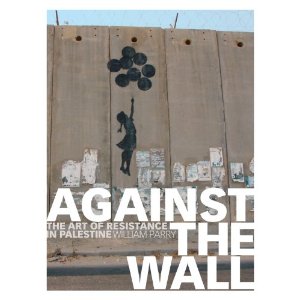
This is the question posed by photojournalist William Parry at the start of his new book Against the Wall: The Art of Resistance in Palestine (Pluto Press, May 2010), in which he documents graffiti artwork on the West Bank Wall and the stories of Palestinians whose lives are affected by said monstrosity.

Below is the introduction to the book, which has been endorsed by political cartoonist Joe Sacco, among others.

Check back early next week for a selection of images from Against the Wall.

***

In December 2007, the celebrated and famously elusive British street artist, Banksy, and a London-based organisation called Pictures on Walls, relocated their annual ‘squat art concept store’ called Santa’s Ghetto from London to Bethlehem and invited 14 other international street artists to join him to work with Palestinian artists. The concept was simple: the artists would make artwork available for sale by auction to the public – but those wanting to buy an original work of art by Banksy or the others had to physically go to Bethlehem, witness Israel’s occupation and checkpoints, and bid in person. The artists also used the opportunity to utilise the Wall as a giant billboard for their own political messages with some massive, stunning images – wall spaces throughout the city were also populated with work that challenged or subverted understandings about the reality faced by Palestinians under occupation. Within a few short weeks, Santa’s Ghetto had raised over $1 million from art sales for local charities and brought Bethlehem and the Wall to the world’s attention in a way that transcended language and engaged millions who wouldn’t ordinarily take an interest in Israel’s illegal occupation of Palestine. Just as important, it sent a message to the people of Palestine: you are not alone in your struggle.

Continue reading “Is the spray can mightier than the sword?”

Pink Floyd reunites for Palestine

David Gilmour and Roger Waters on stage.

Roger Waters and David Gilmour reunite to help young Palestinian refugees at an event organized by Jemima Khan. Rolling Stone reports:

For the first time in five years, the two driving forces behind Pink Floyd, Roger Waters and David Gilmour, reunited onstage at a benefit in England over the weekend. The unannounced team-up went down before the 200 attendees of the Hoping Foundation benefit in Oxfordshire, which raised money for young Palestinian refugees. The duo’s four-song set included Phil Spector’s “To Know Him Is To Love Him” (a Floyd sound-check staple according to the blog on Gilmour’s website) and the band’s classics “Wish You Were Here,” “Comfortably Numb” and “Another Brick in the Wall, Part 2.”

The Saturday night set marks the first time Waters and Gilmour have shared the stage since Pink Floyd’s reunion performance at 2005’s Live 8 in London. The duo’s Hoping Foundation performance helped raise £350,000. At the benefit, Gilmour and Waters — who swapped his bass for an acoustic guitar — were joined by keyboardists Harry Waters and Jonjo Grisdale, drummer Andy Newmark, guitarist Chester Kamen and bassist Guy Pratt, who ironically replaced Waters in the Gilmour-led, Division Bell-era Pink Floyd.

Continue reading “Pink Floyd reunites for Palestine”