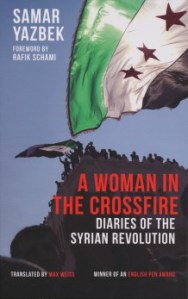
 ‘A Woman in the Crossfire: Diaries of the Syrian Revolution’ by novelist Samar Yazbek is part journalism, part personal memoir, and all literature. It’s literature of the instantaneous sort, a staggered snapshot of the first four months of the revolution, a public history of “a country succumbing to the forces of death,” and an interior history too. Yazbek tells us about her headaches, her insomnia and Xanax addiction, her crying fits, her fears for her daughter and herself, her constant panic. How sometimes in the speeded-up context the rush of information precedes all feeling: “The daily news of killing,” she writes, “was more present inside of me than any emotion.”
Samar Yazbek has always been problematic. Having consecrated herself “to the promise of a mysterious freedom in life,” she left home (in Jableh, on the coast) at sixteen, later divorced her husband and lived in Damascus, a single mother, working in journalism and writing sexually controversial novels. When Syria rose up against the Asad regime she publically supported the victims and their cries for freedom. And she’s an Alawi, a member of the president’s largely loyalist sect, of a well-known family. As an unveiled and obviously independent woman, a secularist and daughter of a minority community, her support for the revolution proved the lie of regime propaganda, which characterised the uprising as Salafist from the start.
So leaflets slandering her were distributed in the mountains. She was called a traitor, made recipient of death threats, publically disowned by family and hometown. Naturally she was visited by the mukhabarat and made to experience, vicariously at least, the domestic wing of regime propaganda – for the theatre of blood is as important inside Syria as the projection of civilised moderation used to be abroad – by being walked through a display of meat-hooked and flayed torturees.
 Earlier this week, I found a message in my inbox by an Israeli, who’s a Jazz musician, who’s paying gig was canceled because of a successful BDS movement campaign to get Swedish Jazzist, Andreas Öberg, to cancel his gig in the Eilat Red Sea Jazz Festival. Usually, the extent of my response, when I get unsolicited mail from angry Israelis, is to take a screenshot and add it to my
  [In his article, The Creed of an Aesthete (in our issue of January 25th), Mr. Clive Bell said: “Mr. Bernard Shaw … is not an artist, much less an aesthete … he is a didactic.” He referred to Mr. Shaw’s rejection of the Darwinian theory because, by depriving Beauty, Intelligence, Honor of their divine origin and purpose, this theory deprives them of their value. To Mr. Bell’s mind, Mr. Shaw feels that “if Life be a mere purposeless accident, the finest things in it must appear to everyone worthless.” The sooner Mr. Shaw knows that this is not so, the better, says Mr. Bell, and proceeds to explain his own creed: “always life will be worth living by those who find in it things which make them feel to the limit of their capacity.” “The advantage of being an aesthete,” he declares, “is that one is able to appreciate the significance of all that comes to one through the senses: one feels things as ends instead of worrying about them as means. … Whatever is precious and beautiful in life is precious and beautiful irrespective of beginning and end.”]

 P U L S E