Anna Baltzer: Palestinians “come second” at peace talks

This interview first appeared at iBrattleboro.com

Anna Baltzer on "The Daily Show"

A visit to the occupied territories of Palestine can change one’s perspectives forever. Such was the case of Anna Baltzer. Baltzer is a Jewish-American granddaughter of Holocaust survivors. In 2002, she was awarded a Fulbright scholarship to teach English in Ankara, Turkey and soon after volunteered with the International Women’s Peace Service in the West Bank. There she was exposed to the Israeli occupation of Palestine. She documented human rights abuses for the IWPS, returned to Palestine/Israel over the years, and published her experiences in a book called “A Witness in Palestine: A Jewish American Woman in the Occupied Territories.”

Baltzer is a leading human rights activist on the Mideast and travels across the country to raise awareness about the Israeli-Palestine conflict. Her appearance on “The Daily Show” with Palestinian human rights activist Mustafa Barghouti was instrumental in raising awareness about life under the Israeli occupation of the West Bank and Gaza. I caught up with Baltzer and we discussed several topics including her “The Daily Show” appearance; occupation myths; Israeli apartheid and the boycott, divestment, and sanctions campaign; and the Mideast peace talks in Washington, DC.

Continue reading “Anna Baltzer: Palestinians “come second” at peace talks”

Jeff Halper: Pete, join the artists who are boycotting Israel

Jeff Halper’s open letter to Pete Seeger.

Dear Pete,

Jeff Halper with legendary singer and ICAHD supporter Pete Seeger.

All the best from your friends in Israel/Palestine. In that spirit, I was surprised to hear of your planned participation in With Earth and Each Other: A Virtual Rally for a Better Middle East. While at first blush it might seem to have something in common with the work of ICAHD and other Israeli and Palestinian peace groups — attempting to build bridges between peoples — it is actually something quite different.

One of the lead partners in the effort is the Jewish National Fund, which is responsible for the allocation of land in Israel. As such, it is a mainstay of the ever-increasing apartheid system there. Among their most recent activities has been the planting of a forest to cover a Bedouin village in the Negev from which the residents have been forcibly removed. They are in fact engaged in various tree-planting exercises that brand them as an environmental organization, when in fact their purpose is to secure the land of Israel, if not all of Palestine, for Jews only. That is their historical role, and so it remains. Efforts to paint Israel as environmentally concerned are mere greenwashing. Israel has repeatedly torn down Palestinian neighborhoods by declaring them green zones.

Continue reading “Jeff Halper: Pete, join the artists who are boycotting Israel”

The Ghetto in the Ghetto

by Michal Schwartz

The past year has witnessed two cases of discrimination in the religious schools [in Israel]: ultraorthodox Jews of West European descent (Ashkenazis) discriminating against ultraorthodox Jews of darker hues. In August 2009, private religious schools in Petach Tikva refused to admit Ethiopian Jews. In response, the Education Ministry threatened to withdraw financial support for these schools and even to shut them down. In this way it compelled them to admit a hundred pupils.

The second, more recent instance occurred at the ultraorthodox West Bank settlement of Immanuel, where a Hasidic group known as the Slonim is dominant. In September 2008 the Slonim separated their daughters from the Mizrahi girls in the settlement’s school. (Mizrahis, also known as Sephardim, derive from North Africa and Arab lands.) The Slonim built a plaster wall the length of the school and put a fence through its yard, covering it with canvas so that their daughters wouldn’t see the Mizrahis. They changed the hours of the breaks and forbade association between the groups.

Continue reading “The Ghetto in the Ghetto”

Israel: A Failing Colonial Project

by M. Shahid Alam

Increasingly, despite its early military and political successes, Israel cannot for long endure as a colonial project. It must choose between wars – and destruction – or transition to a state for all its peoples.

In order to firmly secure its existence – as firmly as that is possible for any state – a settler state has to overcome three challenges. It has to solve the native problem; break away from its mother country; and gain the recognition of neighboring states and peoples. It can be shown that Israel has not met any of these conditions.

Consider Israel’s native problem. In 1948, in the months before and after its creation, Israel appeared to have solved its native problem in one fell swoop. It had expelled 80 percent of the Palestinians from the territories it had conquered. In addition, with the rapid influx of Arab Jews, Palestinians were soon reduced to less than ten percent of Israel’s population.

So, had Israel licked its native problem for good? Not really.

The Palestinians inside Israel pushed back with a high natural rate of growth in their numbers. As a result, despite the continuing influx of Jewish immigrants, the Palestinian share in Israel’s population has grown to above 20 percent. Increasingly, Jews in Israel see Israeli Arabs as a threat to their Jewish state. Some are advocating a fresh round of ethnic cleansing. Others are calling for a new partition to exclude areas with Arab majorities.

The Palestinians expelled from Israel in 1948 did not go away either. Most of them set up camp in areas around Israel – the West Bank, Gaza, southern Lebanon and Jordan. In 1967, when Israel conquered Gaza and the West Bank, it could expel a much smaller fraction of the Palestinians from these territories. In consequence, with more than a million additional Palestinians under its control, Israeli had recreated its native problem.

Continue reading “Israel: A Failing Colonial Project”

Upside Down World Cup

As the corporate-sponsored bonanza that is the football World Cup unfolds into its second week, Raj Patel looks at one of the most overlooked aspects of this year’s tournament: the ongoing struggle of tens of thousands of shack dwellers across the country. Over the past year, shack settlement leaders in Durban, Johannesburg and Cape Town have been chased from their homes by gangs, arrested, detained without hearing, and assaulted. As the World Cup begins, a shack dwellers’ movement known as Abahlali baseMjondolo is mounting what they call an “Upside Down World Cup” campaign to draw attention to their plight.

Getting Out of Palestine?

by M. Shahid Alam

When veteran journalist Helen Thomas was asked recently if she had any comments on Israel, she shot back, “Tell them to get the hell out of Palestine.” She apologized for the remark, but, as the campaign against her escalated, she chose to retire from her position as White House correspondent.
Putting aside the edginess in her words, does Helen Thomas’s remark deserve serious consideration?

Over the years, it has been receiving just that from many tens of thousands of Israelis, who have been emigrating from Israel, applying for emigration, or staying in Israel but holding or applying for dual citizenship. According to Arnaud de Borchgrave, half a million Israelis hold dual citizenship.

Although the Israel lobby expressed particular outrage at Helen Thomas’ suggestion that Israelis go back to Germany and Poland, many Israelis have done precisely that. In his book, The Seventh Million, Tom Segev writes that many thousands of Israelis have “requested and received German passports.” According to the Jewish Virtual Library, there were 118,000 Jews living in Germany in 2006. Another 49,700 lived in Hungary and 3,200 in Poland.

Disconcerting as some Zionists may find this, Jews have not stayed away from countries where they faced near extermination under the Nazis. Does this mean that these countries are now safer for Jews than Israel?

Continue reading “Getting Out of Palestine?”

The housing apartheid in Palestine

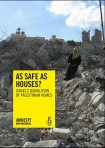
Amnesty International has called on the Israeli authorities to end house demolitions which leave thousands of Palestinians living in daily fear of eviction from their homes…

According to the UN, in 2009 more than 600 Palestinians – over half of them children – lost their homes after they were demolished on order from the Israeli authorities.

“Palestinians living under Israeli occupation face such tight restrictions on what they can build and where that their right to adequate housing is being violated,” said Philip Luther, Amnesty International’s Deputy Director for the Middle East and North Africa.

“The Israeli authorities are putting Palestinians in an impossible situation. Whatever choice they make, they face homelessness.

“The majority of people are denied building permits by Israel, even after lengthy and expensive bureaucratic and legal processes, so they have little choice but to go ahead without official permission. But as they do so, they know that these buildings may soon be flattened by Israeli bulldozers.”

Demolitions are generally carried out with no warning of the date, giving no opportunity for Palestinians to salvage their possessions or find elsewhere to shelter. The UN has estimated that some 4,800 demolition orders are pending.

Under Israeli law, evicted families are not entitled to alternative housing or compensation, meaning many would face homelessness and destitution were it not for relatives, friends and charities.

While homes are often targeted, Israeli authorities have also issued demolition orders against Palestinian schools, clinics, roads, water cisterns, electricity pylons, sheds and animal shelters.

You can view and download the report here (PDF).

Continue reading “The housing apartheid in Palestine”

Occupation 101 by Jimmy Carter

Also, check out the recent article by the brilliant Amira Hass, Lexicon of most misleading terms in Israeli-Palestinian conflict, for a much-needed factual and historical corrective to the amnesia that too often afflicts mainstream journalists covering the issue. Incidentally, she has this to say about the discourse of “(non-)violent resistance”, raised by Robin Yassin-Kassab in an essay published earlier on P U L S E:

When we define the struggle against foreign rule as “non-violent” or “violent,” it’s as if we asked the occupied to prove their resistance is kosher (or not ). And to whom? The very foreign ruler who considers boycotting settlement products to be unkosher. The adjectives “non-violent” or “violent” presume that the occupation is a natural state of affairs, whose violence is permitted, a civilized norm meant to tame its subjects. “A non-violent struggle” therefore diverts attention from the fact that forced rule is based on the use of violence. Every soldier at a roadblock, every camera on the separation fence, every military edict, a supermarket in a settlement and an Israeli diaper factory on Palestinian land – they are all part of the nonstop violence.

Continue reading “Occupation 101 by Jimmy Carter”

Reading Roger Cohen in the New York Times

Roger Cohen: Liberal ZionistM. Shahid Alam

Roger Cohen is the rare columnist at NYT who makes an occasional effort to bring some objectivity to the Israeli-Palestinian conflict. Yet, how far does his objectivity go?

Consider his piece of June 10, “Modern Folly and Ancient Wisdom.”

I have selected a few excerpts for comment.

First excerpt:
“Israel’s bloody interception of the Mavi Marmara and its motley crew was crass — another example of the counterproductive use of force — but nothing about it could justify the Turkish prime minister’s outrageous statement that the world now perceives “the swastika and the Star of David together (italics mine).”

Why does he speak of the “motley crew” on the Mavi Marmara? First, is ‘crew’ the appropriate word for the humanitarian activists on a ship bringing relief to people under blockade. ‘Crew’ has unpleasant connotations. Let us consult the Oxford English dictionary. Originally, it meant “an augmentation or reinforcement of a military force.” Now, by extension, it means “Any organized or associated force, band, or body of armed men.”

In addition, why is this a ‘motley’ crew? Does he mean heterogeneous? In fact, most were Turkish. Why then are they “motley?” The word has a bad odor. The OED concurs. Consider two entries in the OED. Entry one: “Of a thing or collection of things: composed of elements of diverse or varied character, form, appearance, etc. Freq. with implication of poor design or organization (italics added).” And entry two: Of a gathering or group of people: consisting of people of diverse or varied appearance, character, etc.; miscellaneous. Freq. depreciative (italics in the original).

Continue reading “Reading Roger Cohen in the New York Times”

Boycott Israel? Amitav Ghosh & the Dan David Prize

The call for academic and cultural boycott is clearly a way to encourage civil society to play a broader political role—that is why it has the support of wide sections of Palestinian civil society. One of the most significant questions that call poses to us is simply this: How could those of us who oppose apartheid, occupation, and colonialism not support such a call?

Dear Amitav Ghosh,

We wish to express our deep disappointment in your decision to accept the Dan David prize, administered by Tel Aviv University and to be awarded by the President of Israel. As a writer whose work has dwelled consistently on histories of colonialism and displacement, your refusal to take stance on the colonial question in the case of Israel and the occupation of Palestine has provoked deep dismay, frustration, and puzzlement among readers and fans of your work around the world. Many admired your principled stand, and respected your decision not to accept the Commonwealth Writers Prize in rejection of the colonialist framework it represented.

Continue reading “Boycott Israel? Amitav Ghosh & the Dan David Prize”