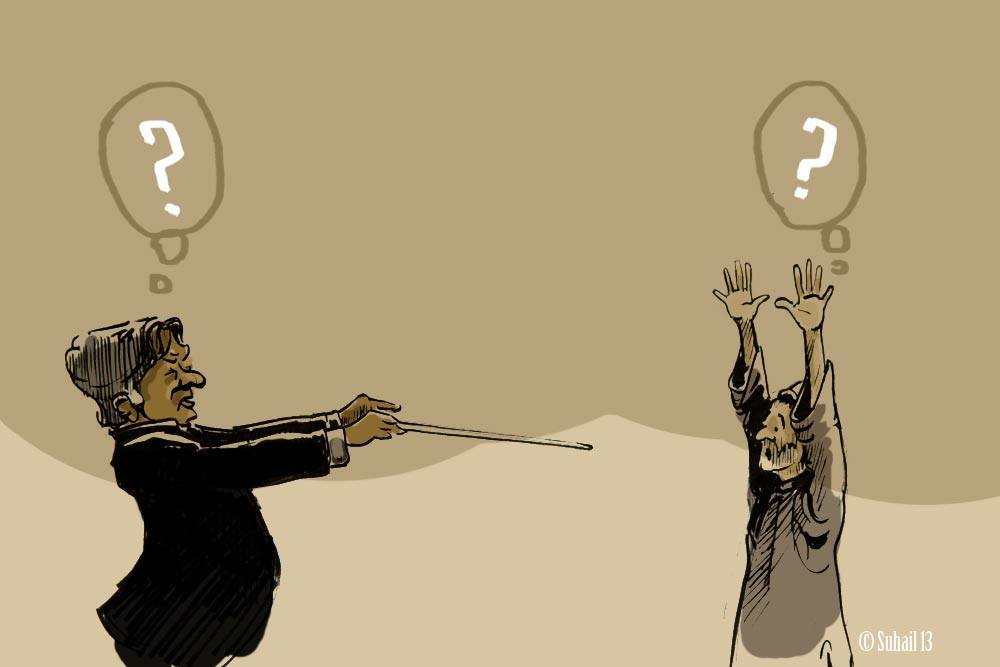
Legitimizing A Military Occupation With Music: Zubin Mehta in Kashmir

It is most unfortunate that the German Embassy should seek to collaborate, perhaps unwittingly, with the Indian State in Kashmir, recognized as an international dispute by the United Nations and the international community, without any sensitivity to the aspirations of the people, or issues faced, or the machinations of the Indian State.

"Facing the Music!" by Suhail Hassan Naqshbandi
“Facing the Music!”

PLEASE SHARE WIDELY! Thanks!

26 August 2013

To
Ambassador Michael Steiner,
German Embassy,
New Delhi, India.

Subject: URGENT Protest Letter to German Embassy on scheduled Zubin Mehta concert in Srinagar, Jammu and Kashmir, on 7 September 2013

1. On 22 August 2013, a press release was issued by the German Embassy that Zubin Mehta would be conducting an orchestra on 7 September 2013 at Shalimar Bagh, Srinagar, Jammu and Kashmir.

2. The press release quoted you as stating that the concert was for the people of Jammu and Kashmir by way of a cultural tribute. The press release also reads that the concert was intended to give a message of hope and encouragement to the people of Jammu and Kashmir. The concert, said to be a part of a “broader engagement” is being organized by the German Embassy and supported by the “competent authorities both at Central as well as at Union State level.” The costs of the concert are covered by “benevolent sponsors mainly from the business world in India and Germany, as well as “Incredible India” and the German Foreign Office”.

3. The people of Jammu and Kashmir take immense pride in our rich history of resisting oppression. We also have historically cultivated a sublime tradition in, and love for, music. Music – which appeals to the higher truths of love, justice, dignity, and peace; which genuinely acknowledges the long suffering, and yet bravely resisting, Kashmiris; and which is performed for the actual public – is wholeheartedly welcomed. However, legitimizing an occupation via a musical concert is completely unacceptable. Art as propaganda, as abundantly documented, was put to horrific use in Nazi Germany. We are sure you will understand that we cannot welcome anything even remotely analogous in Jammu and Kashmir. Sadly, the occupation will be amply reflected in the demographics of the audience of the proposed concert – the list of “invitees only” is bound to be restricted to the members of the apparatuses of the Occupying State: from perpetrators of crimes, as heinous as murder, rape, and torture, to the local collaborators of the State and perhaps some powerless, vulnerable and compliant few. Continue reading “Legitimizing A Military Occupation With Music: Zubin Mehta in Kashmir”

Creative Community for Peace in Letter to Jose Feliciano: Healing with Music in Colonial Times, Building Bridges Over the Bodies of the Oppressed

Right: Jose Feliciano Left: Steve Schnur

Jose Feliciano is scheduled to perform in apartheid Israel on October 10, at Nokia Stadium. Already he’s being sent messages professing liberal language of equality and harmony for all, by that elite club for the endless cycle of war profiteering, whitewashing and violence, otherwise known as “Creative Community for Peace” (CCfP). Creative Community for Peace is a specialist in apartheid PR. They’re mere existence is about diverting attention from Israel’s systematic daily war crimes against the Palestinian population under its control, by abusing the word “Peace” and shooting the messenger- Boycott, Divestment and Sanctions activists (BDS), who connect the dots between Israel’s image of itself and the reality of its erasure of the Palestinian narrative and people.

Unfortunately, Jose Feliciano, for the time being, endorses the “Creative Community for Peace” statement that has been sent to him, and has posted it on the website. Continue reading “Creative Community for Peace in Letter to Jose Feliciano: Healing with Music in Colonial Times, Building Bridges Over the Bodies of the Oppressed”

On the Liberty of Republics

Quentin Skinner giving a talk on liberalism and the liberty of republics.

Continue reading “On the Liberty of Republics”

The solutionist impulse and digital theology

My review of Evgeny Morozov’s To Save Everything, Click Here, published in The National

In her celebrated January 2010 statement on “internet freedom”, Hillary Clinton chided countries such as China, Tunisia, Uzbekistan and Egypt for placing restrictions on internet access. The then-US secretary of state affirmed her government’s conviction that “the more freely information flows, the stronger societies become”, because “access to information helps citizens hold their own governments accountable, generates new ideas, encourages creativity and entrepreneurship”.

Not long after, the whistleblowing website WikiLeaks obtained a trove of information revealing US military and diplomatic conduct in Iraq, Afghanistan and the rest of the world. Information flowed freely. But the US government appeared somewhat less convinced of its capacity for strengthening society. Access to WikiLeaks was restricted in many government agencies; Amazon, MasterCard, Visa and PayPal were persuaded to withdraw their services; and students and government employees were discouraged from sharing Wikileaks information on pain of jeopardising career prospects.

Internet freedom, it turned out, was not a sacrosanct principle. It failed to resist the intrusion of profane political concerns. As an analytical category independent of political and social constraints, the internet produced stirring rhetoric, but shorn of its obfuscating theology, it proved subject to the imperatives of power as much in the United States as in Uzbekistan.

This disconnect between the reality of the internet – the physical infrastructure, with its platforms, protocols and utilities; its promises, perils and limitations – and the idea of “the internet” – as a fixed, coherent and unproblematic phenomenon that is open, public and collaborative – enables two dangerous tendencies that are the subject of Evgeny Morozov’s To Save Everything, Click Here: Technology, Solutionism, and the Urge to Fix Problems That Don’t Exist.

The first he calls “solutionism” – a preoccupation with spectacular and narrow solutions to complex social and political problems. The second is “internet-centrism” – a conviction that “the internet” heralds a revolutionary era, a time of profound change in which old truths have become obsolete.

You can read the rest here.

Gore Vidal and Noam Chomsky in Conversation

Wonders of Youtube! A 1991 video of a conversation between the two greats surfaces.

A Response to Jacky Terrasson’s Agent, Christophe Deghelt, about the Red Sea Jazz Festival

Note: I don’t speak French, I’m responding to a Google Translate version of the original post, so I’ll refrain from my usual special attention to semantics, in order not to dwell on what may be a technical mistake in translation.

Jacky terrasson with manneger Christophe Deghelt

Last Wednesday, Jacky Terrasson’s agent, Christophe Deghelt, responded to the massive campaign to boycott the Israel state sponsored Red Sea Jazz Festival (more details on the government and corporate connections of the festival in this article). Since thought did actually go into this post, I think we in the BDS movement should respond. So here it is, point-by-point. I hope this furthers public discussion, as BDS so often does, because just like Christophe Deghelt, this is a “debate that I hold dear”.

On Notions of  War, Peace, and Popular Struggle

Continue reading “A Response to Jacky Terrasson’s Agent, Christophe Deghelt, about the Red Sea Jazz Festival”

Israel 2012, The Question of a Nation: What Does Culture Have to Do with Politics? (Part 2)

Earlier this week, I found a message in my inbox by an Israeli, who’s a Jazz musician, who’s paying gig was canceled because of a successful BDS movement campaign to get Swedish Jazzist, Andreas Öberg, to cancel his gig in the Eilat Red Sea Jazz Festival. Usually, the extent of my response, when I get unsolicited mail from angry Israelis, is to take a screenshot and add it to my “Love Letters” albums on my Facebook profile. Call it an artistic form of exhibiting political repression, racism and sexism, if you will (but what does culture have to do with politics, I wonder…). This time, however, since we’re not talking about your typical angry Red Hot Chili Peppers fan, but someone who has lost a paying gig. I think it merits a response (even though, as I will argue below, I am actually not the address for cultural worker grievances).

You Don’t Know Me and I Don’t Know You

Continue reading “Israel 2012, The Question of a Nation: What Does Culture Have to Do with Politics? (Part 2)”

Israel 2012, The Question of a Nation: What Does Culture Have to Do with Politics?

For more information on how Israel is using this face to mask its evil, go to http://www.no2brandisrael.org/

The interesting thing about Israel is that its government and registered citizens have a wonky spatial perception, which feeds off itself: In Israel, you’re not in the state, the state is in you. Due to this cyclical perception, along with the “standard” “nation branding” (a marketing lie on to itself, and that sick capitalist perception of a state- a geographic territory with obligations and responsibilities towards its respective inhabitants- as a product which is on the market for sale), known as Brand Israel, much of Israel’s propaganda is based on the blurring of the lines between the individual and the state (and army).

As a BDS activist, whose main focus is cultural boycott, I’ve come up against a very common Israeli claim (individuals, small business, and government officials) that “culture has nothing to do with politics”. Most commonly it comes in the form of a puzzled “rhetorical” question: “What does culture have to do with politics?!” As if asking this question closes the discussion, because it’s so obvious that art, music, books, films, theater and dance are a pure form of entertainment that has no intellectual, political, anthropological value. As if cultural products aren’t bought and sold as commodities and status indicators.

Shuki Weiss Promotion and Production Ltd. in the Service of the State of Israel

Continue reading “Israel 2012, The Question of a Nation: What Does Culture Have to Do with Politics?”

For Omar Misharawi: Killed by Israeli Airstrikes on 11/14/12

BBC journalist Jihad Masharawi carries his son’s body at a Gaza hospital. (Associated Press)
BBC journalist Jihad Misharawi carries his son’s body at a Gaza hospital. (Associated Press)
Omar Misharawi (Jihad Misharawi, via Paul Danahar)

by Shadab Zeest Hashmi

At death you measure
no more than our arms
When we rise
to blow a prayer into your charred lung
we find resplendent
butterflies
milling about — lapidary
punctuations of our time
together
(eleven months in all)

Horror turned honey
and lustrous
as buds of new fruit

Ya Shaheed
You witnessed

O’Reilly v Stewart 2012: The Rumble in the Air-Conditioned Auditorium

Jon Stewart and Fox News host Bill O’Reilly faced off in “the Rumble 2012” debate last night at the Lisner Auditorium on the campus of George Washington University in Washington, D.C.