The People’s Lawyer: In Conversation with Colin Gonsalves

by Saffi Ullah Ahmad

Colin Gonsalves (Photo: Saffi Ullah Ahmad)

Colin Gonsalves is a senior advocate of the Supreme Court of India and a pioneer of public interest and human rights law. He has won over 200 mostly precedent setting cases against the Indian government and powerful corporations in favour of poor and marginalized groups. Gonsalves has been described as a champion of the exploited.

In 1989 Colin founded the human rights law network (HRLN), known today as a network of hundreds of lawyers and social activists whose aim has been to further the struggle for human rights and equality through making justice accessible to disadvantaged members of Indian society. Funded mainly through grants from various organisations, his growing army of lawyers regularly litigates on issues of women’s and minority rights, environmental damage, child labour, disability law, land confiscation, sexual harassment, prisoner abuse, human trafficking and the right to nutrition. Giants taken on by the HRLN include the likes of Enron. The HRLN now has a presence in over 20 Indian states where its centres provide pro bono legal services, undertake public interest litigation and run campaigns to spread awareness of human rights.  In addition to this organization Gonsalves also heads the Indian People’s Tribunal on Environment and Human Rights (IPT).

In 2001 Gonsalves began work on a case which in the face of ever increasing privitisation and withdrawal of food subsidies, aimed to force the central government to implement several food security schemes across the country. He argued that the Indian constitution’s reference to a ‘right to life’ encompasses the right to food, work and fair wages. Also highlighting that as a result of rampant malnutrition 3-5,000 Indians die every year of starvation, Gonsalves and his team of pro-bono lawyers were able to bring relief to over 300 million people following a series of court orders in their favour. The case won him and the HRLN acclaim from former Irish President and UN High Commissioner for Human Rights, Mary Robinson, among others.

Gonsalves has received honorary degrees and awards for his services from a plethora of educational institutions as well as legal and charitable organizations including the American Bar Association’s International Human Rights Award for his ‘extraordinary contribution to the causes of Human Rights rule of law and promotion of Access to Justice’ in 2004.

Gonsalves was recently in London to receive an honorary doctorate in Law from Middlesex University where I interviewed him.

Continue reading “The People’s Lawyer: In Conversation with Colin Gonsalves”

Reese Erlich: “Stop using the word ‘terrorist'”

Defining what a terrorist is and isn’t is a major dilemma. What one may consider terrorism, another may consider resistance. So where does one draw the line? Reese Erlich tackles that topic in his latest book “Conversations with Terrorists: Middle East Leaders on Politics, Violence, and Empire.” Erlich is a veteran journalist who has covered U.S. foreign policy for decades. He has freelanced for National Public Radio, Radio Deutsche Welle, the Australian Broadcasting Corp. Radio, the Canadian Broadcasting Corp. Radio, and writes for The San Francisco Chronicle and The Dallas Morning News.

Drawing on firsthand interviews and original research, Erlich argues that yesterday’s terrorist is often today’s national leader and that today’s freedom fighter may become tomorrow’s terrorist. By branding all of American’s opponents as “terrorists,” it makes it more difficult to look beyond the individual or the political group and understand what they are really all about. I caught up with Erlich recently and here’s what he had to say.

Continue reading “Reese Erlich: “Stop using the word ‘terrorist’””

Why silence over Kashmir speaks volumes

by Pankaj Mishra

Once known for its extraordinary beauty, the valley of Kashmir now hosts the biggest, bloodiest and also the most obscure military occupation in the world. With more than 80,000 people dead in an anti-India insurgency backed by Pakistan, the killings fields of Kashmir dwarf those of Palestine and Tibet. In addition to the everyday regime of arbitrary arrests, curfews, raids, and checkpoints enforced by nearly 700,000 Indian soldiers, the valley’s 4 million Muslims are exposed to extra-judicial execution, rape and torture, with such barbaric variations as live electric wires inserted into penises.
Why then does the immense human suffering of Kashmir occupy such an imperceptible place in our moral imagination? After all, the Kashmiris demanding release from the degradations of military rule couldn’t be louder and clearer. India has contained the insurgency provoked in 1989 by its rigged elections and massacres of protestors. The hundreds of thousands of demonstrators that fill the streets of Kashmir’s cities today are overwhelmingly young, many in their teens, and armed with nothing more lethal than stones. Yet the Indian state seems determined to strangle their voices as it did of the old one. Already this summer, soldiers have shot dead more than 50 protestors, most of them teenagers.

Continue reading “Why silence over Kashmir speaks volumes”

Robert Fisk: The Road out of Kabul goes through Kashmir

The title is actually a quote from veteran journalist Graham Usher, but it pretty much sums up Robert Fisk’s view of the significance of Kashmir to the new Great Game being played in Afghanistan.

Continue reading “Robert Fisk: The Road out of Kabul goes through Kashmir”

Kashmir: Trapped Within Hindu Nationalist Imagination

In annexing Kashmir, Indian leaders put aside their progressive anti-colonialism, and pursued a policy that stood in direct confrontation with the goals of struggling Kashmiris. Nehru’s professed derision for princes and despots proved facile in Kashmir in this first real test of his commitment to anti-colonialism and democratic values. His decision to urge the discredited and runaway Dogra ruler to sign the imperial Instrument of Accession, and then accept it, was a defeat for the oppressed Kashmiris who had, with great sacrifices, forced the Dogra ruler out. By recognizing the authority of the Dogra ruler, Indian sovereignty over Kashmir simply replaced the sovereignty enshrined in the Dogra maharaja. But along with that sovereignty, India inherited Dogra rule’s illegitimacy as well.

by Mohamad Junaid

(First published in Greater Kashmir on August 5, 2010)

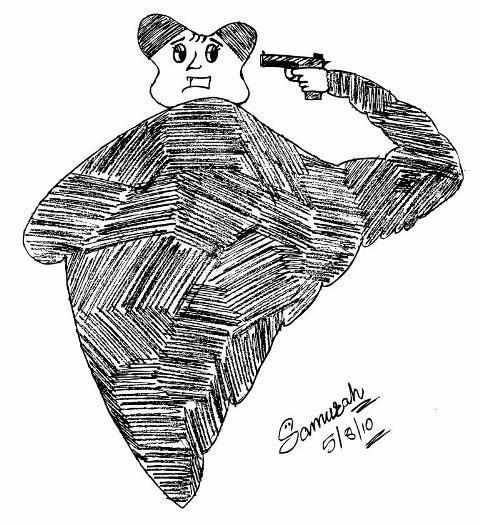
Untitled by Samurah Kashmiri, August 5, 2010
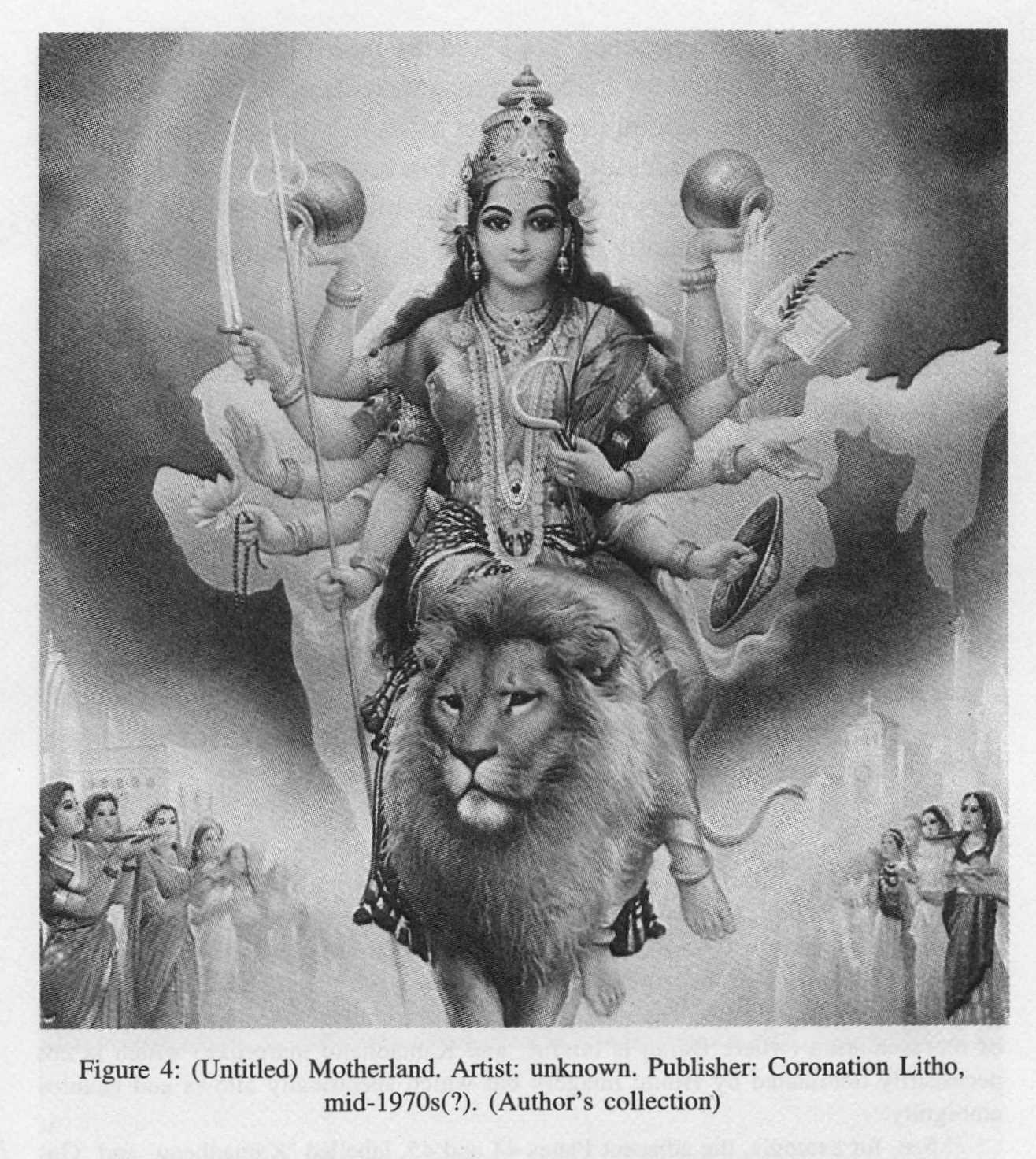
Bharat Mata or Mother India

On 26 January 1992, Murli Manohar Joshi, the leader of the Hindu nationalist Bharatiya Janata Party, after travelling by road all the way from the southern tip of India, was airlifted from Jammu to the heart of Srinagar where he half-raised the Indian flag near historic Lal Chowk. All of Kashmir was put under severe curfew, and the army was given shoot-at-sight orders. Throughout the day soldiers shot dead more than a dozen Kashmiris in the streets of Srinagar. Over the previous two years, the Indian government had unleashed a reign of terror on the people, with massacre upon massacre of unarmed protestors dotting Kashmir’s timeline. Joshi’s Ekta Yatra (Unity March), protected and provided of full support by the Indian government, was an important reminder of the nature of the Indian state and the relationship it sought with the people of Kashmir. The event was designed to put on display the majoritarian character of Indian nationhood, and line up power of the state behind it to send barely coded messages to audiences in India and in Kashmir.

Continue reading “Kashmir: Trapped Within Hindu Nationalist Imagination”

“Truth Alone Triumphs”: of David, Goliath, Stones, and Speech

“Azadi” is also the chant whose echoes swirl in the Kashmir Valley with greater resonance each day, from the minarets and playgrounds, boulevards and alleys, schools and courts, despite the crushing screeches of teargas and bullets of the Indian (in)security forces. It is “scriptured” into utterance by each breath of Kashmiri women, children, and men; calligraphed by their blood on their emerald valley; embroidered by their bones in Kashmiri Arabesque on worn cobblestones of the downtown; and papier-mâchéd in paisley tears on the blue of their beloved lakes.

by Huma Dar

“A Defiant Kashmiri woman being frisked by Indian Security Forces.” 2007. Uncredited photograph from a Kashmiri blogger


And the night’s sun there in Srinagar?  Guns shoot stars into the sky, the storm of constellations night after night, the infinite that rages on.  It was Id-uz-Zuha: a record of God’s inability, for even He must melt sometimes, to let Ishmael be executed by the hand of his father.  Srinagar was under curfew.  The identity pass may or may not have helped in the crackdown.  Son after son–never to return from the night of torture–was taken away.

… But the reports are true, and without song: mass rapes in the villages, towns left in cinders, neighborhoods torched.  “Power is hideous / like a barber’s hands.”  The rubble of downtown Srinagar stares at me from the Times.

… And that blesséd word with no meaning–who will utter it?  What is it?  Will the women pronounce it, as if scripturing the air, for the first time?  Or the last?

… What is the blesséd word?  Mandelstam gives no clue.  One day the Kashmiris will pronounce that word truly for the first time.  (Excerpt from Agha Shahid Ali’s “The Blesséd Word: A Prologue,” in The Country Without A Post Office,  1997: 16-17)

Continue reading ““Truth Alone Triumphs”: of David, Goliath, Stones, and Speech”

The Stones On Our Streets

Lies are created around the truth of our struggle. But truth has a habit of confronting falsehood. Occupation is based on a pile of lies. There’s truth in the resistance of unarmed people on the streets. And truth triumphs in the end. It always does, even if it takes time.

by Majid Maqbool

The street is the home of our stones.  Streets can be occupied, but stones are free for us to pick up, and angrily fling in the air — in protest.  From the hands of the oppressed, once pelted, the stones deliver a message to the oppressor: while you kill with no remorse on my soil, and stage false encounters with all your advanced weapons, I’m not going to keep quiet.  I will not let you kill us without offering resistance.  I have these stones on my streets.  I exist in these stones.  If your occupation is in bullets, our resistance is in these rough-edged, homegrown stones.

We, who come out protesting on the streets, are not an ignorant, frustrated and unemployed lot — as the occupier likes to frame us, and the whole world seems to simplistically believe.  Far from it!  We are the ones who refuse to keep quiet in tyrannical times.  We are the ones who shape the songs of resistance, as we practice them in our streets.  It takes much courage and conviction to come out on the streets, and protest against the heavily militarized state forces.  The sentiment of freedom confronts the idea of occupation.  In every stone that’s pelted, there’s a promise to bring down the structures of occupation, bit by bit, crack by crack.  We know in our hearts and minds that this ugly structure of occupation —  built on deceit over the years — is bound to crumble one day under the force of our stones.  It is this hope that keeps the resistance alive.

Continue reading “The Stones On Our Streets”

Not Crushed, Merely Ignored

by Tariq Ali (first published in the London Review of Books)

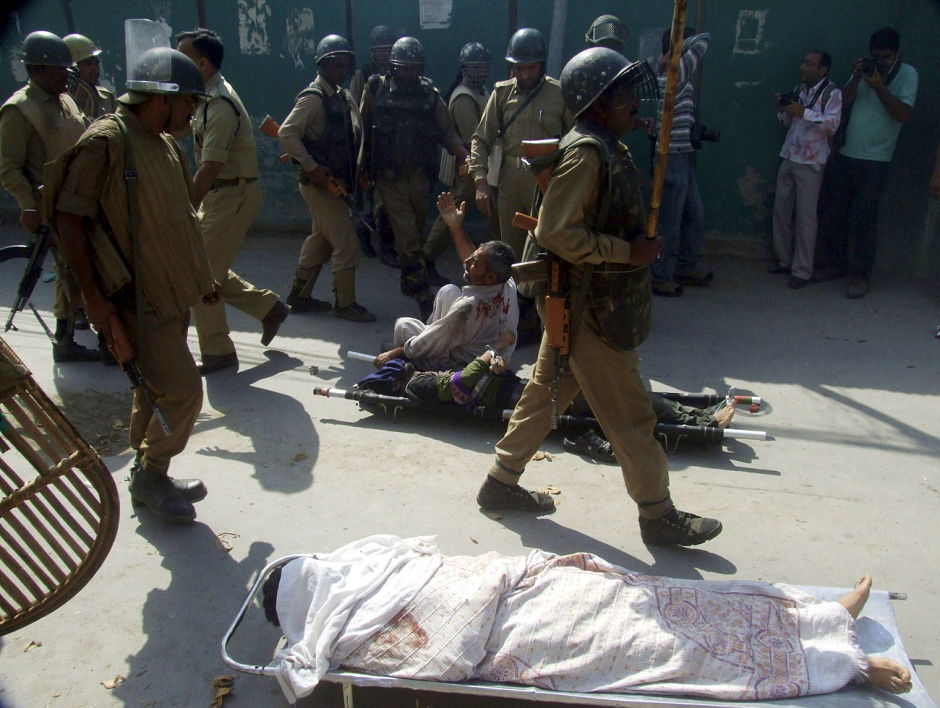
Indian policemen walk past the bodies of Muzaffar Ahmad Bhat and Fayaz Ahmad Wani (front) as they lie on the road after police stopped the funeral procession of the two in Srinagar July 6, 2010. India placed restrictions in parts of its controlled Kashmir on Tuesday and deployed thousands of troops to stop anti-India demonstrations after the death of two youths. Protesters said Fayaz Ahmad Wani and Muzaffar Ahmad Bhat were killed when police took action to stop anti-India demonstrations. (Photo: Umar Ganie/Reuters)

A Kashmiri lawyer rang me last week in an agitated state. Had I heard about the latest tragedies in Kashmir? I had not. He was stunned. So was I when he told me in detail what had been taking place there over the last three weeks. As far as I could see, none of the British daily papers or TV news bulletins had covered the story; after I met him I rescued two emails from Kashmir informing me of the horrors from my spam box. I was truly shamed. The next day I scoured the press again. Nothing. The only story in the Guardian from the paper’s Delhi correspondent – a full half-page – was headlined: ‘Model’s death brings new claims of dark side to India’s fashion industry’. Accompanying the story was a fetching photograph of the ill-fated woman. The deaths of (at that point) 11 young men between the ages of 15 and 27, shot by Indian security forces in Kashmir, weren’t mentioned. Later I discovered that a short report had appeared in the New York Times on 28 June and one the day after in the Guardian; there has been no substantial follow-up. When it comes to reporting crimes committed by states considered friendly to the West, atrocity fatigue rapidly kicks in. A few facts have begun to percolate through, but they are likely to be read in Europe and the US as just another example of Muslims causing trouble, with the Indian security forces merely doing their duty, if in a high-handed fashion. The failure to report on the deaths in Kashmir contrasts strangely with the overheated coverage of even the most minor unrest in Tibet, leave alone Tehran.

On 11 June this year, the Indian paramilitaries known as the Central Reserve Police Force fired tear-gas canisters at demonstrators, who were themselves protesting about earlier killings. One of the canisters hit 17-year-old Tufail Ahmad Mattoo on the head. It blew out his brains. After a photograph was published in the Kashmiri press, thousands defied the police and joined his funeral procession the next day, chanting angry slogans and pledging revenge. The photograph was ignored by the mainstream Indian press and the country’s celebrity-trivia-obsessed TV channels. As I write, the Kashmiri capital, Srinagar, and several other towns are under strict military curfew. Whenever it is lifted, however briefly, young men pour out onto the streets to protest and are greeted with tear gas. In most of the province there has been an effective general strike for more than three weeks. All shops are closed.

Continue reading “Not Crushed, Merely Ignored”

Peaches

by Arif Ayaz Parrey

Can I tell how much I love peaches?
Not ordinary ones
But those plucked from
The orchards along Jhelum

The ones in the basket before me
Are nebrim for sure
But they blush like a home-grown innocence
And hold as many juicy promises

I wonder what tree bore them
I wonder if it’s wise to ignore them

The tree of life
Has many buried roots

It is said that my only son
Was killed under the canopy
Of the branches of one such tree
By the army
Also known as the security forces
An old joke
What do they secure
These so-called security forces?
Not the people, not our lives, not our liberty
Not our sentiments, nor our emotions, not our sanity
Not our sons who are shot
Nor our daughters who are raped
Not the truth, not the facts, not humanity

Continue reading “Peaches”

Boycott Israel? Amitav Ghosh & the Dan David Prize

The call for academic and cultural boycott is clearly a way to encourage civil society to play a broader political role—that is why it has the support of wide sections of Palestinian civil society. One of the most significant questions that call poses to us is simply this: How could those of us who oppose apartheid, occupation, and colonialism not support such a call?

Dear Amitav Ghosh,

We wish to express our deep disappointment in your decision to accept the Dan David prize, administered by Tel Aviv University and to be awarded by the President of Israel. As a writer whose work has dwelled consistently on histories of colonialism and displacement, your refusal to take stance on the colonial question in the case of Israel and the occupation of Palestine has provoked deep dismay, frustration, and puzzlement among readers and fans of your work around the world. Many admired your principled stand, and respected your decision not to accept the Commonwealth Writers Prize in rejection of the colonialist framework it represented.

Continue reading “Boycott Israel? Amitav Ghosh & the Dan David Prize”