Leila al-Shami on Stop the War

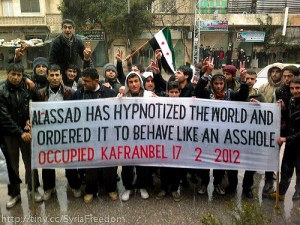
asshole

by Leila al-Shami

(From Leila al-Shami’s blog.)

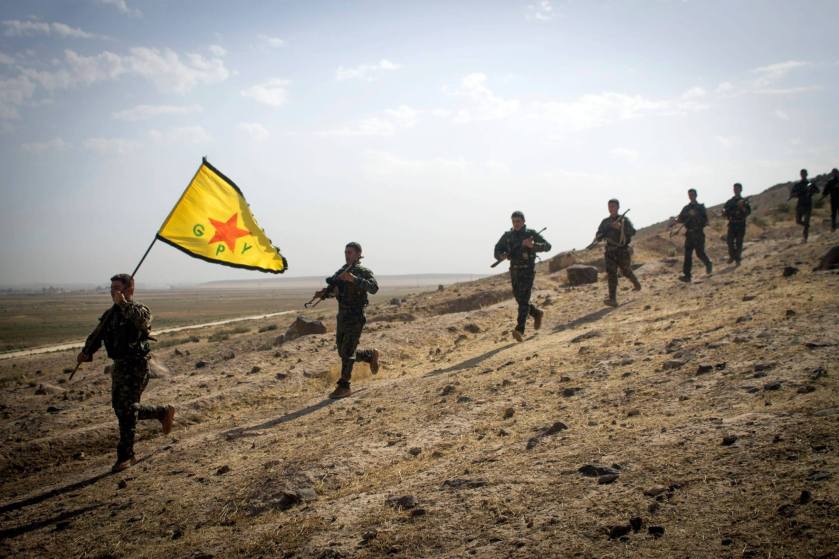
Today, the British parliament will be voting on whether or not to join the US coalition in bombing Daesh (ISIS). During the debates the British left has outdone itself – even by its own usual standard of idiocy – to the extent it makes the Tories look progressive.

Over the past few days, demonstrations have been held in London and elsewhere to oppose the UK bombing Syria. The demonstrations were organized by the Stop the War Coalition (STW), an organization which has long adopted a counter-revolutionary position on Syria. Since the start of the uprising in 2011 STW has refused to acknowledge the agency of the oppressed Syrian people struggling against a fascist regime or to support their struggle in any form, preferring to see the current conflict only through a geopolitical lens. Their selective anti-imperialism means they’ve only ever opposed Western intervention in Syria (even when this was not a reality) and refuse to actively oppose Russian or Iranian intervention. They have never called for any action against Assad or opposed the war he has waged on the Syrian people, raining down barrel bombs and targeting civilian areas with Scud missiles for over four years. It is this war which has been the main cause of civilian deaths in Syria and which has created the vacuum and desperation giving rise to Daesh. These ‘progressives’ have consistently refused to give a platform to revolutionary Syrians. They have even, shamefully, called the police to remove Syrians present at a recent meeting. Conversely, they give non-Syrian apologists for the Assad regime a voice, people such as the odious George Galloway and massacre-denier Mother Agnes.

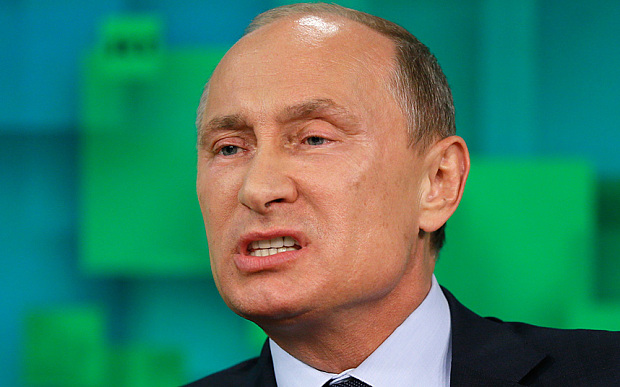
At the demonstrations organized by STW some present were holding Baathist flags and pictures of the mass-murderer Assad. Seriously, a blatant fascist presence was considered acceptable at a protest organized by people who describe themselves as leftists. It is no wonder that their demonstrations were small (compared to the heyday of the Iraq war demos), with no large scale Syrian or Muslim presence. I am sure many who oppose the bombing of Syria would feel alienated joining a protest organized by those who ally themselves with a regime that practices torture on an industrial scale, sodomizes its opponents with broken bottles, and gasses civilian neighbourhoods. One of the speakers at the event held last Saturday, Tariq Ali (once considered a ‘radical’, so I’m told) rhetorically called for Britain to ally itself with Assad and Russia if it wanted to defeat Daesh. This was based on his erroneous claim that Russia is actually attacking Daesh, whilst the evidence shows that the majority of Vlad the Invader’s attacks are aimed at anti-Assad forces (which have also been fighting Daesh since January 2014) and civilians in areas with no Daesh presence. As for Assad, not only has he not attacked Daesh until recently (to gain international legitimacy as a partner in the ever expanding War on Terror) but has actively facilitated its growth.

Jeremy Corbyn, the current leader of the British Labour Party who has been the Chair of STW for the past four years and has now appointed the Stalinist and Putin supporter Seumas Milne as the party’s director of communications, is giving his party’s members the choice of whether to back joining the US coalition or not. To help them make up their minds he has invited Patrick Cockburn to brief Labour MPs on Syria ahead of the vote. Patrick Cockburn openly supports the fascist mass murderer Assad, has called for Britain to ally with Assad’s imperialist sponsors Russia and Iran, has consistently slandered Syrian rebels as ‘Al Qaeda’, makes shit up in his writing like pretending to be an eyewitness to massacres which likely never happened, and recommends Donald Trump’s analysis on the Middle East. Does anyone really consider these people progressives? As an anarchist, it seems to me that the statist ideologies of both left or right have much more in common with each other than any values or principles I adhere to.

As a British Syrian who opposes any foreign power bombing Syria, I cannot help but feel disgusted that these people have hijacked the debate. The only way to defeat Daesh is to give support to local forces which are engaged in the battle with them on the ground. This must include Sunni Arab forces – the population Daesh attempts to rule. Cameron was not wrong when he said there are 70,000 moderate opposition fighters in Syria. However, the idea that these forces will join a coalition fighting Daesh which doesn’t address the main threat to Syrians – the Assad regime – is absurd. As for the anti-war left, if they are to have any relevance or moral compass, they must oppose all those who are bombing Syrians, including the Assad regime and its imperial backers, Russia and Iran. Most of all, they must listen to the voices of Syrians instead of sticking to their patronizing and unprincipled stance of inviting ‘experts’ of dubious credentials speak on their behalf.

Regardless of the outcome of today’s vote, the bombs on Syria will continue to fall.
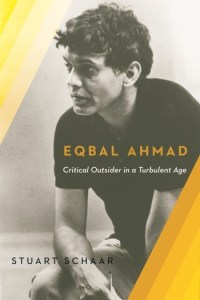


The Legacy of Eqbal Ahmad

Eqbal-Ahmad-biography-coverSadly, Eqbal Ahmad is not as well remembered as he should be. Stuart Schaar’s marvelous new biography, Eqbal Ahmad: Critical Outsider in a Turbulent Age, will help rectify this unfortunate fact.

Among many other endeavours, Ahmad directed the Transnational Institute in Amsterdam, collaborated with Algerian revolutionaries, edited the journal Race & Class, wrote a column for the Pakistani newspaper Dawn, and sat trial for conspiring to kidnap Henry Kissinger. He was a Third Worldist, an internationalist, and a humanist in the very best sense of those terms.

Richard Falk puts it felicitously:

Eqbal Ahmad was a remarkable human being as well as a seminal progressive political thinker. In this illuminating intellectual biography, Stuart Schaar brings his subject to life, drawing on their long, intimate friendship and shared scholarly engagement with the politics of the Middle East and the Islamic world. Above all, Ahmad grasped the toxic interplay between the maladies of postcolonialism and the persistent imperial ambitions of the West better than any of his contemporaries.

In November I had the pleasure of interviewing Schaar about his book for Middle East Dialogues, a video series produced by the Center for Middle East Studies at the University of Denver. Here it is.

Anti-Imperialism for Dummies: Ignoring Syrians and Their Own Contradictions

By Charles Davis
12080219_1014749741879955_4184181291067013278_o
One of the iron laws of the know-nothing “anti-imperialists” is that if a group is supported by the United States, however minimally, or even just perceived as being aligned with U.S. interests, it goes without saying that the group is very bad and to be opposed by every good practicing opponent of empire. This is why many see no need to learn a thing about Syria beyond what can be found in 140 characters or less from Julian Assange, left-wing class analysis forsaken for conspiracy and a tautology: The U.S. is bad, and it says Assad is bad – maybe because of a pipeline, or because he made John Kerry pick up their last bar tab – Assad is therefore good, or at the very least less bad than those backed by the empire.

Preferring the simplicity of a “regime change” narrative that went from stale to rotten in 2013, when the U.S. eagerly embraced an Israeli-brokered deal with Russia to keep Assad in power, those who believe their theory of everything relieves them of the duty to know a thing about Syria or Syrians in particular long ago settled on claiming that all who fight the regime in Damascus are but unthinking “Contras,” or mercenaries fighting not for their own reasons but for the reasons of the regime in Washington. This, despite the fact that when the U.S. tried to create an actual mercenary army to fight ISIS – and, explicitly, ISIS alone – it managed to recruit all of 54 people.

Continue reading “Anti-Imperialism for Dummies: Ignoring Syrians and Their Own Contradictions”

The Syrian Jihad: The Evolution of an Insurgency

A comprehensive presentation on Syria’s evolving insurgency by Charles Lister. (Also don’t miss this interview with Lister).

Ali Abdullatif Ahmida on Libya

Ali Abdullatif Ahmida gives a talk titled “Post February 17 Revolution: The Challenges of Transitional Justice, Truth and National Reconciliation in Libya.” Ahmida features in the listmuse 100 Best Middle East History and Politics Books list.

The Crossing

crossingThis review of Samar Yazbek’s “The Crossing: My Journey to the Shattered Heart of Syria” was first published at the Daily Beast.

This shocking, searing and beautiful book is an account of three visits to Idlib province in northern Syria, an area liberated from the Assad dictatorship “on the ground but betrayed by the sky.”

In the face of regime repression, Syria’s non-violent protests of 2011 had transformed into an armed uprising in 2012. By August of that year, when the author – exiled Syrian novelist and journalist Samar Yazbek – made her first trip, Assad’s forces had been driven from the rural border zones. From a distance, however, via warplanes and long-range artillery, they implemented a policy of scorched earth and collective punishment. So Yazbek finds her homeland changed to a landscape of burnt fields and cratered market places, with boys picking through collapsed homes in search of things to sell and displaced families sheltering in tombs and caves. Death is ever-present. Gardens and courtyards have become cemeteries. Yazbek never shies away from the horror but builds something worthwhile from it, a record and a reflection, for death is ultimately “the impetus of writing and its source.”

Known today only for war, Syria is heir to an ancient civilisation. Idlib province houses the remains of Ebla, a five-thousand-year-old city, and is dotted with half-intact Byzantine towns and churches. The war’s “ruthless sabotage of history” has damaged these priceless sites. In Maarat al-Numan the statue of 9th Century poet Abu Alaa al-Maari, a native of the town highly respected in his own time despite his unusual atheism, has been decapitated by armed Islamists. And the wonderful mosaic museum at the same location has been bombed by the regime and looted by various militias.

But amid these ruins Yazbek encounters a people giving voice to their aspirations after half a century of enforced silence. In revolutionary towns the walls are “turned into open books and transient art exhibits”. Activists organise “graffiti workshops, cultural newspapers, magazines for children, training workshops, privately-run community schools.” In the context of state collapse these projects are born of necessity, but they also reflect the kind of society the revolutionaries hoped to build – inclusive, democratic, forward-looking – one which they are in fact trying to build, even as extremists fashion their own, much darker versions. Through self-organised committees and councils, Yazbek is told, “each region now has its own administration, and every village looks after itself.” This – Syrians’ willed self-determination, Syrian creativity amid destruction – is the positive story so often missed in the news cycle, and it represents a hope for the future, faint though it is. The activists know they are working against insurmountable odds, but continue anyway. They document atrocities and reach out to international media, an endeavour which has so far failed to bear tangible fruit. When they can, they laugh – it’s “as though they inhaled laughter like an antidote to death.”

Continue reading “The Crossing”

We Break It, You Own It: Putin’s Syria Strategy

putinSharp analysis from Thomas Pierret, published first at the Global Observatory.

Some Western observers of Russia’s recent intervention in Syria are convinced President Vladimir Putin is making a mistake—and, following wisdom often attributed to Napoleon Bonaparte, one should never interrupt an enemy while they are making a mistake. By committing its own forces to the defense of beleaguered dictator Bashar al-Assad, some believe that Moscow is about to bog itself down in Syria the same way Washington got stuck in Iraq. However, proponents of this view should be wary the joke might well be on them.

First, although difficult times certainly lie ahead for Russia in Syria, Putin’s intervention will make the conflict more destructive, destabilizing, and intractable, hence more detrimental to all parties. Second, the way Moscow defines success in Syria is hardly comparable to the stabilization-oriented approach adopted by the United States-led coalition in Iraq. Instead, by trying to destroy mainstream insurgents, Putin aims to reshape the Syrian war in a way that would leave Western countries with no other option than to supplement Russia as the protector of Assad.

Russian intervention in Syria will make the war deadlier and heighten the refugee crisis spreading across the region into Europe and beyond. Although they have carried out some precision airstrikes against rebel headquarters, Russian forces have made a greater use of unguided ammunitions, including cluster bombs designed to wreak havoc over vast swaths of territory. As scores of these fail to explode, they will continue to kill civilians who will accidentally set them off years after the end of Russian operations. Russian attacks are not more discriminate than Assad’s, but they are far more powerful. Consequently, they have provoked new displacements of populations in regions whose inhabitants were already used to intensive shelling and bombing, such as the northern countryside of Hama province.

Continue reading “We Break It, You Own It: Putin’s Syria Strategy”

The Dictator’s Last Night

gaddafiAn edited version of this review appeared in the Guardian.

Colonel Gaddafi – “the Brotherly Guide, the miracle boy who became the infallible visionary” – possessed a character so colourful it begged entry into fiction. Yasmina Khadra – pseudonym for Algerian ex-military man and bestselling writer Mohammed Moulessehoul – obliges here in “The Dictator’s Last Night”, a title to be fitted alongside such great dictator novels as Marquez’s “The Autumn of the Patriarch” or Vargas Llosa’s “The Feast of the Goat” (the latter set in the last hours of the Dominican strongman Trujillo). Although Khadra matches neither the epic scale nor the experimental virtuosity of those two, his writing here is compulsive, funny, powerfully emotional, and often sinuously intelligent.

For his last night, the “untameable jealous tiger that urinates on international conventions to mark his territory” is confined to a disused school in Sirte, the sky aflame with NATO bombs and rebel bullets, his generals either fleeing or collapsing from exhaustion.

Like Hitler in the bunker he rails against his people’s betrayal – “Libya owes me everything!” – against the West which so recently feted him and, with no irony at all, against his fellow Arab autocrats, those “pleasure-seeking gluttons.”

Khadra’s imagining of him is probably pretty accurate: bullying, mercurial, grandiose, containing an egomaniac’s contradictions – self-obsessed but craving approval, ruthless but oversensitive. It’s “my full moon, nobody else’s,” he declares, and “Everything I did worked.”

Gaddafi remembers his poor Beduin beginnings, fatherless and disturbed, and his struggles against “the barriers of prejudice”. He was spurned when, as a young officer, he proposed marriage to a social superior. The reader sympathises with the humiliation – until shown the nature of the dictator’s later response. Gaddafi’s voice careers from sentimentality to brutality and back, and at first the reader’s heart follows.

Continue reading “The Dictator’s Last Night”

Interview with Saud Alsanousi

SaudI interviewed Kuwaiti novelist Saud Alsanousi for the National. My earlier review of his novel “The Bamboo Stalk” is here.

Born in 1981, Kuwaiti writer Saud Alsanousi won the 2013 International Prize for Arabic Fiction (IPAF) for his novel “The Bamboo Stalk”. A warm and generous interlocutor, here he speaks about otherness, his ‘method-writing’ approach to characterisation, and his aversion to the ‘shock method’…

RYK: Why did you choose the half-Kuwaiti, half-Filipino Isa/Josè as your hero?

SA: Since my childhood I’ve been interested in the image of the other. The other was always seen negatively, whether he was a Westerner, an east Asian, or an Arab from beyond the Gulf. And in turn the West, the Asians, and the Arabs saw us as the other. Of course I rejected their negative image. At the same time I realised that some of it was true – we Kuwaitis had social problems, we were closed in upon ourselves, we didn’t know any culture except our own. We always think we’re right and the other is wrong, socially, religiously. Through reading and travel I discovered that the world was much bigger than us, that we weren’t the axis of the whole universe.

How could I approach the topic in writing? I thought a novel would be better than journalism, because a newspaper article is a brief phenomenon, whereas when a reader follows the life story of a character through a novel, day by day and page by page, he builds a relationship with that character, he really engages with him.

And why Josè specifically? Previous stories about ‘the other’ have focused on the West. We already know the West looks down on us, how Hollywood depicts us, and we’re used to it. Instead I wanted to concentrate on those some may consider our inferiors. I chose the lowest class, those who serve us in shops and hospitals. I wanted to imagine how they see us. Of course, the hero had to be half-Kuwaiti in order to gain intimate access to a Kuwaiti household. My first idea was to make him half-Indian, but the problem with that was that he wouldn’t look foreign enough. He could pass easily for a Kuwaiti. But Josè looks east Asian, and is judged by his appearance.

RYK: How did you set about building the character?

SA: I only talk for myself, but I found that research by reading and watching documentaries wasn’t nearly enough. It produced only cold information, and when I wrote the result looked like a tourism brochure.

So I travelled to the Philippines and lived in a simple house in a traditional village. I wore their clothes. I ate their food and I breathed their air. And I met a lot of expatriate workers in Kuwait, not just Filipinos, and listened to their problems.

I embodied the character. I’m not exaggerating when I say that when I came back home, from the moment I arrived in the airport, I wasn’t Saud Alsanousi but Josè Mendoza. I saw my own country through the eyes of a stranger. From May 2011 to May 2012, while I was writing, I continued to be Josè. I visited the places he would, I rode a bike like him, I tuned my satellite to the Filipino channels, even if I didn’t understand the language. And I surrounded my workspace with bamboo. I could only write the character by embodying it.

RYK: The novel’s themes are human, social, even spiritual. What is your aim in writing? Why do you write?

SA: Let me start with “The Bamboo Stalk.” We don’t know anything about the Filipino. We see him working in Starbucks – that’s it. We know nothing about his cultural and intellectual wealth, his history, his struggle against Spanish colonialism, nor about the social peace in his country despite the presence of three religions. It’s because we don’t know his background that we deal with him in this stereotypical and disrespectful way. And because we don’t know the other, we don’t know our own place in this world.

Continue reading “Interview with Saud Alsanousi”

“India,” “Secularism,” and Its Dissenting Authors Or “Der Āyad, Durust Āyad, but is this even an arrival”?

by Huma Dar

“Prominent writers in India are collectively protesting what they consider an increase in hostility and intolerance, which they argue has been allowed to fester under the government of Prime Minister Narendra Modi, by returning a prestigious literary award.”

Referring to attacks against Muslims, including the killing of a man who had been suspected of slaughtering a cow, he said, “This is not the country that our great leaders had envisioned.” (Ghulam Nabi Khayal, Sahitya Akademi Award, 1975)
The newsfeed on most South Asian social media has been deluged by articles like the one in The New York Times above. However, one has to wonder what kept these literary “stars” from this praiseworthy gesture of returning their State-given awards when the Gujarat pogroms were going on in 2002, or against the pogroms that followed the demolition of Babri masjid in 1992/3, or against the genocide of Sikhs around 1984, or heck, against the ongoing genocide in Indian Occupied Kashmir or that of Dalits…
My apologies for this query, which despite seeming cynical at first blush, is actually a probing of the very problematic and exceptionalizing notions of “India as a nation” and “Indian secularism” that these authors and poets valorize, explicitly or implicitly, through this joint gesture of returning their awards or through their separate oeuvre at large. It is precisely these twin concepts of unprobed “Indian secularism” and even more foundationally, the unproblematized, dehistoricized, and normalized idea of “India as a nation” (see The Indian Ideology (2012) by Perry Anderson for a resounding deconstruction of this) that are the fecund incubating grounds of much violence – violence which is Brahminical, colonial, and Islamophobic at the core. This is true not only with regard to the acts of spectacular violence, like the mob lynching of Muhammad Ikhlaq in the current context of Dadri, at the contemporary moment of Modi-fied India, but also for the billion and one banal acts of quotidian casteist, colonial, and communal violence that fertilize the roots of the phenomenon in modern India. This is especially true for the comparably spectacular violence of the allegedly “secular” contexts – the genocidal violence of the Indian state in Kashmir, Punjab, Hyderabad, Assam, Manipur, Jharkhand, Chhattisgarh, in every Dalit basti et al – that preceded the current Hindutva regime (and co-exist at any given time). In fact, it can be argued that the exceptionalization of India not only papers over much of this epistemic violence by making it invisible but actually enables it by helping it elide scrutiny. Thus no gesture of protest, however “well intentioned” it might be, will bear fruit until and unless the very problematic exceptionalism that undergirds the allegedly “secular India” is deconstructed.

Continue reading ““India,” “Secularism,” and Its Dissenting Authors Or “Der Āyad, Durust Āyad, but is this even an arrival”?”