UPDATE I: Ali Abunimah describes below what is happening in the video. UPDATE II: an eyewitness report on the aftermath of the march.
Dramatic footage of Syrians and Palestinians braving bullets and landmines to return to occupied Golan.
UPDATE I: Ali Abunimah describes below what is happening in the video. UPDATE II: an eyewitness report on the aftermath of the march.
Dramatic footage of Syrians and Palestinians braving bullets and landmines to return to occupied Golan.
This article first appeared on Gaza TV:
On 15 May, the annual commemoration of the creation of the state of Israel and the expulsion of Palestinians, known as Nakba, Egyptians plan to march to Palestine under the slogan “Cairo’s liberation will not be complete without the liberation of Al-Quds [Jerusalem].”
Following Egypt’s January 25 Revolution, Egyptians are pushing for some of the country’s foreign relations policies to change, especially those related to Israel and Palestine. Aid or protest convoys to Gaza were frequently stopped or arrested during the Mubarak era by the ousted president’s regime, and now for the first time since the revolution thousands of activists are planning to march to the Rafah border town.
Continue reading “Egyptians to mark Nakba with a march to Palestine”

Our dear friends Phil Weiss and Adam Horowitz of Mondoweiss at an event organized by Middle East Children’s Alliance (MECA) to launch of their new book The Goldstone Report: The Legacy of the Landmark Investigation of the Gaza Conflict, an edited version of Judge Goldstone’s U.N. report documenting war crimes during Israel’s Operation Cast Lead in Gaza. It includes essays by Raji Sourani, Leila El-Haddad, Ali Abunimah, Rashid Khalidi, Letty Cottin Pogrebin, Brian Baird, with a forward by Desmond Tutu and an introduction by Naomi Klein.
The event was chaired by Penny Rosenwasser of MECA. Also speaking at the event were Prof. George Bisharat of UC Hastings Law School and Barbara Lubin of MECA.
 Tony Judt’s Ill Fares The Land: A Treatise On Our Present Discontents is an elegantly crafted elegy for the postwar consensus and a concise and erudite statement by a towering public intellectual of political wisdom accumulated over a lifetime of achivement. Its intended audience is ‘youths on both sides of Atlantic,’ who are too leery of civic engagement because of their disillusionment with politics and suspicion of government. Judt aims to invigorate their interest with challenging ideas and a practical project for political transformation. He offers no utopia, but an alternative that is ‘better than anything else to hand.’ He makes a case for social democracy, a form of government that can play an enhanced role without threatening liberties.
Judt begins with a diagnosis of the present malaise, a condition JK Galbraith described as ‘private wealth and public squalor.’ Judt finds something ‘profoundly wrong’ with an age which has made ‘a virtue out of the pursuit of material self-interest.’ Like Oscar Wilde’s cynics, he laments, ‘we know what things cost but have no idea of what they are worth.’ With ‘growth’ as the only index of progress, politicians have been able to claim success even as inequality has reached grotesque proportions. The decline began with Reagan and Thatcher’s assault on the welfare state, but has proceeded apace both in Britain and the US under successive Democratic and Labour governments. The result is a society marked by extreme inequality and broken communities. Judt draws on the work of Richard Wilkinson and Kate Pickett, authors of The Spirit Level, to show a correlation between the extreme inequality of the American and British society and its adverse consequences on health, crime, and social mobility.
Hero or villian, Julian Assange stunned the world when he leaked more than 90,000 war files. Accompanying Assange through every step of the unfolding drama, this report reveals a man on a mission.
The rebel army which John Pilger and other Western leftists tell us is a front for CIA.
Facing superior firepower on the battlefield, fighters seeking to overthrow Libyan leader Muammar Gaddafi are left renovating ageing, abandoned military hardware.
As the rebels refurbish old tanks and make launching systems from doorbells, they appeal for new weapons.
Al Jazeera’s Hoda Abdel-Hamid, reporting from Benghazi, has more from the rebels’ workshop.
In this TomDispatch.com interview Civil rights attorney and PULSE contributor Chase Madar outlines the case against––and the defense on behalf of––the soldier who allegedly provided the documents for the latest WikiLeaks release as well as the now infamous “Collateral Murder” video, Private First Class Bradley Manning. Also, don’t miss Chase’s brilliant piece on Bradley Manning.
The brutal repression of demonstrators by the US-backed monarchies continues.
Adam Hanieh: US policy in region based on Gulf Cooperation Council ability to suppress opposition
By Huma Dar
Of Civilities and Dignities
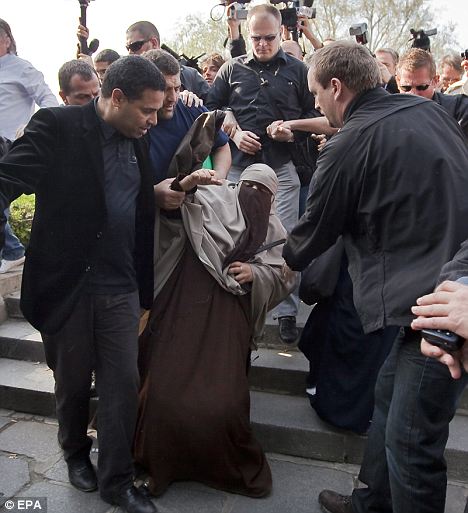
On 22 June 2009, Nicolas Sarkozy, the French President, asserted that burqas (or the burqa-clad?) are “not welcome” in France, adding that “[i]n our country, we cannot accept that women be prisoners behind a screen, cut off from all social life, deprived of all identity” and that “the veils reduced dignity.” France’s Muslim minority is Western Europe’s largest Muslim minority, estimated at six-million-strong. And this is just an approximation, as the French Republic implicitly claims to be post-race and post-religion via a prohibition on any census that would take into account the race or religion of its citizens. (This anxiety mirrors the brouhaha in Indian media àpropos the much-contested enumeration of OBCs or Other Backward Castes in the Indian census surveys of 2011, or the urgency to declare some spaces post-caste, post-feminist, and post-racist while casteism, patriarchy and racism continue unabated.)
Continue reading “Of Niqabs, Monsters, and Decolonial Feminisms”
Herbert Marcuse gained world renown during the 1960s as a philosopher, social theorist and political activist; his most famous work is One-Dimensional Man, which had a strong influence on the New Left. Here he’s interviewed by Bryan Magee on the Frankfurt School.
 P U L S E