As the people of southern Sudan prepare to vote in a referendum that may see them secede from the North, Al Jazeera maps the turbulent history of a country on the verge of a momentous decision.
Category: Africa
Whatever Happened to AIDS?

PULSE readers may not have noticed but Lady Gaga is dead. Justin Timberlake is dead. So are Alicia Keys, Elijah Wood and a host of other celebrities. Well not literally dead – ‘digital death’ is what they call it. This past Wednesday, on World AIDS Day, all of these people have seized communication with the outside world through their Twitter and Facebook accounts. (Some lower-caste people too have joined the invitation to commit digital suicide.) The basic aim is to raise money for Alicia Keys’ Keep a Child Alive charity. Only after fans have donated one million dollars to the cause, will the celebrities revive their digital lives.
It’s a great bargain. For as little as $10 not only will you not have to suffer the void in your everyday life of not “knowing where they are, what they had for dinner, or what interesting things are happening in their lives”, at the same time you buy yourself into a community that saves millions of lives and “give[s] millions of real people the care, love and hope they deserve”.
Do “what you always do”, says Keys, and save a few Africans.
A World Without Water
From El Alto to Cochabamba, Detroit to Dar Es Salaam, A World Without Water documents the human costs of water privatisation and the systemic denial of access to safe drinking water through its commodification. According to the World Health Organisation, 1.1 billion people has no access to any type of improved drinking source of water, 2.6 billion people lack even a simple ‘improved’ latrine, and, as a direct consequence, 1.6 million people die every year from diarrhoeal diseases (90% of these are children under 5).
Mozambique’s Food Riots – the True Face of Global Warming
Thirteen people were killed and hundreds wounded last week in Mozambique when police cracked down on a three-day protest over a 30 percent hike in the price of bread. The UN says the riots in Mozambique should be a wake-up call for governments that have ignored food security problems since the global food crisis of 2008, when countries around the world saw angry protests in the streets over the rising prices of basic food items. In this extremely informative interview on Democracy Now!, Raj Patel connects the dots between climate change, financial speculation, land grabs across Africa, food sovereignity and global hunger.
Also check out Johann Hari’s recent article on the “speculation-starvation-bubble” behind the 2008 global ‘food crisis’, below the fold.
Continue reading “Mozambique’s Food Riots – the True Face of Global Warming”
Upside Down World Cup
As the corporate-sponsored bonanza that is the football World Cup unfolds into its second week, Raj Patel looks at one of the most overlooked aspects of this year’s tournament: the ongoing struggle of tens of thousands of shack dwellers across the country. Over the past year, shack settlement leaders in Durban, Johannesburg and Cape Town have been chased from their homes by gangs, arrested, detained without hearing, and assaulted. As the World Cup begins, a shack dwellers’ movement known as Abahlali baseMjondolo is mounting what they call an “Upside Down World Cup” campaign to draw attention to their plight.
Outing the Muslimness, Finally: Some Viewing (and Hearing) Pleasures (The King is Out: Part VI)
The King is out: he is irreversibly a Muslim. His name is Khan: pronounce it correctly please. Long Live the King!
by Huma Dar
[Read Part I Part II Part III Part IV Part V]

[I]n one scene I wanted to have just a half open door and I wanted to be shown saying namaz once. We couldn’t take that shot. Then we put that bit where I say the prayer: Nasrun minal lahe wah fatahun kareeb (God give me strength to win) [sic] [Victory is Allah’s, and the opening/victory is close] which is my own prayer too. I don’t think we should intellectualise entertainment. See the fun of it.
This is how Shahrukh Khan describes his experience working in the film Chak De! India (Dir: Shimit Amin, 2007). With apologies to King Khan for discarding his proposal to not “intellectualize” films, yet taking due “fun” in it, I argue that it is only in My Name is Khan (Dir: Karan Johar, 2010) that the King finally comes “out” as a Muslim. No “half open door” is needed. This coming out affords particular visceral pleasures to an audience (or at least a large section of it spread across the globe) long resigned to seeing SRK endlessly and persistently marked by the specifically filmic variety of Hinduness practiced in Bollywood: doing various pujas and aartis at different Hindu temples, or adorning his spouses’ hair-parting with sindhoor and smearing his own forehead with tilaks. This performative Hinduization of Shahrukh Khan in Urdu-Hindi cinema is unrelenting precisely due to the dogged presumption of SRK’s Muslimness that is not easily obscured. “In my films I have been going to temples and singing bhajans; no one has questioned that,” (my emphasis) SRK exclaims in the same interview. No one “questions” the diegetic (filmic) Hinduness of SRK; it is expected and mandatory. With the increasing and explicit polarization in India since 1990s, the anxiety around Muslimness is such that it requires perpetual masking: an iterative performance of Hinduness, secular or otherwise. When the mask slips off, the performance is momentarily paused – as when SRK plays a Muslim character in a film and critiqued the anti-Pakistani politics of Indian Premier League (IPL) – Hindutva activists target SRK’s suburban Bombay home, Mannat, with massive demonstrations (See the earlier Part II for more).[1]
The End of the American Empire
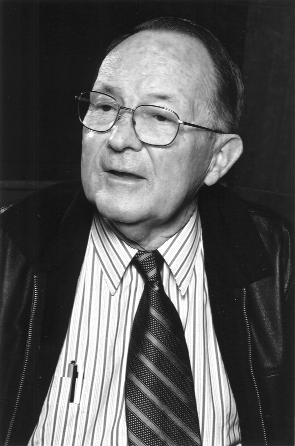 Chalmers Johnson on Media Matters with Bob McChesney.
Chalmers Johnson is president of the Japan Policy Research Institute, a non-profit research and public affairs organization devoted to public education concerning Japan and international relations in the Pacific. He was chairman of the academic advisory committee for the PBS television series “The Pacific Century,” and he played a prominent role in the PBS “Frontline” documentary “Losing the War with Japan.” Both won Emmy awards. His most recent books are Blowback: The Costs and Consequences of American Empire (New York: Metropolitan Books, 2000); The Sorrows of Empire: Militarism, Secrecy, and the End of the Republic (New York: Metropolitan Books, 2004); and Nemesis: The Last Days of the American Republic (New York: Metropolitan Books, 2007).
Equatorial Guinea: The good, the bad and the ugly
by Agustín Velloso

The Bad
Teodoro Obiang Nguema Mbasogo, Equatorial Guinea’s recalcitrant leader, is a very wealthy man. He has amassed such a fortune that he could only get rid of his bank notes by burning them.
He cannot use his money to buy power – he has, after all, enjoyed that in its absolute form for the last thirty years. His eldest son wants for nothing, and his family is wallowing in plenty. Global Witness published a report entitled ‘The Secret Life of a Shopaholic: How an African dictator’s playboy son went on a multi-million dollar shopping spree in the US’.
Neither does Teodoro Obiang need money to earn a place among the world’s most powerful. He is already a welcome member of this cabal, which often treats him with affection. Welcoming him in Washington back in 2006, erstwhile secretary of state Condoleeza Rice said, ‘You are a good friend, and we welcome you’.
He has been welcomed to Beijing six times by Hu Jintao, who said to him, ‘bilateral relations between our two countries have developed through goodwill’.
Continue reading “Equatorial Guinea: The good, the bad and the ugly”
A Eurocentric Problem
M. Shahid Alam

He who knows himself and others
Here will also see,
That the East and West, like brothers,
Parted ne’er shall be.
Goethe[1]
In no other major civilization do self-regard, self-congratulation and denigration of the ‘Other’ run as deep, nor have these tendencies infected as many aspects of their thinking, laws, and policy, as they have in Western Europe and its overseas extensions.[2] These tendencies reached their apogee during the nineteenth century, retreated briefly after World War II, but have been staging a come back since the end of the Cold War.
For several decades now, critics have studied these Western tendencies under the rubric of Eurocentrism, a complex of ideas, attitudes, and policies, which treat Europe — when it is convenient — as a geographical, racial and cultural unity, but places Western Europe and its overseas extensions at the center of world history since 1000 CE.[3]
Unlike the garden variety of ethnocentrism, Eurocentrism emerged as an ideological project — shaped by Europe’s intellectual elites — in the service of Europe’s rising expansionist states, starting in the sixteenth century. It makes sweeping claims of European superiority in all spheres of civilization. In this worldview, only Europeans have created history over the past three thousand years, beginning with the ancient Greeks. In various accounts, this centrality is ascribed to race, culture, religion and geography.
Beyond the praise for Paul Kagame
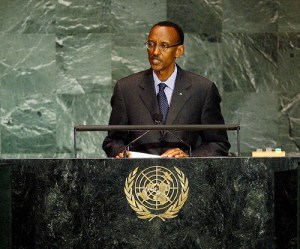 Rwandan Tutsi leader turned President Paul Kagame is a popular man in the West. And why not? In his ten years in office he has lead his war-ravaged nation through a period of unprecedented economic growth which has turned Rwanda into a playground for foreign investors. At the same time, he emphasizes self-reliance and efficient government while supporting populist spending programs that could make Rwanda the only African nation to meet the UN Millennium Development Goals (not that he is a fan of the UN, which he frequently criticizes for its response to the 1994 civil war). His administration in Kigali has admittedly wracked up a deficit that would ordinarily draw frowns from World Bank bureaucrats but in the case of Rwanda, the organization that usually demands drastic budget cuts is underwriting a litany of government programs. It helps that some of Kagame’s greatest admirers are Bill Clinton, Tony Blair, and Starbucks magnate Howard Schultz (1). American evangelist Rick Warren (2) considers him something of an inspiration and even Bill Gates has invested in what has been called Africa’s success story. Yes, Western liberals, reactionary evangelicals, and capitalist carpetbaggers alike tout Paul Kagame as the herald of a new, self-reliant African prosperity.
 P U L S E