CulturEscapes and the Moral Duty of BDS Today


The neutral Switzerland is about to host a yearly Culturescapes festival. Every year the festival focuses on a different country. This year- the most successful for cultural boycott, yet- it just had to play into Desmond Tutu’s hands and focus on Israel.

A Word about Culture

Culture is a word I’ve been hearing a lot lately. Israel’s Brand Israel campaign is focusing on PR apartheid; Hiding it’s atrocities as best it can, and highlighting it’s “advantages”:

In the Ministry of Foreign Affairs, 6 niches were identified in which Israel has a relative advantage… The 6 niches through which it is planned to promote Israel, in the world, are environment (with an emphases on desert agriculture); Science and technology (medicine, internet and hi-tech); Culture and art; Human variety and tradition; lifestyle and leisure culture; Tikun Olam [=Fixing the world] (support of populations of special needs).

Continue reading “CulturEscapes and the Moral Duty of BDS Today”

A new report by Who Profits exposes: SodaStream misleads consumers by labeling settlement products as ‘Made in Israel’

A view of SodaStream’s main factory in the industrial park of Mishor Edomim in the occupied West Bank. Photo: Esti Tsal, Who ProfitsThe company, based in Mishor Edomim Industrial Park, an Israeli settlement in the West Bank, markets its devices and bottles under a ‘Made in Israel’ label.  By doing so, SodaStream (also known as Soda Club), world leader of home beverage carbonating devices, misleads consumers in Europe and the United States.

SodaStream misleadingly markets its devices and bottles under the Made in Israel label while in fact these products were manufactured in the Mishor Edomim Industrial Park, an illegal settlement in the occupied West Bank.

The company has recently faced a ruling by the European Court of Justice, stating that goods produced in settlements should not be considered as made in Israel and enjoys the tax exempt of the EU-Israel Association Agreement.

The report was published by Who Profits from the Occupation, a research project of the Coalition of Women for Peace. The project investigates Israeli and international corporate involvement in the Israeli occupation.

Continue reading “A new report by Who Profits exposes: SodaStream misleads consumers by labeling settlement products as ‘Made in Israel’”

From Beyond the Walls and the Barbed Wire: A Message From Abdullah Abu Rahmah

Last Friday, the 10th of December was International Human Rights Day. In the village of Bil’in, we protested a year to Abdullah Abu Rahmah’s arrest.

Abu Rahmah has yet to be released. Through his lawyer, he was able to pass on a very loaded message; From the details of his arrest and the stalling of his release, to the impact on his family, to the impact on the village, to prison torture of children, to military court violations, to support for BDS and implementation of international law. The letter was published in full, in the Huffington Post and I bring it to you in full. This is what hope in spite of apartheid looks like:

A year ago tonight, on International Human Rights Day, our apartment
in Ramallah was broken into by the Israeli military in the middle of
the night and I was torn away from my wife Majida, my daughters Luma
and Layan, and my son Laith, who at the time was only nine months
old.

Continue reading “From Beyond the Walls and the Barbed Wire: A Message From Abdullah Abu Rahmah”

Wilkerson on the significance of Wikileaks and Israeli Apartheid

Colonel Lawrence Wilkerson on Countdown with Keith Olbermann to discuss Wikileaks.

Vodpod videos no longer available.


Zionism: Two Deficits

M. Shahid Alam

We do not fit the general pattern of humanity…”

David Ben-Gurion

…only God could have created a people so special as the Jewish people.

Gideon Levy

The fecundity of the Zionist project in producing claims of exceptionalism is not in doubt. Anyone who scans the voluminous Zionist literature will be suitably impressed by its repeated resort to claims of Jewish and Israeli exceptionalism. There is scarcely any aspect of Israeli or Jewish history that has not been embellished with some claim to uniqueness.

Israeli exceptionalism has many uses. It defends, obscures, explains away the ‘abnormal’ character of the Zionist nationalist project. When the Irish sought national liberation, their goal was straightforward. They wanted to regain national control over their lives and their country from a foreign power. No one had to convince the Irish that they are descended from the gods; that they possessed a unique essence which set them apart from all other peoples; or that their history, religion, race, language, morality or culture set them above their colonial masters. Occasionally, driven by exuberance or hubris, nationalists have advanced exceptionalist claims, but the success of their movement has not depended on their acceptance. The Irish claimed sovereignty because they knew that they are a nation with their own territory. In order to create their own state, they did not have to establish that they are exceptional.

The Zionists confronted two handicaps that Irish nationalists did not face. The diverse and scattered Jewish communities of Europe – and even more so, the world – did not constitute a single people. Instead, the Jews of the world were loosely united by their religious heritage, but they shared their languages, cultures and genes with their neighboring communities. Moreover, no Jewish community had its own country, a substantial and contiguous territory where it formed a majority of the population. Despite these twin Jewish deficits – the absence of a nation and a national territory – the Zionists were determined to ‘liberate’ the Jews of Europe and endow them with their own state.

The Zionists would remedy the first deficit by denying its existence. They knew that the Jews were not a nation, but it would be unwise to begin their ‘nationalist’ movement with the admission that a Jewish nation did not yet exist. They also did not think that this deficit was a serious hindrance to their movement. With help from anti-Semites, whose attacks had been growing in recent decades, the Zionists were convinced that they could quickly convince enough frightened Jews that they are a nation. Instead of constructing a nationalism based on a common religion, however, the Zionists chose to cultivate a racial basis for Jewish nationalism. They embraced the anti-Semitic accusation that Jews of Europe are an alien race, not Germans or Russians, descended from the ancient Hebrews.

Continue reading “Zionism: Two Deficits”

Playing with Water

Screen Shot 102
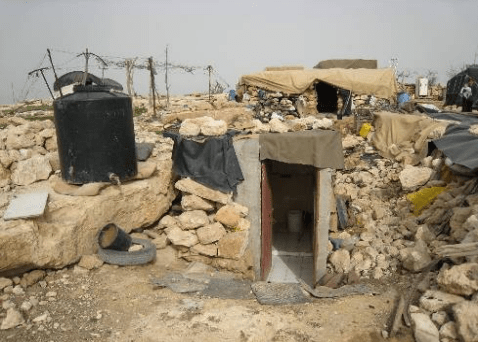
Susya toilet under demolition order by the Israeli army (Amnesty International, “TROUBLED WATERS – PALESTINIANS DENIED FAIR ACCESS TO WATER”, p.2 )

Water in Israel is probably one of the most blatant faces of apartheid. As reports like the Amnesty International report of 2009, “Troubled Waters” and the B’tselem website coverage of the issue, “The Water Crisis” show us,  Israel’s resources are invested in water theft/access denial from Palestinians. But water in Israel is not just a substance of life, for those who can’t have it, it’s a tradable commodity, for those who’ll never miss it.

Like a Fish in National Waters

Water resources in Israel are all state-owned. Naturally- as is usually the case within the militaristic, nationalistic Israel- the state will allocate these resources to serve its “national needs”. Water theft is a good example of “negative” policy, which is so obviously discriminatory, violent and inexcusable, that the only way to sell it to the public is not to mention it at all. True to form, when cave- dwelling Palestinians are kicked out of their caves and their harvesting canisters (on the cave roof?) are destroyed [“Troubled Waters”, p.2], there’s no Israeli media around to record it, spin it and dish it. “Positive” policy, however, is always easy to sell. After all, we “dried the swamps and made the wilderness bloom”, and the environmental devastation of swamp drying still isn’t being taught in schools.

Continue reading “Playing with Water”

Palestine liberation recalls anti-apartheid tactics, responsibilities and controversies

by Patrick Bondhttps://i0.wp.com/sabbah.biz/mt/wp-content/uploads/2007/04/4_9Mirror_on_Apartheid_Wall.jpg

On a full-day drive through the Jordan Valley late last month, we skirted the earth’s oldest city and the lowest inhabited point, 400 meters below sea level. For 10,000 years, people have lived along the river separating the present-day West Bank and Jordan.

Since 1967 the river has been augmented by Palestinian blood, sweat and tears, ending in the Dead Sea, from which no water flows out, it only evaporates. Conditions degenerated during Israel’s land-grab, when from a peak of more than 300,000 people living on the west side of the river, displacements shoved Palestinian refugees across to Jordan and other parts of the West Bank. The valley has fewer than 60,000 Palestinians today.

But they’re hanging in. “To exist is to resist,” insisted Fathi Ikdeirat, the Save the Jordan Valley network’s most visible advocate (and compiler of an exquisite new book of the same name). At top speed on the bumpy dirt roads, Ikdeirat maneuvered between Israeli checkpoints, through Bedouin outposts in the dusty semi-desert, where oppressed communities eke out a living from the dry soils.

Continue reading “Palestine liberation recalls anti-apartheid tactics, responsibilities and controversies”

Divesting From Injustice

Last week the University of Johannesburg, following a campaign endorsed by over two hundred of South Africa’s most prominent public intellectuals, voted “not to continue a long-standing relationship with Ben Gurion University (BGU) in Israel in its present form” and to set conditions “for the relationship to continue.” Though falling short of an outright boycott of BGU, the UJ Senate set an ultimatum of six months for BGU to comply with two conditions:

(1) that the memorandum of understanding governing the elationship between the two institutions be amended to include Palestinian universities chosen with the direct involvement of UJ;

(2) the UJ will not engage in any activities with BGU that have direct or indirect military implications, this to be monitored by UJ’s senate academic freedom committee

Interestingly, the AP report following the vote, reprinted in both the Jerusalem Post and Haaretz, fails to mention the second condition nor anything pertaining to BGU’s direct complicity with the occupation of Palestine. But as the tireless campaigner for justice, Desmond Tutu , notes: “Israeli Universities are an intimate part of the Israeli regime, by active choice. While Palestinians are not able to access universities and schools, Israeli universities produce the research, technology, arguments and leaders for maintaining the occupation.” (see Tutu’s full letter below the fold)

How subtle censorhip can be in the Middle East’s only democracy…

Continue reading “Divesting From Injustice”

South African Academics Call for Boycott of Ben Gurion University

A long brewing South African campaign at the prestigious University of Johannesburg to cut off academic links with Ben Gurion University due to its complicity and racist practices has won the endorsement of John Dugard, Desmond Tutu, Breyten Breytenbach, Allan Boesak, Mahmoud Mamdani and almost 200 other academics from 22 academic institutions in South Africa.

SOUTH AFRICAN ACADEMICS SUPPORT THE CALL FOR UJ TO TERMINATE RELATIONSHIP WITH ISRAELI INSTITUTION

As members of the academic community of South Africa, a country with a history of brute racism on the one hand and both academic acquiescence and resistance to it on the other, we write to you with deep concern regarding the relationship between the University of Johannesburg (UJ) and Ben-Gurion University of the Negev (BGU). The relationship agreement, presented as ‘merely the continuation’ of a ‘purely scientific co-operation’ is currently being reviewed owing to concerns raised by UJ students, academics and staff. For reasons explained below and detailed in the attached Fact Sheet, we wish to add our voices to those calling for the suspension of UJ’s agreement with BGU.

Continue reading “South African Academics Call for Boycott of Ben Gurion University”

Zionist Dialectics: Past and Future

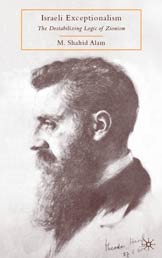
Excerpted from Israeli Exceptionalism (Palgrave: 2009).

by M. Shahid Alam

My God! Is this the end? Is this the goal for which our fathers
have striven and for whose sake all generations have suffered?
Is this the dream of a return to Zion which our people have
dreamt for centuries: that we now come to Zion to stain its soil
with innocent blood?”

Ahad Ha’am, 1921

This study has employed a dialectical framework for analyzing the destabilizing logic of Zionism. We have examined this logic as it has unfolded through time, driven by the vision of an exclusionary colonialism, drawing into its circuit – aligned with it and against it – nations, peoples, forces, and civilizations whose actions and interactions impinge on the trajectory of Zionism, and, in turn, who are changed by this trajectory.

It would be a bit simplistic to examine the field of interactions among the different actors in this historic drama on the essentialist assumption that these actors and their interests are unchanging. Instead, we need to explore the complex ways in which the Zionists have worked – and, often have succeeded – to alter the behavior of the other political actors in this drama: and, how, in turn, the Zionists respond to these changes. Most importantly, we need to explore all the ways in which the Zionists have succeeded in mobilizing the resources of the United States and other Western powers to serve their specific objectives.

Continue reading “Zionist Dialectics: Past and Future”