Palestine in Pieces: Graphic Perspectives on the Israeli Occupation

When you have seen the vast extent and permanence of Israeli settlements throughout the West Bank and East Jerusalem; when you have endured the checkpoints that squeeze and confine Palestinians and stop any hope of Palestinian economic development in its tracks; when you have watched homes, the very center of people’s lives, being demolished for no other reason than that their owners are not Jews; when even inside Israel you have seen the homes and villages of Palestinians and Palestinian Bedouins who are citizens of Israel  being destroyed because they stand in the way of Jewish development and expansion — when you have seen all these things, it is crystal clear that Zionism’s design is absolute Jewish control over the entirety of Palestine swept clean of Palestinians.

Kathleen and Bill Christison’s Palestine in Pieces: Graphic Perspectives on the Israeli Occupation is a labor of love. Compellingly written and meticulously structured, this book combines historical fact with narrative accounts and photographic images of the everyday realities faced by Palestinians in the West Bank, Gaza and East Jerusalem in order to provide the reader with an experience-near understanding of what it means to live in a state of dispossession.

Continue reading “Palestine in Pieces: Graphic Perspectives on the Israeli Occupation”
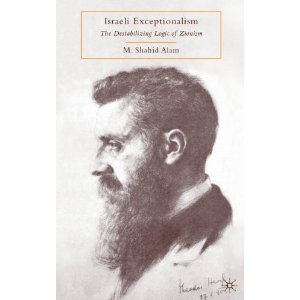
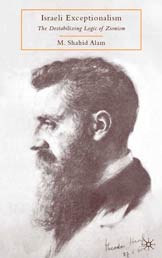
Violent Logic: A Review of M. Shahid Alam’s Israeli Exceptionalism: The Destabilizing Logic of Zionism

People have been against both the idea and practice of Zionism since its inception.  Zionism is an ideology that has never earned the support of all Jews, and one that has never been accepted by the vast majority of Palestinians, Arabs, and Muslims.  Zionism has likewise failed to achieve significant support in the so-called Third World, and has been almost uniformly rejected by black nationalists inside the United States.  Yet Zionism has been successful insofar as its desire to create a Jewish-majority nation-state has been achieved.  Despite its discursive self-image as a liberation movement, Zionist practice is colonialist and brutally violent.

In his latest book, Israeli Exceptionalism:  The Destabilizing Logic of Zionism (Palgrave Macmillan), M. Shahid Alam explores these paradoxes with great skill and insight.  Israeli Exceptionalism takes its place among a series of recent books that question the logic of Zionism.  Most of these books argue in favor of a one-state solution to the Israel-Palestine conflict; inherent in that argument is a rejection of Zionism.  Alam takes a slightly different approach in his rejection of Zionism, one that is global in scope.  He points out that “[a]s an exclusionary settler colony, Israel does not stand alone in the history of European expansion overseas, but it is the only one of its kind in the twentieth and twenty-first centuries” (14).  Israel, in other words, is an anomaly:  a settler colonial society still in thrall of the ideologies and racism of the nineteenth century.  As with the European colonization of North America, Zionism conceptualizes itself as an exceptional force of good in history.

Continue reading “Violent Logic: A Review of M. Shahid Alam’s Israeli Exceptionalism: The Destabilizing Logic of Zionism”

Elaine Hagopian Reviews Israeli Exceptionalism

Israeli Exceptionalism: The Destabilizing Logic of Zionism (Palgrave Macmillan, November 10, 2009). Publisher’s link.

by Elaine Hagopian

Cover Image GIFFor those unfamiliar with the extraordinary evolution of Israeli exceptionalism emanating from its Zionist narrative and assuring Israel’s incredible success as a colonial settler state, M. Shahid Alam’s book is the one to read.  He has recorded a compelling, uniquely comprehensive and enlightening historical analysis of the inherently destabilizing dynamic of Zionism.  Of particular note are his detailed Chapters Nine and Thirteen.

In Chapter Nine, he documents the constellation of Jewish factors that came together in the 19th century which assured Zionist success: the spread of Jewish intellectuals and professionals across major cities in Europe; Jewish population growth to 16.7 million in 1939 which could root a nationalist movement; business acumen and ownership of major banks and a strong media presence; growth of interchange with other Jewish leaders contributing to a sense of community – important considering that Jews had not previously formed a sense of nation according to Alam; and as European nationalism grew, Jews were affected by the idea though they had no majority presence in any one state which could be claimed by them.  Historical anti-Semitism prodded the Jewish elites toward formulation of the Zionist project even as Jews were moving out of the ghettos of a liberalized Europe.  Given their distribution throughout Europe and without a territorial base of their own, the Zionist sought and captured the needed “mother” country to implement their colonial settler state in Palestine.  This they found in the U.K initially and then in the U.S. with periodic support by other countries such as France.

Continue reading “Elaine Hagopian Reviews Israeli Exceptionalism”

Myth and Memoricide: Shlomo Sand’s “Invention of the Jewish People”

Denise Buonanno's "Le Juif Errant"

This review essay was published at The Drouth.

A nation is “a group of persons united by a common error about their ancestry and a common dislike of their neighbours.” Karl Deutsch.

“I don’t think books can change the world, but when the world begins to change, it searches for different books.” Shlomo Sand.

Our Assumptions About Israel

Here is what we in the West, to a varying extent, whether we are religious or not, assume about the Jews and Israel:

The Jews of the world, white, black and brown, are the sons of Abraham, Isaac and Jacob. Moses, after leading the Jews out of Egyptian enslavement, gave them laws. Emerging from the desert, the Jews conquered the promised land of Canaan, which became Judea and Israel, later the mighty kingdom of David and Solomon. In 70CE the Romans destroyed the temple at Jerusalem and drove the Jews from their land. A surviving Jewish remnant was expelled when Muslim-Arab conquerors colonised the country in the 7th Century. And so the Jews wandered the earth, the very embodiment of homelessness. But throughout their long exile, against all odds, the Jews kept themselves a pure, unmixed race. Finally they returned, after the Holocaust, to Palestine, “a land without a people for a people without a land.”

This story has been told again and again in our culture. Today we find bits of it in Mark Twain and Leon Uris, in Hollywood’s output and in church pulpits, and of course in the mainstream news media. American Christian Zionists – devotees of the Scofield Bible – swear by it, and swear to support Israel with all the power of their voting block until the Risen Christ declares the apocalypse.

Continue reading “Myth and Memoricide: Shlomo Sand’s “Invention of the Jewish People””

Boycott Israel? Amitav Ghosh & the Dan David Prize

The call for academic and cultural boycott is clearly a way to encourage civil society to play a broader political role—that is why it has the support of wide sections of Palestinian civil society. One of the most significant questions that call poses to us is simply this: How could those of us who oppose apartheid, occupation, and colonialism not support such a call?

Dear Amitav Ghosh,

We wish to express our deep disappointment in your decision to accept the Dan David prize, administered by Tel Aviv University and to be awarded by the President of Israel. As a writer whose work has dwelled consistently on histories of colonialism and displacement, your refusal to take stance on the colonial question in the case of Israel and the occupation of Palestine has provoked deep dismay, frustration, and puzzlement among readers and fans of your work around the world. Many admired your principled stand, and respected your decision not to accept the Commonwealth Writers Prize in rejection of the colonialist framework it represented.

Continue reading “Boycott Israel? Amitav Ghosh & the Dan David Prize”

Clan, State, Islamic Polity

Abdelwahab el-Affendi

Could the root causes of the Arab-Muslim ‘malaise’ be cultural? That’s what journalist Brian Whitaker suggests in his book ‘What’s Really Wrong With the Middle East’. The thesis sounds suspicious, but Whitaker isn’t a cheap Orientalist, and he uses interviews with Arabs as his raw material. The key issues his informants keep pointing to are indeed the issues that, wherever you meet them, young Arabs complain about. These include an undue emphasis on submission and obedience in the education system, at work, and in the home, the social valorisation of conformity, and a corrupt public space.

The personal is the political. The problem in every sphere is one of overbearing authority, and it’s true that this is ultimately family-based, ultimately the result of overly-narrow personal identifications. In fact, I would argue that tribalism, nepotism, sectarianism, even forced marriage and honour killing, are all manifestations of the tyranny of the clan. And the tyranny of the clan is the result of bad governance.

Continue reading “Clan, State, Islamic Polity”

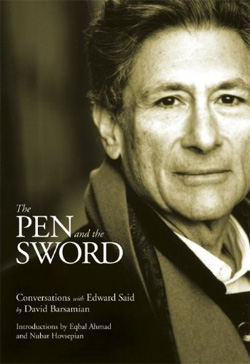
The Pen and the Sword

This review was originally published at the indispensable Electronic Intifada.

Edward Said was one of the great public intellectuals of the twentieth century – prolific, polymathic, principled, and always concerned to link theory to practice. Perhaps by virtue of his Palestinian identity, he was never an ivory tower intellectual. He never feared dirtying his hands in the messy, unwritten history of the present moment. Neither was he ever a committed member of a particular camp. Rather he offered a discomfiting, provocative, constantly critical voice. And against the postmodern grain of contemporary academia, his perspective was consistently moral, consistently worried about justice.

Said was primarily a historian of ideas. More precisely, he was interested in ‘discourse’, the stories a society tells itself and by which it (mis)understands itself and others. His landmark book “Orientalism” examined the Western narrative of empire in the Islamic Middle East, as constructed by Flaubert and Renan, Bernard Lewis and CNN. Said’s multi-disciplinary approach, his treatment of poetry, news coverage and colonial administration documents as aspects of one cultural continuum, was hugely influential in academia, helping to spawn a host of ‘postcolonial’ studies. Said’s “Culture and Imperialism” expanded the focus to include Western depictions of India, Africa, the Caribbean and Latin America, and the literary and political ‘replies’ of the colonised.

Continue reading “The Pen and the Sword”

Ill Fares The Land

By Tony Judt

—This essay is drawn from the opening chapter of Tony Judt’s new book, Ill Fares the Land (Penguin), first excerpted at NY Review of Books. A review of the book will follow shortly.

On the left, Marxism was attractive to generations of young people if only because it offered a way to take one’s distance from the status quo. Much the same was true of classical conservatism: a well-grounded distaste for over-hasty change gave a home to those reluctant to abandon long-established routines. Today, neither left nor right can find their footing.

For thirty years students have been complaining to me that “it was easy for you”: your generation had ideals and ideas, you believed in something, you were able to change things. “We” (the children of the Eighties, the Nineties, the “Aughts”) have nothing. In many respects my students are right. It was easy for us—just as it was easy, at least in this sense, for the generations who came before us. The last time a cohort of young people expressed comparable frustration at the emptiness of their lives and the dispiriting purposelessness of their world was in the 1920s: it is not by chance that historians speak of a “lost generation.”

If young people today are at a loss, it is not for want of targets. Any conversation with students or schoolchildren will produce a startling checklist of anxieties. Indeed, the rising generation is acutely worried about the world it is to inherit. But accompanying these fears there is a general sentiment of frustration: “we” know something is wrong and there are many things we don’t like. But what can we believe in? What should we do?

Continue reading “Ill Fares The Land”

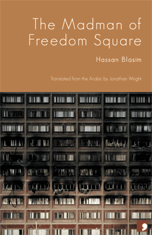
The Madman of Freedom Square

I see no need to swear an oath in order for you to believe in the strangeness of this world.”

How can imagination respond to a situation like Iraq’s, in which truth is so blatantly stranger and more horrifying than the darkest fiction? Perhaps by simply recording real stories, then sometimes allowing reality to slip a little further in the direction it’s already chosen.

Hassan Blasim, film maker, refugee, and author of the astounding short-story collection “The Madman of Freedom Square,” has a more precise formulation:

The important thing is to observe at length, like someone contemplating committing suicide from a balcony. The other important thing is to have an imagination which is not melodramatic but malicious and extremely serious, and to have an ascetic spirit that is close to death.

Except this isn’t a formulation but a voice within a story. In another story there is a man who throws himself from a balcony – a man who clears blood and debris in the aftermath of explosions, then migrates to Holland, renames himself Carlos Fuentes, becomes a Hirsi Ali figure, more Dutch than the Dutch, and suffers nightmares. There’s a man who dreams a number which foretells not a lottery ticket but .. something else. I give away too much.

Continue reading “The Madman of Freedom Square”

Zeitoun

This review appeared in the Independent.

Abdulrahman Zeitoun was born in Jebleh, on Syria’s Mediterranean coast. Decades later and thousand of miles away he awakes from dreaming of a fishing expedition out of his childhood home: “Beside him he could hear his wife Kathy breathing, her exhalations not unlike the shushing of water against the hull of a wooden boat.” As so often in Dave Eggers’s latest novel, the docudrama “Zeitoun”, a caught image opens a window on an ocean of memory and a state of mind.

Zeitoun now lives in New Orleans, where he runs a painting and building company and owns several buildings. He’s a dedicated businessman, father, husband, and Muslim. His painter’s van is emblazoned with a rainbow, which Zeitoun soon discovers has gay associations for Americans. But he doesn’t change it. “Anyone who had a problem with rainbows, he said, would surely have trouble with Islam.”

Kathy, practical and strong-willed, was brought up a Baptist in Baton Rouge. Attracted by “the doubt sown into the faith” and “the sense of dignity embodied by the Muslim women she knew,” she converted to Islam after her failed first marriage. Some years later she married the much older Zeitoun. Eggers describes their domestic bustle and warmth, and their personal irritations. For Zeitoun, these include his children’s wastefulness and obsession with pop music, and his alienation in a family of women. Kathy is bothered by Zeitoun’s stubbornness and her own family’s Islamophobic nagging.

Continue reading “Zeitoun”