Part of Al Jazeera’s The Arab Awakening series.
As revolution shakes the Arab world, a series of films explore the roots of the uprisings and ask ‘what next’? Those in a position to know reveal the ‘tricks of the trade’ of Arab dictatorship.
Part of Al Jazeera’s The Arab Awakening series.
As revolution shakes the Arab world, a series of films explore the roots of the uprisings and ask ‘what next’? Those in a position to know reveal the ‘tricks of the trade’ of Arab dictatorship.
This article first appeared on Gaza TV:
On 15 May, the annual commemoration of the creation of the state of Israel and the expulsion of Palestinians, known as Nakba, Egyptians plan to march to Palestine under the slogan “Cairo’s liberation will not be complete without the liberation of Al-Quds [Jerusalem].”
Following Egypt’s January 25 Revolution, Egyptians are pushing for some of the country’s foreign relations policies to change, especially those related to Israel and Palestine. Aid or protest convoys to Gaza were frequently stopped or arrested during the Mubarak era by the ousted president’s regime, and now for the first time since the revolution thousands of activists are planning to march to the Rafah border town.
Continue reading “Egyptians to mark Nakba with a march to Palestine”
 This review of Leila Aboulela’s novel was published in the excellent Wasafiri magazine.
It’s the mid twentieth century, as British control over north east Africa fails. Sudanese cotton tycoon Mahmoud Abuzeid, awarded the title Bey by Egypt’s King Farouk, is pulled between his two wives.
“They belonged to different sides of the saraya, to different sides of him. He was the only one to negotiate between these two worlds, to glide between them, to come back and forth at will.”
The two wives share a compound. Sudanese Waheeba in her hoash – a traditional living space half open to the air – represents “decay and ignorance…the stagnant past” to gregarious, multi-lingual Mahmoud. Egyptian Nabilah, much younger, better educated, attempts to recreate Cairo in her Italian-furnished modern salon. She represents “the glitter of the future..sophistication.” But events question such easy distinctions.
The Arab Spring is in full bloom. Peaceful uprisings in Tunisia and Egypt sparked a democratic tide that has swept across the region.
In Libya, Yemen, Syria and Bahrain, it is now a tale of two protests, with the situation deteriorating into widespread violence and outright war.
It seems some regimes will stop at nothing to resist change. So with no unified leadership or clear agenda, and with domestic complications in each and every country, is this truly a revolution? And if this is an Awakening — what path will it follow — that of Turkey? Of Iran? Or rather a third way, an Arab way. Empire finds out.
By Huma Dar
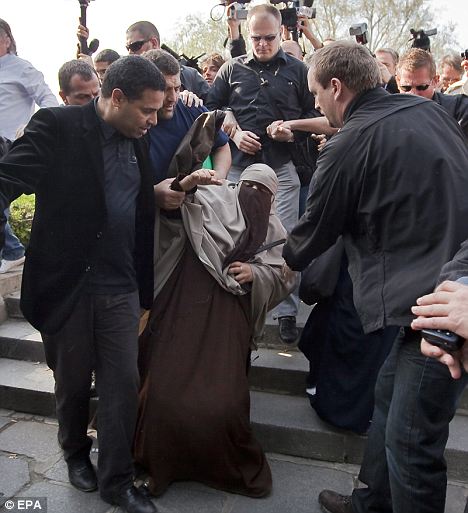
Of Civilities and Dignities
On 22 June 2009, Nicolas Sarkozy, the French President, asserted that burqas (or the burqa-clad?) are “not welcome” in France, adding that “[i]n our country, we cannot accept that women be prisoners behind a screen, cut off from all social life, deprived of all identity” and that “the veils reduced dignity.” France’s Muslim minority is Western Europe’s largest Muslim minority, estimated at six-million-strong. And this is just an approximation, as the French Republic implicitly claims to be post-race and post-religion via a prohibition on any census that would take into account the race or religion of its citizens. (This anxiety mirrors the brouhaha in Indian media àpropos the much-contested enumeration of OBCs or Other Backward Castes in the Indian census surveys of 2011, or the urgency to declare some spaces post-caste, post-feminist, and post-racist while casteism, patriarchy and racism continue unabated.)
Continue reading “Of Niqabs, Monsters, and Decolonial Feminisms”
The End of a Dictator. An excellent Al Jazeera documentary about the fall of Hosni Mubarak.
Driven by its youth, Egypt’s revolution embraced all sectors of society. As the fear barrier was broken, destinies were transformed by the tumultuous events. This film offers an examination of the demise of the Mubarak regime through the eyes of people whose lives were, until now, defined by it.
Al Jazeera’s Empire on the history and politics of the Muslim Brotherhood.
After decades in the political wilderness, the Muslim Brotherhood became an integral part of the popular upheavals that swept through the Arab world – and while they may not have initiated the recent revolution in Egypt, the overthrow of Mubarak’s regime leaves a power vacuum that the Brotherhood are now well-positioned to fill. How will the Muslim Brotherhood reconcile their ideology with democracy?
Rageh Omaar examines how the death of a street vendor led to a wave of uprisings across Arab world. (Also see Part I)
Our good friend Tariq Ali on the Arab uprisings and the US response. You can ignore the neocon Uncle Tom who appears afterwards.
by Ali Gharib
 British writer Ian McEwan took a lot of heat for accepting the Jerusalem Book Prize. The literary award is given out every two years at the Jerusalem International Book Fair, an event that appears to be put on by the Jerusalem municipal government.
In response to British writers who criticized his decision to accept the prize, McEwan wrote (with my emphasis):
I’m for finding out for myself, and for dialogue, engagement, and looking for ways in which literature, especially fiction, with its impulse to enter other minds, can reach across political divides.
But there are ways to do both: reject the prize and dialogue and engage, though it may not be to the liking of those who have awarded you the honor.
The lesson comes from Egypt, naturally. I discovered this by finally getting to the back of the book of the February issue of Harper’s. It’s from a retrospective review of two Egyptian writers, Albert Cossery and and Sonallah Ibrahim.
Continue reading “Lesson from Egypt: How to Reject A Literary Prize”
 P U L S E