Fault Lines presenter Avi Lewis sits down for a one-on-one interview with author and activist, Arundhati Roy, one of PULSE’s 20 Top Global Thinkers of 2009.
Category: India
Searching for Jake Sully in India’s Heartland
by Harsha Walia
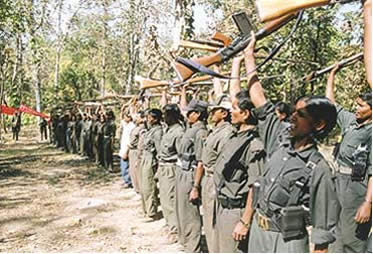 Building traditional irrigation systems, practicing forest conservation and cooperative farming, and providing educational and medical facilities in the isolated rural forests of India. This could apply to any NGO or charity, but is actually the work of armed Naxalite Maoists. In addition to community development, Naxalites have organized politically to self-govern and have claimed responsibility for numerous killings of government officials, security personnel, and alleged informers. Today, many of the Naxal cadres are Adivasis (tribal indigenous) and 40% are women. Naxalites have been operating since the 1970s in 20 states around the jungles of Central and Eastern India.
Naxalites recently made headlines as Indian Prime Minister Manmohan Singh declared them “the most serious internal threat to India’s national security” and unleashed Operation Green Hunt. Under Green Hunt 250,000 police, armed forces, and counter-insurgency teams have been deployed, while the US provides military intelligence and tactical guidance. The jungles are under a heavy siege: checkpoints, army patrols, helicopter missions, gunfire battles that kill 40 civilians per week. Based on the counterinsurgency model of soft power alongside military might (charity from the barrel of a gun), government-sponsored agencies are setting up rehabilitation camps for the 200,000 already-displaced villagers.
Continue reading “Searching for Jake Sully in India’s Heartland”
Outing the Muslimness, Finally: Some Viewing (and Hearing) Pleasures (The King is Out: Part VI)
The King is out: he is irreversibly a Muslim. His name is Khan: pronounce it correctly please. Long Live the King!
by Huma Dar
[Read Part I Part II Part III Part IV Part V]

[I]n one scene I wanted to have just a half open door and I wanted to be shown saying namaz once. We couldn’t take that shot. Then we put that bit where I say the prayer: Nasrun minal lahe wah fatahun kareeb (God give me strength to win) [sic] [Victory is Allah’s, and the opening/victory is close] which is my own prayer too. I don’t think we should intellectualise entertainment. See the fun of it.
This is how Shahrukh Khan describes his experience working in the film Chak De! India (Dir: Shimit Amin, 2007). With apologies to King Khan for discarding his proposal to not “intellectualize” films, yet taking due “fun” in it, I argue that it is only in My Name is Khan (Dir: Karan Johar, 2010) that the King finally comes “out” as a Muslim. No “half open door” is needed. This coming out affords particular visceral pleasures to an audience (or at least a large section of it spread across the globe) long resigned to seeing SRK endlessly and persistently marked by the specifically filmic variety of Hinduness practiced in Bollywood: doing various pujas and aartis at different Hindu temples, or adorning his spouses’ hair-parting with sindhoor and smearing his own forehead with tilaks. This performative Hinduization of Shahrukh Khan in Urdu-Hindi cinema is unrelenting precisely due to the dogged presumption of SRK’s Muslimness that is not easily obscured. “In my films I have been going to temples and singing bhajans; no one has questioned that,” (my emphasis) SRK exclaims in the same interview. No one “questions” the diegetic (filmic) Hinduness of SRK; it is expected and mandatory. With the increasing and explicit polarization in India since 1990s, the anxiety around Muslimness is such that it requires perpetual masking: an iterative performance of Hinduness, secular or otherwise. When the mask slips off, the performance is momentarily paused – as when SRK plays a Muslim character in a film and critiqued the anti-Pakistani politics of Indian Premier League (IPL) – Hindutva activists target SRK’s suburban Bombay home, Mannat, with massive demonstrations (See the earlier Part II for more).[1]
The Price of Translating a Narrative and its Context (The King is Out: Part V)
Karan Johar falteringly attempts to fashion a cinematic alliance of sorts between African-Americans and South Asians — very unusual in the Bollywood context and more so for Karan Johar, himself — but fails to seize the radical politics embedded. One wishes that the spirit of this song was continuously re-thought, re-energized, re-contextualized, re-translated. A revolution that stops moving, stops “revolving,” is nothing but an aborted one.
by Huma Dar
[read Part I Part II Part III Part IV]
In an interesting twist, Karan Johar’s My Name is Khan displaces or translates (one original meaning of “translate” is to bear or carry across from one place to another) the convoluted and complex, determining context from India, with a specific genealogy, on to the US. The post-9/11 circumstances provide some unfortunate resonances, yet much of the untranslated/untranslatable context results in the particular aporias of the filmic text. Even beyond Mandira’s furious and irrational directive to Rizwan Khan, he has to go around saying his name is Khan and “he is not a terrorist” because in that originary terrain of imposed defensiveness there is not much space for a “Muslim name” (besides certain limited spheres), leave alone for “My Name is Khan, and I am an American.” This latter, more “affirmative” alternative to the “apologetic” cinematic version, is proposed by Suad Abdul-Khabeer in her excellent critique of the film.
Continue reading “The Price of Translating a Narrative and its Context (The King is Out: Part V)”
A Suitable Boy, “Decent” People, and Names that Pass (The King is Out: Part IV)
by Huma Dar
[read Part I Part II Part III]
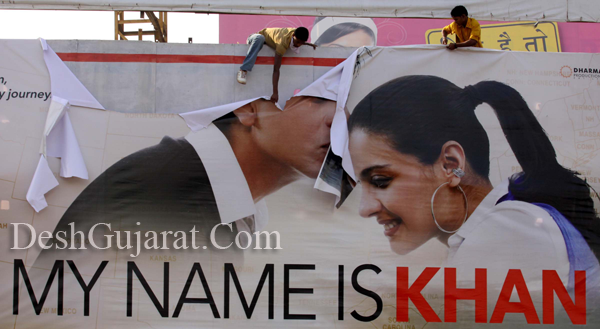
In the second half of the film, My Name is Khan (2010), Karan Johar shows that Rizwan Khan’s wife, Mandira (played by Kajol) is on a personal journey to obtain justice for her son and accountability from the perpetrators of a hate crime. It is thus ironic that Mandira’s own negligence towards Rizwan Khan (played by SRK) and the lack of accountability for making him set off on an ostensibly unfeasible mission, albeit in a fit of grief and anger, is not problematized at all in the film. A mission that might very well have remained unfulfilled but for Rizwan Khan’s Herculean efforts, his unusual talents and disabilities, and a string of exceptional circumstances. Rizwan Khan, given his Asperger’s syndrome, “fear of new places,” and his Muslimness (actively practiced), would have been equally, if not more, susceptible to the kind of hate crime that victimized Mandira’s son. After the initial outburst at the place of death, Mandira had had enough time to re-think the consequences of her angry directive to Khan, yet she never apologizes to Khan. Here too, the immediate context of Bollywood, the multiple Hindu-Muslim marriages amongst the stars of Bombay, and the general lack of acceptance of such marriages in mainstream India are crucial to keep in mind.
Continue reading “A Suitable Boy, “Decent” People, and Names that Pass (The King is Out: Part IV)”
Placating the gods of Citizenship: the Ritual Sacrifice (The King is Out: Part III)
The obligatory declaration of cinematic patriotism for Indian Muslims necessitates a continuous performance of “loyal citizenship” invariably through offering the sacrifice of a “disloyal” one. This leaves little space for critical engagement with the nation and the state.
by Huma Dar
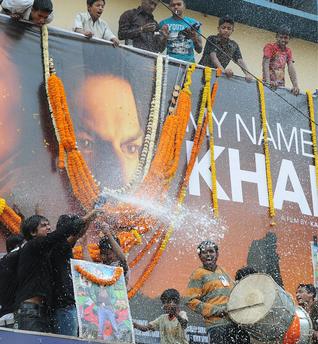
The obligatory declaration of cinematic patriotism for Indian Muslims (discussed in Parts I and II earlier) necessitates a continuous performance of “loyal citizenship” invariably through offering the sacrifice of a “disloyal” one. This leaves little space for critical engagement with the nation, the state, and the unending wars. An example of this ritual performance is the sequence in My Name is Khan where Rizwan Khan, played by Shahrukh Khan (SRK), reports the “doctor” in the Los Angeles Masjid to the FBI. How do we know the “bad” doctor is an al-Qaeda member or a terrorist? Dr. Faisal Rahman does indeed talk about his “blood boiling” at the oppression of the Muslim Ummah in Iraq, Afghanistan, Palestine, Chechnya, Kashmir et al and even exhorts the handful of audience in a completely open space inside the Masjid to “join him and do something.” The details of that “something” are never revealed.
The King is Out, His Name is Khan: Long Live the King (Part I)
My Name is Khan, although narratively based mostly in the USA, has to be theorized within and around the framework of Bollywood; the Urdu-Hindi film history, and its transnational circuits of production, distribution, and consumption; Shahrukh Khan’s star narrative, and the determining context of the Indian political scene along with that in the US and its “war on/of terror.”
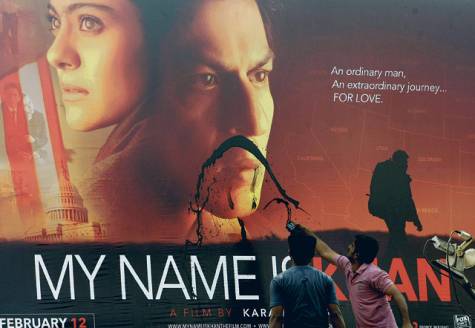
The Defacing of Khan: It's Not Easy Being Muslim in Mumbai or in Newark
My Name is Khan, although narratively based mostly in the USA, has to be understood and theorized within and around the framework of Bollywood; the Urdu-Hindi film history and its transnational circuits of production, distribution, and consumption; Shahrukh Khan’s star narrative, and the determining context of the Indian political scene along with that in the US and its “War on/of Terror.” Even prior to the Indian Partition in 1947, most Muslim artists had what Sa’adat Hasan Manto (1912-1955) mockingly called “shuddified” or Hinduized names – Dilip Kumar for Yusuf Khan, Madhubala for Mumtaz Begum Jahan Dehlavi (1933-1969), Meena Kumari for Mahjabeen Bano (1932-1972), or the more ambivalent (non-halal) Johnny Walker for Badruddin Jamaluddin Qazi (1923-2003) and Nargis for Fatima Rashid (1929-1981). At the contemporary moment, the biggest stars of the Urdu-Hindi film industry in India are Khans: Shahrukh, Salman, Aamir, Saif Ali et al. It might therefore be tempting to conclude that the Bombay film industry is indeed a level playing field. The Khans are all Muslims, at least nominally. Cinematically, they enact, with a few notable exceptions, Hindu characters. Culturally, the vigorous fanzines of Bollywood idolize them as comfortably suave denizens of metropolitan Bombay[Mumbai] with understated or unexpressed Muslimness — their Hindu wives, girlfriends, or mothers facilitating this imagined assimilation or passing. Of course, for regular, non-filmi (“film-related” in Urdu-Hindi) Muslim men, this assimilation through marriage to Hindu women is generally frowned upon and can have potentially fatal consequences.
My ruminations on My Name is Khan, like a typical Urdu-Hindi film, lengthy and replete with intermissions, are an entryway into not just the film as cinematic text, but also its complex and rich transnational contexts that must be read in tandem. In a series of six thematic posts, with this as the first, I will expand on:
(i) The (B)Onus of Muslimness in Bollywood
(ii) Shahrukh Khan and the Pound of Flesh: the Cost of Stardom
(iii) Placating the gods of Citizenship: the Ritual Sacrifice
(iv) A Suitable Boy, “Decent” People, and Names that Pass
(v) The Price of Translating a Narrative and its Context
(vi) Outing the Muslimness, Finally: Some Viewing (and Hearing) Pleasures
Continue reading “The King is Out, His Name is Khan: Long Live the King (Part I)”
Al-Biruni on India
M. Shahid Alam

Speak the truth,
even if it were against yourselves.
Quran (4:134)
It was my master, Abu Sahl, who led me on to it.
“Write what you know about the Hindus,” he said,
“There are people who want to converse with them,
To understand their religion, science and literature.
We only have hear-say, a farrago of materials never
Sifted for accuracy. Give us facts with analysis.”
And so I put my heart to it, starting with Sanskrit.
This wasn’t an easy undertaking, without grammar
And dictionaries. I traveled through their country
Quite a bit, talking to learned Brahmans, and spared
Neither trouble nor money collecting manuscripts.
Often I invited their scholars from far-away places–
Kashmir and Kashi–to come and work with me
In Ghazni. I have endeavored in writing this book
Not to be polemical. I intend this account of India
To be nothing but a simple historic record of facts,
At once comprehensive and objective. I present
To you the theories of the Hindus, exactly as they
See them, supporting my explanations of them
With ample quotations. If any of this strikes you
As heathenish, then try to understand that such
Are the beliefs of the Hindus, and they themselves
Are best able to defend it. This book should suffice
Anyone who wants to understand the Hindus,
And discuss with them their myths, metaphysics,
And mathematics; their astronomy, arithmetic,
And astrology; their codes, customs, and conceits
On the very basis of their own civilization.
First published in Swan, 2004
–M. Shahid Alam is professor of economics at Northeastern University. He is author of Israeli Exceptionalism: The Destabilizing Logic of Zionism (Palgrave Macmillan, 2009). Write to him at alqalam02760@yahoo.com.
Afghanistan: The Kashmir Connection
It is a mark of how far right things have moved in the past 30 years that even a Cold War hawk such as Zbigniew Brzezinski can come across sounding more reasonable than the putatively ‘liberal’ US president. The following is an interesting interview in which Brzezinski explicates his oft-misrepresented position on Central Asia. It also marks the clear split between the realist and neoconservative worldviews. Though both are marinated in American exceptionalism, unlike the neoconservatives, the realists have a sense of the limits of US power. That’s the main reason why all of them opposed the Iraq war. Brezinski’s comments about Afghanistan toward the end of the interview are notable: as he points out, the US cannot resolve the conflict unless it addresses the issue of Kashmir first. This same opinion was forwarded by Graham Usher earlier in the London Review of Books, and most recently by Pankaj Mishra in the New York Review of Books. I have excerpted at length Mishra’s must-read article below.
Obama’s long speech on Afghanistan on December 1 did not refer even once to India or Kashmir. Yet India has a large and growing presence in Afghanistan, and impoverished young Pakistanis, such as those who led the terrorist attack against Mumbai last November, continue to be indoctrinated by watching videos of Indian atrocities against Muslims in Kashmir. (Not much exaggeration is needed here: in late November an Indian hu-man rights group offered evidence of mass graves of nearly three thousand Muslims allegedly executed over the last decade by Indian security forces near the border with Pakistan.) Another terrorist assault on India is very likely; it will further stoke tensions between India and Pakistan, enfeebling America’s already faltering campaign against the Taliban and al-Qaeda.
‘I’m here to understand what you mean by Taliban’

Salman Siddiqui on Arundhati Roy’s address at the Karachi Press Club. (It looks like a bad transcript.)
Is there a threat of Talibanisation engulfing the entire region?
I think it has already engulfed our region. I think there’s a need for a very clear thinking (on this issue of Talibanisation). In India, there are two kinds of terrorism: one is Islamic terrorism and the other Maoist terrorism. But this term terrorism, we must ask, what do they mean by it.
In Pakistan, I’m here to understand what they mean by this term. When we say we must fight the Taliban or must defeat them, what does it mean? I’m here to understand what you mean when you say Taliban. Do you mean a militant? Do you mean an ideology? Exactly what is it that is being fought? That needs to be clarified.
Continue reading “‘I’m here to understand what you mean by Taliban’”
 P U L S E
