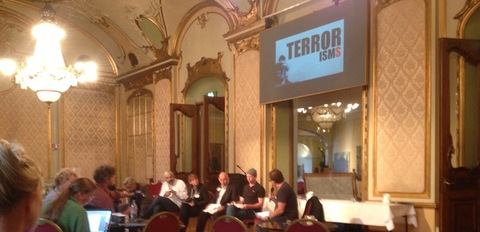
There’s drama stirring in the Oslo National Theatre, but not the kind most cultural institutions expect. Under the auspiciousness of The Union of Theaters of Europe, the Oslo National Theatre has committed to a two-year project titled “TERRORisms”:
From 2013 to 2015, theatres from Oslo, Stuttgart, Belgrade, Tel Aviv, London and Reims will get closer to their TERRORisms. They will elaborate different points of view, exploring different aspects likely to determine fundamentally our societies… dealing with the issue of terrorism and its appropriation by artists.
I’ve just come back from Oslo, and to be honest, Norwegians- as individuals and as a society- didn’t strike me to be particularly “determined fundamentally” by “their” “terrorisms”. Admittedly, I’m not an expert on European contemporary art, but it doesn’t seem to me like there’s a lot ofartistic appropriation of terrorism being done in the European cultural sphere, and the notion is rather- let’s just say- foreign.
The Union of Theaters of Europe: The New Propaganda Front for Israel’s TERRORisms
Janine R. Wedel writes about power, influence, and governing through the unique lens of a social anthropologist. A professor in the School of Public Policy at George Mason University and senior research fellow at the New America Foundation, Wedel is the first anthropologist to win the Grawemeyer Award for Ideas Improving World Order.
Her book Shadow Elite: How the World’s New Power Brokers Undermine Democracy, Government, and the Free Market (Basic Books 2009) was named Book of the Month by The Huffington Post in January 2010.
Today, [Creative Community for Peace] say, there is not a single musical act, from Justin Timberlake to the Rolling Stones to Alicia Keys, that they have not approached and coached in advance of their performance in Israel. ~Times of Israel
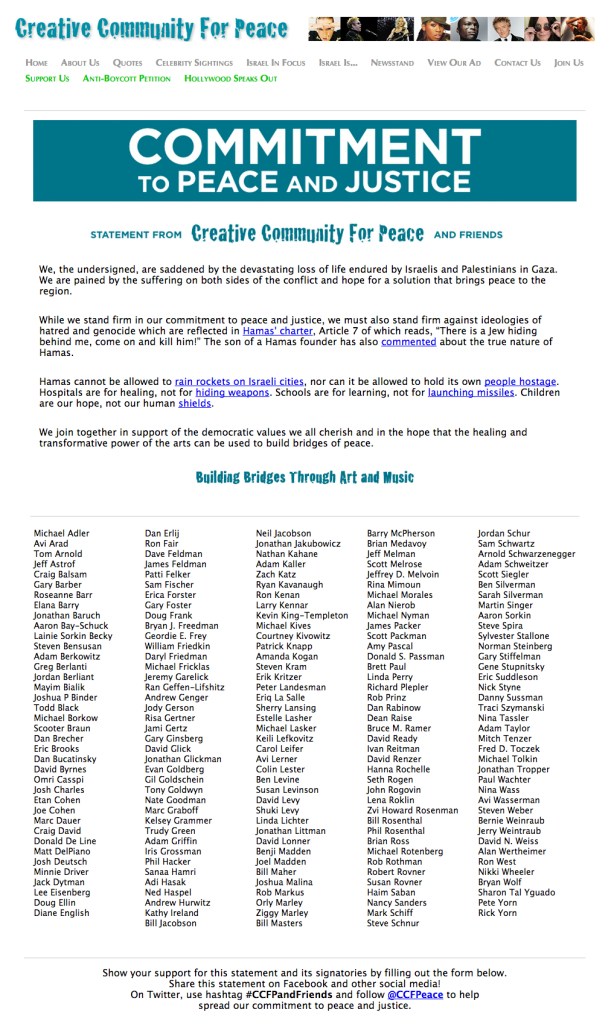
It’s no surprise that the genocidal Times of Israel is so eager to push anti-BDS initiatives. It’s also no surprise that one of Israel’s most well connected, elite whitewashing team, Creative Community for Peace [CCfP], is doing exactly what it vowed to do- whitewash genocide. However one might wonder about some of the names on the below statement that CCfP has published:
Solidarity disclaimer: This piece was written about a half a year ago, as I returned excitedly from a workshop in South Africa. These are my (a privileged beneficiary of the Israeli apartheid system) conclusions and analysis, and in no way presume to be an “ultimate truth”, or an attempt at dictation for Palestinian action. I only hope that it’s instructive and serves as yet another window, out of many, for thoughts, debate and input. The word “we” refers to participants of the workshop.
Often when I’m asked what the point of BDS is, I quickly answer “to get the Israeli regime to the negotiating table with no preconditions” and then I move on to tactics. Sometimes we get so mired in the blood and brutality on our path of resistance, that we need to be yanked out of it, in order to stop and see our golden milestones.
Chris Hedges, a Pulitzer Prize-winning American journalist specializing in politics and society, spoke at Moravian College on Tuesday, October 22, 2013. Hedges is the seventh Peace and Justice Scholar in Residence at Moravian College. His talk was drawn from his most recent book, Days of Destruction, Days of Revolt.
The author of several books including Seeing Like a State, Professor Scott’s research concerns political economy, comparative agrarian societies, theories of hegemony and resistance, peasant politics, revolution, Southeast Asia, theories of class relations and anarchism. We talk with Professor Scott about his newest book, The Art of Not Being Governed. It is the first-ever examination of the volumes of literature on state-making that evaluates why people would deliberately remain stateless.
“Conflicts have always allowed very suitable ecosystems for Non Governmental Organisations or NGOs to flourish in. Embroiled with armed insurgency for about two decades now, Kashmir has attracted a plethora of organizations. But going by the numbers, the region seems to have become a heaven for NGO activity.”
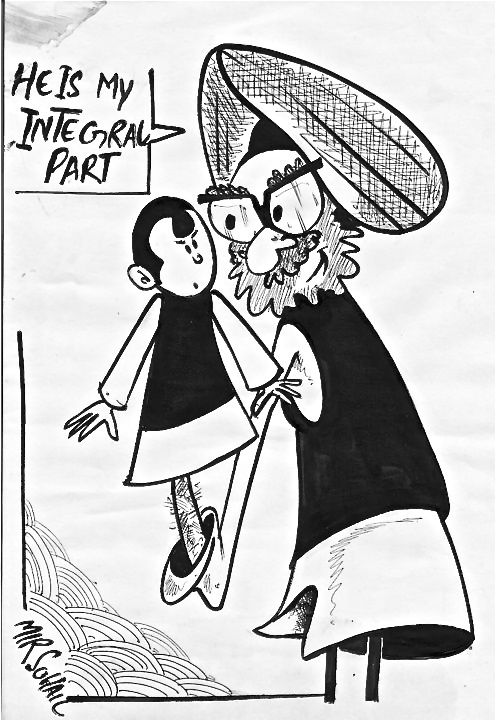
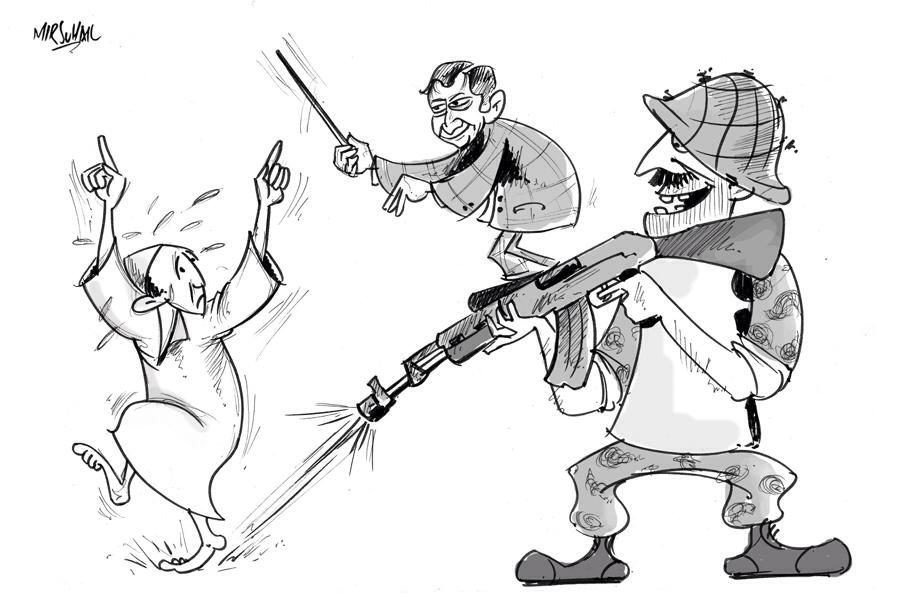
Kashmir as an Integral Part of India. Cartoon by Mir Suhail Qadiri
Conflicts have always allowed very suitable ecosystems for Non Governmental Organisations or NGOs to flourish in. Embroiled with armed insurgency for about two decades now, Kashmir has attracted a plethora of organizations. But going by the numbers, the region seems to have become a heaven for NGO activity.
There is no central register for the NGOs operating here, no guidelines or any overt accountability. Various estimates put the figure of existing NGOs up to 16,000. Apart from the office of the Registrar of Societies, NGOs are registered for various non-profit activities as trusts and voluntary groups in the district courts. Besides, many NGOs from across the country operating in Kashmir are not registered here.
All you need is five persons and a draft of bylaws along with a declaration of supposed objectives that is then registered in any district court where no count is maintained.
Just what is this huge mass of NGOs doing and who are the people who run them? What is the real intent and incentive for this NGO boom in a region that is still considered business ‘unfriendly’? Where is the funding coming from? A superficial enquiry reveals a dizzying range of unclear activity bordering on subterfuge.
Government employees, close relatives of bureaucrats, politicians, well-off families and people who have been a part of counter insurgency think tanks, run a number of NGOs in the Valley. Kashmir Foundation for Peace and Developmental Studies (KFPDS) run by a former militant commander, Firdous Sayeed Baba alias Babar Badr, has been on the scene for many years now. Babar and four other former militant commanders were the first to enter into dialogue with New Delhi in 1995. He is also known to be very close to the former Intelligence Bureau (IB) chief A S Dullat, who for many years earlier and during NDA regime served as New Delhi’s point man on Kashmir affairs. Continue reading “The Eerie NGO Phenomenon in Kashmir”
We appeal all sections of Kashmiri society to join the Haqeeqat-e-Kashmir event to express their solidarity with the resilience and suffering of people of Jammu and Kashmir.
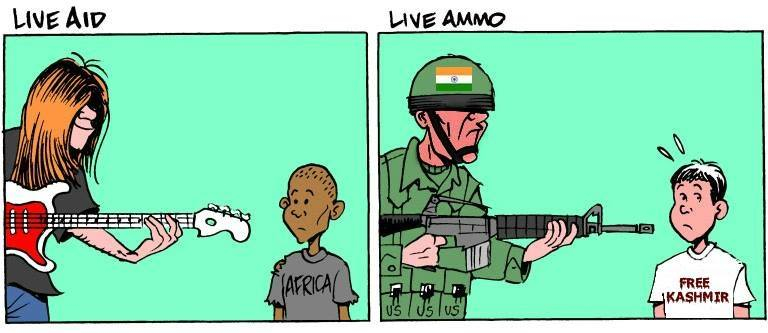
Live Aid, Live Ammo: India and Zubin Mehta’s Psyop Concert in Indian Occupied Kashmir
Organizing Committee, Haqeeqat-e-Kashmir
Press release, 5 September 2013
On 22 August 2013, the German Embassy, New Delhi, issued a press release that Zubin Mehta would be conducting an orchestra on 7 September 2013, at the Mughal Garden, Shalimar Bagh, in Srinagar, Jammu and Kashmir. On 26 August 2013, civil society members of Jammu and Kashmir – from lawyers and businessmen to poets and scholars – registered a strong protest against the proposed concert and concerns were communicated to the German Embassy and the people of Germany – from political representatives to artists and activists.
The people of Jammu and Kashmir take immense pride in our rich history of resisting oppression. We also have historically cultivated a sublime tradition in, and love for, music. Music – which appeals to the higher values of love, justice, dignity, and peace; which genuinely acknowledges the long-suffering, yet bravely resisting, Kashmiris; and which is performed for the actual public – is wholeheartedly welcome.
However, legitimizing an occupation via a musical concert is completely unacceptable. Art as propaganda, as abundantly documented in history, is put to horrific use across the world. Art as propaganda in Jammu and Kashmir is unacceptable. The Zubin Mehta concert is organized and controlled by Government of India and the German Embassy, with extensive corporate sponsorship. It serves to build on the State narrative that seeks to dilute the reality of Jammu and Kashmir and peoples’ aspirations. It seeks to promote an image of a “peaceful” and “normal” Jammu and Kashmir. The pain, suffering, courage and bravery of the resistance will find no place in this concert. Indian State operations that seek to support the occupation must be resisted. To build this Statist narrative of Jammu and Kashmir, an estimated Rs.100 crores [INR 10 billion or USD 16 million] is reported to being spent, and invitations have been sent to corporate India (Tatas, Birlas, Ambanis, Bajajs, CII, FICCI..), the film world (Amitabh Bachchan, Rajinikanth, Katrina Kaif…) and sportsmen (Sachin Tendulkar, Boris Becker…). It is most condemnable that the Government of Germany has chosen to be party to the Indian States’ continued political machinations in Jammu and Kashmir. So far Indian army and various Indian institutions have been organizing psychological operations which are termed by Indian military as Sadbhavana Operation. We protest German government’s joining the efforts of Indian army. It appears an attempt by the Indian State to outsource its military psychological operations to the international community. Continue reading “More on “Haqeeqat-e-Kashmir”: India and Zubin Mehta’s Psyop Concert in Indian Occupied Kashmir”
We submit that it is incumbent upon the people of Germany to put pressure on the German Embassy to immediately recognize the reality, the horrifying context, within which this proposed concert is to take place, issue a statement that accepts the disputed nature of Jammu and Kashmir, and recognizes the pain and legitimate political and legal struggle of its people. Crucially, pressure must be put on the German Embassy to withdraw its support to the concert.
“Zubin Mehta, Indian Army, and Kashmir” by Mir Suhail Qadiri
September 2, 2013
To
The People of Germany
(Political Representatives, Civil Society, Artists, Activists and Citizens)
Of Occupation, Resistance and Music: An Appeal
1. On 22 August 2013, the German Embassy, New Delhi, issued a press release that Zubin Mehta would be conducting an orchestra on 7 September 2013, at the Mughal Garden, Shalimar Bagh, in Srinagar, Jammu and Kashmir. The press release stated that the concert was “a wonderful cultural tribute to Kashmir,” and intended “to reach the hearts of the Kashmiris with a message of hope and encouragement.” “The ‘Kashmir Concert’ is part of a broader engagement,” it further stated.
2. On 26 August 2013, civil society members of Jammu and Kashmir – from lawyers and businessmen to poets and scholars – registered a strong protest against the proposed concert. To date, the German Embassy has failed to respond – privately or publicly – to this letter of protest. Faced with this unforeseen and complete apathy from the German embassy, we believe it is incumbent upon us to reach out to the people of Germany to express our serious concerns with a concert that seeks not to entertain, but to subtly control the political message from Jammu and Kashmir, i.e. manipulate it into a message of “peace” and “normalcy” that ignores ground realities. For example, even as we write this appeal, Jammu and Kashmir Police are conducting door to door searches and identification exercises at the homes of the residents in and around the Shalimar neighborhood, the proposed venue of the concert. Surely this exposes the rot at the core of the much-touted “peace” and “normalcy.”
3. The people of Jammu and Kashmir take immense pride in our rich history of resisting oppression. We also have historically cultivated a sublime tradition in, and love for, music. Music – which appeals to the higher truths of love, justice, dignity, and peace; which genuinely acknowledges the long-suffering, yet bravely resisting, Kashmiris; and which is performed for the actual public – is wholeheartedly welcome.
4. However, legitimizing an occupation via a musical concert is completely unacceptable. Art as propaganda, as abundantly documented in history, is put to horrific use across the world. We are sure you will understand that we cannot welcome anything even remotely analogous in Jammu and Kashmir. In a state of affairs where the poets and musicians of Jammu and Kashmir, such as Ghulam Nabi Sheikh, well-known Kashmiri national singer, Inayatullah Bhat, a guitar/harmonium player, and Ali Mohammad Shahbaz, a poet from Handwara, have themselves been victims of the violence of the Indian State, it is but obvious that there needs to be a political understanding of the uses and abuses of art. Given this sordid context, which cannot be naïvely wished away, we must then ask this crucial question of the people of Germany, and the world citizenry at large: Should we, as people of conscience, support art which not only does not highlight the sufferings of an oppressed people, leave alone which offers balm to its pain, but instead which, through its setting within the particular landscape of power, actively serves to silence and obfuscate our appeals to the rest of humanity, and thus furthers oppression? Continue reading “Of Occupation, Resistance and Music: An Appeal”

 P U L S E