In this TomDispatch.com interview Civil rights attorney and PULSE contributor Chase Madar outlines the case against––and the defense on behalf of––the soldier who allegedly provided the documents for the latest WikiLeaks release as well as the now infamous “Collateral Murder” video, Private First Class Bradley Manning. Also, don’t miss Chase’s brilliant piece on Bradley Manning.
Category: US Foreign Policy
Of Niqabs, Monsters, and Decolonial Feminisms
By Huma Dar
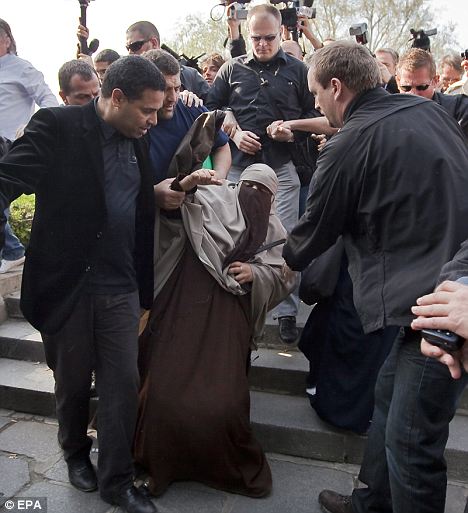
Of Civilities and Dignities
On 22 June 2009, Nicolas Sarkozy, the French President, asserted that burqas (or the burqa-clad?) are “not welcome” in France, adding that “[i]n our country, we cannot accept that women be prisoners behind a screen, cut off from all social life, deprived of all identity” and that “the veils reduced dignity.” France’s Muslim minority is Western Europe’s largest Muslim minority, estimated at six-million-strong. And this is just an approximation, as the French Republic implicitly claims to be post-race and post-religion via a prohibition on any census that would take into account the race or religion of its citizens. (This anxiety mirrors the brouhaha in Indian media àpropos the much-contested enumeration of OBCs or Other Backward Castes in the Indian census surveys of 2011, or the urgency to declare some spaces post-caste, post-feminist, and post-racist while casteism, patriarchy and racism continue unabated.)
Continue reading “Of Niqabs, Monsters, and Decolonial Feminisms”
PLO: History of a Revolution
1. Masters of their Own Destiny
Masters of their own Destiny is the first episode in Al Jazeera’s six-part series on the history of the Palestine Liberation Organisation. It looks at the challenges encountered as Palestinians sought to wrest control of their own destiny from Arab regimes and create an independent Palestinian organisation that would lead the struggle for a national home.
United States of Israel
Sarah Palin is just the latest GOP politician to visit to Israel after a string of possible Presidential hopefuls to make a pilgrimage to the Holy Land in the past few months. Why is establishing your credentials in Tel Aviv before running for US president as vital as stumping in New Hampshire?
Breaking Australia’s silence: WikiLeaks and freedom
‘Breaking Australia’s silence: WikiLeaks and freedom’ was a public forum held on 16 March 2011 at the Sydney Town Hall. The event was staged by the Sydney Peace Foundation, Amnesty, Stop the War Coalition, and supported by the City of Sydney.
Chaired by Mary Kostakidis, it featured speeches by John Pilger, Andrew Wilkie MP (the only serving Western intelligence officer to expose the truth about the Iraq invasion) and Julian Burnside QC, defender of universal human rights under the law.
Gaddafi is the regime
Charles Glass has an excellent post on the London Review Blog, worth reproducing in full:
The Libyan dictator is resisting the popular forces ranged against him in ways that his counterparts in Tunisia and Egypt did not. In Tunis and Cairo, Zine Abedine Ben-Ali and Hosni Mubarak were the faces of military regimes. Colonel Muammar Gaddafi is not the face: he is the regime. The Egyptian and Tunisian army chiefs calculated that sacrificing their nominal commanders-in-chief would preserve their own positions without jeopardising the interests of their American benefactors. Playing the role of saviours of the nation, after years in which the officer class enriched itself and ordinary soldiers were made to repress dissent, the armies in Tunisia and Egypt emerged as arbiters of whatever order will follow the post-dictator era.
Since Gaddafi seized power in Libya with his co-conspirator Major Abdul Salam Jalloud in 1969, he has remade the military in his own image to enforce his rule. In this, he enjoyed the successive support of the CIA, the Soviet Union and the East German security services. In Egypt, the army had some legitimacy from the Nasser era, when a whole generation of junior officers (all of whom entered the army after its officer class was expanded beyond the pashas in the 1930s) supported the revolution of 1952. When Nasser died in 1970 and Sadat was assassinated in 1981, the army set ground rules for transition that preserved its position. Libya, since Gaddafi overthrew King Idris, has never faced a transition. Gaddafi is not contemplating one, which leaves his army no option but to retain him. If he goes, they are finished.
Right to intervene?
As Muammar Gaddafi strikes to crush rebel forces in Libya, Empire looks at the case for and against intervention.
Conversations with History — Richard J. Goldstone
Justice Richard J. Goldstone discusses “The Rule of Law” with Harry Kreisler on Conversations with History.
Conversations host Harry Kreisler welcomes Justice Richard J. Goldstone for a discussion of the role of law in transitions to democracy, in the prosecution of war crimes, and in the enforcement of the rules of war in the post 911 environment. Drawing on his experiences in South Africa, on his work as special prosecutor for the Bosnia and Rwanda tribunals, and for his leadership of the UN commission on the Gaza War, Justice Goldstone discusses the distinctive features of the South African transition, the ground breaking work that facilitated a breakthrough in the Bosnia conflict, and the goals and accomplishments of the commission examining the conduct of Hamas and Israel in the Gaza War. He concludes with lessons learned from his efforts to insure the rule of law.
The revolt comes to Saudi Arabia

Meaningful change in the Middle East is not possible until the malign influence of the House of Saud is lifted. For nearly eight decades it has served as a bulwark of American power in the region, and in more recent years has emerged as a key ally of Israel. When Israel was devastating Lebanon in 2006 and Gaza in 2009, the Saudi government reserved its criticism for the war’s victims. It has also tried to draw attention away from its own domestic failings by joining Israel and the US in ratcheting up propaganda against Iran. (As with pre-Jan25 Egypt, the accomodation with Zionism resulted in Iran replacing Israel as the chief bogeyman). It has yet to pay a price for the repeated betrayals of its own people and for spreading the brand of conservative, intolerant Salafist Islam that is today fragmenting societies from Beirut to Jakarta. It is time for a reckoning, and as Robert Fisk reports, the date has been set for March 11.
Saudi Arabia was yesterday drafting up to 10,000 security personnel into its north-eastern Shia Muslim provinces, clogging the highways into Dammam and other cities with busloads of troops in fear of next week’s “day of rage” by what is now called the “Hunayn Revolution”.
Saudi Arabia’s worst nightmare – the arrival of the new Arab awakening of rebellion and insurrection in the kingdom – is now casting its long shadow over the House of Saud. Provoked by the Shia majority uprising in the neighbouring Sunni-dominated island of Bahrain, where protesters are calling for the overthrow of the ruling al-Khalifa family, King Abdullah of Saudi Arabia is widely reported to have told the Bahraini authorities that if they do not crush their Shia revolt, his own forces will.
A new beginning? — Tariq Ali on the Arab uprisings
Our good friend Tariq Ali on the Arab uprisings and the US response. You can ignore the neocon Uncle Tom who appears afterwards.
 P U L S E