Of Niqabs, Monsters, and Decolonial Feminisms

By Huma Dar

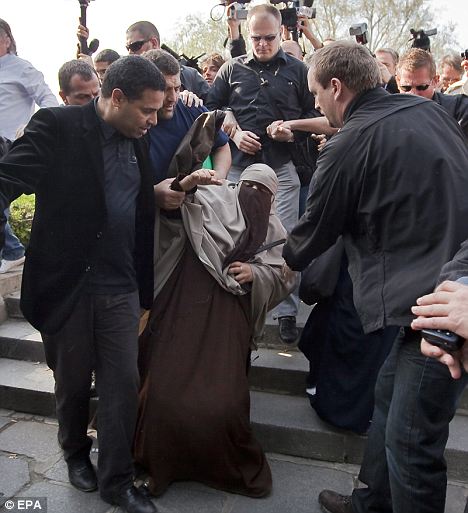
A woman in niqab being arrested in Paris, April 12, 2011, copyright EPA

Of Civilities and Dignities

On 22 June 2009, Nicolas Sarkozy, the French President, asserted that burqas (or the burqa-clad?) are “not welcome” in France, adding that “[i]n our country, we cannot accept that women be prisoners behind a screen, cut off from all social life, deprived of all identity” and that “the veils reduced dignity.” France’s Muslim minority is Western Europe’s largest Muslim minority, estimated at six-million-strong.  And this is just an approximation, as the French Republic implicitly claims to be post-race and post-religion via a prohibition on any census that would take into account the race or religion of its citizens. (This anxiety mirrors the brouhaha in Indian media àpropos the much-contested enumeration of OBCs or Other Backward Castes in the Indian census surveys of 2011, or the urgency to declare some spaces post-caste, post-feminist, and post-racist while casteism, patriarchy and racism continue unabated.)

Continue reading “Of Niqabs, Monsters, and Decolonial Feminisms”

Fight for Ajdabiya continues

Forces loyal to Libyan leader Muammar Gaddafi are said to have taken up key positions around the opposition-held city of Ajdabiya.

The eastern city has been fought over now for more than two weeks.

Many people have fled and others are hiding indoors.

Al Jazeera’s James Bays reports on the desperate conditions for people who have chosen to stay.

Gaddafi bears responsibility

French-Lebanese scholar Gilbert Achcar on the no-fly zone in Libya:

Over at Al Jazeera, Marwan Bishara asks:

So who bears the responsibility for turning Libya into a war zone and an object of an international military intervention?

Could it be those who confronted a peaceful civil uprising for freedom with lethal force, and when it escalated into a full-fledged revolt, used aerial bombardments, heavy artillery to quell it?

Libya could have and should have gone Tunisia or Egypt’s path of change. But while their militaries conceded the need for regime change, in Libya the family-led powerful militias, financed and groomed to defend the regime’s “country estate”, sided with their pay masters.

While the Gaddafis continue to show images of pro-Gaddafi demonstrators in Tripoli to offset the images of widespread anti-Gaddafi/pro-change, in reality, Libya is not divided between two visions for their country.

Rather between a majority that seeks free and prosperous Libya, and a mostly small heavily-armed minority that runs or benefits from a corrupt rule.

Continue reading “Gaddafi bears responsibility”

Srebrenica on the Mediterranean

Two days after Gaddafi promised that he’ll show ‘no mercy’, his troops are bombarding, some entering, Benghazi. The UN Security Council had passed a resolution declaring a no-fly zone over Libya. Thus far, the sky belongs to Gaddafi. There was a point where Gaddafi could have been thwarted, had his armoured columns been checked by the presence of hostile air power. No need to bomb them, just bomb the road ahead. Check their advance, send a message. Instead, the troops have been allowed to enter Benghazi. Now they cannot be attacked without inflicting high casualties on civilians. The UN forces will likely excuse themselves by claiming that tanks can’t be attacked because now they are in the city. Western forces are also reluctant because since 2003, Gaddafi has been a reliable economic parter and Libya has been a favoured destination for rendition flights. (Remember where Ibn al-Shaykh al-Libi died?)

The UN could still salvage the situation by threatening Gaddafi’s supply lines. But I fear we are about to see another Srebrenica. In that instance, the UN forces delayed intervention till the Serbs had encircled the enclave and then declined to intervene because they said it would put their own peacekeepers lives at risk. Meanwhile the slaughter continues.

Violence continues across Bahrain

Also see this article by Marc Lynch on the Bahraini government use of sectarianism as a counterinsurgency tool.

Bahrain’s largest opposition group has urged Saudi Arabia to withdraw its forces and called for a UN inquiry into the the government’s on-going crackdown.

Clashes between security forces and anti goverment protesters continue, spilling into villages across the country.

Our special correspondent, whom we are not naming for security reasons, filed this report.

Deadly crackdown in Yemen

Yemeni security forces have opened fire at a protest in the capital Sanaa, killing at least 30 people.

It is the highest death toll in a single day after weeks of demonstrations calling for Ali Abdullah Saleh, the Yemeni president, to stand down.

Witnesses say armed men opened fire from nearby buildings as protesters gathered in Sanaa’s University Square after Friday prayers

Al Jazeera’s Alan Fisher reports.

When Revolution Becomes the Only Choice

by Ali Jawad

New York Times columnist Nicholas Kristof has graphically chronicled the heart-wrenching realities that have shrouded over Manama in recent days. Whilst there may be criticisms of a sometimes de-contextualised narrative, his articles are nevertheless sufficient to shed light on the fundamental grievances that have spurred the popular protests across Bahrain. There is more than enough in his articles to evoke the deepest emotion and sympathy for unarmed civilians being systematically crushed under the juggernaut of a western-armed foreign mercenary force doggedly determined to maintain the vestiges of a brutally authoritarian regime.

Officials at the Pentagon have surely read some of Kristof’s reports by now, and have no doubt made note of the striking similarities between the Al-Khalifa regime and its ousted Tunisian and Egyptian counterparts. The intelligence services and their head, Leon Panetta, are also acutely aware – no doubt – of the voluminous grievances held by the vast majority of Bahrainis towards a ruling monarchy that is increasingly acquiring the “illegitimate” prefix; this in addition to a growing view amongst Bahrainis equating the Al-Khalifa regime as the prime obstacle to serious democratic change. In spite of this however, the placid petulance that has characterised the statements of the US Secretary of State has served to further underline to the lay Arab citizen that despite its mendacious, last-minute attempts to embrace the Tunisian and Egyptian revolutions, the US remains firmly committed to the vocation of bolstering tyrants and dictators – only opting to disown them as the latter partake in their final rites.

Continue reading “When Revolution Becomes the Only Choice”

Clinton’s goons assault a 71-year-old veteran even as she berates Iran for violence against protesters

There is of course the further irony of the fact that she is speaking at a conference on Internet Freedom even as her government has spent the past few months trying to suppress websites associated with Wikileaks and to have its founder extradited. As the great Ray McGovern says: straight out of Kafka!

US wavers on Middle East

Barack Obama, who even today was lecturing Iran in the obnoxious school-masterly tone which American presidents feel obliged to adopt in their declamations, once again turns a blind eye when the violence is pepetrated by a friendly despot.

The US and president Barack Obama continue to waver in their position regarding the unrest sweeping through the Middle East. The country says it will not dictate events in the region. But Obama has criticised the Iranian government’s violent response to protests there, while at the same time maintaining a more neutral tone with Bahrain. Many find the US’s response disappointing, and some feel the White House will only react strongly to those governments it does not have a stake in.

Al Jazeera’s Patty Culhane reports.

And this is the kind of violence that is being wrought by this ‘reliable ally.’