Colonizing the Mind: Israel’s Assault on Palestinian Education

Yesterday, I stumbled across a title in Ma’an that shook me to the core:

Palestinian schools switch to Israeli curriculum in Jerusalem

To anyone who knows the Israeli curriculum, this is one of the most chilling statements anti-colonialists can imagine. The Israeli school curriculum is what allows millions of Israelis to enlist to the army, to cheer on as it slaughters Palestinians en-masse, and to be OK with being “a little bit fascist” .

I want to make a very important stop here, before we continue examining the article and the questions which it raised in my mind, so my readers, who didn’t grow up through Israel’s public school indoctrination, can get a basic idea of how it works. So sit back for 28 minutes and get to know the incredibly important research of Nurit Peled-Elhanan about the colonialist racist discourse in Israeli textbooks:

  Continue reading “Colonizing the Mind: Israel’s Assault on Palestinian Education”

How Pakistan Can Stop Drone Strikes

This article appeared at The Atlantic.

Nawaz SharifThe picturesque valleys of Pakistan’s Gilgit-Baltistan are overlooked by the immense snowcaps of Nanga Parbat. At more than 26,000 feet, it is the world’s ninth tallest mountain, but for alpinists it is a challenge far greater than Everest. It’s a rare mountaineer who is unaware of its reputation as “the killer mountain.” The notoriety derives from its deadly avalanches and crevasses, but the death that was visited on a group of climbers last month took a much different form. Eleven mountaineers were killed when militants affiliated with the Pakistani Taliban entered their basecamp and unleashed a deadly fusillade.

The assailants claimed the slaughter was retaliation for a June 7 drone strike that killed the Taliban deputy leader Waliur Rehman. Unlike the mountaineers, Pakistan was braced for the attack. Only the location came as a surprise.

Earlier in the month, when the newly elected Prime Minister Nawaz Sharif took office, he had used his inaugural address to ask the U.S. to refrain from further attacks in Pakistan. It took less than 48 hours for the CIA to ignore his demand and launch the deadly strike that killed nine, including the Taliban leader. Pakistanis were incensed. It was more than a breach of the country’s sovereignty; it was also an intervention in its politics and an invitation to further violence.

Continue reading “How Pakistan Can Stop Drone Strikes”

Glenn Greenwald on the state of American journalism

Glenn Greenwald speaks at the Socialism 2013 conference. He is introduced by Jeremy Scahill.

Rihanna, Get on the Virtual Tour-Bus: From Yarkon Park Tel Aviv, Around the World, to Occupied Palestine!

At the hight of the campaign to urge Alicia Keys to cancel her performance in apartheid Israel, the Jerusalem Post excitedly announced that “despite the bad investment” Israel is willing to “invest” in Forbes’ fourth most powerful celebrity of 2012, Rihanna. The mega-celebrity, holding the formidable position of most popular person on Facebook, 4th most followed on Twitter, and most viewed and subscribed musician on YouTube, is returning to Israel for a second time, on October 22.

Rihanna Unlike Alicia Keys, Rihanna is quite reachable, so make sure to go to her page at http://www.rihannanow.com/contact/ and respectfully explain why she should cancel her performance in Israel.

Since Rihanna is returning for a second time, it seems to me she may have missed the official celebrity tour by the Tourism Ministry. So I’d like to guide Rihanna on a virtual journey, from Yarkon Park Tel Aviv to occupied Palestine.

Continue reading “Rihanna, Get on the Virtual Tour-Bus: From Yarkon Park Tel Aviv, Around the World, to Occupied Palestine!”

Ambiguous drone policies cast doubt on Obama’s lofty pledges

An earlier version of this appeared in The National last week.

It was a “season of fear,” he said. Government trimming facts and evidence “to fit ideological predispositions”; making “decisions based on fear rather than foresight; setting aside principles “as luxuries that we could no longer afford”. “In other words,” he concluded, “we went off course”.

We “cannot keep this country safe unless we enlist the power of our most fundamental values”, he said. Institutions will have to be updated with “an abiding confidence in the rule of law and due process; in checks and balances and accountability.”

It was a fine speech: thoughtful, bold, idealistic. US president Barack Obama delivered it at the National Archives in Washington, on May 21, 2009.

Last Thursday, when President Obama again addressed the question of national security, he sounded equally high-minded. But where in his first speech he had to address the excesses of his predecessor; this time he had his own to consider. The most serious of these were born of Obama’s inability to deliver fully on promises he made in 2009.

At the National Archives speech, Obama had vowed to end torture, shut down CIA black sites, and close Guantanamo. It was the clean break he had promised his base. But faced with a Republican backlash, Obama caved. Torture and black sites were abolished, but Guantanamo remained. Torture memos were released, but torturers roamed free. And to shield himself against charges of weakness, Obama escalated the covert war.

Continue reading “Ambiguous drone policies cast doubt on Obama’s lofty pledges”

Tales in a Kabul Restaurant

by Kathy Kelly

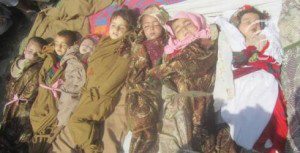
Afghan children
Twelve children killed in the Kunar province, April 2013 (Photo credit: Namatullah Karyab for The New York Times)

May 21, 2013 – Kabul–Since 2009, Voices for Creative Nonviolence has maintained a grim record we call the “The Afghan Atrocities Update” which gives the dates, locations, numbers and names of Afghan civilians killed by NATO forces.  Even with details culled from news reports, these data can’t help but merge into one large statistic, something about terrible pain that’s worth caring about but that is happening very far away.

It’s one thing to chronicle sparse details about these U.S. led NATO attacks. It’s quite another to sit across from Afghan men as they try, having broken down in tears, to regain sufficient composure to finish telling us their stories.  Last night, at a restaurant in Kabul, I and two friends from the Afghan Peace Volunteers met with five Pashtun men from Afghanistan’s northern and eastern provinces. The men had agreed to tell us about their experiences living in areas affected by regular drone attacks, aerial bombings and night raids.  Each of them noted that they also fear Taliban threats and attacks. “What can we do,” they asked, “when both sides are targeting us?”

Continue reading “Tales in a Kabul Restaurant”

The Jenin Jenin Amendment: Israel from Ethnocracy to Fascism

Last Monday, on the 6th of May, Israel’s Ministerial Committee for Legislation decided to approve the “Jenin Jenin Amendment” in a paramilitary hearing. The amendment [Hebrew] is an addition to the Israeli Defamation Law [Hebrew], stating that army personnel and the state can sue individuals, who expose army violence, for libel, without proving damages. The amendment comes as a reaction to Israel’s Supreme Court rejecting soldiers’ class action suit of defamation against actor/director Mohammad Bakri, for his documentary Jenin Jenin (watch it in full here), in which Palestinian testimonies describe their experiences of the 2002 massacre perpetrated by Israel’s army in the besieged refugee camp.

Continue reading “The Jenin Jenin Amendment: Israel from Ethnocracy to Fascism”

True costs of Iraq War whitewashed by fuzzy maths

This article appears in The National. (Also see my earlier article on the causes of the war)

‘So many’, wrote TS Eliot, reflecting on the waste land left by the First World War. “I had not thought death had undone so many.”

This notion is unlikely to cross the minds of those surveying the devastation left by the 2003 invasion of Iraq. The most frequently quoted fatality figure – about 115,000 Iraqis killed – is shocking. But compared to major conflicts of the past century, it is a relatively modest toll. The Battle of the Somme alone killed three times as many. More were killed by a single bomb dropped on Hiroshima during the Second World War.

Former British prime minster Tony Blair, and then-US vice president Dick Cheney, were perhaps conscious of this when they expressed “no regrets” on the 10th anniversary of the war last month.

That the perpetrators of an aggressive war should accept the lowest costs for their folly is unsurprising. What is less explicable is why so many supposed critics of the war are crediting the same estimate. Brown University’s Costs of War project and the Centre for American Progress’s Iraq War Ledger use it as their main source.

You can read the rest here.

Agony in Aleppo: a city abandoned by the world?

From Channel 4: In the first of a Channel 4 News series charting Syria’s descent in the face of civil war, German filmmaker Marcel Mettelsiefen’s spends several weeks in Aleppo witnessing a civilian population isolated and under siege. (Caution: contains highly distressing scenes of war including images of children who have been wounded and killed)

‘We are those two Afghan children’

by Dr. Hakim and the Afghan Peace Volunteers

Two young Afghan boys herding cattle in Uruzgan Province of Afghanistan were mistakenly killed by NATO forces yesterday.

They were seven and eight years old.

Our globe, approving of ‘necessary or just war’, thinks, “We expect this to happen occasionally.”

Some say, “We’re sorry.”

Therefore today, with sorrow and rage, we the Afghan Peace Volunteers took our hearts to the streets.

We went with two cows, remembering that the two children were tending to their cattle on their last day.

We are those two children.

We want to be human again.

Continue reading “‘We are those two Afghan children’”