Rahimullah Yusufzai on the assassination of Usama bin Laden, the man who led all of 100 men in Afghanistan according to former National Security Advisor Gen. James Jones.
Category: War
Want to make your war a “Just War”? A quick how-to, with help from WikiLeaks.
War is hell, war is pain and sorrow–unless of course it’s a Just War which is noble, heroic, every true Christian’s blessed jihad, and if you can swing it, fully authorized by the UN Security Council. Even if Just Wars both ancient (say, the Albigensian crusade) and modern (the starvation of thousands of Iraqis by UN Security Council-authorized sanctions) have been unspeakably nasty, Just Wars are still at least Just, so what’s not to like?

There are two ways to make your war a Just War, with all the fringe benefits. Please read carefully.
First, convince the world that the war is just by invoking the UN Charter and getting Security Council authorization. The law involved is less straightforward than the Scholastic neo-Aristotelianism that used to justify Just Wars, so you’ll be wanting to hire some lawyers. Less intelligent presidents will put angry anti-diplomats like John Bolton on the task, but cannier ones will hire smoother jurists like Harold Koh and Samantha Power to make the case in the dulcet tones of humanitarian NGOese. This is the preferred way of making a war Just nowadays, most likely a matter of supply and demand, as there’s no shortage of secular casuists graduating from the top law schools, and the US Department of Defense has 15,000 lawyers on hand.
The second way to make your war a Just War is to get the Pope to declare it so, or at least not denounce it as an unjust war. This may sound self-consciously retro, but new WikiLeaks disclosures reveal that it has never truly gone out of style. The story Continue reading “Want to make your war a “Just War”? A quick how-to, with help from WikiLeaks.”
Chase Madar: In defense of Bradley Manning
In this TomDispatch.com interview Civil rights attorney and PULSE contributor Chase Madar outlines the case against––and the defense on behalf of––the soldier who allegedly provided the documents for the latest WikiLeaks release as well as the now infamous “Collateral Murder” video, Private First Class Bradley Manning. Also, don’t miss Chase’s brilliant piece on Bradley Manning.
War, a documentary by Gwynne Dyer
Gwynne Dyer’s War is a seven part miniseries, released in 1983, that explores the evolution of war from the bronze age to the Napoleonic era, from the World Wars to the nuclear age. The film has a broad scope, funded by The National Film Board of Canada, it was shot in ten countries, features six national armies, and contains interviews with many veterans and military specialists, including the infamous Bomber Harris.
Dyer himself has a strong military background: he served in the Canadian, American and British navies as a reserve officer; taught military affairs at the Canadian Forces College in Toronto; and for four years was a senior lecturer in war studies at Sandhurst, Britain’s Royal Military Academy. One suspects that, at least at one time, Dyer must have been relatively enthusiastic about the military, but through his understanding of the consequences of a war between great powers has become anti-war, recognising that such a confontation would inevitably escalate to nuclear war, threatening all life on the planet.
The premier episode defines the milestones along the road to total war: the birth of nationalism, conscription, the mobilization of large armies; the invention of the machine gun, tank and atomic bomb; and the deliberate killing of civilians. Paintings and visual material from archives around the world complement interviews and Mr. Dyer’s commentary, which sums up modern warfare, from Napoleon to Nagasaki.
The series was broadcast in 45 countries and the episode The Profession of Arms was nominated for an Academy Award.
The Road to Total War
Of Niqabs, Monsters, and Decolonial Feminisms
By Huma Dar
Of Civilities and Dignities
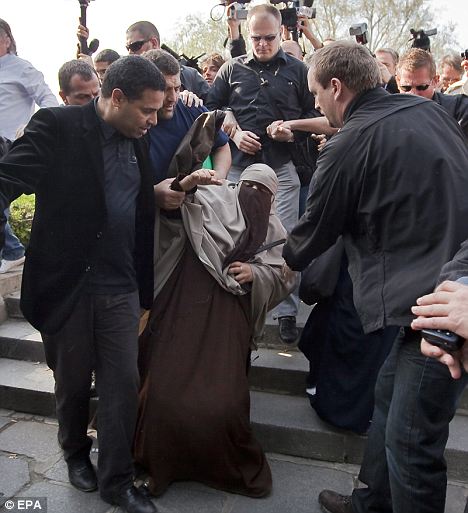
On 22 June 2009, Nicolas Sarkozy, the French President, asserted that burqas (or the burqa-clad?) are “not welcome” in France, adding that “[i]n our country, we cannot accept that women be prisoners behind a screen, cut off from all social life, deprived of all identity” and that “the veils reduced dignity.” France’s Muslim minority is Western Europe’s largest Muslim minority, estimated at six-million-strong. And this is just an approximation, as the French Republic implicitly claims to be post-race and post-religion via a prohibition on any census that would take into account the race or religion of its citizens. (This anxiety mirrors the brouhaha in Indian media àpropos the much-contested enumeration of OBCs or Other Backward Castes in the Indian census surveys of 2011, or the urgency to declare some spaces post-caste, post-feminist, and post-racist while casteism, patriarchy and racism continue unabated.)
Continue reading “Of Niqabs, Monsters, and Decolonial Feminisms”
Fight for Ajdabiya continues
Forces loyal to Libyan leader Muammar Gaddafi are said to have taken up key positions around the opposition-held city of Ajdabiya.
The eastern city has been fought over now for more than two weeks.
Many people have fled and others are hiding indoors.
Al Jazeera’s James Bays reports on the desperate conditions for people who have chosen to stay.
Gaddafi bears responsibility
French-Lebanese scholar Gilbert Achcar on the no-fly zone in Libya:
Over at Al Jazeera, Marwan Bishara asks:
So who bears the responsibility for turning Libya into a war zone and an object of an international military intervention?
Could it be those who confronted a peaceful civil uprising for freedom with lethal force, and when it escalated into a full-fledged revolt, used aerial bombardments, heavy artillery to quell it?
Libya could have and should have gone Tunisia or Egypt’s path of change. But while their militaries conceded the need for regime change, in Libya the family-led powerful militias, financed and groomed to defend the regime’s “country estate”, sided with their pay masters.
While the Gaddafis continue to show images of pro-Gaddafi demonstrators in Tripoli to offset the images of widespread anti-Gaddafi/pro-change, in reality, Libya is not divided between two visions for their country.
Rather between a majority that seeks free and prosperous Libya, and a mostly small heavily-armed minority that runs or benefits from a corrupt rule.
Srebrenica on the Mediterranean
Two days after Gaddafi promised that he’ll show ‘no mercy’, his troops are bombarding, some entering, Benghazi. The UN Security Council had passed a resolution declaring a no-fly zone over Libya. Thus far, the sky belongs to Gaddafi. There was a point where Gaddafi could have been thwarted, had his armoured columns been checked by the presence of hostile air power. No need to bomb them, just bomb the road ahead. Check their advance, send a message. Instead, the troops have been allowed to enter Benghazi. Now they cannot be attacked without inflicting high casualties on civilians. The UN forces will likely excuse themselves by claiming that tanks can’t be attacked because now they are in the city. Western forces are also reluctant because since 2003, Gaddafi has been a reliable economic parter and Libya has been a favoured destination for rendition flights. (Remember where Ibn al-Shaykh al-Libi died?)
The UN could still salvage the situation by threatening Gaddafi’s supply lines. But I fear we are about to see another Srebrenica. In that instance, the UN forces delayed intervention till the Serbs had encircled the enclave and then declined to intervene because they said it would put their own peacekeepers lives at risk. Meanwhile the slaughter continues.
Violence continues across Bahrain
Also see this article by Marc Lynch on the Bahraini government use of sectarianism as a counterinsurgency tool.
Bahrain’s largest opposition group has urged Saudi Arabia to withdraw its forces and called for a UN inquiry into the the government’s on-going crackdown.
Clashes between security forces and anti goverment protesters continue, spilling into villages across the country.
Our special correspondent, whom we are not naming for security reasons, filed this report.
Deadly crackdown in Yemen
Yemeni security forces have opened fire at a protest in the capital Sanaa, killing at least 30 people.
It is the highest death toll in a single day after weeks of demonstrations calling for Ali Abdullah Saleh, the Yemeni president, to stand down.
Witnesses say armed men opened fire from nearby buildings as protesters gathered in Sanaa’s University Square after Friday prayers
Al Jazeera’s Alan Fisher reports.
 P U L S E