In 2010 Time magazine defied the judgment of its readers to select Facebook founder Mark Zuckerberg over Julian Assange as its person of the year. In a readers’ poll Assange had secured 382,000 votes to Zuckerberg’s 18,000. It had been some years since Facebook was big news; some therefore suggested Time had really chosen 2007’s person of the year. Explaining his choice, Time managing editor Richard Stengel confidently declared that ‘Assange might not even be on anybody’s radar six months from now…I think Assange will be a footnote five years from now.’ This was a day before Mohamed Bouazizi set himself alight. It was also before Tahrir Square. It’s over six months since Stengel’s daring prediction yet Assange still remains on the radar and his list of media partners has expanded to over 60—and its growing. Wikileaks has yet to release a much anticipated tranche of documents on the banking sector. It is safe to assume that Wikileaks will be with us for some time to come. But given the present state of publishing, it is likelier that Time will be a footnote five years from now. Here are some recent interviews with Assange:
Category: Alternative Media
Ellsberg: I’m not a traitor… nor is Manning
Daniel Ellsberg, former U.S. military analyst who famously leaked the Pentagon Papers in 1971 weighs in on if he thinks this has been a good or bad year for journalism.
‘WikiSecrets’ Julian Assange full interview footage
PBS Frontline has just aired a documentary “WikiSecrets” — I’ve seen the first few minutes, and already it comes across as a hatchet job. In the interest of transparency, Wikileaks has released the full video of Martin Smith’s interview with Julian Assange because it predicted that the film would distort reality. This is a very interesting interview, so don’t miss.
On 24 May, 2011, 9pm EST, PBS-Frontline will air a documentary “WikiSecrets”. WikiLeaks has had intelligence for some time that the program is hostile and misrepresents WikiLeaks’ views and tries to build an “espionage” case against its founder, Julian Assange, and also the young soldier, Bradley Manning.
In accordance with our tradition of “scientific journalism” (full primary sources) we release here our, behind the scenes, interview tape between Julian Assange & PBS Frontline’s Martin Smith which was recorded on 4/4/2011. In the tape, Assange scolds Martin Smith for his previous coverage of Bradley Manning and addresses a number of issues surrounding the 1917 Espionage Act investigation into WikiLeaks and Bradley Manning.
The Frontline documentary will include footage of a number of individuals who have a collective, and very dirty personal vendetta, against the organization. These include David Leigh, Adrian Lamo, Daniel Domscheit-Berg, Eric Schmitt and Kim Zetter. While the program filmed other sources, such as Vaughan Smith who provided a counter-narrative, these more credible voices have been excluded from the program presented to the US public.
Julian Assange’s Sydney Peace Medal speech
Julian Assange was recently awarded the Sydney Peace Foundation (SPF)’s peace medal, presented to him in London. The event was organised at the Frontline Club. Assange’s acceptance address follows introductions by the SPF’s Stuart Rees and Mary Kostikidis.
A write up of a Q&A section with Assange, which followed the speeches, can be found here (part I) and here (part II).
Vodpod videos no longer available.
Inside Wikileaks
Hero or villian, Julian Assange stunned the world when he leaked more than 90,000 war files. Accompanying Assange through every step of the unfolding drama, this report reveals a man on a mission.
Of Niqabs, Monsters, and Decolonial Feminisms
By Huma Dar
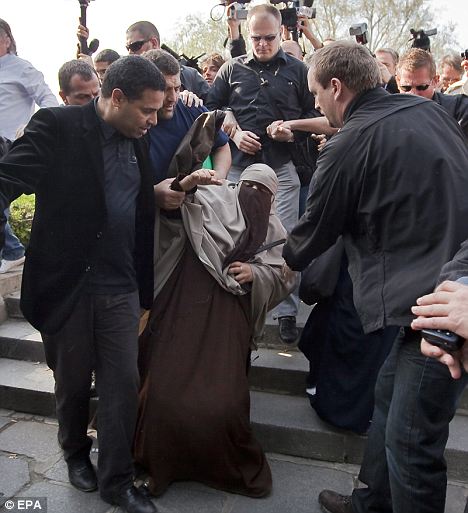
Of Civilities and Dignities
On 22 June 2009, Nicolas Sarkozy, the French President, asserted that burqas (or the burqa-clad?) are “not welcome” in France, adding that “[i]n our country, we cannot accept that women be prisoners behind a screen, cut off from all social life, deprived of all identity” and that “the veils reduced dignity.” France’s Muslim minority is Western Europe’s largest Muslim minority, estimated at six-million-strong. And this is just an approximation, as the French Republic implicitly claims to be post-race and post-religion via a prohibition on any census that would take into account the race or religion of its citizens. (This anxiety mirrors the brouhaha in Indian media àpropos the much-contested enumeration of OBCs or Other Backward Castes in the Indian census surveys of 2011, or the urgency to declare some spaces post-caste, post-feminist, and post-racist while casteism, patriarchy and racism continue unabated.)
Continue reading “Of Niqabs, Monsters, and Decolonial Feminisms”
Information Wars
Part I of this episode of Al Jazeera’s Empire is available here.
Information is power and in the age of the information revolution, cyber and satellite communication is transforming our lives, reinventing the relationship between people and power. How will governments deal with the information revolution?
Breaking Australia’s silence: WikiLeaks and freedom
‘Breaking Australia’s silence: WikiLeaks and freedom’ was a public forum held on 16 March 2011 at the Sydney Town Hall. The event was staged by the Sydney Peace Foundation, Amnesty, Stop the War Coalition, and supported by the City of Sydney.
Chaired by Mary Kostakidis, it featured speeches by John Pilger, Andrew Wilkie MP (the only serving Western intelligence officer to expose the truth about the Iraq invasion) and Julian Burnside QC, defender of universal human rights under the law.
Don’t mess with Anonymous
Anonymous, or Anon, is a movement made up of a number of nameless internet activists from around the world. For many, the ‘hacktivist’ group has become the face of the new cyber-war against oppressive governments and all-powerful corporates. Others say the group’s actions are reckless. Describing itself as “the freedom of speech, the freedom of information and the freedom of expression taken to a logical extreme,” Anon says it breaks laws, but only for the greater good.
Al Jazeera’s Scott Heidler reports.
Philip Weiss on the Arab Revolt
This is as good as talk radio gets. Our friend, the great Phil Weiss on Radio Open Source with Chris Lydon to discuss the implications of the Arab revolt and the changing discourse in the American Jewish community.
 P U L S E