George Orwell’s ‘The Road To Wigan Pier‘ was a classic expose of poverty in 1930s Britain. 75 years later, journalistStephen Armstrong travelled the same route and encountered levels of inequality and social injustice that Orwell would have recognised.
In a special event at the RSA, Stephen Armstrong is joined in conversation by Danny Dorling, professor of Human Geography at the University of Sheffield, to discuss why inequality persists in the UK today and where we might find grounds for optimism about the future.
This is what sexist whitewashing of military occupation looks like: AnnaLynne McCord on tour with America’s Voices in Israel as displayed by the official IDF Flickr account at http://www.flickr.com/photos/idfonline/7159040848/
Celebrities embody a unique and very emblematic space in the capitalist system in which they are both human individuals and a brand name at the same time. They often endorse products and services they enjoy. Of course, one would be naive to assume that their enjoyment of these products and services and consequent endorsement is an organic process. Understanding the leveraging power of the celebrity status, corporations woo big name actors and musicians with thousands of dollars worth of sample gift baskets and free services, hoping the celebrity would tie their brand name with the corporation’s brand name.
The problem with this system, as is common with capitalism, is that in the majority of cases the celebrities don’t check the label, so to speak, and often endorse corporations which abuse the environment, animals and humans. As always, I’ll be tying this with the brand name that is no exception to capitalist brutality: Brand Israel.
Israel’s Tourism Industry and the American Celebrity
One of Israel’s favorite selling points, in its campaign to rebrand itself and divert attention from its ongoing theft of Palestinian land by means of ethnic cleansing, military control and apartheid policies, is its claim to world leadership in medicine. The problem with this line of apartheid PR is, of course, the failure to mention the control the state of Israel has over the Palestinian healthcare system.
Captive Economy, a new report by Who Profits investigates the involvement of Israeli and multinational pharmaceutical industries in the occupation of Palestinian land.
2 a: a sudden, radical, or complete change b: a fundamental change in political organization; especially : the overthrow or renunciation of one government or ruler and the substitution of another by the governed c: activity or movement designed to effect fundamental changes in the socioeconomic situation d : a fundamental change in the way of thinking about or visualizing something : a change of paradigm <the Copernican revolution> e : a changeover in use or preference especially in technology <the computer revolution> <the foreign car revolution>
Almost a year ago a wave of massive popular protests began within the state of Israel. Though my initial criticisms still stands, I’d like to add that over the past year, at least in the south of Tel Aviv, there’s a constant learning about egalitarian politics, co-ops and community projects. People are changing and that can’t be a bad thing. Still, on the Palestinian liberation front there’s little change. The protests have remained Jewish-centered and protesters are still hostile to the mere mention of Arabs (Palestinians are people from another country, of course).
“I can see us as water-spiders, gracefully skimming, as light and reasonable as air, the surface of the stream without any contact at all with the eddies and currents underneath.”
That was how John Maynard Keynes, speaking in 1938 in a talk later published as his brilliant memoir My Early Beliefs, recalled his younger self and his friends in the Bloomsbury Group as they had been in the years before World War I.
The influential Cambridge economist has figured prominently in the anxious debates that have gone on since the crash of 2007-2008. For most of those invoking his name, he was a kind of social engineer, who urged using the power of government to lift the economy out of the devastating depression of the 30s.
That is how Keynes’s disciples view him today. The fashionable cult of austerity, they warn, has forgotten Keynes’s most important insight – slashing government spending when credit is scarce only plunges the economy into deeper recession.
What is needed now, they believe, is what Keynes urged in the 30s – governments must be ready to borrow more, print more money and invest in public works in order to restart growth.
But would Keynes be today what is described as a Keynesian? Would this supremely subtle and sceptical mind still believe that policies he formulated long ago – which worked well in the decades after the World War II – can solve our problems now?
It’s me again. After 11 letters from all around the world, a petition with over 6400 signatories that just keeps growing, and a couple groups on Facebook [1,2], it seems like you’re determined to go through the motions of a performance in apartheid Israel. Sure enough, after a long silence from you, we’re seeing the standard Shuki Weiss promotional video, reassuring fans that past cancellations won’t repeat, and that the world still in fact loves Israel. I can reiterate what was written in other letters and statements, but I much rather just respond to one thing you said in the video, which burns with irony: “We love playing for people. Children, middle aged, and old people. So come one come all.”
From Christopher Lydon’s outstanding Radio Open Source: A fascinating conversation with John Lanchester, editor of the London Review of Books and author of the new novel Capital.
Lydon writes:
John Lanchester has written a sprawling neo-Dickensian novelCAPITAL about London in the age of funny money and the crash of 2008. He got the germ of it five years ago, noticing a parade of “florists, dog-walkers, pilates instructors” on his own once-modest street south of the Thames, being radically made-over for bankers and the blooming investment-services class — “manifestly symptomatic,” as he says, “of a boom that would turn into a bust.” Like Bleak House or Our Mutual Friend, CAPITAL has what the Brits call a “state of the nation” feel, delivered in the voice attributed to Dickens of the “special correspondent for posterity.” But of course he’s illuminating an affliction gone global by now, describing life as lived in New York, too, or Shanghai, or Boston for that matter. One moral that Lanchester has given his tale is: “We are not in this together,” inverting the Tory slogan. In conversation he adds a touch from the Gospel of Mark: “To them that hath shall be given.” I marvel at how casino capitalism and its costs come clearer, stranger, more ridiculous, more destructive, more outrageous in fiction than in fact – how the right novels can feel truer than the news.
A surprise peak of Madonna concert ticket sales comes from a small territory in the Middle East known as “The Dictatorship Formerly Known as Palestine”. A war-torn land, which’s people have obviously suffered enough. Thus, in a desperate attempt to escape the hardships of every day shopping, they turn to the Material Girl’s hard hitting, politically provocative show. With international hits like “Girl Gone Wild” (dedicated to Palestinian activist Rana Nazzal Hamadeh who courageously mounted the notorious “Skunk” truck) and that song of hope and liberation “Turn Up The Radio”, Madonna always has world peace on her mind.
Due to the high ticket sales, super-mega-star Madonna has treated the Middle East with what its been thirsting for. Nope, it’s not water; It’s a second concert, dubbed “Dirty Laundry”. Once again, calling attention to the colonial state of Israel’s policies of apartheid against the Palestinian people, Madonna shines with yet another brilliant PR move. Outdoing her own diplomatic efforts of the 2009 concert in Israel and far surpassing Leonard Cohen’s whitewashing of concert proceeds with NGOs in desperate need of cash, Madonna chose to buy out the already sold-out Peace Industry NGOs with more slogans of peace and free tickets.
Madonna’s diplomatic efforts of the 2009 concert in Israel, after the crisis of The Gaza Massacres.
Arriving a week early for rehearsals, we met up with the pop diva for a sun bathing session on the shores of the White City, and she carried this message of peace on earth:
Music is so universal and if there’s any chance that through my performance I can bring further attention and enlightenment to honor the peace efforts in the Middle East and help people come together, it would be an honor for me. It is my way of thanking those who are making so much effort toward bringing peace to the Middle East.
Madonna’s humble gratitude doesn’t go unanswered and already pro-peace-Israel’s biggest propaganda outlets are abuzz with the latest elevating of hardships, due to the cultural siege it’s been suffering:
The fact that she chose Israel to begin her world tour and will be arriving a week early to hold rehearsals has been seen as a boost for the country, which has witnessed some performers canceling shows and others opting not to appear here at all.
But gratitude must also be extended to those tireless Non-Governmental-At-All activists at the Creative Community for Peace Laundromat who brought Conan O’Brien along to add that missing air of glitter quality. And producer (and dry-cleaner extraordinaire by day and “cultural terrorism” fighter by night) Shuki Weiss, who was willing to sell the “Dirty Laundry” tickets at a reduced price and even provide free tickets for white-as-snow government celebrities:
From Madonna’s 2009 concert, “Looking Swank After Cast Lead” (from right: Shimon “Pass Me the Napalm” Peres, Benjamin “Holcausting Me a Fortune” Netanyahu, Tzipi “Hamas Must Be Toppled by Doves” Livni)
The artist’s shrewd political maneuver has indeed brought the much needed unity to the inflamed region, as a joint statement was issued by President of the Palestinian National Authority, Mahmoud Abbas and Hamas leader in the Gaza strip, Khaled Mashal:
We, Mahmoud Abbas and Khaled Mashal, the leaders of the new unity government of the Palestinian people would like to bestow Madonna with an honorary Palestinian citizenship on this wondrous occasion of her bridge-building concert (and once we get our land back), but we are stuck at the checkpoint and being shot at in the “Death Zone” respectively.
What prompted the popular writer to go back to his Cambridge roots and rehash this very Humanities 101 debate? Why the Boycott Divestment and Sanctions movement of course!
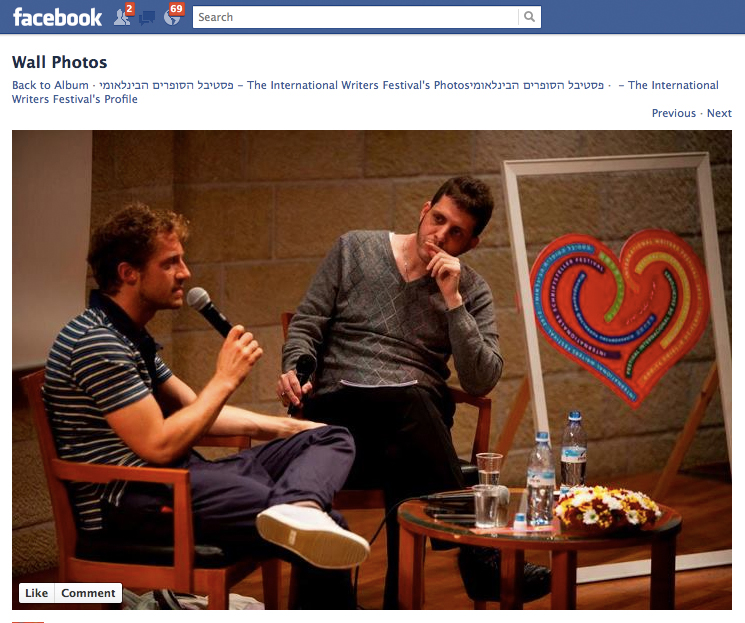
Tom Rob Smith at the Jerusalem Writers Festival not discussing the ways in which it whitewashes apartheid, and is sponsored by an organization which is responsible for ongoing ethnic cleansing, only minutes away from the premises. (source: The Jerusalem Writers Festival Facebook page)

 One of Israel’s favorite selling points, in its campaign to rebrand itself and divert attention from its ongoing theft of Palestinian land by means of ethnic cleansing, military control and apartheid policies, is
  ost a year ago a wave of massive popular protests began within the state of Israel. Though
 John Lanchester



 P U L S E