Indians Against Democracy

by Pankaj Mishra

Growing up in India in the 1970s and 80s, I often heard people in upper-caste middle class circles say that parliamentary democracy was ill-suited to the country. Recoiling from populist politicians who pandered to the poor, many Indians solemnly invoked the example of Singapore’s leader Lee Kuan Yew. Here was an Oxbridge-educated and suitably enlightened autocrat, who suffered no nonsense about democracy, and, furthermore, believed firmly in the efficacy of publicly caning even minor breakers of the law. Devising his wise policies with the help of experts and technocrats, he simply imposed them on the population. Lee Kuan Yew’s success in transforming a city-state into a major economic power was apparent to all: clean, shiny, efficient, and prosperous Singapore, the very antithesis of corrupt and squalor-prone India.

Such yearnings for technocratic utopia may seem to have little in common with the middle class protests against “corruption” that recently gained much attention before abruptly losing steam at the end of the year. Led by Anna Hazare—an army veteran described in the foreign press as a “simple man in a Gandhian cap” when he went on a hunger strike last summer— the movement was presented by sections of the media in both India and the West as a long overdue political awakening of the middle class, even as India’s “second freedom struggle.” With his unambiguous denunciations of venality in public life, Hazare seemed to have alerted tens of millions of otherwise apolitical Indians to the possibilities of civil society, mass mobilization, and grass-roots activism.
Continue reading “Indians Against Democracy”

eXing TEDx

TED is… TED is…. OK, I’m actually having a seriously hard time defining this… thing. And the site isn’t very helpful. So, as far as I can gather, TED was a conference in 1984, that brought together people from the Technology, Entertainment and Design industries for the Technology, Entertainment and Design industries people. It’s become a non-profit (owned by the Sapling Foundation), which holds double-annual conference, traditionally held in Long Beach and Palm Springs and Edinburgh, Scotland (but they’d rather say “Edinburgh, UK”, mind you). The goal of TED is to “spread great ideas”, they call those “ideas worth spreading”.

TEDx – The Image of a Perfectly Western World

Continue reading “eXing TEDx”

WikiLeaks: Saudis Often Warned U.S. About Oil Speculators

Further evidence of the vacuity of the ‘war for oil’ argument. Much of the price for oil is today determined in the derivatives market by Wall Street speculators rather than by producers or suppliers. The underlying commodity usually has a minimum impact on the actual price. But the Commodity Futures Trading Commission will not investigate this for the same reason why it was prevented from investigating the banks. Because Wall Street owns the executive branch. (Don’t miss the excellent Inside Job and this post by Pat Lang).

Kevin Hall: The Saudis have been saying for years something should be done to curb the influence of banks that are speculating on the price of oil.

Is there a chance of another economic meltdown?

Gerald Epstein: Real message of S&P downgrade of US debt outlook is threat of another meltdown of finance sector.

Meanwhile, Goldman Sachs, the investment giant that brought you the financial crisis and world food crisis, is lobbying to weaken the Volcker rule, which is designed to limit banks from speculating with their own money.

Continue reading “Is there a chance of another economic meltdown?”

Khirbat Tuqu’ & the Silent World

It must have been late at night when this rare, short, late-night segment on Channel 10 sneaked by the editors:

Between Judea and Samaria & the West Bank

While I’m astonished that an Israeli mainstream news service would even address this story at all, let alone report in a considerably balanced manner; There are many very basic questions that this 2-and-a-half minute segment whizzes through, that I’d like to comment on.
Continue reading “Khirbat Tuqu’ & the Silent World”

Keynes, Crisis and Monopoly Capitalism

Robert Skidelsky and Paul Jay discuss Keynes, the IMF, concentration of ownership, political power and rebellion.

Of Niqabs, Monsters, and Decolonial Feminisms

By Huma Dar

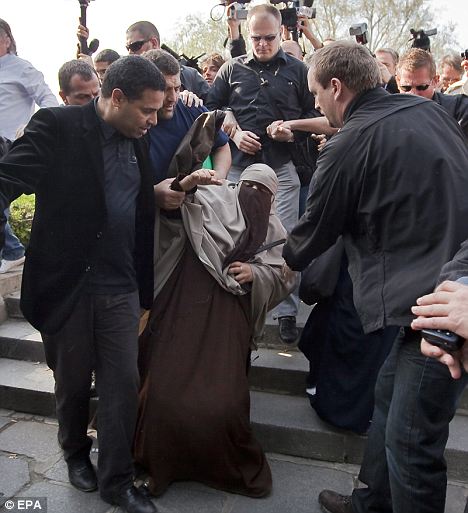
A woman in niqab being arrested in Paris, April 12, 2011, copyright EPA

Of Civilities and Dignities

On 22 June 2009, Nicolas Sarkozy, the French President, asserted that burqas (or the burqa-clad?) are “not welcome” in France, adding that “[i]n our country, we cannot accept that women be prisoners behind a screen, cut off from all social life, deprived of all identity” and that “the veils reduced dignity.” France’s Muslim minority is Western Europe’s largest Muslim minority, estimated at six-million-strong.  And this is just an approximation, as the French Republic implicitly claims to be post-race and post-religion via a prohibition on any census that would take into account the race or religion of its citizens. (This anxiety mirrors the brouhaha in Indian media àpropos the much-contested enumeration of OBCs or Other Backward Castes in the Indian census surveys of 2011, or the urgency to declare some spaces post-caste, post-feminist, and post-racist while casteism, patriarchy and racism continue unabated.)

Continue reading “Of Niqabs, Monsters, and Decolonial Feminisms”

23 Things They Don’t Tell You About Capitalism

In the latest issue of Vanity Fair, Joseph Stiglitz writes:

The upper 1 percent of Americans are now taking in nearly a quarter of the nation’s income every year. In terms of wealth rather than income, the top 1 percent control 40 percent. Their lot in life has improved considerably. Twenty-five years ago, the corresponding figures were 12 percent and 33 percent. One response might be to celebrate the ingenuity and drive that brought good fortune to these people, and to contend that a rising tide lifts all boats. That response would be misguided. While the top 1 percent have seen their incomes rise 18 percent over the past decade, those in the middle have actually seen their incomes fall. For men with only high-school degrees, the decline has been precipitous—12 percent in the last quarter-century alone. All the growth in recent decades—and more—has gone to those at the top. In terms of income equality, America lags behind any country in the old, ossified Europe that President George W. Bush used to deride. Among our closest counterparts are Russia with its oligarchs and Iran. While many of the old centers of inequality in Latin America, such as Brazil, have been striving in recent years, rather successfully, to improve the plight of the poor and reduce gaps in income, America has allowed inequality to grow. […]

The top 1 percent have the best houses, the best educations, the best doctors, and the best lifestyles, but there is one thing that money doesn’t seem to have bought: an understanding that their fate is bound up with how the other 99 percent live. Throughout history, this is something that the top 1 percent eventually do learn. Too late.

One of the reasons this state of affairs obtains, argues Ha-Joon Chang, is because of the chimera of a ‘free market.’

Continue reading “23 Things They Don’t Tell You About Capitalism”

The Crash

On May 2, 2011, US Treasury Secretary Timothy Geithner sent his third ultimatum to Congress noting that the US is set to reach its statutory debt limit of $14.3 trillion by May 16, and unless the ceiling was raised by August 2, the country could face default. ‘The economy is still in the early stages of recovery,’ he warned, ‘and financial markets here and around the world are watching the United States closely.  Delaying action risks a loss of confidence and accompanying negative economic effects.’ These will have a ‘catastrophic economic impact’ and ‘broad range of government payments would have to be stopped, limited or delayed, including military salaries, Social Security and Medicare payments, interest on debt, unemployment benefits and tax refunds.’ It will also lead to ‘sharply higher interest rates and borrowing costs, declining home values and reduced retirement savings for Americans.’ Mostly ominously, it will ‘cause a financial crisis potentially more severe than the crisis from which we are only now starting to recover.’

The situation doubtless sounds dire, but there is something mildly ironic about a Treasury Secretary warning the government against losing the trust of an industry which he only recently rescued with an extraordinary cash transfusion of $4.1 trillion in public money. The real costs of the bailout are estimated by Bloomberg at $ 12.8 trillion. But it is easy to overlook the consistency in Geithner’s assessment: the US government was a hostage to the financial industry when it faced collapse, and it is a hostage to it when its own economic future turns increasingly uncertain. The doubling of US national debt between 2004 and 2011 is merely a symptom of the problem—two wars and the bailout have both paid a part—but at its root are the regulatory failures and conflict of interests which are embodied in the person of Timothy Geithner. For over two decades the US Treasury has functioned as a de facto arm of Wall Street, eschewing its regulatory function to act as a passive enabler. Little surprise then that three years after the crisis the institutions that caused the collapse continue to evade responsibility and the price is instead paid by the taxpayer in exorbitant, lost homes and depleting employment opportunities.

How did things go so bad?

Continue reading “The Crash”