Of Niqabs, Monsters, and Decolonial Feminisms

By Huma Dar

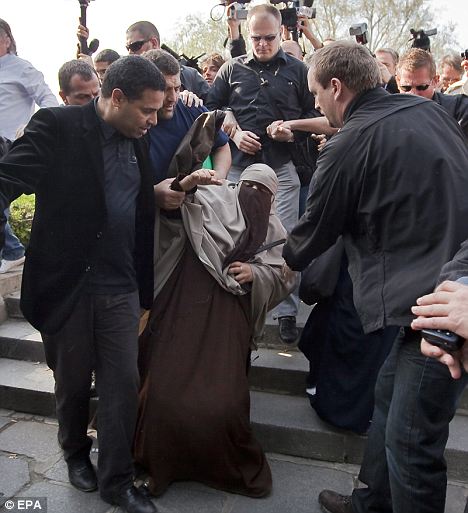
A woman in niqab being arrested in Paris, April 12, 2011, copyright EPA

Of Civilities and Dignities

On 22 June 2009, Nicolas Sarkozy, the French President, asserted that burqas (or the burqa-clad?) are “not welcome” in France, adding that “[i]n our country, we cannot accept that women be prisoners behind a screen, cut off from all social life, deprived of all identity” and that “the veils reduced dignity.” France’s Muslim minority is Western Europe’s largest Muslim minority, estimated at six-million-strong.  And this is just an approximation, as the French Republic implicitly claims to be post-race and post-religion via a prohibition on any census that would take into account the race or religion of its citizens. (This anxiety mirrors the brouhaha in Indian media àpropos the much-contested enumeration of OBCs or Other Backward Castes in the Indian census surveys of 2011, or the urgency to declare some spaces post-caste, post-feminist, and post-racist while casteism, patriarchy and racism continue unabated.)

Continue reading “Of Niqabs, Monsters, and Decolonial Feminisms”
A Call from Home

By Majid Maqbool

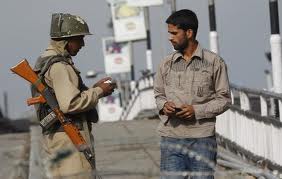
Checking a Kashmiri Youth’s ID Card

“Card chukha seath thavaan?”

(Do you carry the ID card with you?)

Mother worries over frequent phone calls

Away from home, home enters questions

‘Identity’ printed on a piece of paper

cuts through her voice; a discomforting lullaby:

“Card gase hamashe seath thavun”

(always carry the ID card with you)

Home leaves a permanent imprint…

On scattered notes, stamped on memories

At home, mother would tiptoe after me

At the door, before endless blessings, she always asked –

That question mothers have for their sons –

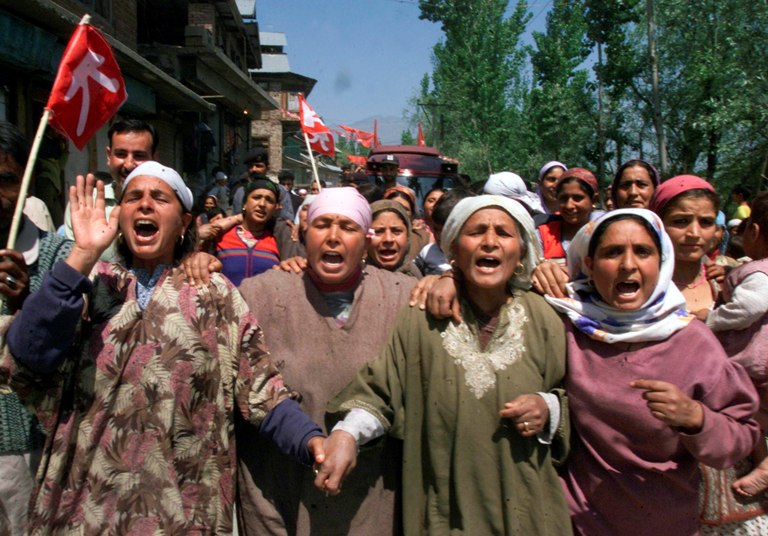
Protesting Kashmiri Women al (Yawar Nazir, IMOW)

“Card tultha seath?”

(are you carrying your ID card?)

From Delhi now, your question settles on my unrest

Identity – detached from the card – hangs heavy

This is not Kashmir, mother

“Toete gase card seath thavun…”

(Still you must carry the card with you…)

The line dropped on this insistence

I kept redialing, to rest her concerns,

her unfinished questions, unanswered

Hello..helloo… mother

Can you hear me?

I left the card at home, mother

In the back pocket of my worn-out jeans

Interrogating Identity in Kashmir

Find: a fading photograph, scrutinized edges

And no trace of those unrecognized questions

forever inked on my memory

For troops to question my absence

The proof I left behind is not enough

That frisked ID card remains

like a festering wound, pocketed pain

I carry everywhere


Majid Maqbool is a young journalist/writer from Kashmir.  Some of his writings can be found on his blog maqboolvoice.blogspot.com.

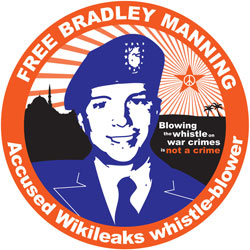
The Trials of Bradley Manning: A Defense

For the past seven months, US Army Private First Class Manning has been held in solitary confinement in the Marine Corps brig in Quantico, Virginia. Twenty-five thousand other Americans are also in prolonged solitary confinement, but the conditions of Manning’s pre-trial detention have been sufficiently brutal for the United Nation’s Special Rapporteur on Torture to announce an investigation.

Pfc. Manning is alleged to have obtained documents, both classified and unclassified, from the Department of Defense and the State Department via the Internet and provided them to WikiLeaks.  (That “alleged” is important because the federal informant who fingered Manning, Adrian Lamo, is a felon convicted of computer-hacking crimes. He was also involuntarily committed to a psychiatric institution in the month before he levelled his accusation.  All of this makes him a less than reliable witness.)  At any rate, the records allegedly downloaded by Manning revealed clear instances of war crimes committed by U.S. troops in Iraq and Afghanistan, widespread torture committed by the Iraqi authorities with the full knowledge of the U.S. military, previously unknown estimates of the number of Iraqi civilians killed at U.S. military checkpoints, and the massive Iraqi civilian death toll caused by the American invasion.

For bringing to light this critical but long-suppressed information, Pfc. Manning has been treated not as a whistleblower, but as a criminal and a spy.  He is charged with violating not only Army regulations but also the Espionage Act of 1917, making him the fifth American to be charged under the act for leaking classified documents to the media.  A court-martial will likely be convened in the spring or summer.

Continue reading “The Trials of Bradley Manning: A Defense”

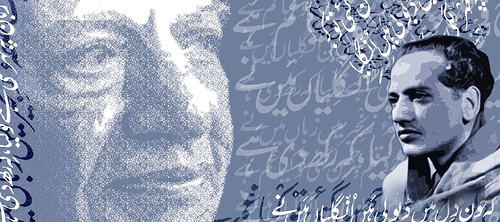
Thus Alone, and Always, Have People Resisted Tyranny: Remembering Faiz on his Birth Centenary

Today is the first birth centenary of Faiz Ahmed Faiz: one of South Asia’s most beloved radical Urdu poets. Today is also, just two days after Mubarak’s resignation as a result of the inspiring revolution in Umm al-Duniya, Mother of the World, Egypt; and almost a month after Tunisia’s courageous revolution. How ecstatic would Faiz have been today?!

by Huma Dar

Today is the first birth centenary of Faiz Ahmed Faiz: one of South Asia’s most beloved radical Urdu poets.  Today is also, just two days after Mubarak’s resignation as a result of the inspiring revolution in Umm al-Duniya, Mother of the World, Egypt; and almost a month after Tunisia’s courageous revolution.  How ecstatic would Faiz have been today?!  Faiz, who had lived in Beirut, in exile from Pakistan — when ruled by the US-bolstered military dictator, General Zia-ul Haq.  Faiz, who wrote a beautiful lullaby for a Palestinian child, and a poem for those who were martyred outside their beloved Palestine.  Faiz, whose poem commonly mis-titled, “Ham Dekhenge,” is a battle-song for people fighting for social justice from Sindh, Pakistan to Kashmir to Chhattisgarh, India.

The title of this particular poem of Faiz is in Arabic: “Wa Yabqaa Wajhu Rabbika.”  It is most often brushed aside as it does not fit the simplistic profile of the “avowed atheist” assigned to Faiz.  Being a socialist does not preclude belief in Islam, but this nuance is lost on many who cannot easily imagine Faiz being a Muslim, leave alone leading a prayer in the mosque of his ancestral village, especially given the subtle Islamophobia that pervades élite political and literary discourses, both within and without South Asia.  For some, even more difficult “to reconcile [is] the glowing tribute [that Faiz wrote] to Muhammad Ali Jinnah,” but this has to do with the rigorous demonology of Jinnah, the founder of Pakistan, in Indian historiography, and the hegemonic status of India and Indian academics, even those who vigorously critique nationalisms of all kinds, within South Asian Studies.

Continue reading “Thus Alone, and Always, Have People Resisted Tyranny: Remembering Faiz on his Birth Centenary”

Empire Abroad, Surveillance At Home

Download mp3.

The cover of McCoy's book is deep red, dark blue, and a sepia white. The photo is of a several ranks of Philippine military troups. The man in front salutes, while an American flag flies overhead.I have an obsessive interest in the history of empires, but a lot of the information in this fascinating lecture by Alfred McCoy was still new to me. I hope you find it as useful as I did. (via Against the Grain)
As the nineteenth century drew to a close, the US engineered its conquest of the Philippines. According to Alfred McCoy, the security and surveillance methods introduced and refined by the US in the Philippines were brought home to these shores, for use in domestic policing, intelligence, and other repressive techniques and systems that had profound consequences for civil liberties.

Alfred McCoy, Policing America’s Empire: The United States, the Philippines, and the Rise of the Surveillance State U. of Wisconsin Press, 2009

Zapping and Groping are Bad Enough Already; Emulating Israel Will Only Make Them Worse

About a month ago, one of my colleagues was describing to me a forthcoming trip, when he paused and reflected, “I’m still not sure whether I want to be groped or zapped.”  It is a question many Americans have contemplated in recent weeks, “groping,” of course, being the instantly-infamous “enhanced pat downs” airport travelers can opt for if they refuse a “zapping,” the new X-ray backscatter or millimeter-wave machines that provide TSA shockingly clear body images.  Both types of machine are known as Advanced Imaging Technology [AIT].

A few days ago I traveled internationally and had some opportunities to experience these notorious new security measures.  Because AIT, according to Congressional testimony by Columbia University biophysicist David Brenner, delivers radiation at a rate of “20 times the average dose that is typically quoted by TSA and throughout the industry,” I leaned toward being groped rather than zapped.  The TSA has been lying about other things, after all, proclaiming that the AIT machines don’t record or store images when in fact they can and sometimes do.

Exhausted after entering customs in Detroit after a fourteen hour flight, however, I was in no mood to have my privates jostled, so I opted for a zapping.  It seemed innocuous enough.  I cleared my pockets, stood in the transparent cylinder, and raised my arms as the panels rotated and emitted a flash of light.  Not even Aldous Huxley was imaginative enough to have predicted the scene.  While I was in the cylinder awaiting the zap, I rolled my eyes at a skeptical woman who seconds earlier had flatly proclaimed to the agent, “I’m not getting in that thing.”  She grinned at me, a favor I was able to return a minute later after I had gathered my belongings and passed her as she stood in an area designated for miscreants, a TSA agent’s hands down the back of her pants.

Continue reading “Zapping and Groping are Bad Enough Already; Emulating Israel Will Only Make Them Worse”

Manufacturing Consent and Violence: Azadi, Arundhati, Hindutva Terror, and Indian Media

by Huma Dar

At a groundbreaking seminar, ‘Azadi: The Only Way,’ organized by the Committee for the Release of Political Prisoners (CRPP) in New Delhi, India, on October 21st, 2010, the minutes record that Arundhati Roy, the prize-winning author of The God of Small Things, asserted that

[Kashmir] has never been an integral part of India and the Indian government recognised it as a disputed territory and took it to the UN on its own accord. In 1947 we were told that India became a sovereign democracy. But it became a country as per the imagination of its colonizer, and continued to be a colonizer even after the British left the country. Indian state forcibly or deceitfully annexed the North-East, Goa, Junagarh, Telangana, etc… the Indian state has waged a protracted war against the people which it calls its own. Who are the people it has waged war against? The people of North-East, Kashmir, Punjab, etc. This is an upper caste Hindu state waging a continuing struggle against the people. Continue reading “Manufacturing Consent and Violence: Azadi, Arundhati, Hindutva Terror, and Indian Media”

Feeling the Loyalty to the Jewish State of Israel

By Max Blumenthal and Joseph Dana

The Israeli Knesset is debating a bill proposed by David Rotem of the extreme right Yisrael Beiteinu party that would require all Israeli citizens to swear loyalty to Israel as a “Jewish and democratic state.” This bill is targeted at increasing pressure on the twenty percent of Israelis who are Palestinian citizens while forcing the ultra Orthodox Jewish minority who reject the legitimacy of any state not based on Jewish biblical law to accept Zionism. If passed in its proposed form, citizens unwilling to take the loyalty oath would be at risk of losing citizenship.

Continue reading “Feeling the Loyalty to the Jewish State of Israel”

Rocking the Boat: A Brief History of Anti-Migrant Hysteria in Canada

In November, 76 Tamil refugees escaped Sri Lanka on a rusty freighter. They arrived in Victoria, where they were met by Royal Canadian Mounted Police (RCMP) and Canadian Border Services Agency (CBSA) officials, who promptly jailed them for three months on allegations of terrorism. It would be fully half a year before the CBSA would admit that it had never had any evidence… In 2008, the federal and provincial governments were forced to issue apologies for the Komagata Maru. Now, two years later, if those words are to mean anything, we cannot afford to repeat history: let them stay.

by Fathima Cader

"MV Sun Sea" Uncredited Photo at: http://www.edynews.com/top-news/18-almost-500-sri-lankan-migrants-are-in-canadian-custody.html

They’re at it again.

In November, 76 Tamil refugees escaped Sri Lanka on a rusty freighter. They arrived in Victoria, where they were met by Royal Canadian Mounted Police (RCMP) and Canadian Border Services Agency (CBSA) officials, who promptly jailed them for three months on allegations of terrorism. It would be fully half a year before the CBSA would admit that it had never had any evidence.

By then, however, it was too late: anti-Tamil and anti-refugee hysteria had spread like wildfire. Now, mere weeks after that most tepid of mea culpas from the CBSA, the hysteria greeting the Tamil MV Sun Sea passengers is worse. As with the Ocean Lady, these migrants will be detained in Maple Ridge jails before their refugee claims are considered. The Conservatives have begun to create new rules to treat refugees who arrive by boat differently from others. Meanwhile, Paul Fromm, the infamous neo-Nazi, has been receiving uncritical coverage in mainstream media with his demands that the migrants be sent back.

As the paranoia grows ever more heightened, it becomes increasingly important that we resist it. The universal rights of safety and mobility must be upheld, not only for the Sun Sea migrants, but for all people fleeing violence.

Continue reading “Rocking the Boat: A Brief History of Anti-Migrant Hysteria in Canada”

Kashmir: Trapped Within Hindu Nationalist Imagination

In annexing Kashmir, Indian leaders put aside their progressive anti-colonialism, and pursued a policy that stood in direct confrontation with the goals of struggling Kashmiris. Nehru’s professed derision for princes and despots proved facile in Kashmir in this first real test of his commitment to anti-colonialism and democratic values. His decision to urge the discredited and runaway Dogra ruler to sign the imperial Instrument of Accession, and then accept it, was a defeat for the oppressed Kashmiris who had, with great sacrifices, forced the Dogra ruler out. By recognizing the authority of the Dogra ruler, Indian sovereignty over Kashmir simply replaced the sovereignty enshrined in the Dogra maharaja. But along with that sovereignty, India inherited Dogra rule’s illegitimacy as well.

by Mohamad Junaid

(First published in Greater Kashmir on August 5, 2010)

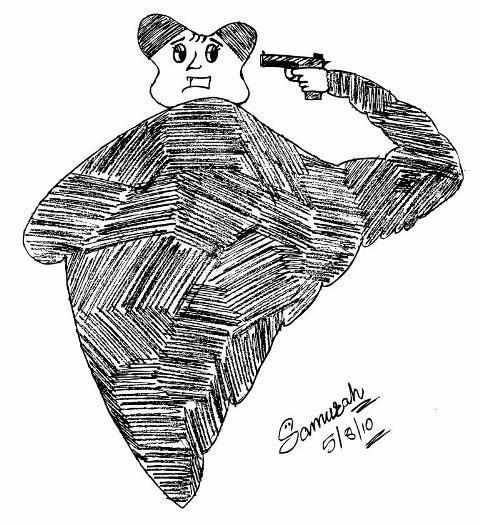
Untitled by Samurah Kashmiri, August 5, 2010
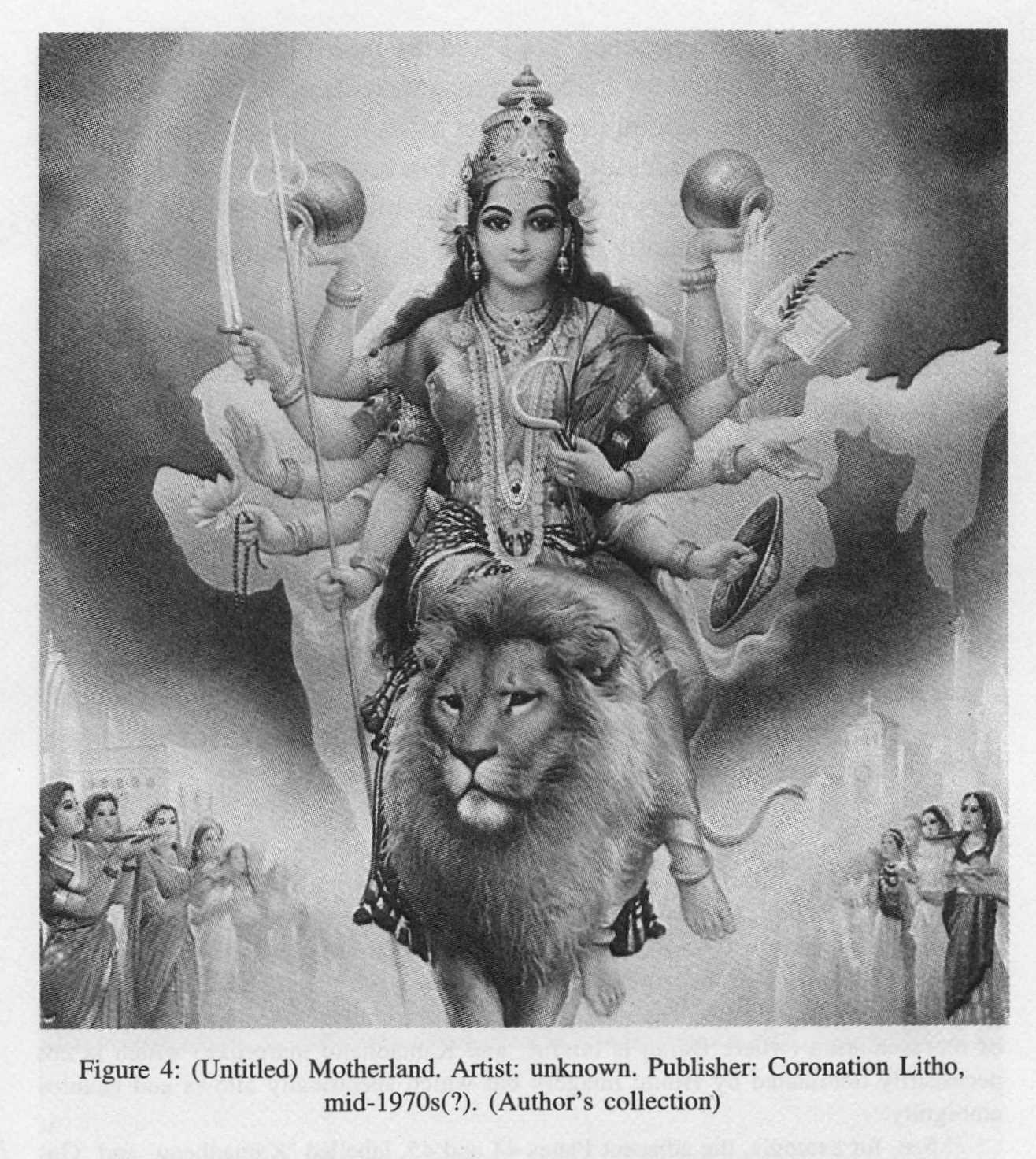
Bharat Mata or Mother India

On 26 January 1992, Murli Manohar Joshi, the leader of the Hindu nationalist Bharatiya Janata Party, after travelling by road all the way from the southern tip of India, was airlifted from Jammu to the heart of Srinagar where he half-raised the Indian flag near historic Lal Chowk. All of Kashmir was put under severe curfew, and the army was given shoot-at-sight orders. Throughout the day soldiers shot dead more than a dozen Kashmiris in the streets of Srinagar. Over the previous two years, the Indian government had unleashed a reign of terror on the people, with massacre upon massacre of unarmed protestors dotting Kashmir’s timeline. Joshi’s Ekta Yatra (Unity March), protected and provided of full support by the Indian government, was an important reminder of the nature of the Indian state and the relationship it sought with the people of Kashmir. The event was designed to put on display the majoritarian character of Indian nationhood, and line up power of the state behind it to send barely coded messages to audiences in India and in Kashmir.

Continue reading “Kashmir: Trapped Within Hindu Nationalist Imagination”