Just a normal democracy

Here is a news item from Israel, which is, we are assured in the West by many politicians, commentators, and lobbyists, a regular democracy, if not a multicultural paradise.

Nazareth Illit, which has recently come under threat of an Arab demographic takeover, now is headed to be the religious-Zionist capital of the lower Galilee…

The article goes on to describe various initiatives intended to boost the city’s Jewish population, as a response to an increase in the number of Palestinian citizens who have moved in, keen for a better standard of living. The projects, overseen by the town’s mayor Shimon Gapso, include the renovation of “an old school building to house 15 young families from the former Gush Katif yeshiva of Torat HaChaim” – in other words, former residents of a Gaza Strip colony.

Apparently, one of the other figures involved in these efforts is MK Uri Ariel, who in 2008 “called on the government to encourage Israeli Arabs to “willingly emigrate” from Israel and from large cities within it”. Another personality is Rabbi Hillel Horowitz, who spent years living in the Hebron area settlements.

The piece concludes by reprinting a message from Mayor Gapso that appears on Nazareth Illit’s website:

“It is time to call a spade a spade. Just as Ben-Gurion and Peres said in the 1950’s that the Galilee must be Jewish, we say the same about Nazareth Illit: It must retain its Jewish character. Our goal is to bring 3,000 families within five years… We have been in contact with various ideological groups, and we are definitely considering building a hareidi-religious neighborhood as well. The primary goal is to put the brakes on the demographic deterioration…”

Continue reading “Just a normal democracy”

The Stones On Our Streets

Lies are created around the truth of our struggle. But truth has a habit of confronting falsehood. Occupation is based on a pile of lies. There’s truth in the resistance of unarmed people on the streets. And truth triumphs in the end. It always does, even if it takes time.

by Majid Maqbool

The street is the home of our stones.  Streets can be occupied, but stones are free for us to pick up, and angrily fling in the air — in protest.  From the hands of the oppressed, once pelted, the stones deliver a message to the oppressor: while you kill with no remorse on my soil, and stage false encounters with all your advanced weapons, I’m not going to keep quiet.  I will not let you kill us without offering resistance.  I have these stones on my streets.  I exist in these stones.  If your occupation is in bullets, our resistance is in these rough-edged, homegrown stones.

We, who come out protesting on the streets, are not an ignorant, frustrated and unemployed lot — as the occupier likes to frame us, and the whole world seems to simplistically believe.  Far from it!  We are the ones who refuse to keep quiet in tyrannical times.  We are the ones who shape the songs of resistance, as we practice them in our streets.  It takes much courage and conviction to come out on the streets, and protest against the heavily militarized state forces.  The sentiment of freedom confronts the idea of occupation.  In every stone that’s pelted, there’s a promise to bring down the structures of occupation, bit by bit, crack by crack.  We know in our hearts and minds that this ugly structure of occupation —  built on deceit over the years — is bound to crumble one day under the force of our stones.  It is this hope that keeps the resistance alive.

Continue reading “The Stones On Our Streets”

Peaches

by Arif Ayaz Parrey

Can I tell how much I love peaches?
Not ordinary ones
But those plucked from
The orchards along Jhelum

The ones in the basket before me
Are nebrim for sure
But they blush like a home-grown innocence
And hold as many juicy promises

I wonder what tree bore them
I wonder if it’s wise to ignore them

The tree of life
Has many buried roots

It is said that my only son
Was killed under the canopy
Of the branches of one such tree
By the army
Also known as the security forces
An old joke
What do they secure
These so-called security forces?
Not the people, not our lives, not our liberty
Not our sentiments, nor our emotions, not our sanity
Not our sons who are shot
Nor our daughters who are raped
Not the truth, not the facts, not humanity

Continue reading “Peaches”

Israel: A Failing Colonial Project

by M. Shahid Alam

Increasingly, despite its early military and political successes, Israel cannot for long endure as a colonial project. It must choose between wars – and destruction – or transition to a state for all its peoples.

In order to firmly secure its existence – as firmly as that is possible for any state – a settler state has to overcome three challenges. It has to solve the native problem; break away from its mother country; and gain the recognition of neighboring states and peoples. It can be shown that Israel has not met any of these conditions.

Consider Israel’s native problem. In 1948, in the months before and after its creation, Israel appeared to have solved its native problem in one fell swoop. It had expelled 80 percent of the Palestinians from the territories it had conquered. In addition, with the rapid influx of Arab Jews, Palestinians were soon reduced to less than ten percent of Israel’s population.

So, had Israel licked its native problem for good? Not really.

The Palestinians inside Israel pushed back with a high natural rate of growth in their numbers. As a result, despite the continuing influx of Jewish immigrants, the Palestinian share in Israel’s population has grown to above 20 percent. Increasingly, Jews in Israel see Israeli Arabs as a threat to their Jewish state. Some are advocating a fresh round of ethnic cleansing. Others are calling for a new partition to exclude areas with Arab majorities.

The Palestinians expelled from Israel in 1948 did not go away either. Most of them set up camp in areas around Israel – the West Bank, Gaza, southern Lebanon and Jordan. In 1967, when Israel conquered Gaza and the West Bank, it could expel a much smaller fraction of the Palestinians from these territories. In consequence, with more than a million additional Palestinians under its control, Israeli had recreated its native problem.

Continue reading “Israel: A Failing Colonial Project”

Getting Out of Palestine?

by M. Shahid Alam

When veteran journalist Helen Thomas was asked recently if she had any comments on Israel, she shot back, “Tell them to get the hell out of Palestine.” She apologized for the remark, but, as the campaign against her escalated, she chose to retire from her position as White House correspondent.

Putting aside the edginess in her words, does Helen Thomas’s remark deserve serious consideration?

Over the years, it has been receiving just that from many tens of thousands of Israelis, who have been emigrating from Israel, applying for emigration, or staying in Israel but holding or applying for dual citizenship. According to Arnaud de Borchgrave, half a million Israelis hold dual citizenship.

Although the Israel lobby expressed particular outrage at Helen Thomas’ suggestion that Israelis go back to Germany and Poland, many Israelis have done precisely that. In his book, The Seventh Million, Tom Segev writes that many thousands of Israelis have “requested and received German passports.” According to the Jewish Virtual Library, there were 118,000 Jews living in Germany in 2006. Another 49,700 lived in Hungary and 3,200 in Poland.

Disconcerting as some Zionists may find this, Jews have not stayed away from countries where they faced near extermination under the Nazis. Does this mean that these countries are now safer for Jews than Israel?

Continue reading “Getting Out of Palestine?”

Boycott Israel? Amitav Ghosh & the Dan David Prize

The call for academic and cultural boycott is clearly a way to encourage civil society to play a broader political role—that is why it has the support of wide sections of Palestinian civil society. One of the most significant questions that call poses to us is simply this: How could those of us who oppose apartheid, occupation, and colonialism not support such a call?

Dear Amitav Ghosh,

We wish to express our deep disappointment in your decision to accept the Dan David prize, administered by Tel Aviv University and to be awarded by the President of Israel. As a writer whose work has dwelled consistently on histories of colonialism and displacement, your refusal to take stance on the colonial question in the case of Israel and the occupation of Palestine has provoked deep dismay, frustration, and puzzlement among readers and fans of your work around the world. Many admired your principled stand, and respected your decision not to accept the Commonwealth Writers Prize in rejection of the colonialist framework it represented.

Continue reading “Boycott Israel? Amitav Ghosh & the Dan David Prize”

Outing the Muslimness, Finally: Some Viewing (and Hearing) Pleasures (The King is Out: Part VI)

The King is out: he is irreversibly a Muslim. His name is Khan: pronounce it correctly please. Long Live the King!

by Huma Dar

[Read Part I Part II Part III Part IV Part V]

Rizwan Khan Offering His Namaz

[I]n one scene I wanted to have just a half open door and I wanted to be shown saying namaz once. We couldn’t take that shot. Then we put that bit where I say the prayer: Nasrun minal lahe wah fatahun kareeb (God give me strength to win) [sic] [Victory is Allah’s, and the opening/victory is close] which is my own prayer too. I don’t think we should intellectualise entertainment.  See the fun of it.

This is how Shahrukh Khan describes his experience working in the film Chak De! India (Dir: Shimit Amin, 2007).  With apologies to King Khan for discarding his proposal to not “intellectualize” films, yet taking due “fun” in it, I argue that it is only in My Name is Khan (Dir: Karan Johar, 2010) that the King finally comes “out” as a Muslim.  No “half open door” is needed.  This coming out affords particular visceral pleasures to an audience (or at least a large section of it spread across the globe) long resigned to seeing SRK endlessly and persistently marked by the specifically filmic variety of Hinduness practiced in Bollywood: doing various pujas and aartis at different Hindu temples, or adorning his spouses’ hair-parting with sindhoor and smearing his own forehead with tilaks.  This performative Hinduization of Shahrukh Khan in Urdu-Hindi cinema is unrelenting precisely due to the dogged presumption of SRK’s Muslimness that is not easily obscured.  “In my films I have been going to temples and singing bhajans; no one has questioned that,” (my emphasis) SRK exclaims in the same interview.  No one “questions” the diegetic (filmic) Hinduness of SRK; it is expected and mandatory.  With the increasing and explicit polarization in India since 1990s, the anxiety around Muslimness is such that it requires perpetual masking: an iterative performance of Hinduness, secular or otherwise.  When the mask slips off, the performance is momentarily paused – as when SRK plays a Muslim character in a film and critiqued the anti-Pakistani politics of Indian Premier League (IPL) – Hindutva activists target SRK’s suburban Bombay home, Mannat, with massive demonstrations (See the earlier Part II for more).[1]

Continue reading “Outing the Muslimness, Finally: Some Viewing (and Hearing) Pleasures (The King is Out: Part VI)”

“Veil in the Time of War” or “Veilin’ the Time of War”

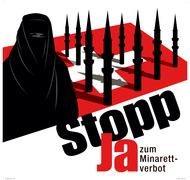
In the context of the current multiple arenas of war and occupation in Muslim-majority regions, the issues of gender and sexuality are vitally linked to the casus belli, both within and without academia. Such linkages, with a long and complicated genealogy thoroughly imbricated in the politics of colonization, decolonization, and neo-colonization, also indicate an obsessive desire to re-enact the “discovery narrative” or the “rescue narrative.” Examining current contestations in popular media – including recent articles written by Maureen Dowd, Naomi Wolf and Phyllis Chesler et al and the poster designed by Alexander Segert, which was integral to the success of the anti-minaret Swiss referendum – this essay investigates whether, how, and where the neoconservative, neoliberal, and the mainstream feminist discourses converge, diverge, and intersect.

Segert's Anti-Minaret Poster

by Huma Dar

In the context of the current multiple arenas of war and occupation in Muslim-majority regions, the issues of gender and sexuality are vitally linked to the casus belli, both within and without academia.  Such linkages, with a long and complicated genealogy thoroughly imbricated in the politics of colonization, decolonization, and neo-colonization, theorized by Inderpal Grewal, Gayatri Spivak, Lata Mani, Leila Ahmed, Sherene Razack, Saba Mahmood, Sunera Thobani amongst others, also indicate an obsessive desire to re-enact the “discovery narrative” or the “rescue narrative.”  Examining current contestations in popular media – including recent articles written by Maureen Dowd, Naomi Wolf and Phyllis Chesler et al and the poster designed by Alexander Segert, which was integral to the success of the anti-minaret Swiss referendum – I investigate whether, how, and where the neoconservative, neoliberal, and the mainstream feminist discourses converge, diverge, and intersect.  I undertake to deconstruct the ongoing debates that obsessively revolve around the veil or the sexuality that is variously professed to be suppressed, annihilated, or even “discovered” beneath the veil by some liberal explorers.

Continue reading ““Veil in the Time of War” or “Veilin’ the Time of War””

Israeli Apartheid in al-Naqab

The following is taken from an email sent out by Yeela Ranaan, from the Regional Council for the Unrecognized Villages (RCUV):

The Government of Israel is putting me on trial next week (Monday, April 19th, 11:00am in Beer Sheva): for expressing my displeasure at the brutal home demolitions in the Unrecognized Bedouin Villages. The government and its acting bodies do not want any resistance to the implementation of their racist policies, and therefore wish to scare and intimidate those who speak out…

I grew up in Arad, a town built among the Bedouin, to make sure that the Jews become the rulers of this space. It took me many years to realize that the Bedouin I saw every time I left my hometown are not part of nature, like the rocks and the wadis. It was not my education that had opened my eyes, a good Zionist education, teaching me to be part of a dream of redeeming the land. It was despite this education.

But once the blinds were lifted, it started hurting. I saw the pain in the injustice, in the ongoing feeling of my neighbors, now turned friends, of being treated as deserving less, as a bother to the natural development of our region – the Negev. Every baby born – a “demographic threat”, every time a home is built, economic stability achieved – it is seen as a menace in the only country they can call home… Continue reading “Israeli Apartheid in al-Naqab”

Israel’s colonization of East Jerusalem – some context

The first political planning decision in the ‘reunified’ city concerned plans not for construction but for the geopolitical determination of borders…the determining consideration, ‘a maximum of vacant space with a minimum of Arabs,’ laid down as the basic tenet in the delineation of the borders, made possible the planning and implementation of the prinicipal political objective: the creation of physical and demographic faits accomplis.

[It became] clear that the planners must set their sights on the vacant areas on the outskirts of the city and surrounding it. These areas would have to be expropriated from their Arab owners. The legal instrument at the disposal of the Israelis for this purpose was the Land Ordinance (Expropriation for Public Purposes) of 1943, which grants the treasury minister the authority to expropriate private land when there is a ‘public need’ for such action – with the definition of ‘public need’ left to the minister himself…

But no one was deceived by the designation of these ‘ethnically colorblind’ needs; the expropriated areas were being taken from Arabs and handed over to Jews. This was an extraordinary interpretation of the word public: The only legitimate public was Jewish, and therefore only jews were entitled to benefit from the expropriation.

From Meron Benvenisti, City of Stone: The Hidden History of Jerusalem, Berkeley, CA: University of California Press, 1996, pp.154-55.

Continue reading “Israel’s colonization of East Jerusalem – some context”